447 and 448 PPC in Pakistan: Trespass Punishment, Bail and Compromise
447 PPC trespass carries 3 months or Rs 1,500 in Pakistan, 448 house-trespass 1 year or Rs 3,000. Both bailable and compoundable; 452 is 7 years. Full rules.
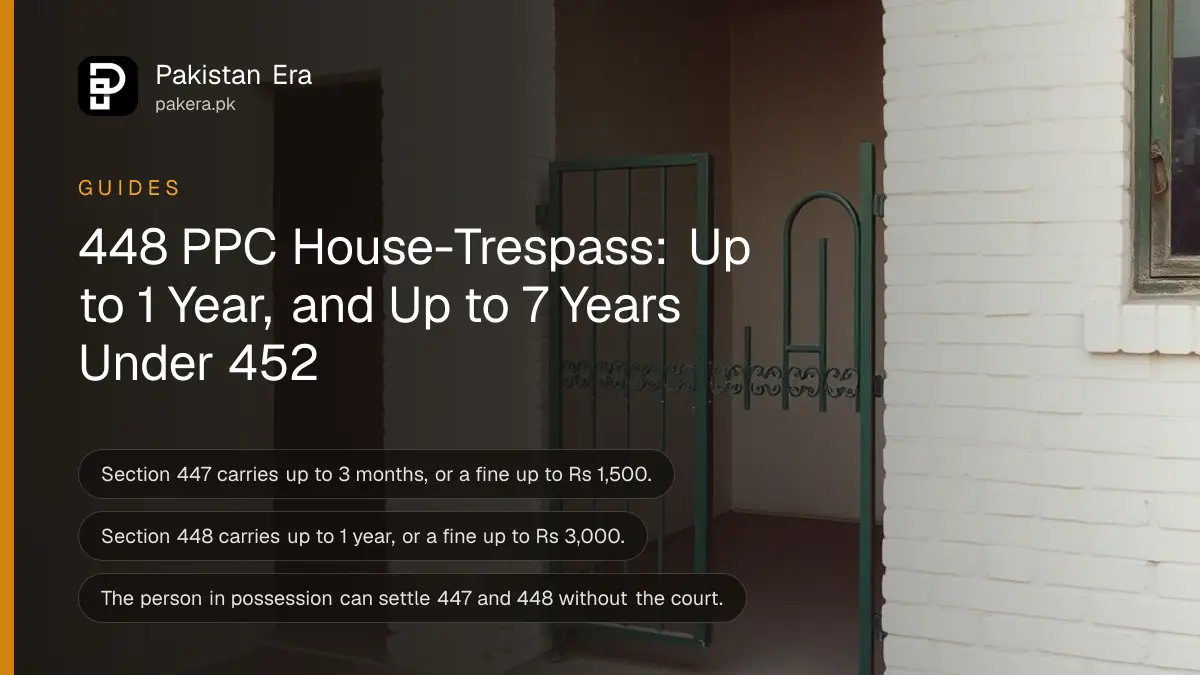
Short answer: Criminal trespass under Section 447 of the Pakistan Penal Code (PPC) carries up to 3 months, or a fine up to Rs 1,500, or both. House-trespass under Section 448 carries up to 1 year, or a fine up to Rs 3,000, or both. Both are bailable, and the person in possession of the property can settle them without the court's permission. Trespass with preparation to hurt someone, under Section 452, is far heavier: up to 7 years and not bailable.
Trespass sections appear in a lot of FIRs about property in Pakistan: a neighbour who enters a plot, a relative who walks into a house during an inheritance quarrel, a group that comes to "talk" and starts a fight. The section number decides whether the case is minor or serious. Here is how each one works.
Criminal trespass needs entry with a wrongful intent
Section 441 PPC defines criminal trespass as entering property in another's possession to commit an offence, or to intimidate, insult or annoy the person in possession. Staying on after a lawful entry, with the same intent, also counts.
Two points often get missed:
- Possession, not ownership: the property must be in the possession of another. A tenant in possession can be the victim of trespass by the owner.
- Intent matters: walking across an open field by mistake is not criminal trespass. The entry must be meant to commit an offence, or to intimidate, insult or annoy.
Section 442 makes it house-trespass when the criminal trespass is into a building, tent or vessel used as a home, a place of worship, or a place to keep property. Putting any part of the body inside is enough to count as entering.
The trespass sections and their punishments
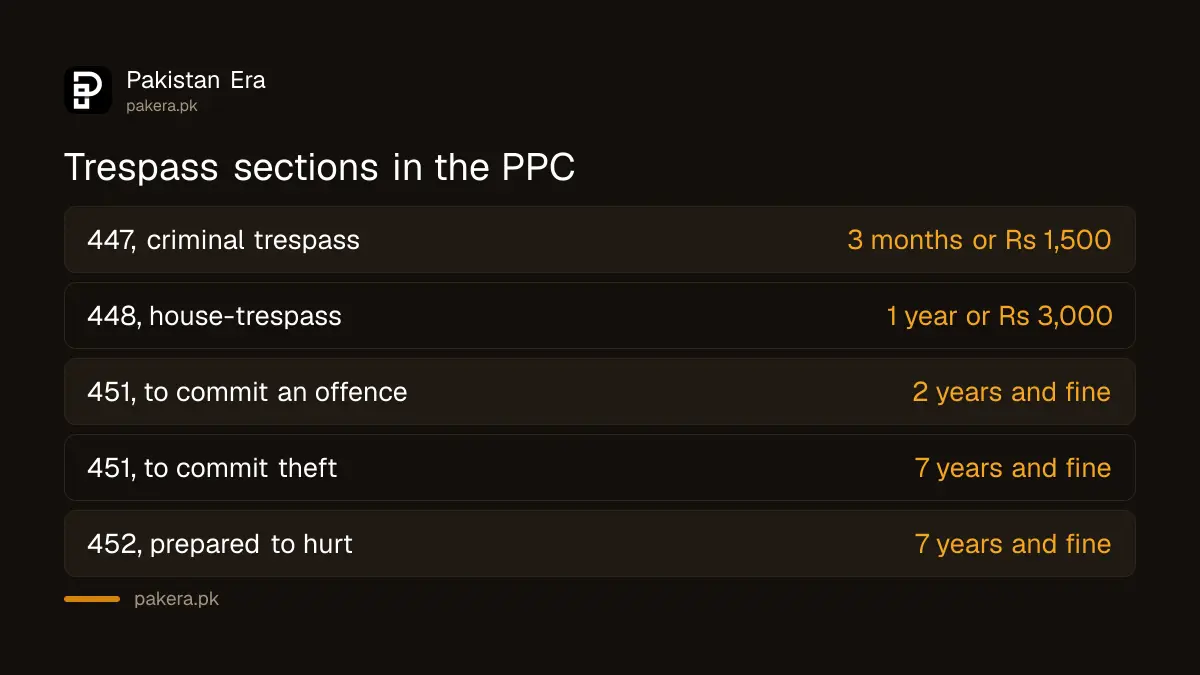
Section 447 is the basic offence, and Section 448 is the basic house-trespass. The punishment climbs sharply when the trespass is meant to commit another offence or comes with preparation for violence.
| Section | Offence | Maximum | Bail | Compromise |
|---|---|---|---|---|
| 447 | Criminal trespass | 3 months, or fine up to Rs 1,500, or both | Bailable | By the person in possession |
| 448 | House-trespass | 1 year, or fine up to Rs 3,000, or both | Bailable | By the person in possession |
| 451 | House-trespass to commit an offence punishable with prison | 2 years and fine | Bailable | With court permission |
| 451 | Same, where the intended offence is theft | 7 years and fine | Not bailable | Not compoundable |
| 452 | House-trespass after preparation for hurt, assault or restraint | 7 years and fine | Not bailable | Not compoundable |
The fines in Sections 447 and 448 are small. Section 452 is where the real weight sits, because it covers a house-trespass made after preparing to hurt, assault or restrain someone, such as entering a house carrying sticks or weapons.
Arrest and bail in a trespass case
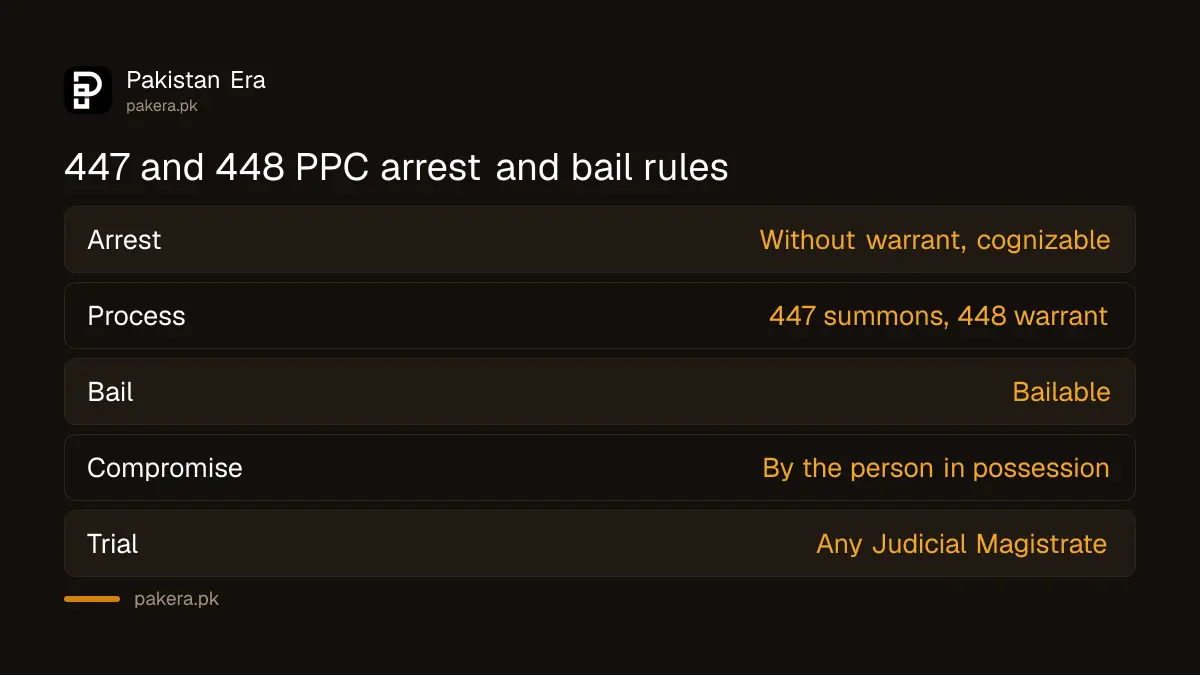
The CrPC's second schedule says police may arrest without a warrant for Sections 447 and 448, so both are cognizable. Section 447 is a summons case and Section 448 a warrant case. Both are bailable, so the accused has a right to bail on a bond.
Any Judicial Magistrate can try 447 and 448. For Section 452, police may arrest without a warrant, a warrant issues, and the offence is not bailable. The accused must apply for bail, and the court decides on the facts. The difference is explained in bailable and non-bailable offences.
Trespass is often settled by compromise
Section 345(1) of the CrPC lets "the person in possession of the property trespassed upon" compound Sections 447 and 448 without asking the court. Section 451, in its basic form, can be compounded only with the court's permission. Sections 451 for theft and 452 cannot be compounded.
A compromise under Section 345 has the effect of an acquittal. The steps are set out in settling a criminal case under Section 345.
Trespass is not the same as being thrown off your land
A trespass case punishes the entry. It does not by itself give your land or house back. If someone has taken over and stays in possession, the Illegal Dispossession Act gives a separate remedy in the Court of Session, alongside a civil suit.
- Record the entry. Date, time, names, and photos or video of the people on the property.
- Keep proof of possession. Utility bills, rent receipts, a fard or registry, and neighbours who can confirm who lives there.
- Report at the police station. In writing, with a copy kept, because 447 and 448 are cognizable.
- Check if you were dispossessed. If the other side has taken over, consider a complaint under the Illegal Dispossession Act.
- For a land record dispute, the revenue and civil courts decide title. A Magistrate's order under Section 145 CrPC can deal with a possession dispute likely to cause a breach of the peace.
If you are the one accused of trespass, keep your own proof of possession or permission to be there, and speak to a lawyer before you go to the police station. Free legal help is on the Supreme Court's legal aid helpline, 1818.
Common questions
What is the punishment for 447 PPC?
Up to 3 months of imprisonment, or a fine up to Rs 1,500, or both.
What is the punishment for 448 PPC?
Up to 1 year of imprisonment, or a fine up to Rs 3,000, or both, for house-trespass.
Is 448 PPC bailable?
Yes. The CrPC schedule lists both 447 and 448 as bailable, so the accused has a right to bail on a bond.
Is 447 PPC compoundable?
Yes. The person in possession of the property trespassed upon can compound 447 and 448 under Section 345(1) CrPC, without court permission.
What is 452 PPC?
House-trespass after preparation to cause hurt, assault or wrongful restraint. It carries up to 7 years and a fine, and is not bailable or compoundable.
Can an owner be charged with trespass on his own property?
Yes, if someone else, such as a tenant, is in lawful possession. Section 441 protects possession, not ownership.
How we verified this
What we checked and where we read it.
Sections 441, 442, 447, 448, 451 and 452 are from the Pakistan Penal Code PDF, and the second schedule rows and the Section 345 tables are from the Code of Criminal Procedure PDF, both on the Ministry of Law's Pakistan Code website. The fine amounts of Rs 1,500 and Rs 3,000 appear in both the PPC sections and the CrPC schedule rows. This page explains the law and is not legal advice.
Last checked 15 November 2026.
About the author

Global Affairs & Political Economy Writer
Muhammad Hatim is a book lover who started writing because he enjoys it. At Pakistan Era he writes about international relations, geopolitics and the global economy, with a particular interest in South Asia and the forces behind current events.