How to Add Your Shipping and Returns Policy to Google for a Pakistani Online Shop
Pakistani online shops can now share shipping and return policies with Google through Search Console or markup, with no Merchant Center. See the six steps.
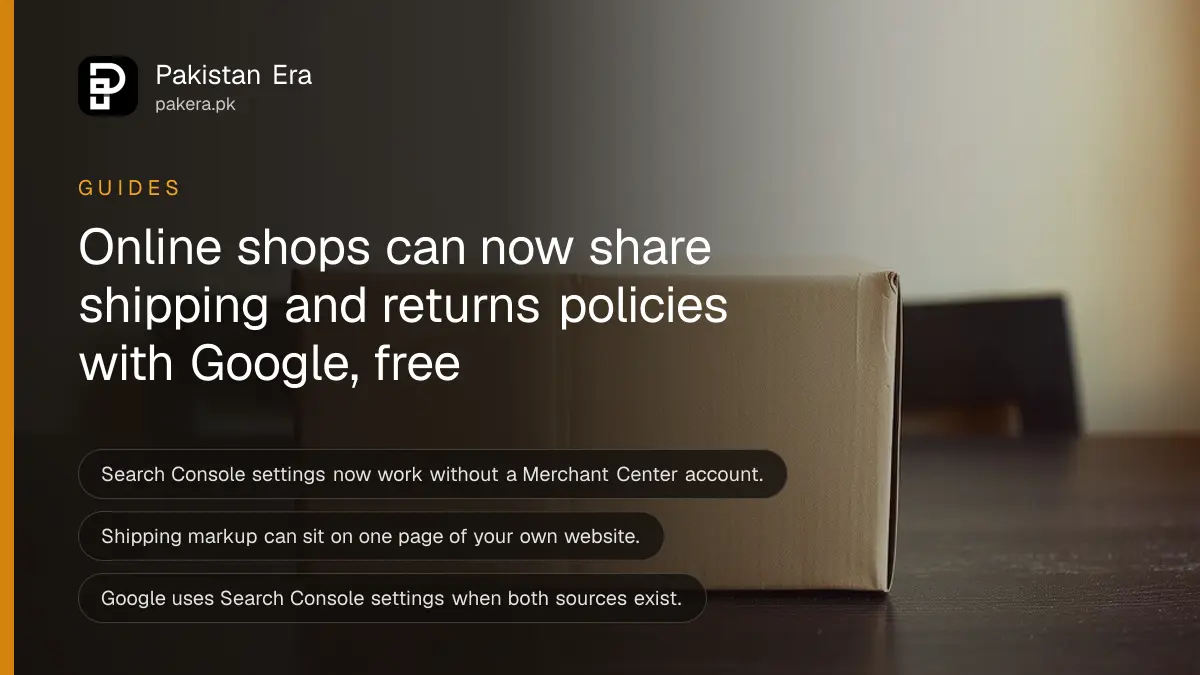
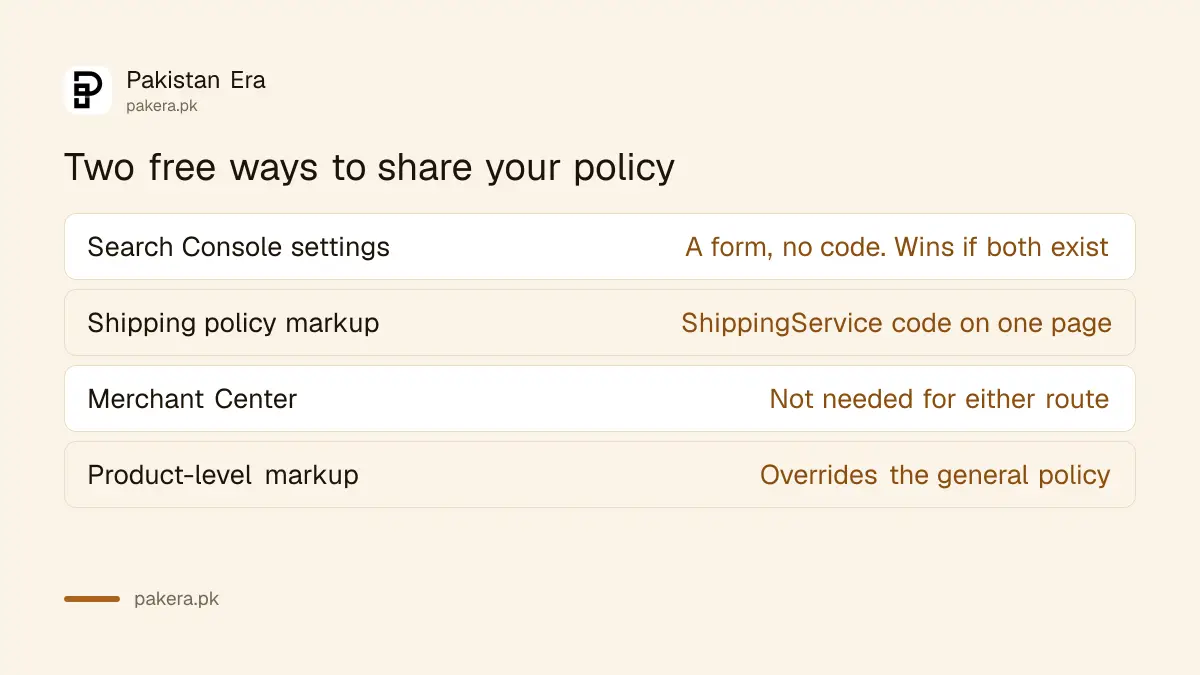
An online shop can now tell Google its shipping and return policy in two free ways: in Search Console settings, or with shipping policy markup on its own website. You no longer need a Merchant Center account for either. If you set both, Google says it uses only the Search Console settings.
For a Pakistani shop, a clear delivery fee, delivery time and return rule can show beside your products and in your business panel on Google. Google says this may help shoppers trust you before they click. It does not promise any ranking boost, and we do not promise one either. We read Google's announcement of 12 November 2025 and its shipping policy documentation, last updated 8 September 2026. We did not test the Search Console screen.
Search Console settings are the easier route
Google has opened the Shipping and returns feature in Search Console settings to every website it identifies as an online merchant. Before, you needed a configured Merchant Center account. You fill in your policy on a form instead of writing code.
Google says the rollout is gradual, for all countries and languages. The feature appears only if Google has identified your site as an online merchant. So a brand new shop may not see it yet. If you cannot find the setting, use the markup route in the next section instead.
One rule matters: settings in Search Console take precedence over structured data on your site. If the two disagree, Google follows Search Console. So keep them the same, or use only one.

Shipping policy markup goes on one page
The code route uses ShippingService structured data nested under Organization. Google recommends putting it on the single page where you describe your shipping policy. You do not need it on every page. Product-level shipping details still win over it for that product.
Google's example describes a store with free two day shipping over a set amount and a fee below it. Each shipping condition needs a destination, a rate and a transit time. The only required property for ShippingService is shippingConditions. Name, description, handling time and fulfillment type are recommended.
Here is a small shape for a Pakistani shop, adapted by us from Google's pattern. It says delivery inside Pakistan costs Rs 250 and takes two to four days. The amounts are an example only. Replace them with your real policy.
{
  "@context": "https://schema.org",
  "@type": "OnlineStore",
  "name": "Your Shop Name",
  "hasShippingService": {
    "@type": "ShippingService",
    "name": "Standard delivery in Pakistan",
    "shippingConditions": {
      "@type": "ShippingConditions",
      "shippingDestination": { "@type": "DefinedRegion", "addressCountry": "PK" },
      "shippingRate": { "@type": "MonetaryAmount", "value": 250, "currency": "PKR" },
      "transitTime": {
        "@type": "ServicePeriod",
        "duration": { "@type": "QuantitativeValue", "minValue": 2, "maxValue": 4, "unitCode": "DAY" }
      }
    }
  }
}
Google recommends the OnlineStore or LocalBusiness subtypes of Organization for shops. If you also have a physical counter, the steps to add LocalBusiness schema to your shop website cover that markup.
Add your policy in six steps
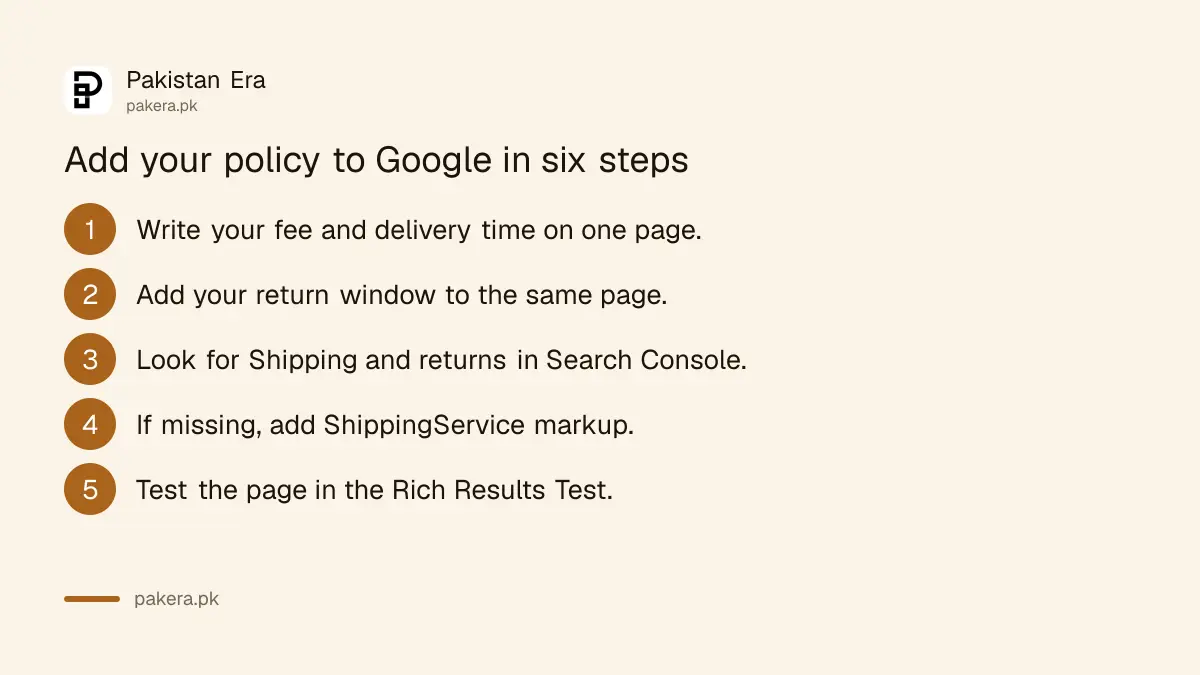
Write your real policy in plain words on one page first. Then enter it in Search Console, or add the markup to that page, test it in the Rich Results Test and ask Google to recrawl the page.
- Write your delivery fee, handling time and delivery time on one policy page.
- Write your return window and who pays for the return on the same page or a linked page.
- Open Search Console settings and look for Shipping and returns. If it is there, fill it in.
- If it is missing, add ShippingService markup under Organization on the policy page.
- Test the page in Google's Rich Results Test and fix any critical error.
- Use URL Inspection to check the page, then ask Google to recrawl it.
Do not promise what you cannot do. A fee or a delivery time in your markup must match what customers really get. Our advice: keep the visible page and the code the same, so no customer is surprised.
Google picks one source when settings clash
When several sources exist, Google uses a fixed order. From strongest to weakest: the Content API for Shopping, then Merchant Center or Search Console settings, then product-level markup, then organization-level markup.
| Order | Source Google uses |
|---|---|
| 1 (strongest) | Content API for Shopping account-level settings |
| 2 | Merchant Center or Search Console settings |
| 3 | Product-level merchant listing markup |
| 4 (weakest) | Organization-level markup |
In practice, a small Pakistani shop will usually use only one source. If you also list products free in Google's shopping results, see how Pakistani sellers use Merchant Center free listings, because delivery settings there rank above your site markup.
Common questions about shipping and returns policies on Google
Do I need a Merchant Center account to share my shipping policy?
No. Since Google's update of 12 November 2025 you can use Search Console settings or organization-level markup without Merchant Center.
Why can I not see Shipping and returns in Search Console?
The setting is offered to sites Google identifies as online merchants, and the rollout is gradual. Use the markup route if it has not reached you.
Which wins if Search Console and my markup disagree?
Search Console. Google says settings configured there take precedence over structured data on your site.
Does shipping markup improve my ranking?
Google does not say so. It says the information may appear in knowledge panels, brand profiles and product search results, and may attract more customers.
Can I list a different shipping rule for one product?
Yes. Product-level shipping details in your markup take priority over the general organization-level policy for that product.
How we verified this
What we checked, where we read it, and what we could not confirm.
Last checked 14 October 2026. The two routes, the precedence rules and the rollout note come from Google's Search Central Blog post More ways to share your shipping and returns policies with Google, dated 12 November 2025. The markup requirements and the order of sources come from Google's shipping policy structured data page, last updated 8 September 2026. The Pakistani rupee example is our own adaptation and is untested. We did not open a Search Console account, so check the setting there yourself.
About the author

Founder and Editor
Umer Kureshi founded Pakistan Era in July 2024 and runs it as administrator, SEO lead and writer, overseeing website operations, search growth, content strategy and coverage of technology and current affairs.