Sub-Registrar Refused to Register Your Deed? Appeal to the Registrar in 30 Days in Pakistan
If a Sub-Registrar refuses to register your property deed, get the written reasons free and appeal to the Registrar in 30 days. Then you have 30 days to sue.
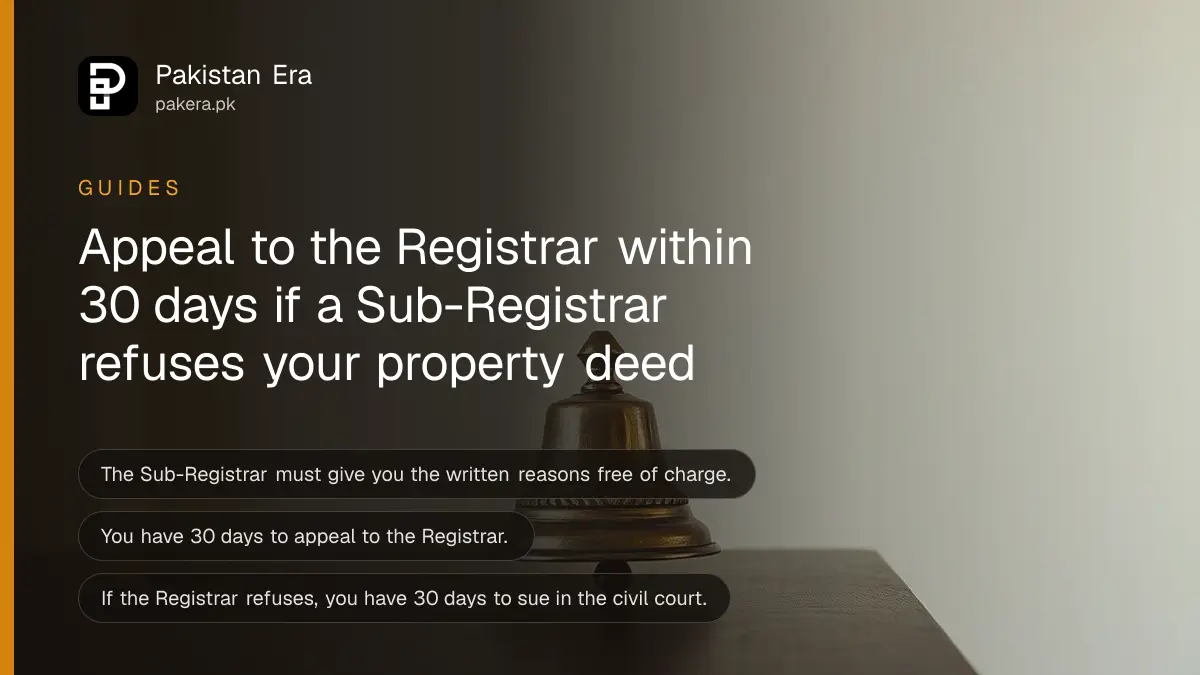
Short answer: If a Sub-Registrar refuses to register your property document, ask for the written reasons, free of charge, and appeal to the Registrar within 30 days of the order. If the Registrar also refuses, you have 30 more days to sue in the civil court under the Registration Act, 1908.
You brought a sale deed to the Sub-Registrar, paid what was asked, and heard "registration refused." Many buyers walk away and lose weeks. The Registration Act gives you a fixed path with two short deadlines, and each one is 30 days.
We read Part XII of the Registration Act, 1908 on the Pakistan Code (pakistancode.gov.pk) on 14 October 2026, along with sections 34 and 35. This is the federal text. Provinces can amend the Act and set their own fees, so confirm the details with your Registrar. For the filing side, see our page on the 4 month deadline to present a deed.
The Sub-Registrar must record his reasons and give you a copy
Section 71 says a Sub-Registrar who refuses to register a document must make an order of refusal, record his reasons in Book No. 2, and write "registration refused" on the document. On application, he must give you a copy of the reasons without payment and without unnecessary delay.
Ask for the reasons in writing the same day. You need them for every later step, and the 30 day clocks start from the date of the order. The only exception is a refusal because the property lies outside his sub-district. Then no appeal is needed. You take the deed to the right office.
An endorsed document cannot be accepted again by the registering officer until it has been directed to be registered under the later sections.
The ground of refusal decides your route
There are two routes. If the refusal is on any ground other than a denial of execution, such as a missing paper or a defect, you appeal to the Registrar under section 72. If a signer denies he signed, you apply to the Registrar under section 73.
Section 35 explains the denial case. If a person named as signer denies signing, appears to be a minor or of unsound mind, or is dead and his heir denies the signing, the officer refuses to register as to that person. In that case the Registrar looks into the facts himself.
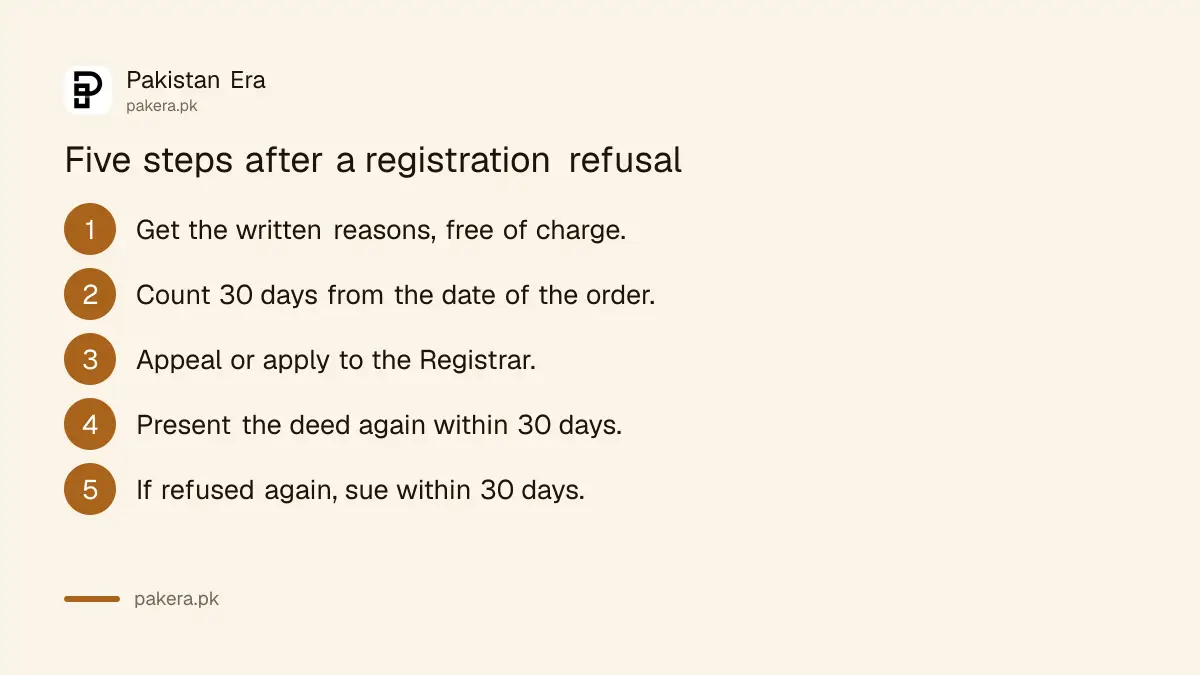
- Get the written reasons from the Sub-Registrar the day he refuses.
- Note the date of the order and count 30 days from it.
- Appeal (section 72) or apply (section 73) to the Registrar to whom the Sub-Registrar is subordinate.
- If the Registrar orders registration, present the document again within 30 days of his order.
- If the Registrar refuses, sue in the civil court within 30 days of that refusal.
An appeal to the Registrar has a 30 day limit
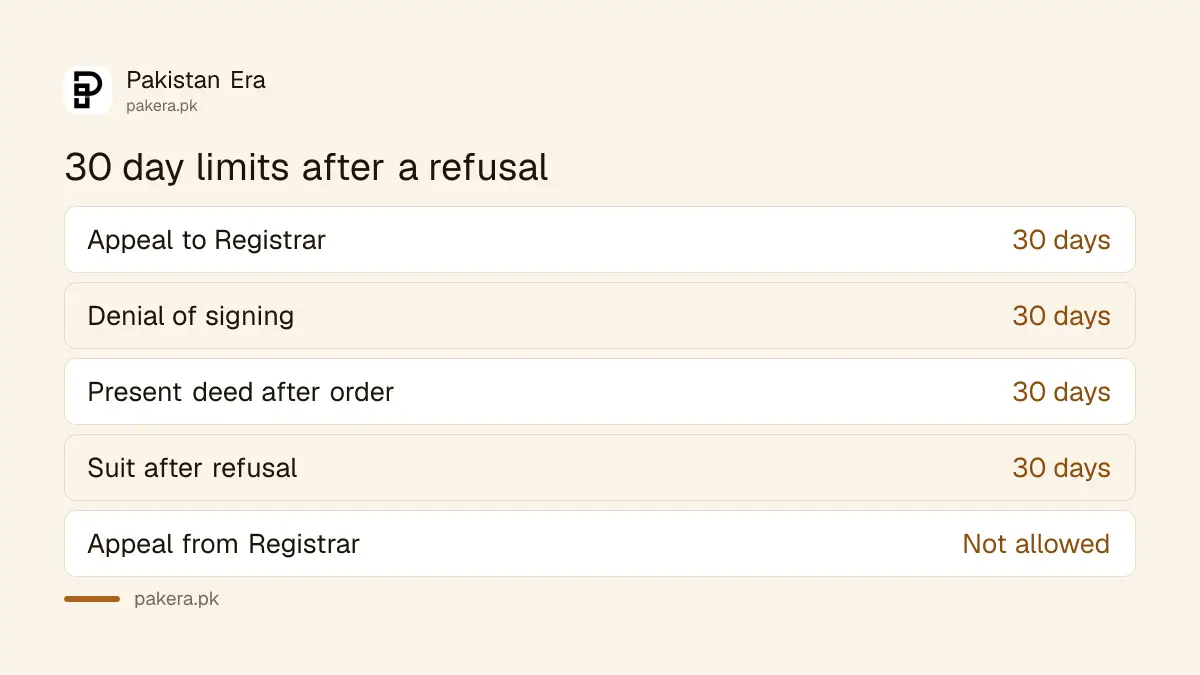
Under section 72, when the refusal is on any ground other than a denial of execution, you can appeal to the Registrar within thirty days from the date of the order. The Registrar may reverse or change the order. This applies to compulsory and optional registration alike.
If the Registrar directs registration, you must present the document again within thirty days of his order. The Sub-Registrar must obey, and the registration takes effect as if the document had been registered when first presented. That date can matter if a second buyer rushed in.
Write the appeal in plain language: your name, the document, the date of refusal, the reasons given, and why you say they are wrong. Attach the copy of the reasons and the document.
A denial of signing goes to the Registrar for an enquiry
Under section 73, if a Sub-Registrar refuses because a signer denies signing, the person claiming under the document can apply to the Registrar within 30 days. The application is in writing, comes with a copy of the reasons, and is verified like a plaint.
Section 74 says the Registrar then enquires whether the document was signed and whether the law was followed. Under section 75 he can summon witnesses and order the document registered if he finds it was signed and the rules are met.
The registration then takes effect from the date of first presentation. The Registrar can also order who pays the costs of the enquiry. You may need a lawyer for this route, because a witness may be called.
| Stage | What you do | Time limit | Section |
|---|---|---|---|
| Sub-Registrar refuses | Ask for written reasons | As soon as possible, free | 71 |
| Refusal on a defect or other ground | Appeal to the Registrar | 30 days from the order | 72 |
| Refusal because a signer denies signing | Apply to the Registrar | 30 days from the order | 73 |
| Registrar orders registration | Present the document again | 30 days from his order | 72, 75 |
| Registrar refuses | Sue in the civil court | 30 days from the refusal | 77 |
If the Registrar refuses, the next step is a civil suit
Section 76 says no appeal lies from the Registrar's refusal. Section 77 lets the person claiming under the document sue within 30 days in the civil court where the registration office sits, for a decree directing registration. After a decree, you present the document within 30 days.
The same section adds a safety net. Failing to sue, or losing the suit, does not remove any other remedy you have based on the unregistered document. For example, you may still have a claim on the agreement itself.
Because the time limits are short, speak to a lawyer once the Registrar refuses. Also see how long other claims last in our guide to time limits to sue in Pakistan.
Check the 4 month rule first
Refusals often come because the deed is late. Section 23 requires presentation within four months of signing, and section 25 allows a further four months on a fine of up to ten times the fee for urgent necessity. If your refusal was for delay, say so in your appeal and give proof.
Other common causes are a missing signer, a wrong property description, or a proxy without a valid authority. Fix the cause before you appeal. An appeal can only cure what the Act allows the Registrar to cure.
For a deed that relies on an overseas signer, see the page on making a power of attorney from abroad.
Common questions
What can I do if the Sub-Registrar refuses to register my deed?
Ask for the reasons in writing, free of charge, then appeal to the Registrar within 30 days. If a signer denies signing, apply to the Registrar within 30 days instead. Both routes are under Part XII of the Act.
Does the Sub-Registrar have to explain a refusal?
Yes. Section 71 requires him to record his reasons and give you a copy, without payment, when you apply. Insist on it, because the later steps need it.
Is there a fee to appeal to the Registrar?
We did not find a court fee in the sections we read. The Act leaves fees to each province, so ask the Registrar's office what it charges.
Can I appeal if the Registrar also refuses?
Not by appeal. Section 76 bars it. You can sue in the civil court within 30 days under section 77 for a decree directing registration.
Do I lose my rights if I miss the 30 days?
You lose the registration route, but the Act says failing to sue does not disentitle you to any other remedy on the unregistered document. Get legal advice early.
Does the property being in another district matter?
Yes. A refusal because the property is outside the Sub-Registrar's sub-district needs no appeal. You present the document at the right office.
How we verified this
What we checked, where we read it, and what we could not confirm.
Last checked 14 October 2026. We read sections 34, 35 and 71 to 77 of the Registration Act, 1908 as published on pakistancode.gov.pk. This is the federal text, and provinces may have changed some details. We did not find fee amounts for appeals, and we did not check recent court rulings. Confirm with the Registrar's office.
About the author

Tax, Bills and Technology Writer
Ali Akhtar is a young and curious voice here at Pakistan Era. He is currently pursuing his A-Levels and has a growing interest in Pakistan’s changing industrial landscape and educational trends. Ali likes to write in a way that helps him explain and explore the world around him. His writing reflects the perspective of the new generation navigating the evolving trends of Pakistan where technology, youth innovation, and shifting opportunities are reshaping the country’s future.