Register Your Property Document Within 4 Months in Pakistan or Pay Up to 10 Times the Fee
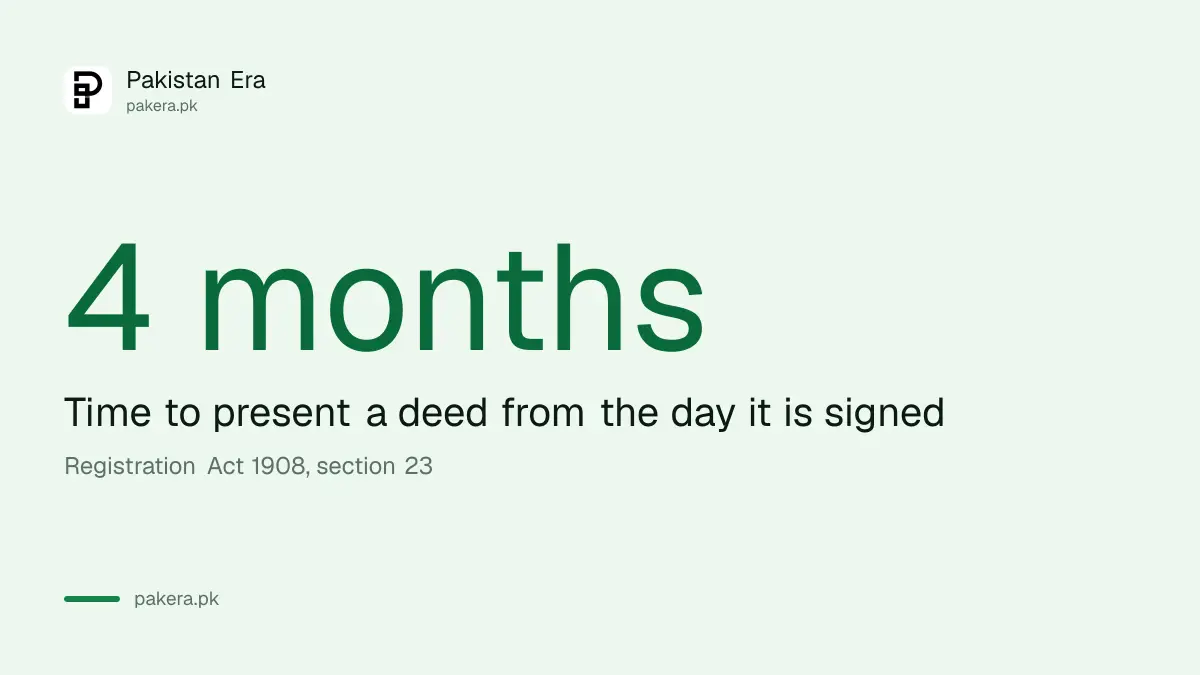
Section 23 of the Registration Act gives 4 months from signing to register a property deed. A late deed can be accepted with a fine of up to 10 times the fee.

Short answer: Under section 23 of the Registration Act, 1908, a property document must reach the registration office within 4 months of the day it was signed. If you are late by up to 4 more months for an urgent reason, the Registrar can accept it on a fine of up to 10 times the registration fee.
Sale deeds get signed in a rush, and then the paper sits in a drawer. Months later the seller dies, or the buyer wants a loan, and the Registrar says the document is too old. A late document can still be saved, but only inside a narrow window.
We read the Registration Act, 1908 on the Pakistan Code (pakistancode.gov.pk), the federal text kept by the Ministry of Law and Justice, on 14 October 2026. Provinces set their own fees and can amend the Act for their own area, so check your provincial rules too. For the Punjab version of agreements and powers of attorney, see how to register an agreement to sell in Punjab.
The 4 month clock starts on the day of signing
Section 23 says no document, other than a will, is accepted for registration unless presented to the proper officer within four months from the date of its execution. Execution means the day it was signed. A court decree copy gets 4 months from the day it was made.
The clock does not start when you pay the stamp duty, nor when you get the keys. It starts on signing. If several people sign on different days, section 24 gives four months from each signing, so late signers do not spoil the document.
Count the months on a calendar the day you sign. Put the last safe date in your phone, and file well before it.
Registration is compulsory for most property documents
Section 17 makes registration compulsory for gifts of immovable property, other documents that create or end any right in immovable property worth Rs 100 or more, leases from year to year or over one year, and, since 2022, powers of attorney and agreements to sell.
The federal text carries clause (ba), added by the Registration (Amendment) Act, 2022. It covers an instrument that gives power to an attorney, or that is an agreement to create or end by way of sale any right in immovable property worth Rs 100 or more. Section 49 then says a document that must be registered does not create or transfer any right in immovable property unless it is registered.
The rule has teeth. A sale deed that is not registered does not pass title. To see how to check a property before you pay, read how to verify a property's title before you buy.
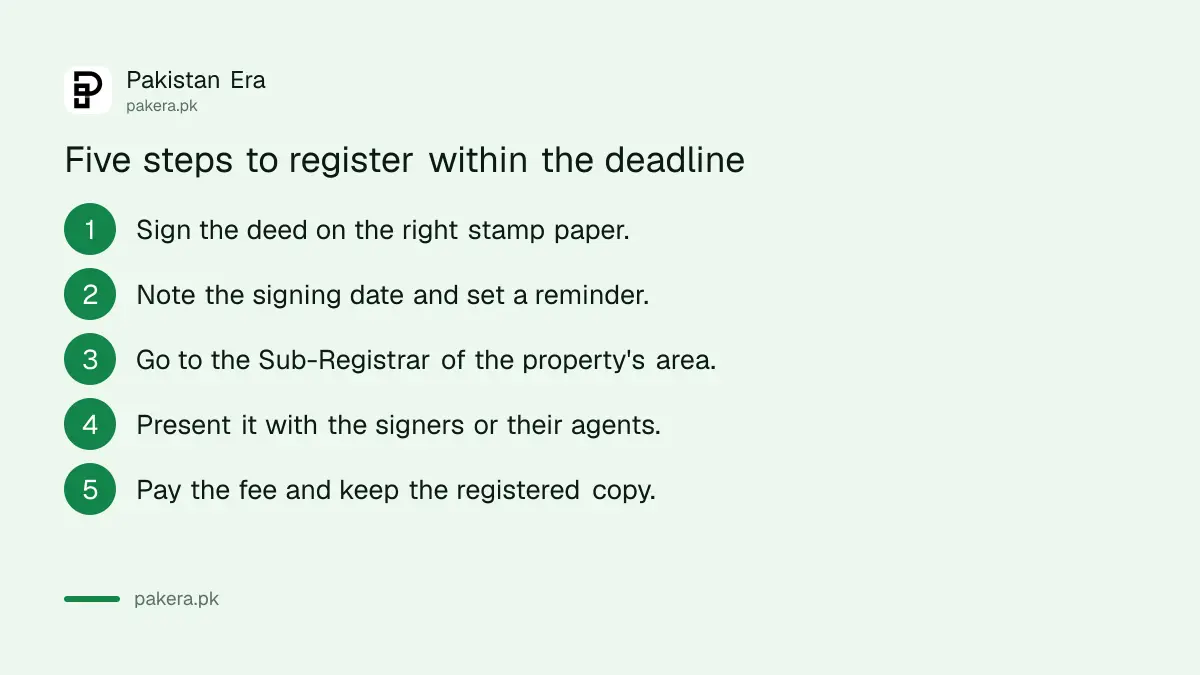
- Sign the deed on the right stamp paper with the seller, buyer and witnesses.
- Note the signing date and set a reminder for 3 months later.
- Take the deed to the Sub-Registrar of the sub-district where the property stands.
- Present it together with the persons who signed, or their authorised agents.
- Pay the registration fee, and keep the receipt and the registered copy.
A late document can be accepted with a fine
Section 25 allows the Registrar to accept a late document if the delay was due to urgent necessity or unavoidable accident, and does not exceed four months. The fine can be up to ten times the proper registration fee. You apply through the Sub-Registrar, who forwards it.
That means a hard outer limit of about eight months from signing. After that, the Act gives no late path. The Registrar has discretion, not duty. You must show a real reason, such as an illness or a flood, and keep proof.
For example, if the registration fee were Rs 10,000, the most the Registrar could fine you is Rs 100,000. The fee itself depends on the province and the property value. Section 78 says it cannot be more than one percent of the property value.
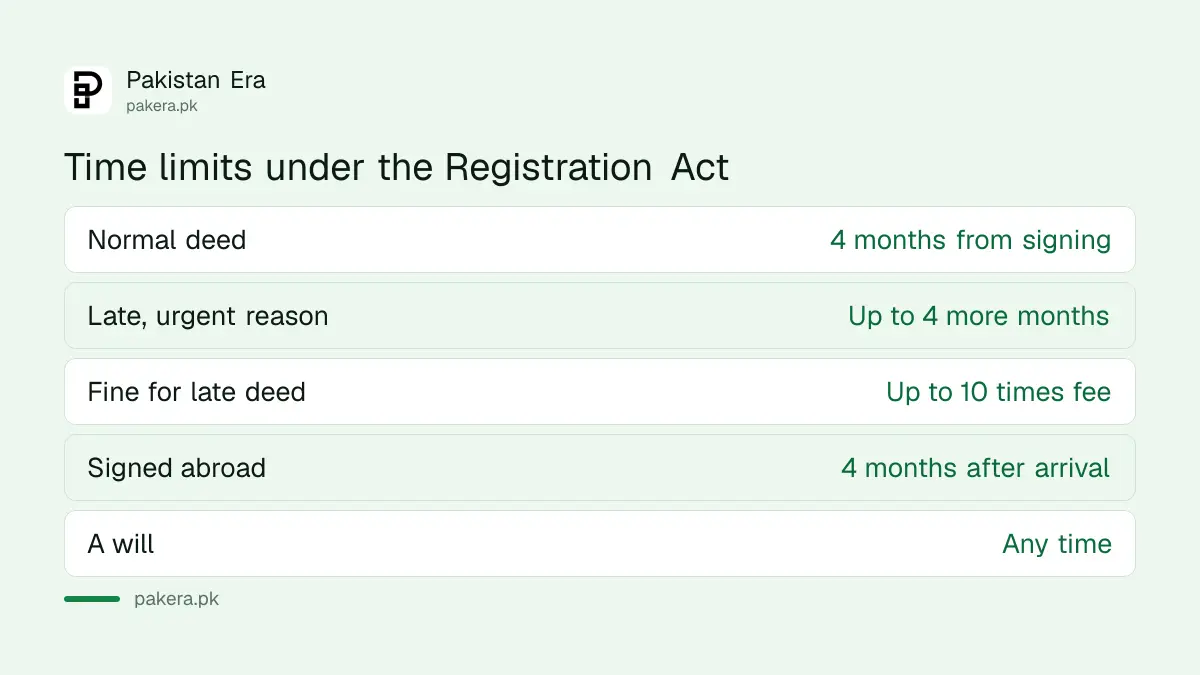
| Situation | Time to present | Section |
|---|---|---|
| Normal document | 4 months from signing | 23 |
| Several signers on different days | 4 months from each signing | 24 |
| Late for urgent reason | Up to 4 more months, fine up to 10 times the fee | 25 |
| Signed outside Pakistan | 4 months after it arrives in Pakistan, proper fee | 26 |
| A will | Any time | 27 |
Papers signed abroad get a separate clock
Section 26 covers documents signed outside Pakistan. If the paper reaches Pakistan after the normal time, the registering officer can accept it on payment of the proper fee, provided it is presented within four months after its arrival in Pakistan. No fine applies.
The officer must be satisfied that the document was signed as claimed. An overseas Pakistani who signs a sale deed or power of attorney at an embassy should keep the courier slip or the arrival record. It fixes the day the four months begin. For the Islamabad route, read how an overseas Pakistani registers a power of attorney.
The fee is fixed by each province
Section 78 says each provincial government prepares a table of registration fees, capped at one percent of the value of the property conveyed. Section 79 says the table must be published in the Gazette and displayed in English and the local language in every registration office.
So ask the Sub-Registrar to show you the posted table before you pay. Stamp duty and taxes are separate from the registration fee. For the tax side, see what tax you pay when you buy or sell property.
The Act also lets an officer attend at a home for a special cause, such as a very ill seller. Section 31 says this needs special cause shown, and the officer decides.
Wills are the exception
Section 27 says a will may be presented for registration or deposited at any time. The four month rule does not apply. A will can also be registered after the maker has died, if the person presenting it shows he is entitled and the officer is satisfied.
That gives families more room, but not for sale deeds. If a buyer waits for a seller to die, the buyer cannot register on the seller's behalf unless a registered power of attorney exists. Our guide to writing a valid will in Pakistan covers the will itself.
Common questions
What is the time limit to register a sale deed in Pakistan?
Four months from the date of signing, under section 23 of the Registration Act, 1908. A late deed can still be accepted for up to four more months with a fine, if the delay was due to urgent necessity or unavoidable accident.
How big can the fine for late registration be?
Up to ten times the proper registration fee, under section 25. The Registrar decides the amount. He is not bound to accept the document at all, so give a clear reason and proof.
Is an unregistered sale deed valid?
Section 49 says a document that must be registered does not create or transfer any right in immovable property unless it is registered. Another section protects some buyers in possession, so see a lawyer before you rely on it.
Do I need to register an agreement to sell?
The federal text of section 17(1)(ba), added in 2022, makes an agreement to sell property worth Rs 100 or more compulsorily registrable. Provinces may have their own rule, so check yours.
What if I signed the deed abroad?
You have four months after the paper arrives in Pakistan, paying the proper fee. Keep proof of the arrival date. No fine applies under section 26.
Can a will be registered after the owner dies?
Yes. Section 27 allows a will to be presented at any time, and section 41 lets a person entitled to present it do so after the maker's death, if the officer is satisfied.
How we verified this
What we checked, where we read it, and what we could not confirm.
Last checked 14 October 2026. We read sections 17, 23 to 27, 31, 48, 49, 78 and 79 of the Registration Act, 1908 as published on pakistancode.gov.pk. This is the federal text. We did not check each province's amendments, fee tables or stamp duty rates, so confirm them with your Sub-Registrar.
About the author

Senior Writer, Public Services and Technology
Shahid joined us in 2024 as an author. He is a senior contributor to Pakistan's leading technology websites. He writes detailed articles, mostly covering his expertise in the latest tech, mobiles, apps, gadgets, and step-by-step guides. His ideology is to help people understand the latest trends and explain complex methods through very easy-to-understand guides.