How to Write a Valid Will (Wasiyat) in Pakistan
A Muslim will in Pakistan covers one third of the estate, and gifts to heirs need consent. Witnesses, optional registration, stamp duty and non-Muslim rules.
A Muslim in Pakistan can leave up to one third of what they own by will (wasiyat). A gift by will to one of your own heirs, or anything above the third, only works if the other heirs agree after your death. Write it down, sign it in front of two adult witnesses who get nothing under it, and keep it safe. Registration is optional, and we found no stamp duty listed for a will.
Most families learn what a will can do only after a death, when it is too late to fix. In Pakistan a wasiyat sits on top of fixed inheritance shares. It does not replace them.
We read the laws on wills on the federal and Punjab law portals on 3 October 2026, plus two Sindh High Court orders. One change matters in Punjab: since May 2026 you can no longer leave a sealed will with the Registrar there.
The one-third rule decides what a Muslim will can do
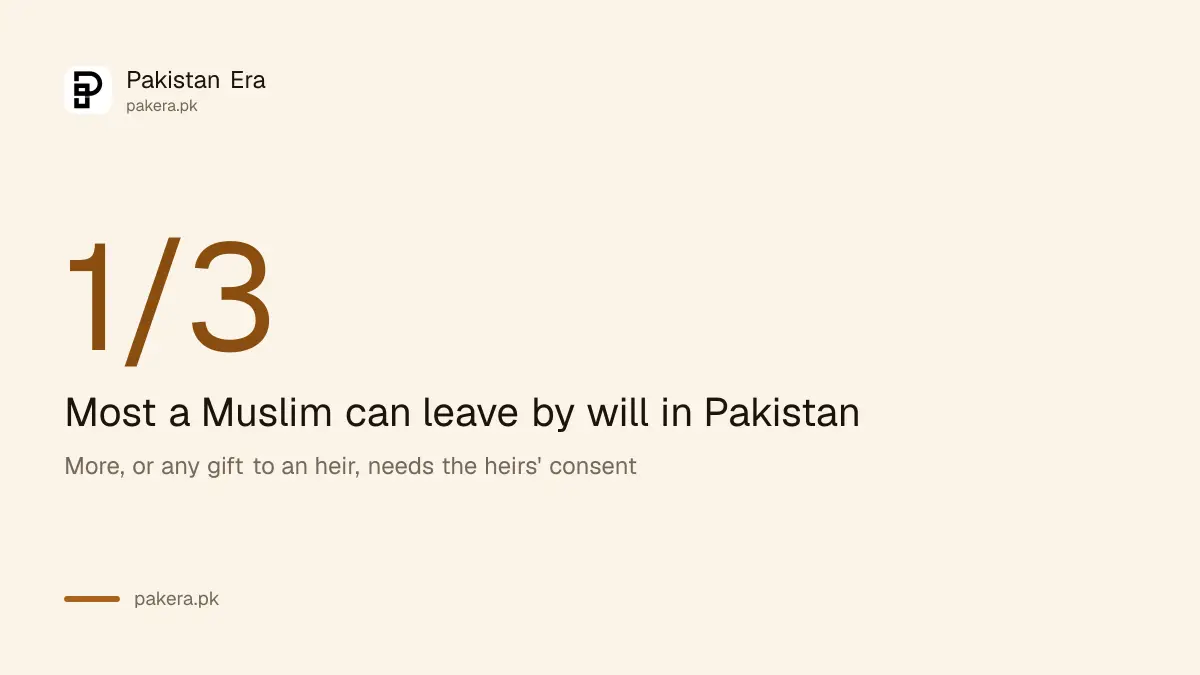
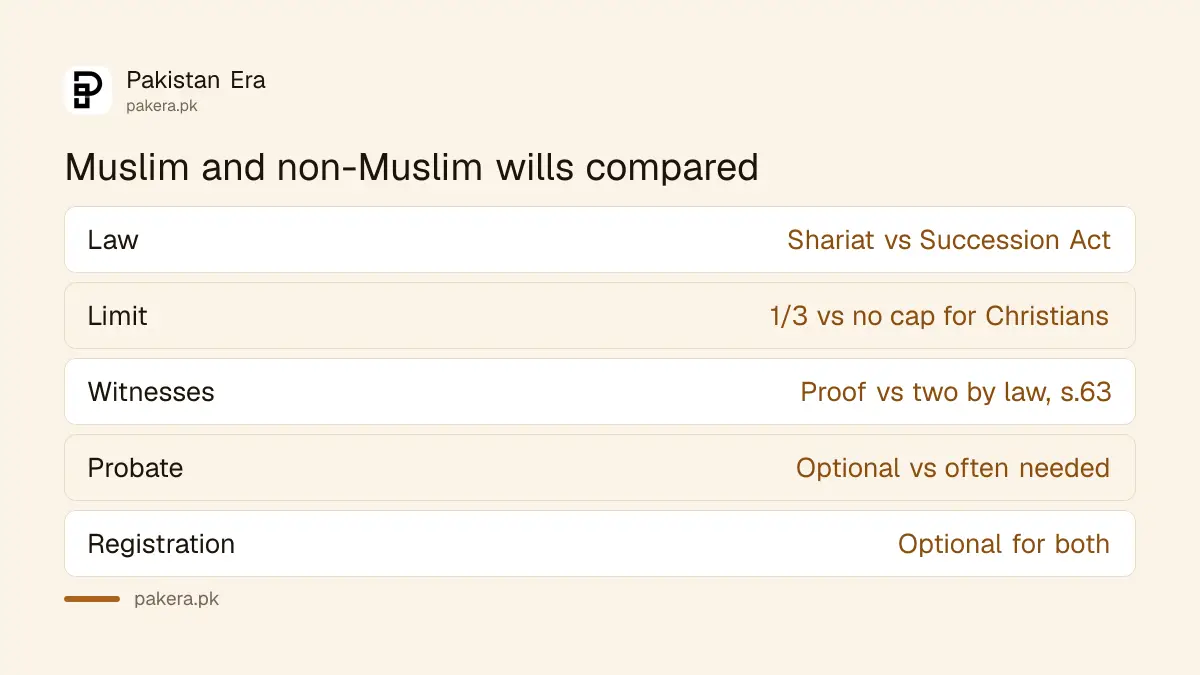
For Muslims, a will can cover at most one third of the estate. The other two thirds go to the legal heirs in their fixed shares, whatever the will says. A bequest above one third is not valid unless the heirs consent to it.
The West Pakistan Muslim Personal Law (Shariat) Application Act, 1962 says Muslim personal law decides questions of wills and succession between Muslims. Section 58 of the Succession Act, 1925 confirms its own chapter on wills does not apply to Muslims.
The Sindh High Court put it plainly in a 2016 probate order. A Muslim's bequest "can be only to the extent of a third", but where the heirs consent, a bequest above one third "would become valid".
The third is usually counted from what is left after funeral costs and debts. So a will helps most for someone who would not inherit at all: a grandchild whose parent is alive, a loyal employee, a mosque or a school. The fixed shares are set out in who gets what under Pakistani inheritance law.
A will in favour of an heir needs the other heirs to agree after death
You cannot use a will to give one heir more than their fixed share, even within the third. The extra gift works only if the other heirs consent after your death. If they object, it fails.
The Sindh High Court applied this in April 2022. A father left a house to one son by will, on top of his normal share, and the other sons objected. The court held that a bequest to an heir is "not valid unless the other heirs consent to the bequest after the death of the testator".
The father was over 90 and died within 40 days of signing. The court said a deathbed will needs special care, such as announcing it in front of the other heirs. It also noted that one of the two witnesses did not support the will.
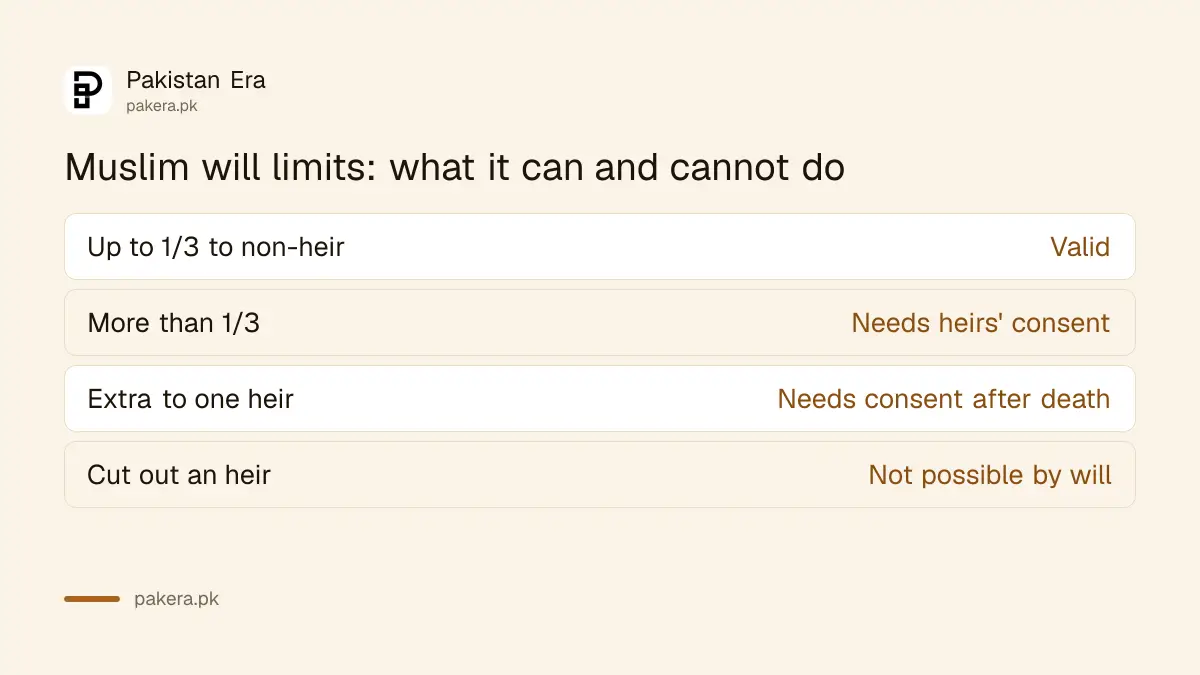
| What the will tries to do | Valid on its own? | What makes it work |
|---|---|---|
| Leave up to one third to a non-heir or charity | Yes | Nothing more is needed |
| Leave more than one third to anyone | No, not the excess | Consent of the heirs |
| Give one heir more than their share | No | Consent of the other heirs after death |
| Cut an heir out entirely | No | Fixed shares cannot be removed by will |
If you want an heir to get more, a will is the wrong tool. A lifetime gift is the usual route, and in Punjab that means a registered hiba of property.
How to write and sign a valid wasiyat
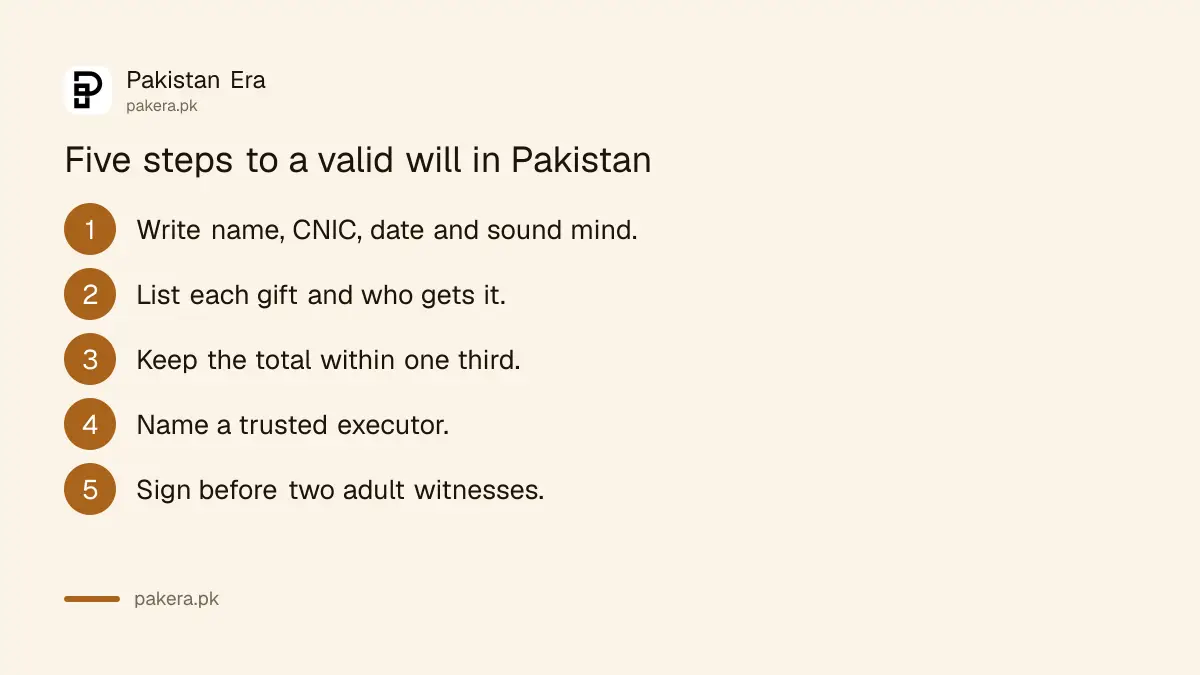
Write the will clearly, sign it, and have two adult witnesses sign it in your presence. The Succession Act's signing rules do not bind Muslims, but a court will still ask for proof, and witnesses who can confirm the signing are that proof.
- Write your full name, CNIC number, address and the date. Say you are of sound mind and acting freely.
- List each bequest: who gets what, with their CNIC and a clear description, such as a plot number.
- Keep the total within one third.
- Name an executor, a trusted person who will carry out the will.
- Sign every page in front of two adult witnesses, who sign and add their name, CNIC and address.
Pick witnesses who get nothing under the will and will be around for years. Article 79 of the Qanun-e-Shahadat Order, 1984 says an attested document cannot be used in evidence until two attesting witnesses are called, if alive. Its exemption for registered documents expressly excludes wills, so registration does not replace your witnesses.
Registering a will is optional, and Punjab ended sealed deposit in 2026
You do not have to register a will. The Registration Act, 1908 lets you present it to a Registrar or Sub-Registrar at any time. In Punjab, the option of depositing a will in a sealed cover was removed in May 2026.
Section 17 lists documents that must be registered, and covers non-testamentary documents only. A will falls under section 18, where registration is optional. Section 40 lets the person making the will, or an executor after death, present it.
The Punjab text now shows Part IX, "Deposit and Disposal of Wills", as omitted by the Registration (Amendment) Act 2026, Punjab Gazette, 14 May 2026. The same Act runs Punjab registration through the Punjab Land Records Authority's electronic system, with biometric checks.
The Sindh text, as compiled by the Sindh Judicial Academy up to May 2024, still allows deposit. We did not check Khyber Pakhtunkhwa or Balochistan. We also could not read a current registration fee for a will, so ask the Sub-Registrar and get a receipt.
No stamp duty is listed for a will
We searched the Stamp Act, 1899 on the Punjab Code and found no article that charges duty on a will. Its definitions keep wills apart from deeds that carry duty, such as gifts and settlements.
A "settlement" in the Act means a non-testamentary disposition, and the adoption and partition entries both exclude a will. So unlike a rent agreement on stamp paper, a will can be on plain paper.
Wills by Christians, Hindus and other non-Muslims follow the Succession Act
For non-Muslims, the Succession Act, 1925 sets the rules. There is no one-third cap for Christians, so they can divide their property freely. Section 63 requires the testator's signature and at least two witnesses, each signing in the testator's presence.
Section 59 lets any person of sound mind who is not a minor make a will. Section 61 makes a will void if fraud or coercion caused it.
Probate is a court's official confirmation of a will. Section 213 makes it necessary to claim as executor or legatee, but not for Muslims or Parsis, and only for certain Hindu, Buddhist, Sikh and Jain wills. For bank accounts and shares after a death, families usually need a succession certificate instead.
You can change or cancel your will at any time
A will has no effect until death, so you can change or cancel it whenever you like. The safest way is a new written will that says it cancels all earlier ones, signed and witnessed the same way.
For non-Muslims, section 70 of the Succession Act allows revoking by a later will, a signed and witnessed writing, or destroying it on purpose. If you registered the old will, keep copies of both and destroy loose drafts.
Common questions
Can a Muslim in Pakistan leave all property to one child by will?
No. A child is already an heir, so any extra gift needs the other heirs' consent after the death.
Is a handwritten will valid in Pakistan?
Yes, if it is clear and signed in front of two adult witnesses who also sign.
Do I need stamp paper for a will?
No. We found no article in the Stamp Act, 1899 that charges duty on a will.
Is registration of a will compulsory?
No. Section 18 of the Registration Act, 1908 makes it optional.
Can a wife leave property to her husband by will?
He is a legal heir, so the other heirs must consent after her death. Within the third, she can freely leave property to a non-heir.
Can I still deposit a sealed will with the Registrar in Punjab?
No. The Registration (Amendment) Act 2026 removed that option from May 2026. You can still register a will.
If a will ends in a dispute and cost is the problem, ask about a free lawyer through legal aid in Punjab. This is general information, not legal advice.
How we verified this
What we checked, where we read it, and what we could not confirm.
Last checked on 3 October 2026. The Muslim Personal Law (Shariat) Application Act, 1962, sections 57 to 63, 70 and 213 of the Succession Act, 1925 and Article 79 of the Qanun-e-Shahadat Order, 1984 were read on the Pakistan Code. The Registration Act, 1908, including the removal of Part IX by the Registration (Amendment) Act 2026, and the Stamp Act, 1899 were read on the Punjab Code. The Sindh deposit sections were read in the Sindh Judicial Academy's compilation to 3 May 2024. The one-third rule and heirs' consent come from Sindh High Court orders in SMA No. 174 of 2016 (22 December 2016) and R.A. No. 133 of 2021 (25 April 2022) on the Sindh High Court case law site. We could not read a registration fee for wills.
About the author

Senior Writer, Public Services and Technology
Shahid joined us in 2024 as an author. He is a senior contributor to Pakistan's leading technology websites. He writes detailed articles, mostly covering his expertise in the latest tech, mobiles, apps, gadgets, and step-by-step guides. His ideology is to help people understand the latest trends and explain complex methods through very easy-to-understand guides.