Probation Instead of Jail in Pakistan: How the 1960 Ordinance Works
Pakistan's 1960 probation law lets a court release an offender for 1 to 3 years, or discharge after a warning for offences up to 2 years. See who qualifies.
A Pakistani court can release a convicted person on probation for 1 to 3 years instead of sending him to jail, under the Probation of Offenders Ordinance, 1960. The court needs written reasons, a bond to keep the peace, and a probation officer. For minor first offences up to two years' punishment, it can discharge the offender after a warning.
The Ordinance extends to the whole of Pakistan. Provincial governments make the rules and run the probation departments. We read the Ordinance on the Pakistan Code portal on 22 October 2026, in the copy updated to 17 April 2023. It is a rarely used route, but a lawyer can ask for it at the time of sentence. This page is general information, not legal advice.
Section 4 allows a warning or conditional discharge for offences up to two years
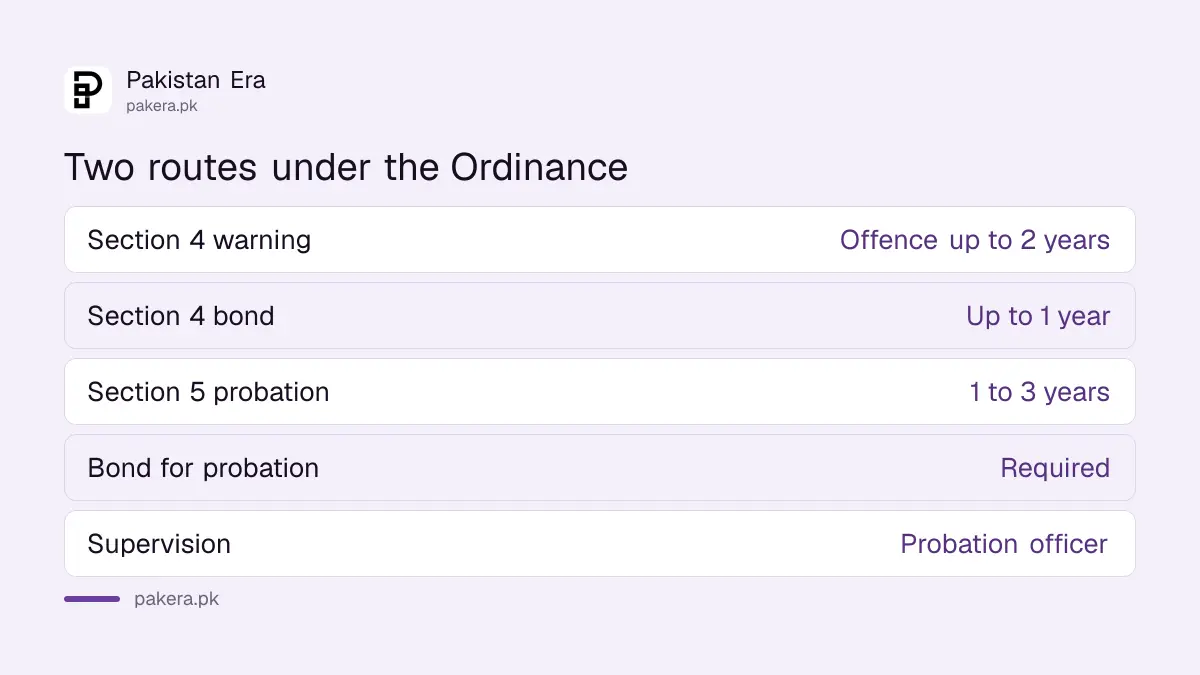
Section 4 applies to a person not proved to have a previous conviction, convicted of an offence punishable with imprisonment of not more than two years. The court may discharge him after due admonition, meaning a warning. Or it may discharge him on a bond not to offend, for up to one year.
The court weighs age, character, antecedents, physical or mental condition, the nature of the offence and any extenuating circumstances. It must record its reasons in writing and explain in ordinary language that a new offence means sentence for the original one.
Section 5 allows a probation order of one to three years
A court may, instead of sentencing at once, place the offender under a probation officer's supervision for not less than one year and not more than three. The offender must sign a bond, with or without sureties, to commit no offence, keep the peace and appear for sentence if called.
The court must also be satisfied that the offender or a surety has a fixed home or regular work within its area and is likely to stay there. It can add conditions on residence, environment and avoiding intoxicants. A surety is a person who guarantees that the offender will comply. How surety works in a bail setting is explained in the guide to standing surety for a bail bond.
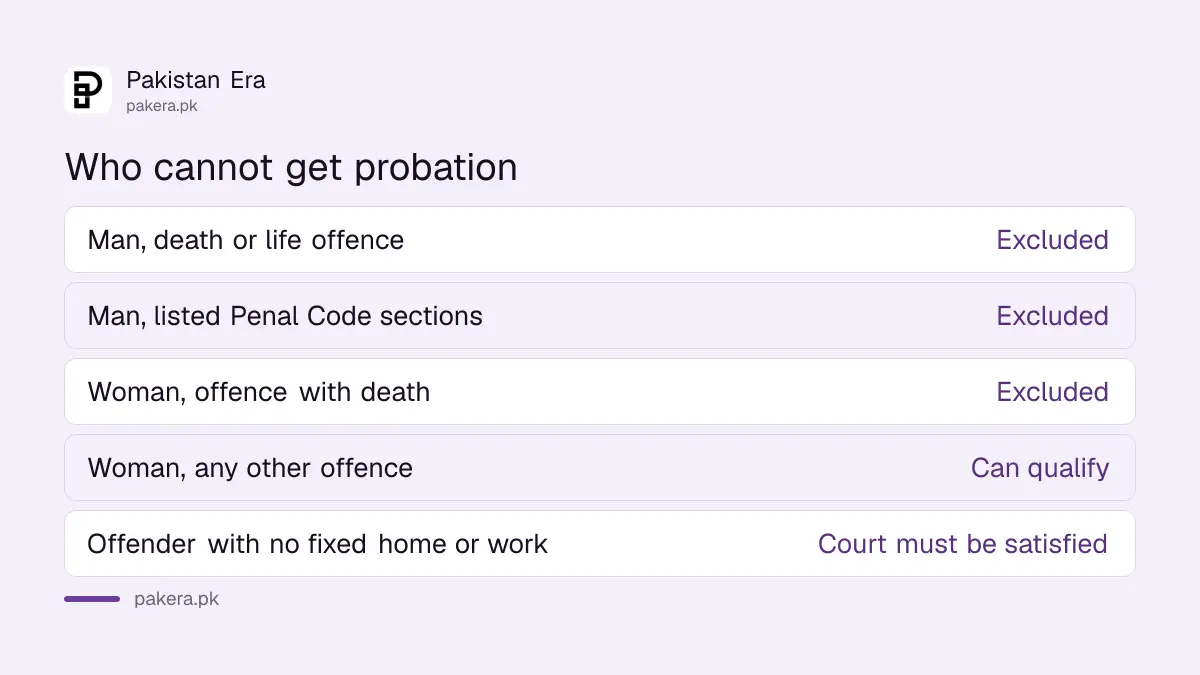
Serious offences are excluded for men, and women are excluded only for capital offences
For a man, section 5 excludes offences under Chapters VI and VII of the Pakistan Penal Code, a list of named sections (including 328, 382, 386 to 389, 392, 393, 397 to 399, 401, 402, 455 and 458) and any offence punishable with death or imprisonment for life. For a woman, any offence except one punishable with death can qualify.
Whether a particular Penal Code section is on the list is a lawyer's question, and the list above is not complete. The Juvenile Justice System Act also relies on probation officers, and defines them by reference to this Ordinance.
| Feature | Section 4 discharge | Section 5 probation |
|---|---|---|
| Eligible offence | Punishable with up to 2 years | Most offences, with exclusions |
| Previous conviction | Must not be proved | Not named as a bar |
| Length | Warning, or bond up to 1 year | 1 to 3 years |
| Supervision | None | Probation officer |
| Bond | Optional | Required |
The court can order compensation, but not more than the fine it could have imposed
Under section 6, the court may order the offender to pay compensation or damages for loss or injury caused to any person, and the costs of proceedings. The total cannot exceed the fine the court could have imposed for the offence. It is recoverable like a fine, and counted against any later civil damages.
This helps a victim. A complainant who wants payment more than prison has a reason to support probation. For wider settlement between the parties, see compromise in compoundable offences.
Breaking the bond means sentence for the original offence or a fine up to Rs 1,000
If the court believes a condition was broken, it can issue a warrant or summons to the offender and sureties. After a hearing, it may sentence him for the original offence, or impose a fine not exceeding Rs 1,000 and keep the bond alive. A fine not paid in time can also lead to the original sentence.
The probation officer visits the offender, checks the bond, reports on behaviour and helps find work. The court can vary the bond between one and three years, or end probation early if conduct is satisfactory.
A probation outcome is not treated as a conviction for other purposes
Section 11 says a conviction followed by a discharge or probation order is deemed not to be a conviction for any purpose outside those proceedings. It is also disregarded under any law that disqualifies convicted persons. The exception: an offender aged 18 or older who is later sentenced for the same offence loses that protection.
That is the practical gain. A police character record or a job application may be affected differently, so ask the court for the order in writing. Our page on the police character certificate in Khyber Pakhtunkhwa shows how such certificates are issued, but we did not verify how a probation order appears on them.
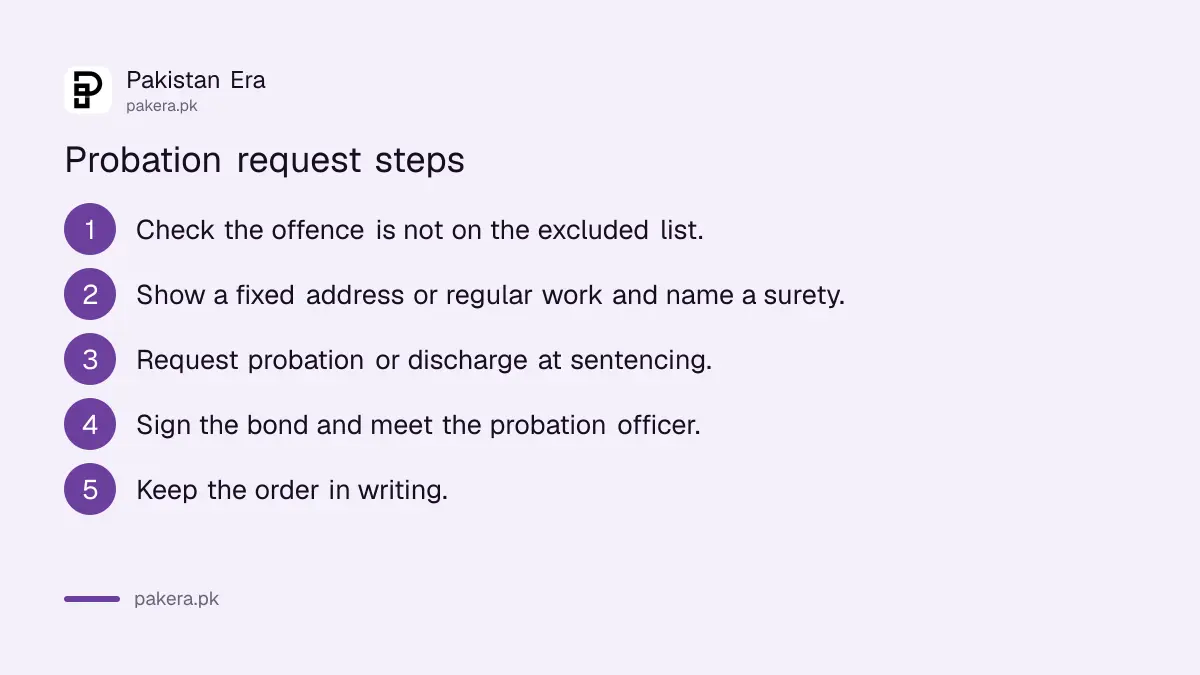
- Ask your lawyer whether the offence is outside the excluded list.
- Show a fixed address or regular work, and name a surety.
- Request a probation order or discharge at the time of sentence, or in appeal or revision.
- Sign the bond and meet the probation officer on the dates fixed.
- Keep the order and any discharge in writing.
Common questions
Which courts can make a probation order?
A High Court, a Court of Session and a first class magistrate, or another magistrate specially empowered. They may act at trial, in appeal or in revision.
Can an appeal court order probation?
Yes. Section 3 lets a court use these powers in original hearing, appeal or revision, and section 8 covers appeals against such orders.
How long does probation last?
One to three years under section 5. The court can extend or reduce within that range.
Does probation work for a woman convicted of murder?
No. For a woman the only excluded offences are those punishable with death.
Is the probation officer a police officer?
No. He is appointed by the head of the Probation Department and advises and assists the offender.
What if I move house?
The bond conditions include residence. Tell the probation officer and ask the court to vary the bond before you move.
How we verified this
What we checked, where we read it, and what we could not confirm.
Last checked 22 October 2026. We read the Probation of Offenders Ordinance, 1960 (Ordinance No. XLV of 1960) on the Pakistan Code portal, updated until 17 April 2023. We did not read provincial probation rules or any judgment, and we did not check whether every district has a working probation department. The exclusion list above is partial, see section 5 for the full text.
About the author

Senior Writer, Public Services and Technology
Shahid joined us in 2024 as an author. He is a senior contributor to Pakistan's leading technology websites. He writes detailed articles, mostly covering his expertise in the latest tech, mobiles, apps, gadgets, and step-by-step guides. His ideology is to help people understand the latest trends and explain complex methods through very easy-to-understand guides.