Australia Reordered Its Skilled Visa Queue, and Pakistani Applicants Sit Lower Than Before
From 25 July, police, defence, health, teaching and construction go first, and onshore beats overseas. What it means from Pakistan.
Australia has rewritten the order in which it processes skilled migration applications, and the change is not a small administrative tweak: it moves whole categories of applicant up and down a queue that already runs in years.
For anyone applying from Pakistan, the honest summary is uncomfortable. Unless you work in a prioritised occupation, you have moved down.
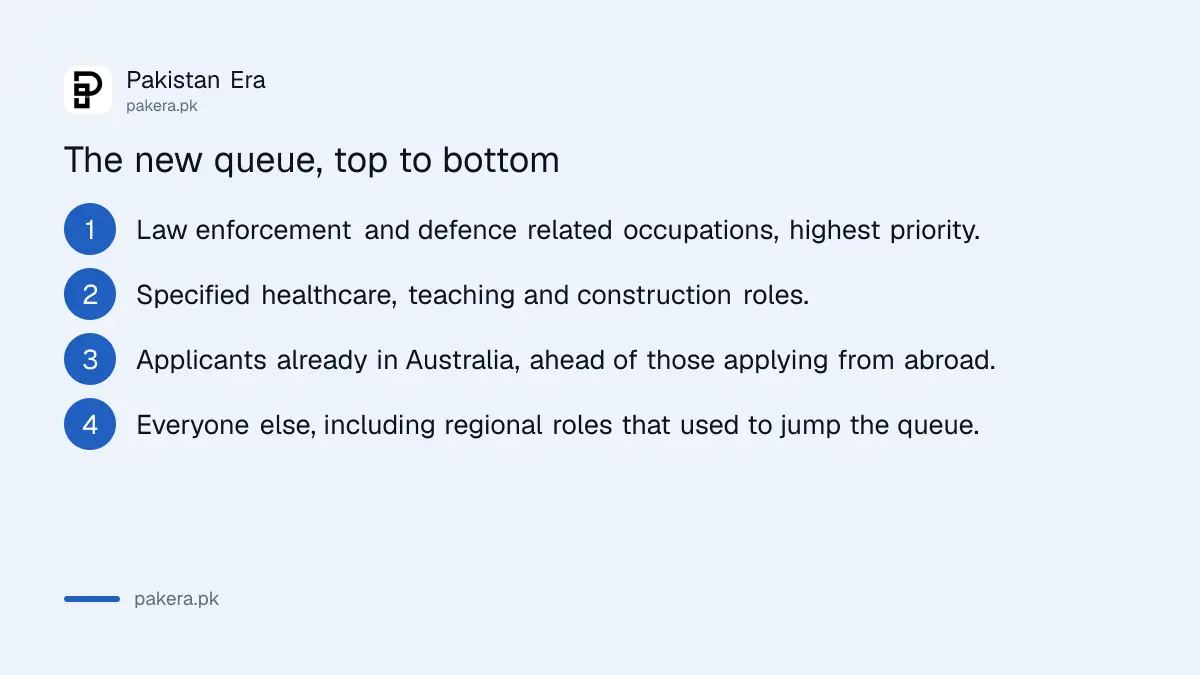
The new order
Applications lodged on or after 25 July 2026 fall under the new framework, and so do older applications that have not yet been decided. That second part matters: if your file has been sitting since last year, it is being reordered too.
- Law enforcement and defence related occupations now sit at the top, framed around national interest and Australia's AUKUS commitments with the UK and US.
- Specified healthcare, teaching and construction roles come next.
- Applicants already in Australia are processed ahead of those applying from overseas.
- Everyone else, which now includes regional applications that used to enjoy an advantage.
Two priorities were removed outright: the advantage previously given to regional positions, and the one given to applications from accredited sponsors. If your strategy was built on either, the strategy has changed underneath you.
Which visas this covers
| Subclass | Name |
|---|---|
| 186 | Employer Nomination Scheme |
| 482 | Skills in Demand |
| 189 | Skilled Independent |
| 190 | Skilled Nominated |
| 491 | Skilled Work Regional |
| 494 | Skilled Employer Sponsored Regional |
Family Migration and the National Innovation programme were also reweighted, in the same direction, toward people already in Australia.
What it means from Pakistan, without the softening
Almost everyone applying from Pakistan is, by definition, an offshore applicant. The framework now explicitly places offshore behind onshore. That is the single most consequential line in the change for this readership, and no amount of positive framing gets around it.
The exception is occupation. A Pakistani nurse, doctor, teacher or construction professional in a specified role sits in the second tier and may see movement that a general skilled applicant will not. The occupation you are assessed under now matters more than it did last month, and more than the state you nominated.
Reporting notes that applications previously moving in 12 to 15 months may now take longer, with regional 186 cases outside the prioritised sectors specifically flagged. If you are already in that queue, the realistic planning assumption is a longer wait, not a shorter one, and decisions like resigning a job or selling property should be made against the new expectation rather than the old timeline.
Check your own case at the source
Priority frameworks are dry documents that decide years of people's lives, and they are published. The Department of Home Affairs runs the official site at immi.homeaffairs.gov.au, which we opened before publishing this, along with its visa processing times page, where current estimates are given per subclass.
Read your own subclass there rather than relying on any summary, including ours. What we can tell you is what changed and what it means directionally; what your file does is a function of your subclass, your occupation and where you are sitting.
The consultant economy that follows every rule change
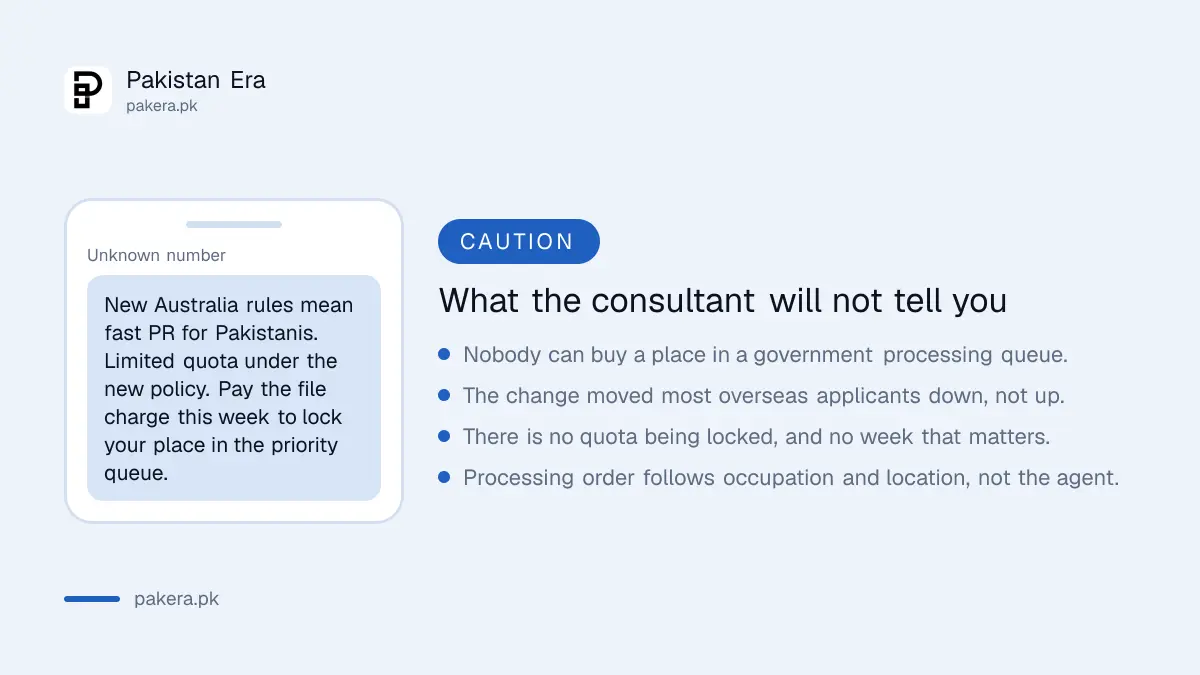
Within days of any announcement like this, the pitch arrives: new rules mean fast PR, limited quota, pay the file charge this week to secure your place in the priority queue.
Every part of that is false in a specific way worth knowing. Nobody buys a position in a government processing queue. There is no quota being opened by this change. And the change moved most overseas applicants down, so any consultant selling it as an opportunity for offshore applicants is either not reading the framework or counting on you not to.
Legitimate migration advice exists and is regulated: Australia registers migration agents, and the register is public. An adviser who cannot give you their registration number is not one. It is the same rule that runs through everything we write about scams, applied to a market where the sums are life savings rather than a few thousand rupees.
If Australia has become harder, the alternatives are real
A queue that has lengthened is a reason to widen the search rather than to wait passively. Our guides cover the German work visa route, the Portugal route and the UAE's labour visa rules, and the UK's funded study route is open right now through Chevening, which is a different door into the same ambition.
Whatever the destination, the paperwork underneath is the same and can be got ready now: a passport with real validity left, which tracks by one SMS, and the police character certificate that every skilled migration file eventually asks for and that just moved online.
Questions readers are asking
What changed in Australia's skilled visa processing?
A new priority framework, applying from 25 July 2026, puts law enforcement and defence occupations first, then specified healthcare, teaching and construction roles, and processes applicants already in Australia ahead of those overseas.
Does it affect applications I already lodged?
Yes. The framework applies to applications lodged on or after 25 July and to older applications that have not yet been finalised.
Which visa subclasses are covered?
186, 482, 189, 190, 491 and 494, with Family Migration and the National Innovation programme also reweighted toward onshore applicants.
Is this good or bad for Pakistani applicants?
For most, worse, because applicants from Pakistan are offshore and offshore now sits behind onshore. Those in prioritised occupations such as specified healthcare, teaching or construction roles are the exception.
Will processing take longer?
For applications outside the prioritised categories, yes. Cases previously moving in 12 to 15 months may extend, with regional 186 applications specifically flagged.
Can an agent get me into the priority queue?
No. Priority is set by occupation and location, not by who lodges the file. Any consultant selling queue position or a new quota after this change is misrepresenting it.
About the author

Public Services and Education Journalist
Fajr Riaz is a journalist and content writer at Pakistan Era, based in Lahore. She covers the questions people meet in everyday life in Pakistan: how a public service works, what a change in the rules means, and where to find a reliable answer.