Bait-ul-Mal Old Home in Pakistan: Who Is Eligible and How to Ask for a Place
Bait-ul-Mal runs an Old Home for shelterless elderly people in five cities. See who it is for, what it provides and how to ask for a place without a form.
Pakistan Bait-ul-Mal runs an Old Home project for shelterless, abandoned and invalid elderly people. It started in Islamabad, Lahore, Karachi, Peshawar and Quetta, with room for 50 residents at each. The website lists no application form for it.
That last point is the one families need to know first. Many search for an old age home admission form and find nothing. This page explains what Bait-ul-Mal says, what it does not, and where to turn while you ask.
The facts below come from them.
The PBM Old Home is for elderly people with nowhere to live
Bait-ul-Mal says the Old Home project follows its Act and aims to rehabilitate the invalid, shelterless and abandoned elderly. The target group is shelterless elderly citizens from across Pakistan, including AJK, Gilgit-Baltistan and FATA, who are invalid, abandoned or socially deprived.
This is not a retirement home that anyone can join by paying. It is welfare housing for people with no family support and no place to go. If an elderly parent has a home and relatives, this is not the scheme.
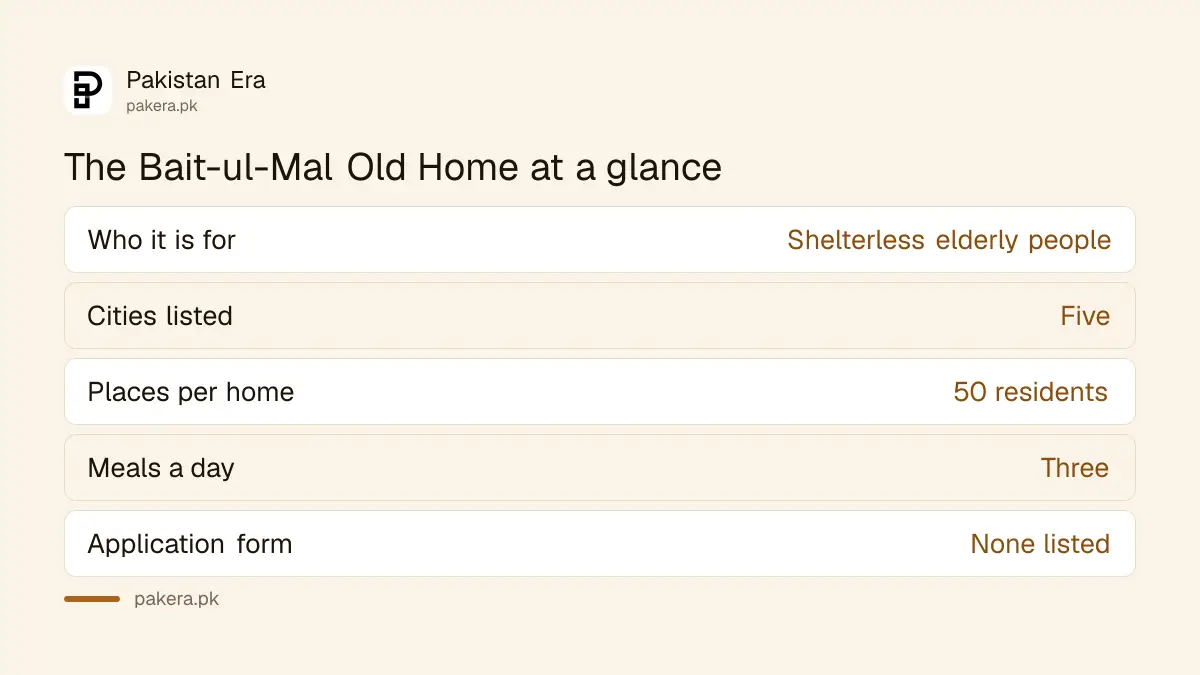
| Detail | What the site says |
|---|---|
| Who it is for | Invalid, abandoned or shelterless elderly |
| First locations | Islamabad, Lahore, Karachi, Peshawar, Quetta |
| Capacity | 50 residents per location |
| Meals | Three times a day, tailored to health needs |
| Fee | None stated |
The facilities are listed as free of charge in kind
The page lists furnished dormitory-style rooms with bedding, three meals a day, regular check-ups and access to medicine through government facilities, seasonal clothes, free laundry, a prayer room and recreation. No fee is mentioned anywhere on the page.
The stated aim is a family-like atmosphere for neglected senior citizens. That wording suggests a small residential home, not a hospital. If the person needs nursing care all day, ask what the home can manage before you move anyone.
The page says the project began in five cities and aims to expand nationwide. It does not say whether all five homes are open today. Check the current position before you travel.
No application form is listed, so ask the office first
The forms page has 13 rows. They cover disabled persons, thalassemia, orphans in Sweet Home, hepatitis C, surgery, artificial limbs, cancer, heart, hearing aids, general medicine, cost estimates and education. There is no row for the Old Home.
So the step-by-step is a request, not a form. Do this.
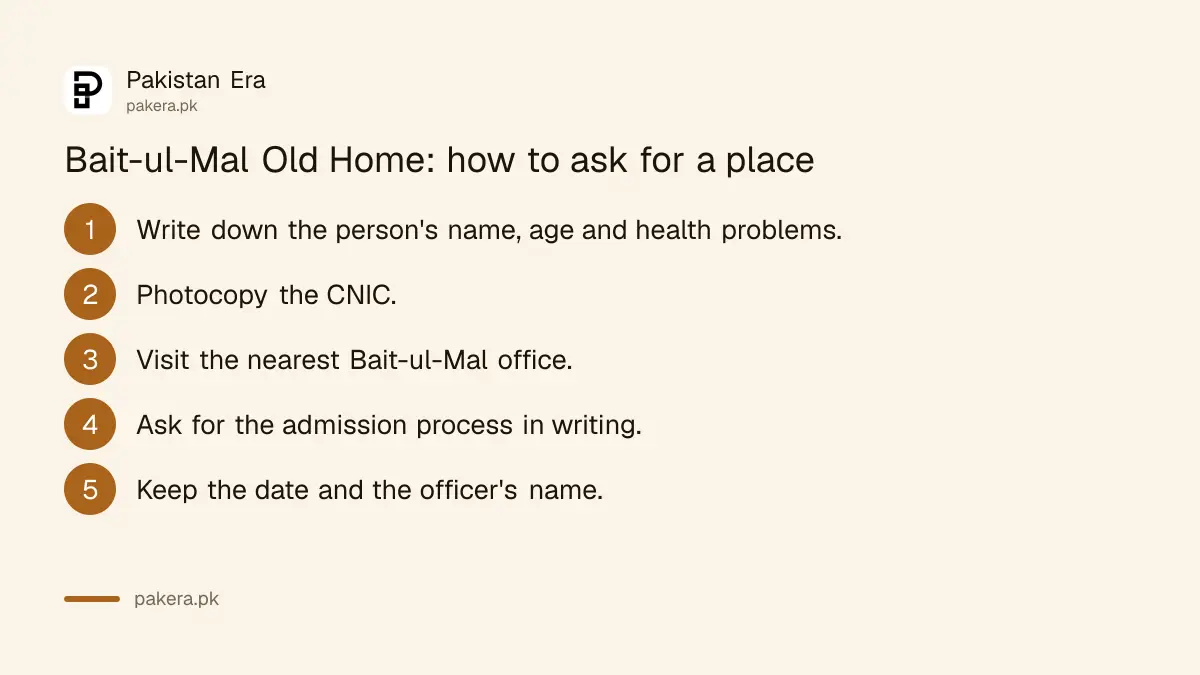
- Write down the person's name, age, CNIC number, health problems and why they have no family support.
- Photocopy the CNIC. If a CNIC is missing, see what to do about a lost CNIC first.
- Go to the nearest Pakistan Bait-ul-Mal office and ask for the Old Home admission process in writing.
- Ask which cities have an open home, how many places are free and whether a medical report is needed.
- Keep a receipt or the name of the officer you spoke to, with the date.
Use the contact details on the official site, and take the CNIC copy and your written note on the same visit.
Go early in the day, take the paper with you and carry a pen to note what the officer says. A short note that lists the person's name, age, CNIC number and health problems saves the officer time and lets you show exactly what you asked. If the office tells you the home is full or not yet open in your area, ask for that answer in writing too, with the date. That record helps if you need to take the matter to a higher office later.
Other help for older people who are not shelterless
Most families do not need a home. They need a card, a pension or a wheelchair. The routes differ by province, and the senior citizen card guide shows where each card exists and what it gives.
A retired government servant or a pensioner can also look at proof of life for pensions through NADRA, which affects whether monthly payments continue.
Bait-ul-Mal itself lists senior citizens aged 60 and over as eligible for a standard wheelchair, with a government doctor's recommendation. That is covered in our wheelchair and hearing aid guide.
Punjab keeps its own list of shelters and welfare homes. See the list of Punjab welfare homes and shelters. Women who need safe shelter can read about admission to a Dar-ul-Aman.
Common questions
Who can live in the PBM Old Home?
The site says invalid, shelterless or abandoned elderly citizens. It does not give an age limit.
How many people does each Old Home hold?
The site lists a capacity of 50 residents at each location.
Where are the Old Homes?
The page names Islamabad, Lahore, Karachi, Peshawar and Quetta as the first locations. It says the plan is to expand across the country.
Is there a form to apply?
None is listed on the forms page. Ask the Bait-ul-Mal office for the admission process.
Does it cost anything?
No fee is stated, so ask when you enquire.
Can I put my parent here if I live abroad?
The target group is those without family support. A parent with children able to care for them is unlikely to fit, though the site gives no test for this.
How we verified this
What we checked and where we read it.
Last checked 7 October 2026. We read the projects page and the forms page on pbm.gov.pk. The description, locations, capacity and facilities come from the PBM Old Home section. Confirm current admission rules with Pakistan Bait-ul-Mal.
About the author

Public Services and Education Journalist
Fajr Riaz is a journalist and content writer at Pakistan Era, based in Lahore. She covers the questions people meet in everyday life in Pakistan: how a public service works, what a change in the rules means, and where to find a reliable answer.