Bank SMS Charges: Senate Orders Them Cut
Alert charges went from 42 paisa to Rs 3.40 since 2021. The Senate has ordered banks to stop, and the numbers do not add up.
Check your bank statement for the line that says SMS charges. Most people never have. It is costing you somewhere between Rs 180 and Rs 325 a month to be told about money you already knew you spent.
Update, 11 October 2026: SBP rules give a 15 day free look when you cancel a bank subscription or alert.
The Senate Standing Committee on Finance has now ordered banks to stop what it called unnecessary SMS charges, and told banks, telecom operators and the State Bank to hand over their transaction data. Bank SMS charges in Pakistan have gone from 42 paisa per message in 2021 to as much as Rs 3.40 today, and nobody has explained why.
The stranger part is that the industry cannot agree on how much money this actually involves. Not roughly. At all.
How much are banks charging for SMS alerts?
Between 30 paisa and Rs 2.50 per message according to what the committee was told, with some customers reporting as much as Rs 3.40. Set against 42 paisa in 2021, that is a rise of several hundred percent on a service that has not changed.
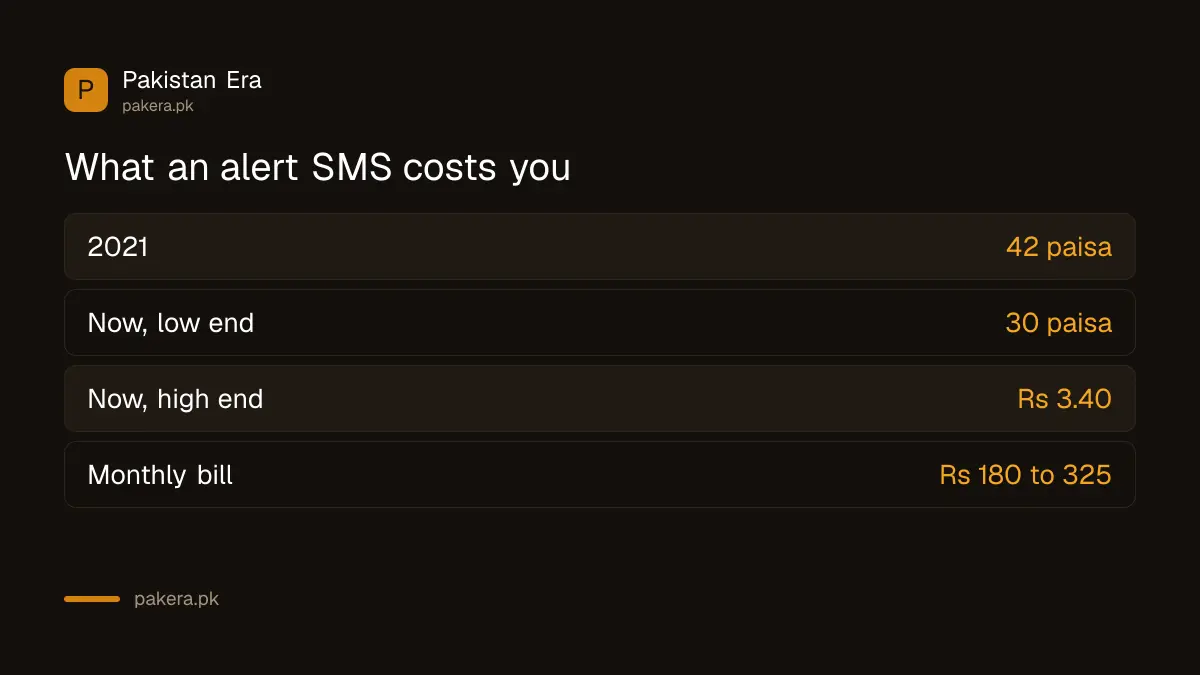
| When | Cost per SMS |
|---|---|
| 2021 | 42 paisa |
| Now, low end | 30 paisa |
| Now, high end | Rs 3.40 |
| What you pay monthly | Rs 180 to Rs 325 |
Testimony to the committee went further, with figures suggesting banks bill up to Rs 12 per message where telecom operators sell bulk SMS to aggregators for Rs 1 to Rs 2. If that gap is real, it is a markup of several hundred percent on a wholesale cost.
Why do the numbers not add up?
Because three different figures are circulating and they cannot all be true. The dispute between banks and telcos was put at Rs 26 billion. A senator told the committee the annual total was closer to Rs 200 billion. And banks say they collect Rs 18.7 billion while paying Rs 25.6 billion to telecom operators.
Read that last pair again. If banks collect Rs 18.7 billion and pay out Rs 25.6 billion, they are losing nearly Rs 7 billion a year running SMS alerts. That cannot sit alongside a claim that the same service earns Rs 200 billion.
| Figure | Amount | Source |
|---|---|---|
| Bank and telco dispute | Rs 26 billion | Committee proceedings |
| Annual total collected | Rs 200 billion | Senator Abdul Qadir |
| Collected from consumers | Rs 18.7 billion | Industry breakdown |
| Paid to telecom operators | Rs 25.6 billion | Industry breakdown |
We are not going to pick the biggest number and put it in a headline. What the contradiction tells you is more useful than any single figure: both sides are briefing numbers that suit them, which is exactly why the committee has demanded the underlying data.
Who is actually taking your money?
Both sides say the other one. Banks point at what telecom operators charge them for bulk messaging. Telecom operators point out they sell SMS in bulk for a fraction of what appears on your statement.
The committee, chaired by Saleem Mandviwalla, sat through exactly that argument and responded by ordering cost breakdowns from everyone including the State Bank. That is a reasonable reaction to being told two incompatible stories in one meeting.
What is not in dispute is the direction. Whoever is keeping the margin, you are paying several times what you paid in 2021 for an identical message.
What can you do about it right now?
More than you think, and none of it requires waiting for the Senate. Most banks let you switch alert channels, and app notifications cost nothing.
- Open your bank's app and look for notification or alert settings. Push notifications are usually free and arrive faster than SMS.
- Check whether you can set a minimum transaction value for alerts, so you stop paying to be told about a Rs 50 payment.
- Read your statement for the SMS charge line and work out your annual total. It is normally worse than people guess.
- Ask your branch directly whether the charge can be waived or reduced. On some account tiers it can.
- If you hold accounts at more than one bank, compare what each charges. The spread across banks is significant.
- Keep SMS alerts on if you do not use a smartphone, because the security value is real and worth the fee in that case.
That last point matters. Transaction alerts are how people catch fraud early, and turning them off entirely to save Rs 200 a month is a poor trade. Switching channel is the sensible move, not going dark.
Will charges actually come down?
Probably, eventually, and less than the headlines will suggest. A Senate committee can order a review and demand data, but the pricing lever sits with the State Bank as regulator, and that process moves slowly.
What tends to happen with charges like this is a cap rather than an abolition. A ceiling per message, or a free allowance before charging starts, is a more likely outcome than banks absorbing the cost entirely.
Worth watching alongside the broader shift in how Pakistanis pay. Our piece on digital payments and the jump in Raast merchant transactions covers where the volume is going, and using Raast is free at the point of transfer, which is a pointed contrast with paying Rs 3 to be told about it.
Frequently asked questions
How much do banks charge for SMS alerts in Pakistan?
Between 30 paisa and Rs 3.40 per message depending on the bank, which works out at roughly Rs 180 to Rs 325 a month for most customers.
Why have SMS charges gone up so much?
Nobody has explained it satisfactorily. Charges have risen from 42 paisa in 2021, and banks and telecom operators each blame the other for the increase.
How much money is involved overall?
Contested. Figures given range from a Rs 26 billion dispute to a claim of Rs 200 billion annually, while banks say they collect Rs 18.7 billion and pay telcos Rs 25.6 billion. Those do not reconcile.
Can I stop paying bank SMS charges?
Usually yes, by switching to free app push notifications in your banking app. Keep SMS if you do not use a smartphone, since the fraud alerts are worth the fee.
Has the Senate banned SMS charges?
No. The Standing Committee on Finance has ordered banks to end unnecessary charges and demanded cost data. A cap is more likely than abolition.
Do telecom operators or banks keep the money?
Each says the other. Telcos sell bulk SMS cheaply, banks bill customers far more, and the committee has asked both plus the State Bank to show their numbers.
About the author

Senior Writer, Public Services and Technology
Shahid joined us in 2024 as an author. He is a senior contributor to Pakistan's leading technology websites. He writes detailed articles, mostly covering his expertise in the latest tech, mobiles, apps, gadgets, and step-by-step guides. His ideology is to help people understand the latest trends and explain complex methods through very easy-to-understand guides.