BISE Rawalpindi Class 11 Registration Extended to 12 October 2026, Fee Rs 2,950
BISE Rawalpindi extended Class 11 registration to 12 October 2026 at Rs 2,950; a Rs 600 late fee runs to 27 October. See the fee parts and the fingerprint rule.
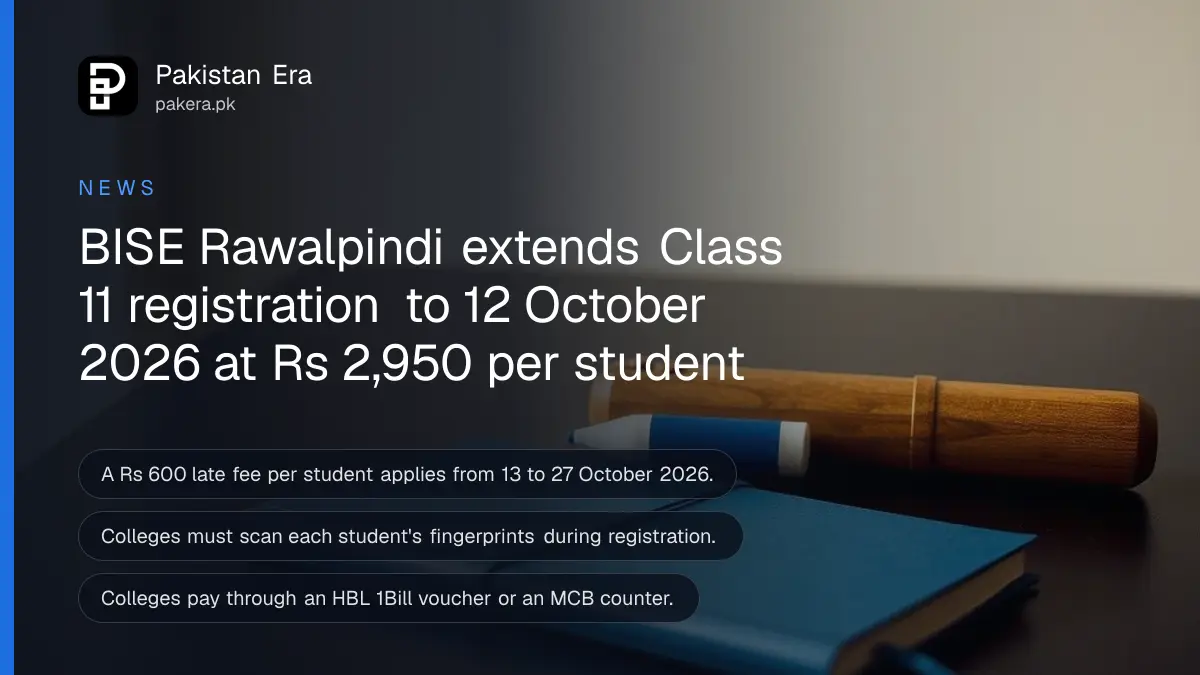
BISE Rawalpindi has extended Class 11 registration for the 2026 to 2028 session: the normal fee of Rs 2,950 per student now applies until Monday 12 October 2026. From 13 to 27 October, a Rs 600 late fee per student is added. The board issued the revised schedule, letter No. OIA/663/26, on Saturday 10 October 2026. It covers students in the first year of intermediate at government and private colleges affiliated with the Rawalpindi board.
We read the three page Urdu schedule on the Board of Intermediate and Secondary Education (BISE) Rawalpindi website on the evening of 10 October 2026. The notice is copied to education officers in Rawalpindi, Attock, Chakwal, Jhelum, Murree and Talagang. Its fee is higher than Lahore's, and it asks for a biometric fingerprint for every student, so the details matter.
BISE Rawalpindi's Class 11 registration now runs to 12 October without a late fee
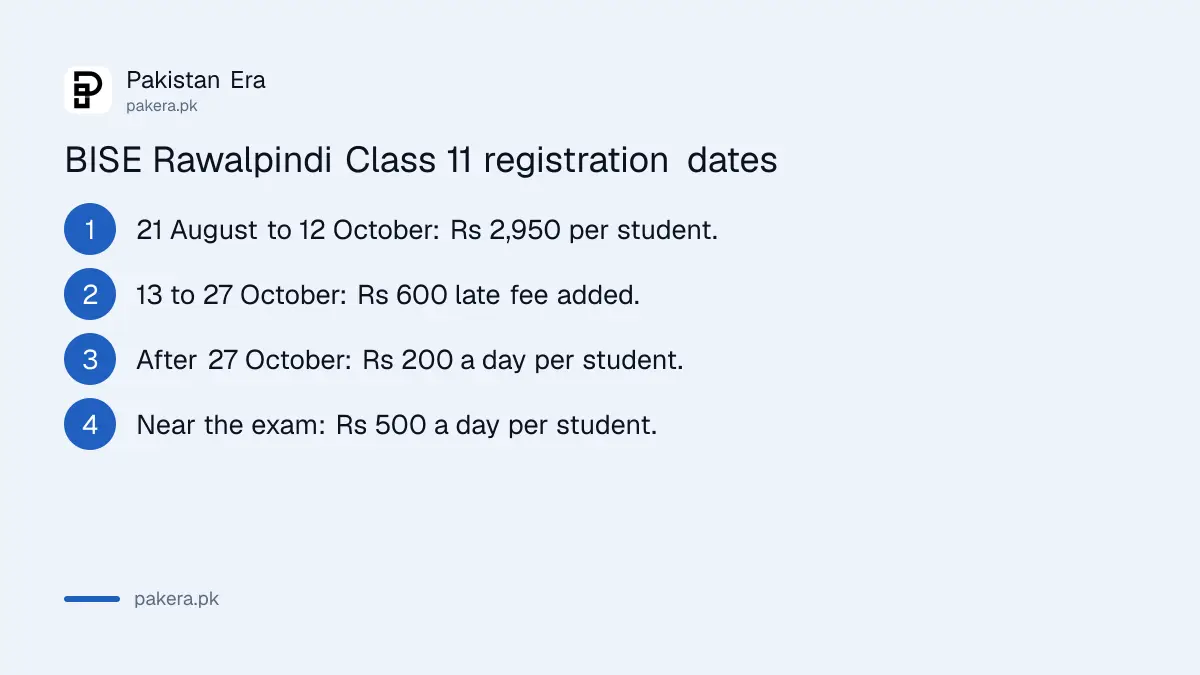
The normal fee window for Class 11 registration at BISE Rawalpindi runs from 21 August to 12 October 2026. A Rs 600 late fee per student applies from 13 to 27 October 2026. After that, daily fines start and keep rising.
The board says the change follows a letter from the chairman of the Punjab Boards Committee of Chairmen (PBCC), dated 9 October 2026. BISE Lahore extended its Class 11 registration to the same dates on the same day, so the move looks province wide.
| Stage | Dates | Cost |
|---|---|---|
| Normal fee | 21 August to 12 October 2026 | Rs 2,950 per student |
| Late fee | 13 to 27 October 2026 | Rs 2,950 plus Rs 600 per student |
| Return not submitted on time | After 27 October, to the triple fee last date for first year exam forms | Normal fee plus Rs 200 a day per student |
| Very late | Up to 3 days before the first year exam | Normal fee plus Rs 500 a day per student |
The Rs 2,950 fee has five parts
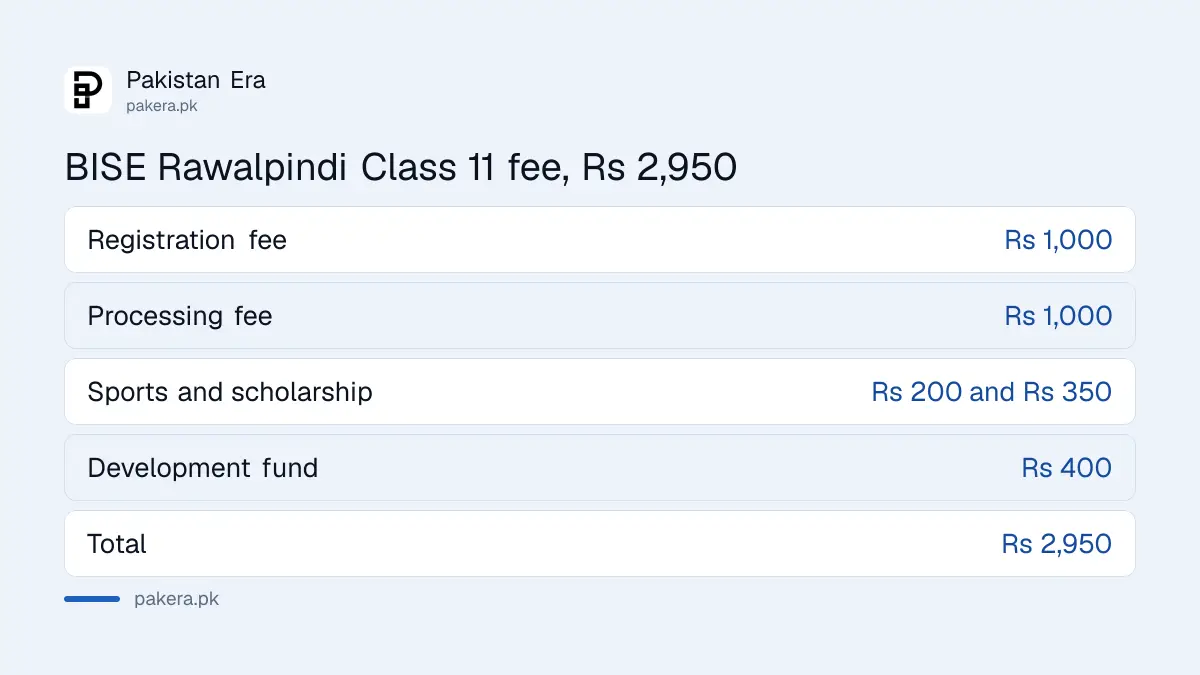
BISE Rawalpindi charges Rs 2,950 per student for Class 11 registration. That is a Rs 1,000 registration fee plus Rs 1,950 in other charges. Lahore charges Rs 2,300 for the same step, so Rawalpindi students pay Rs 650 more.
| Part | Amount |
|---|---|
| Registration fee | Rs 1,000 |
| Processing fee | Rs 1,000 |
| Sports fee | Rs 200 |
| Scholarship fee | Rs 350 |
| Development fund | Rs 400 |
| Total, without late fee | Rs 2,950 |
Colleges pay through an HBL 1Bill voucher, or at an MCB counter into the board's account. The notice says a manual challan will not be accepted. If you pay your college for registration, ask for a receipt that shows the amount.
Every student must give a fingerprint at the college
BISE Rawalpindi requires biometric attendance for Class 11 registration. Colleges must scan each student's fingerprints with a SecuGen HU20-A reader during online registration. The notice says this follows a PBCC decision of 18 February 2026.
That means you cannot be registered by a college clerk on your behalf while you sit at home. Go to the college when it asks. If you were absent on the day it took fingerprints, ask when it will scan again, because the 12 October date applies to the whole registration, fingerprints included.
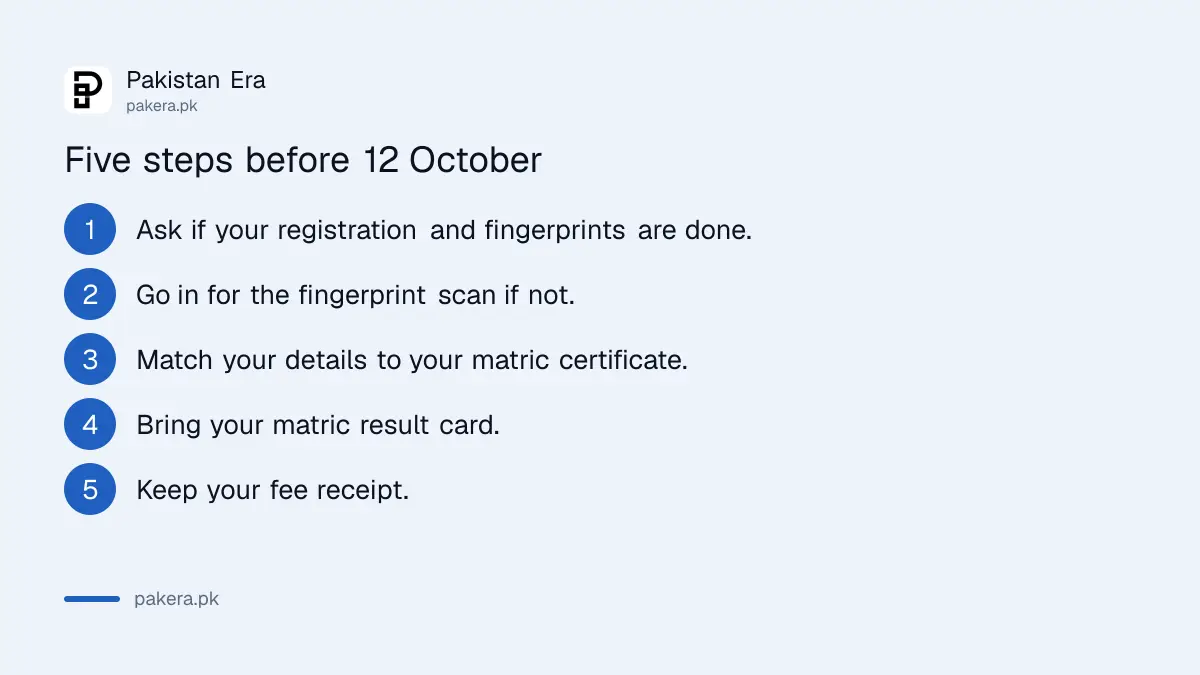
- Ask your college whether your registration and fingerprint scan are done.
- If not, go in before 12 October 2026 for the scan.
- Check your name, father's name and date of birth against your matric certificate.
- Bring your matric result card or certificate, which the notice requires.
- Keep a copy of your fee receipt.
Corrections, migration and other boards cost extra
A mistake on the registration return costs money to fix. BISE Rawalpindi charges Rs 1,270 to correct a detail and Rs 1,370 to fix a photo, through the head of the institution. A change of name or father's name after the exam starts costs Rs 4,000, and a date of birth change costs Rs 5,500.
Students who passed matric from another board need an original NOC, or migration certificate, from that board. They must be registered within 45 days of the NOC, with a Rs 2,950 fee, or pay Rs 500 a day after that. O level students need an IBCC equivalence certificate. If you passed O levels this year, the IBCC equivalence certificate for O and A levels is the paper your college will ask for.
Moving to another college after registration costs Rs 3,000, with a 45 day wait for the NOC. The notice also says students who passed matric in the Arts group cannot join pre-medical or pre-engineering, under a board decision of 26 September 2020.
Students in Islamabad colleges usually sit the Federal Board instead, which has its own FBISE Class 11 registration deadline of 30 October.
Common questions
What is the last date for BISE Rawalpindi Class 11 registration without a late fee?
Monday 12 October 2026, under the board's revised schedule dated 10 October 2026.
What is the BISE Rawalpindi Class 11 registration fee?
Rs 2,950 per student until 12 October. From 13 to 27 October, a Rs 600 late fee is added.
Do I need to give my fingerprints for Class 11 registration in Rawalpindi?
Yes. The college must scan your fingerprints with a SecuGen HU20-A reader during online registration.
Can I register myself online?
No. Your college registers you through the board's institution portal and submits the papers to the board.
How do I pay the BISE Rawalpindi registration fee?
The college pays through an HBL 1Bill voucher or at an MCB counter. Manual challans are not accepted.
How we verified this
What we checked, where we read it, and what we could not confirm.
Last checked on 10 October 2026 at about 20:15 PKT. We read BISE Rawalpindi's "Revised HSSC Registration Schedule for the Session 2026-2028", letter No. OIA/663/26 dated 10 October 2026, linked from biserawalpindi.edu.pk. It cites the PBCC letter dated 9 October 2026, which we did not read. We did not use the institution portal.
About the author

Public Services and Education Journalist
Fajr Riaz is a journalist and content writer at Pakistan Era, based in Lahore. She covers the questions people meet in everyday life in Pakistan: how a public service works, what a change in the rules means, and where to find a reliable answer.