How to Buy a SIM Safely in Pakistan: What PTA Says Sellers Must Do, From Biometrics to a 100 Metre Limit
PTA's report says SIM sellers need three-factor login every three hours and devices locked to 100 metres of the shop. See how to buy a SIM safely today.
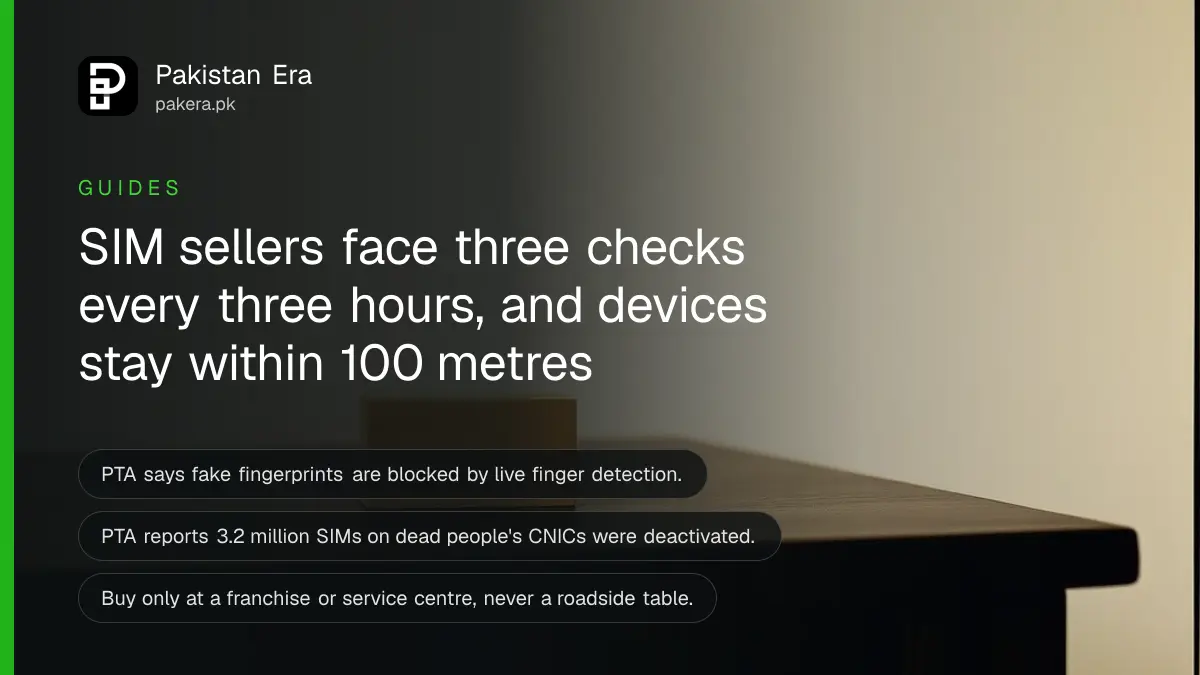
Short answer: Buy a SIM only at an operator franchise or service centre, and expect a live fingerprint scan. PTA's Annual Report 2025 says sellers must now pass three-factor login every three hours, and biometric devices are locked to within 100 metres of the approved shop. A seller who offers a "pre-verified" SIM breaks these rules.
Imagine a man outside a bus stand who offers you a SIM and says no fingerprint is needed. It sounds easy. It is also how SIMs end up on other people's CNICs and then in scam calls.
We read the SIM security part of PTA's Annual Report 2025 on 14 October 2026. It lists the controls PTA put on SIM sellers in FY 2024-25. We did not buy a SIM to test them, so what follows is what PTA reports, not what every shop does.
Sellers now face three checks every three hours
PTA says it made three-factor authentication mandatory for SIM sellers. A seller must log in with a password, enter an OTP and pass a biometric check, and repeat it every three hours. This is meant to stop one login being shared around.
That tells you what a proper shop looks like. The seller works through a verification device, not a paper form alone. If a seller says he can "activate it later" without your fingerprint, he is outside this system.
Biometric devices are tied to the shop
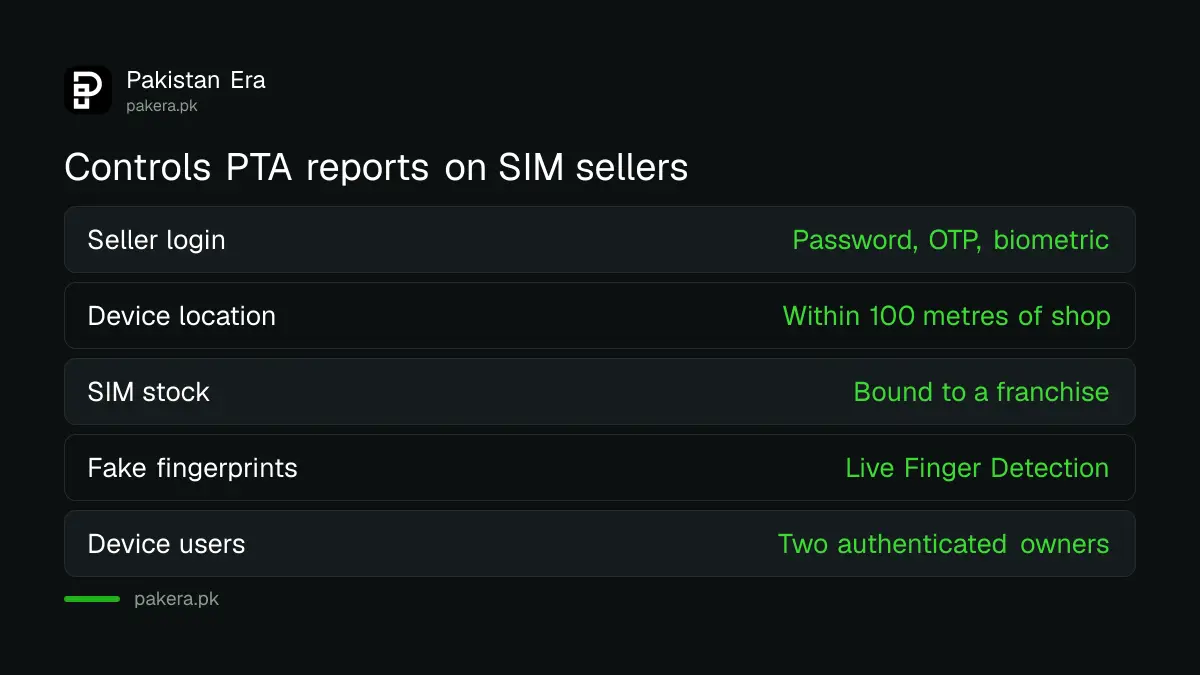
PTA reports that biometric verification devices are geo-fenced within a 100-metre radius of approved sale locations. They cannot be carried around freely. Stock is also bound to each franchise, and each device can be used by only two authenticated owners.
| Control | What PTA reports |
|---|---|
| Seller login | Password, OTP and biometric, every three hours |
| Device location | Locked within 100 metres of the approved shop |
| SIM stock | Bound to a franchise |
| Fake fingerprints | Live Finger Detection on all operator devices |
| Device users | Only two authenticated owners |

For a buyer, the 100-metre rule means a street seller with a device is out of line. The same report says Live Finger Detection was improved on operator devices, to stop the use of fake fingerprints.
PTA also reports raids and clean-ups
From July 2024 to June 2025, PTA says it ran 44 raids in 24 cities on local SIM fraud, with 71 arrests. It also reports 32 raids on illegal international SIM sales, 46 arrests and the blocking of 83 websites selling SIMs without authority.
The clean-up of old records is large. PTA reports that more than 3.2 million SIMs issued on dead people's CNICs were deactivated, and 783,000 on expired CNICs were removed. About 69,000 on cancelled or impounded CNICs were disabled, and 891,000 dormant SIMs were recycled or blocked.
Your own SIM can be caught in this. Read why a SIM is blocked over a cancelled CNIC and what notice you get. If a SIM sits unused, see the 180-day suspension rule.
Those numbers show the scale of the problem. They also show that PTA treats a SIM on someone else's CNIC as a fraud risk, not a paperwork slip. If a shop pressures you to hurry, or asks for a second CNIC copy, walk away.
How to buy a SIM safely
Go to an operator franchise or service centre, carry your original CNIC, and let the seller scan your fingerprint on the device in front of you. Keep the receipt or SMS. Then check how many SIMs sit on your CNIC.
- Choose a franchise or service centre, not a roadside table.
- Bring your original CNIC. Do not leave photocopies behind.
- Give your fingerprint once, on the device, while you watch.
- Never give your OTP to anyone but the number you are registering.
- Check your CNIC the same day for extra SIMs.
The tool for the last step is in how to check SIMs on your CNIC and block any you did not buy. If your fingerprint will not match at the shop, there is a PTA route, shown in buying a SIM when your fingerprint does not match.
Shop hours are also controlled. PTA's rule on SIM sales banned from midnight to 6 am means a late-night sale is a red flag.
PTA also says BISP beneficiaries, about 9.3 million of them, can get SIMs only at authorised Customer Service Centers and registered franchises. This was done to stop fake activations. See the BISP digital wallet and Benazir SIM.
Common questions
Do I need to give a fingerprint to buy a SIM?
Yes. PTA's report describes biometric verification devices with live finger detection for operator sales.
Can a seller activate a SIM without me?
PTA's controls are built to stop that. A seller who offers a "pre-verified" SIM is working outside the system.
What is three-factor authentication for sellers?
It means password, OTP and biometric login, repeated every three hours, according to PTA's report.
Why are devices geo-fenced to 100 metres?
PTA says it keeps sales at registered points only. A device taken elsewhere should stop working.
How do I know if a SIM was issued on my CNIC?
Check the number of SIMs registered to your CNIC and block any you did not buy.
How we verified this
What we checked, where we read it, and what we could not confirm.
Last checked on 14 October 2026, Pakistan time. We read the SIM security part of PTA's Annual Report 2025, which covers FY 2024-25. We did not watch a SIM sale, and shops may not all follow the rules. The report is from November 2025, so newer rules may exist.
About the author

Tax, Bills and Technology Writer
Ali Akhtar is a young and curious voice here at Pakistan Era. He is currently pursuing his A-Levels and has a growing interest in Pakistan’s changing industrial landscape and educational trends. Ali likes to write in a way that helps him explain and explore the world around him. His writing reflects the perspective of the new generation navigating the evolving trends of Pakistan where technology, youth innovation, and shifting opportunities are reshaping the country’s future.