Can Electricity Company Staff Enter Your House in Pakistan? The 24 Hour Notice Rule
Electricity staff in Pakistan need clear 24 hours notice before entering your home, except in a theft raid. See what NEPRA allows them and what you can ask.
Electricity company staff can enter your home in Pakistan to inspect or test the meter and wiring, but they must give you clear 24 hours' notice first. The only exception is a theft raid, which needs no notice. These rules are in clause 14.1 of NEPRA's Consumer Service Manual.
A knock from a line staff member with a clipboard is rarely welcome. Many people do not know if they must open the gate. Others open it for anyone in a company jacket.
We read chapters 4, 9 and 14 of NEPRA's revised Consumer Service Manual on 7 October 2026. This is what the staff may do, what you must allow and what you can ask for.
Staff may enter at reasonable times after a 24 hour notice
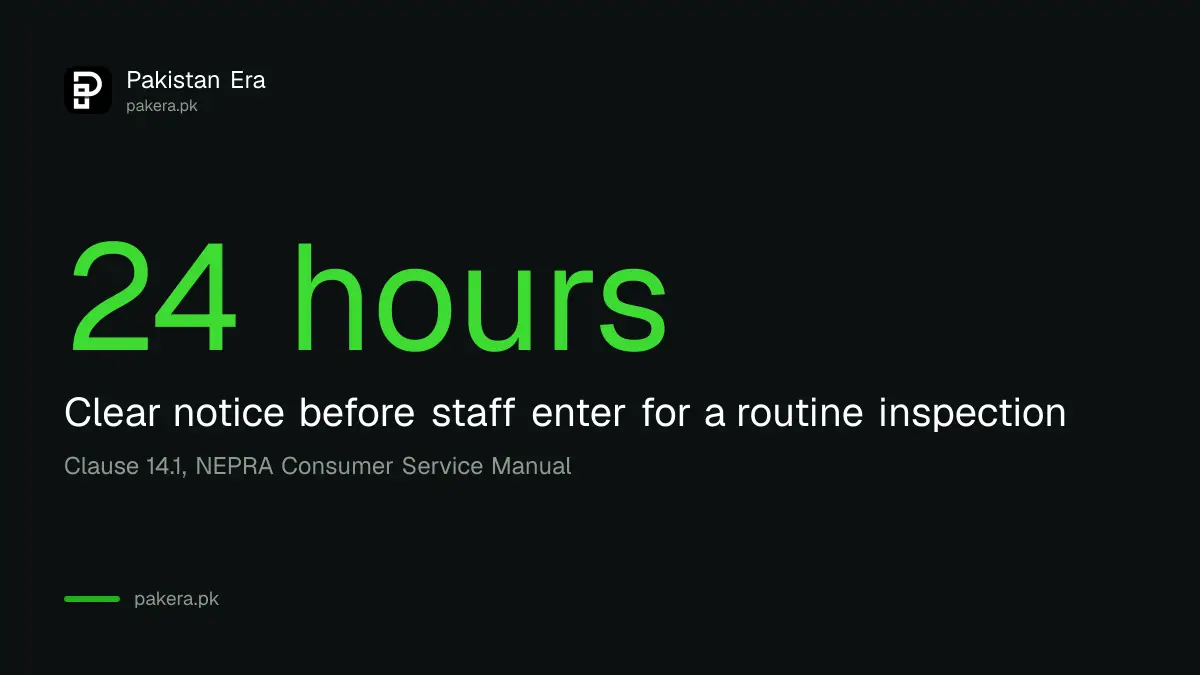
Clause 14.1 says a duly authorised employee may enter premises that get supply from the company. The visit must be at a reasonable time. The company must tell the occupier of its intention and give clear 24 hours' notice.
"Clear" means a full day, not a call from the gate. The manual does not say the notice must be written. Ask for it in writing or by text anyway. A dated message is the only way to show later that no notice was given.
The same rule covers K-Electric, since the manual applies to every distribution company in the country.
The visit must have one of four purposes
Entry is not open ended. Clause 14.1 lists what the staff may do inside:
| Purpose | Clause |
|---|---|
| Examine, inspect and test supply lines, meters, wires, fittings or apparatus, whether the company's or yours | 14.1.1 |
| Find out how much energy was supplied or used | 14.1.2 |
| Remove the company's lines, meters or equipment when supply is no longer needed or the company may cut it off | 14.1.3 |
| Other things needed to supply or maintain the supply | 14.1.4 |
Ask which of these the visit is for. A routine check of the meter and the wiring after a complaint fits 14.1.1. A visit to take the meter away fits 14.1.3 and should follow a disconnection or a request from you.
A theft raid needs no notice
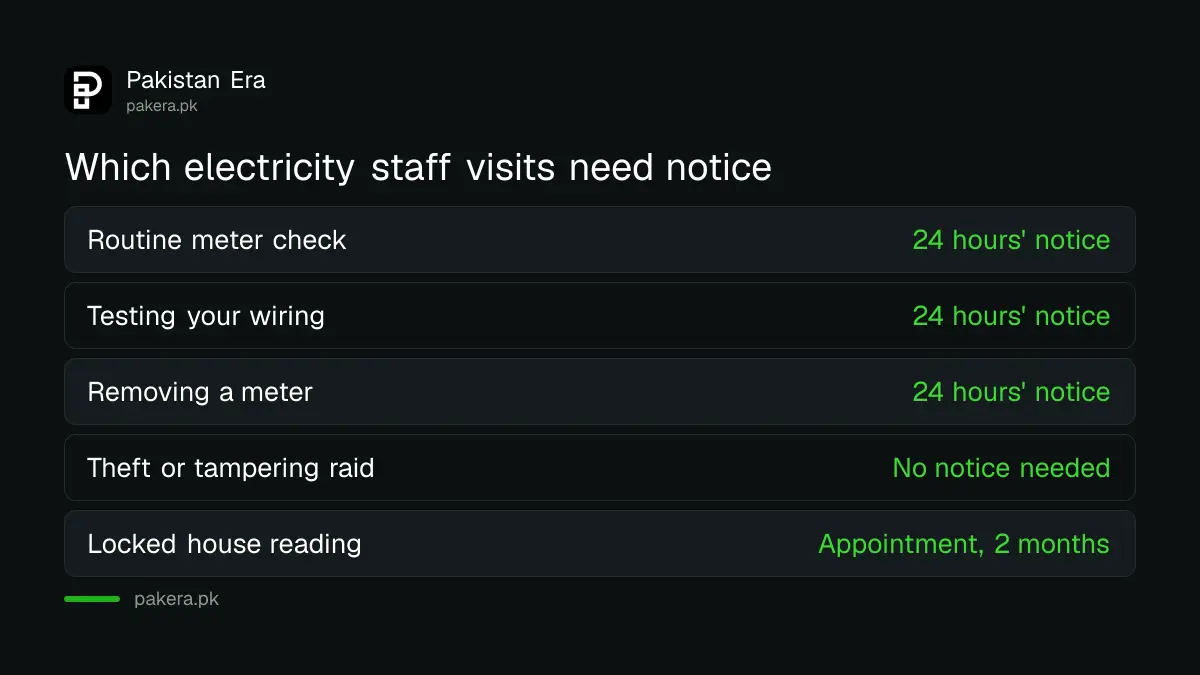
Clause 14.1 makes one exception. No notice is needed for a raid in a case of theft or illegal abstraction of electricity. You cannot insist on 24 hours when the company says it suspects a bypass.
Even then the manual sets steps. Under clause 9.2.2, when the company suspects tampering it must first secure the metering installation without removing it, in the presence of the consumer or a representative. It may take photos or video as proof. Only after it confirms the abstraction does the sub divisional officer serve a notice with the allegations and give you seven days to reply.
Do not block the staff during a raid. Note the names, the time and who was present, then answer the notice in writing. The steps to dispute a detection bill start from that reply. If the visit was for a neighbour's suspected theft, the process to report electricity theft explains how such cases begin.
If staff arrive at your door, do this
- Ask who they are and why they came. The manual says "duly authorised", so a company card or a written order is fair to ask for. That request is our advice, not a manual line.
- Ask if you were given notice. For a routine visit, no notice means you can ask them to return after 24 hours.
- Ask which purpose applies. The four purposes above are the list.
- Stay present. In a suspected tampering case the meter must be secured in front of you or your representative.
- Get a copy of anything they sign or serve, and write down names and the time.
You must give access to the meter and your wiring
The manual puts duties on you too. Clause 14.2 says the company's authorised staff must have access to its meters and service connections inside your premises. Your own utility system must be open to inspection, and failure to allow this within a reasonable time can lead to disconnection.
There is a safeguard. Under clause 14.10 the company may disconnect for non compliance only after seven business days' written notice, in addition to any earlier notice. Keep that notice. It is the paper that shows the company followed its own procedure.
Clauses 14.3.2 and 14.4 add that you pay for damage to the company's meter or equipment caused by your appliances, negligence or intent. Ordinary wear is not on you. The rules for a faulty meter show who pays in each case.
A locked or empty house has special rules
Clause 14.2.3 says you must give access to meters for billing on request. If the house is unoccupied or locked, an appointment for the meter reading is enough for up to two months. After that, a new appointment is needed.
Most meters should not need entry at all. Clause 4.2.1 says the meter is to be fixed at a convenient place outside the premises, and you must provide a safe and accessible spot. Clause 4.2 also says it should be at a height where the reading can be taken without climbing. Each reading also carries a time stamped photo, which you can check against your bill.
If a staff member says a reading needs entry because the meter is inside, you can ask the sub division to shift it outside. The charges for shifting a meter in clause 4.2.8 are Rs 500 for single phase and Rs 1,000 for three phase, plus any extra material.
Complain if the visit broke the rules
Take the dated notice or your note of the visit to the sub division office and ask for a receipt. If that does not work, the route to NEPRA is the same one used for a wrong bill. In Karachi, start with the K-Electric complaint steps through 118. The reply times for each type of complaint are in the NEPRA service deadlines.
Common questions
Can electricity staff enter my house without notice?
Not for a routine check. They must give clear 24 hours' notice, except in a theft or illegal abstraction raid.
Can I refuse to let the electricity company's staff in?
You can ask for notice and the purpose. But clause 14.2 says failing to open your system to inspection within a reasonable time can lead to disconnection, after seven business days' written notice.
What if my house is locked while I am abroad?
An appointment for meter reading is enough for up to two months. After that, a new appointment is needed (clause 14.2.3).
Can they take my meter during a visit?
Only for the purposes in clause 14.1. In suspected tampering, the meter is first secured in your presence, and it is replaced after you pay a detection bill (clause 9.2.3).
Do they need a police officer or a court order?
The manual does not require either for an inspection visit. For a theft case, the company reports the offence to the police in writing (clause 9.2.4).
Can staff read my meter without entering?
Yes, in most homes. Clause 4.2.1 places the meter outside the premises, and readers photograph it from there.
How we verified this
What we checked, where we read it, and what we could not confirm.
Last checked on 7 October 2026. We read NEPRA's revised Consumer Service Manual, issued to all distribution companies on 26 November 2025, as published on GEPCO's website: clauses 4.2, 9.1, 9.2, 14.1 to 14.4 and 14.10. The manual does not say whether the 24 hour notice must be in writing, or what proof of authority staff must show, so those points are our advice and marked as such. We did not request or receive a visit ourselves. Companies differ in practice, and nothing here is legal advice.
About the author

Tax, Bills and Technology Writer
Ali Akhtar is a young and curious voice here at Pakistan Era. He is currently pursuing his A-Levels and has a growing interest in Pakistan’s changing industrial landscape and educational trends. Ali likes to write in a way that helps him explain and explore the world around him. His writing reflects the perspective of the new generation navigating the evolving trends of Pakistan where technology, youth innovation, and shifting opportunities are reshaping the country’s future.