Check Apna Khet, Apna Rozgar Eligibility in Punjab: State Land for the Landless
Check Apna Khet Apna Rozgar eligibility in Punjab: landless or a plot up to 10 marla, same revenue estate, no government job, one plot per family. Read on.
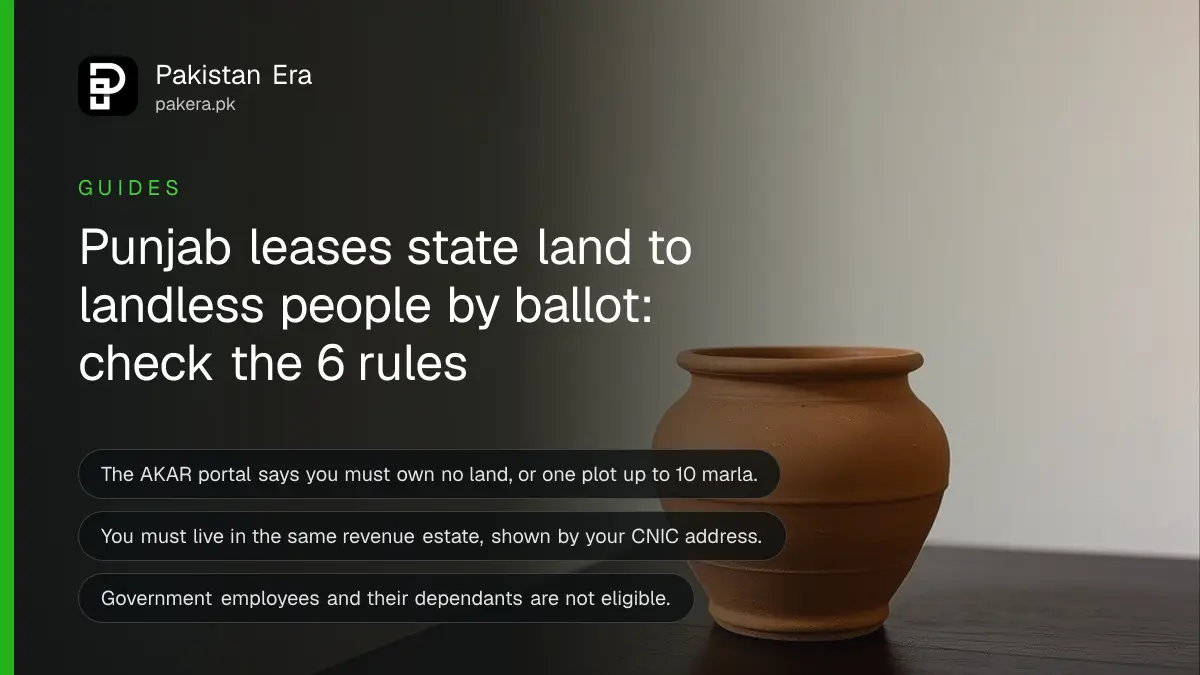
Short answer: Apna Khet, Apna Rozgar (AKAR) leases Punjab state land to landless people by a computerised ballot. On the portal we read, you qualify if you own no land or at most one residential plot up to 10 marla, live permanently in that revenue estate, and neither you nor your dependants work for the government. Applications were listed as "starting soon".
Thousands of rural families in Punjab work other people's fields and own nothing but a house. For them, a plot of state land to farm would change everything. AKAR is the Punjab government's scheme for that, and it runs by lottery, not by connections.
We read the AKAR portal, run by Punjab's state land management system, on 14 October 2026. The portal page is in Urdu. The points below are our plain-English reading of it. Rules can change, so treat this as a checklist and not a promise of a plot.
AKAR leases state land by computerised ballot
The portal describes AKAR as leasing government land for farming to landless people through a transparent, merit-based, computerised ballot. It does not say the land is a gift. It says the land is leased, and a ballot decides who gets each plot.
The portal also announces a Phase 2. After the first phase finished, Phase 2 allots the remaining plots that were not balloted, using the same fixed, transparent, merit-based method. The page said application intake would start soon, and told readers to keep visiting the portal for updates.
Reports differ on what AKAR offers. A Punjab government news item of 13 May 2026 describes interest-free loans and technical help for landless rural residents. The AKAR portal itself speaks only of land leases by ballot. Use the portal as your guide, and ask the focal person about any loan.
Six rules decide who is eligible
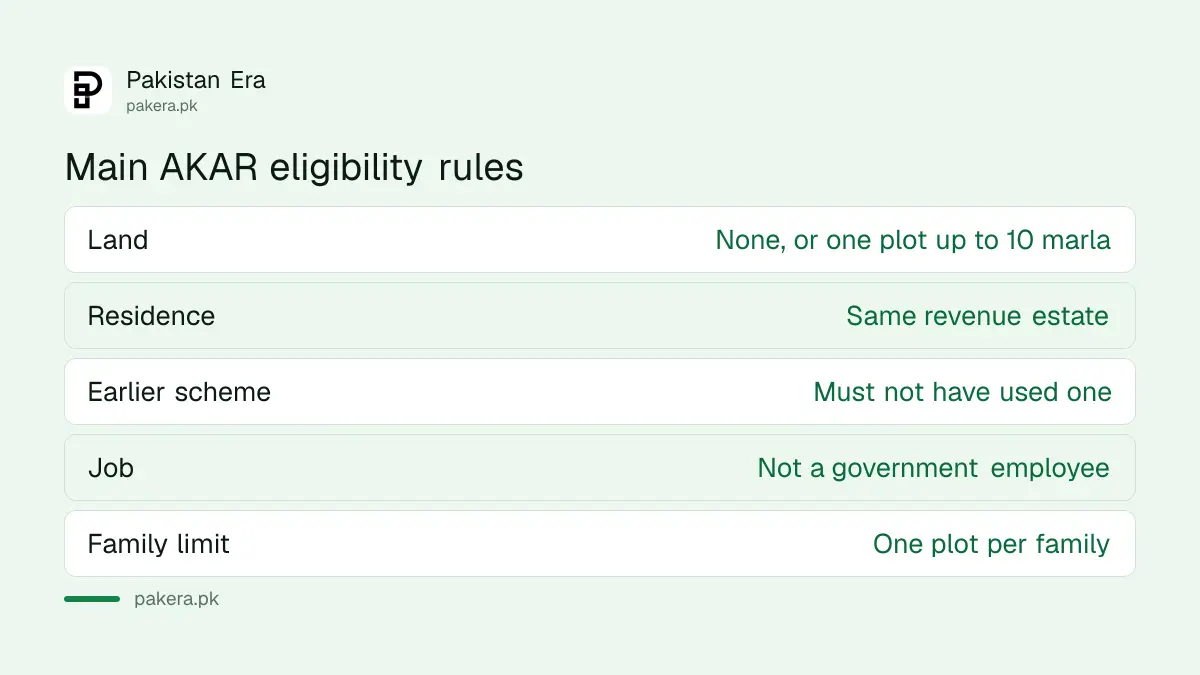
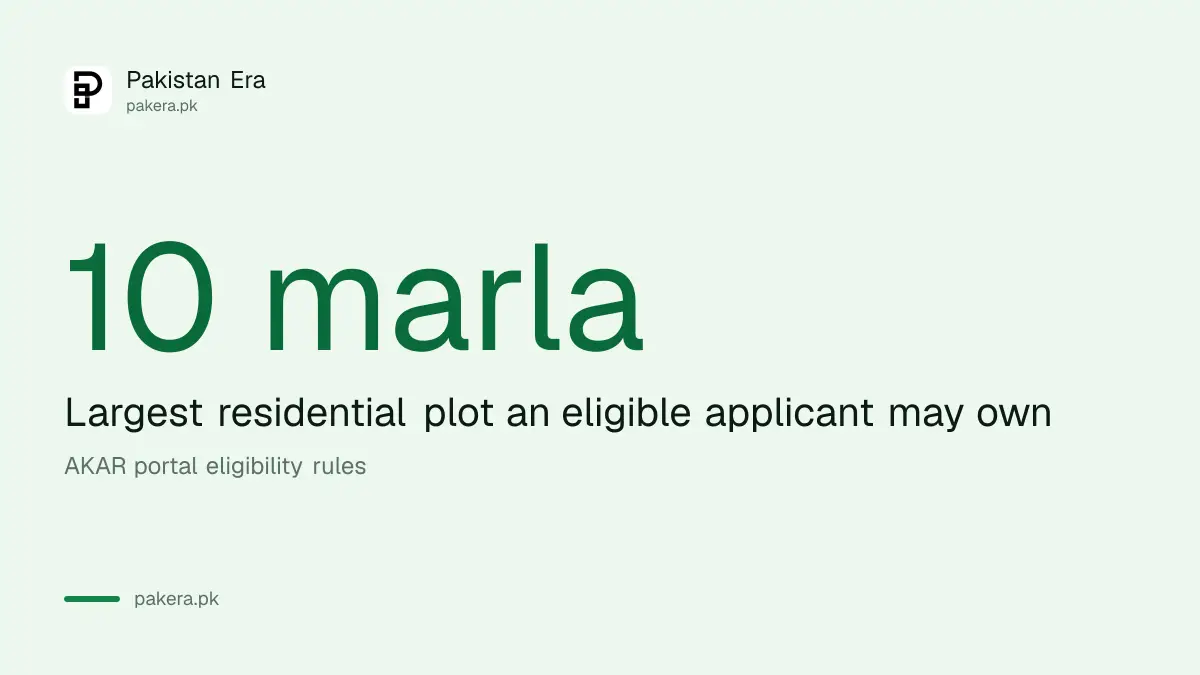
The portal lists six conditions set by the Revenue Department. You must be landless, or own one residential plot of at most 10 marla. You must live in the same revenue estate, and you must not have taken part in an earlier government land scheme.
| Rule | What the portal says |
|---|---|
| Landless | No land, or one residential plot of at most 10 marla |
| Same revenue estate | A genuine permanent resident of the estate where the land lies |
| No earlier scheme | Anyone who benefited from a government allotment or lease scheme is not eligible |
| Not a government employee | Employees of provincial or federal government, autonomous bodies and corporations, and their dependants, are not eligible |
| One family, one plot | Family means husband, wife or wives, and unmarried children; a married adult son living apart is not counted |
| Nearby estate | If no such person lives there, a resident of an adjoining revenue estate can apply |
The portal explains that permanent residence is decided by the permanent address printed on your CNIC. That is why an out-of-date address on the card can cost you. If yours is wrong, see how to change your CNIC permanent address from home on the Pak ID app.
You may change your village once
The portal says an applicant may change their mauza (revenue village) one time. You do this in your profile: choose the estate, then press Save. If you have already submitted an application, you must withdraw it first, then change the village.
The portal gives no fee in the text we read, and does not state the size of each plot or the lease term. We could not confirm either, so do not pay anyone who claims to know them. Any middleman who asks for money for a ballot place should be reported.
The portal also offers a help desk. You choose your district and tehsil to find the AKAR focal person for local help, and a list of programme partners. For other Punjab help, you can check your household in PSER, which many Punjab schemes use.
Follow these steps to prepare
You cannot apply until the portal opens, but you can get ready now. Check your CNIC address, gather proof you live in the village, and find your focal person. This takes an afternoon, and it saves you from missing the short intake window.
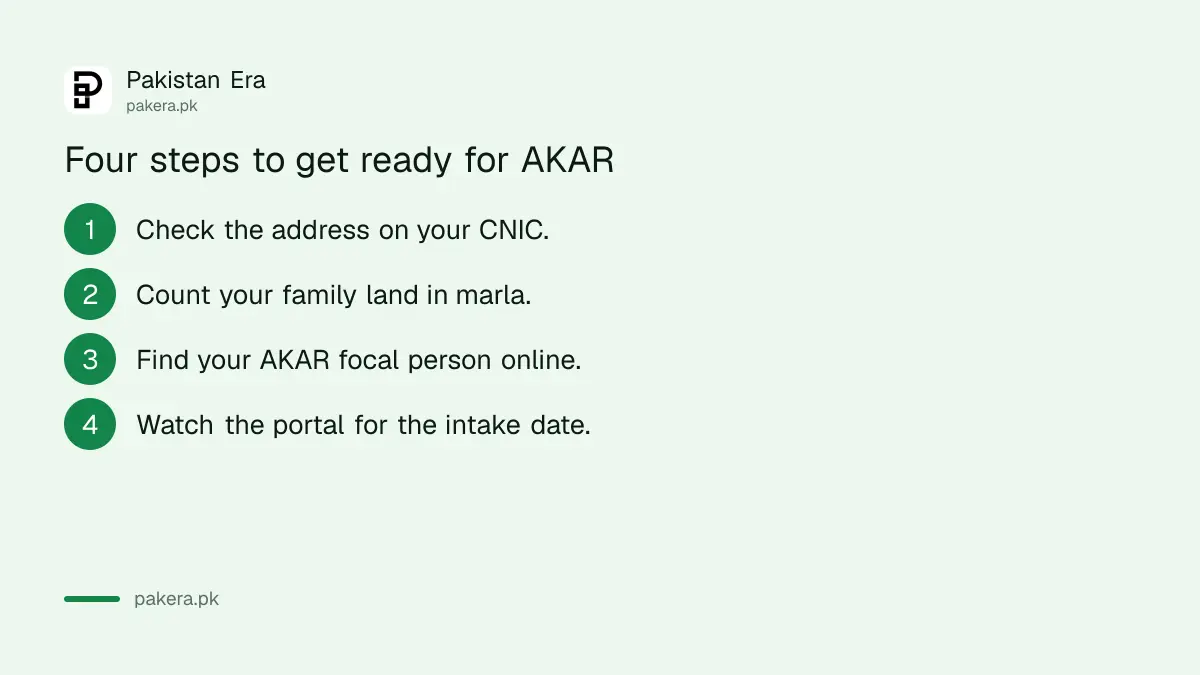
- Check that the permanent address on your CNIC names the right village and tehsil.
- Count what land your family owns, including any residential plot, and its size in marla.
- Confirm that no household member works for the government or has used an earlier land scheme.
- Look up your AKAR focal person on the portal by district and tehsil.
- Visit the portal again to see if applications have opened, and apply only there.
While you wait, read about other farm help in the Punjab Kissan Card and Apni Zameen Apna Ghar, which is a different scheme for housing plots.
Common questions
Is the land free?
The portal says the land is leased by ballot. It does not say it is free or sold. The lease terms were not on the page we read.
Can a government employee's family apply?
No. The portal says employees of provincial or federal government, autonomous bodies and corporations, and their dependants, are not eligible.
Can two members of one family get a plot?
No. The rule is one family, one plot. A married adult son who lives separately is not counted as part of the family.
Can I apply from a nearby village?
Only if no one fitting the main rules lives in the estate. The portal then allows a resident of an adjoining revenue estate.
Are applications open now?
The portal we read said intake would begin soon. Check the portal again, because we cannot see a deadline.
How we verified this
What we checked, where we read it, and what we could not confirm.
Last checked on 14 October 2026, Pakistan time. We read the AKAR state land management portal and the Punjab Portal news item. We did not find plot sizes, lease length, fees or the application dates, so none are stated here.
About the author

Public Services and Education Journalist
Fajr Riaz is a journalist and content writer at Pakistan Era, based in Lahore. She covers the questions people meet in everyday life in Pakistan: how a public service works, what a change in the rules means, and where to find a reliable answer.