Check Co-trimoxazole Shock Warning in Pakistan: What DRAP Alert 64 Says
DRAP Safety Alert 64 warns the antibiotic sulfamethoxazole with trimethoprim can cause circulatory shock. See the signs, who is at risk and when to seek care.
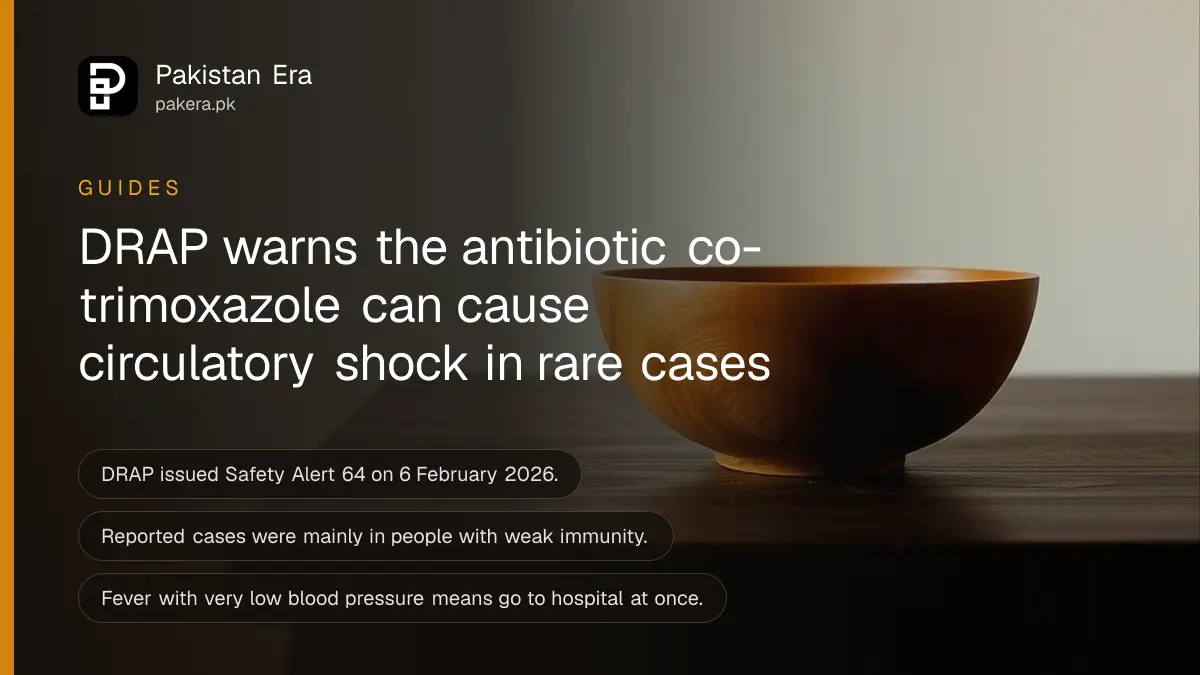
Short answer: DRAP's Safety Alert No. 64 of 6 February 2026 warns that the antibiotic combination sulfamethoxazole and trimethoprim, also called co-trimoxazole, can cause circulatory shock. If you have fever, very low blood pressure or a racing heartbeat after taking it, go to a doctor or hospital immediately. Do not wait for the next dose.
Co-trimoxazole is one of the older, cheaper antibiotics. Doctors prescribe it for chest, urine and other bacterial infections, and many homes have a strip of it left in a drawer. The alert is a reminder that every antibiotic needs a doctor's instruction and a finished course, not a guess.
We read the alert on DRAP's safety page on 12 October 2026. This article explains the warning in plain words, who the alert names as most at risk and what to do.
DRAP warns that co-trimoxazole can cause circulatory shock
Circulatory shock means blood pressure falls so low that organs do not get enough blood. It is an emergency. DRAP's alert says cases have been reported with the combination, often with fever, and often not improving with the usual treatment for an allergic reaction.
The alert follows a May 2025 recommendation by the European Medicines Agency's safety committee. Pakistan's expert committee reviewed it on 31 December 2025. It decided that companies holding a registration must add "circulatory shock" to the adverse reactions section of the label, with the frequency "not known".
"Not known" means the data cannot say how often it happens. The alert gives no figure for Pakistan, and we could not find one.
Reported cases were mainly in people with weak immunity
DRAP says the reported cases were mainly in immunocompromised patients. That means people whose immune system is weakened, for example by HIV, cancer treatment, an organ transplant or long steroid use.
| Sign after taking the tablet | What DRAP says to do |
|---|---|
| Fever together with other symptoms | Treat it as a possible sign of shock and seek care |
| Very low blood pressure, such as dizziness on standing or fainting | Go to a doctor or hospital immediately |
| Fast heartbeat | Go to a doctor or hospital immediately |
| Several of these at once | This is the pattern the alert describes |
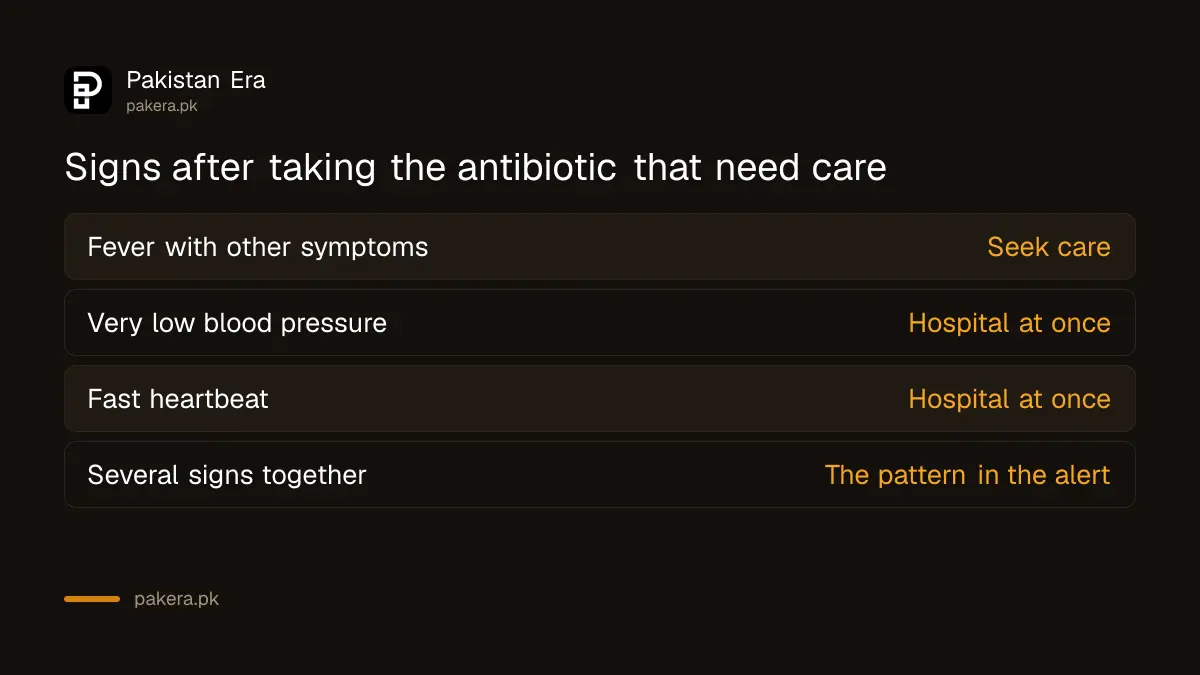
The alert says patients should act when they have multiple symptoms. A single mild symptom, such as a slight fever from the infection itself, is a different case. When unsure, ask a doctor.
What to do if you feel unwell after taking it
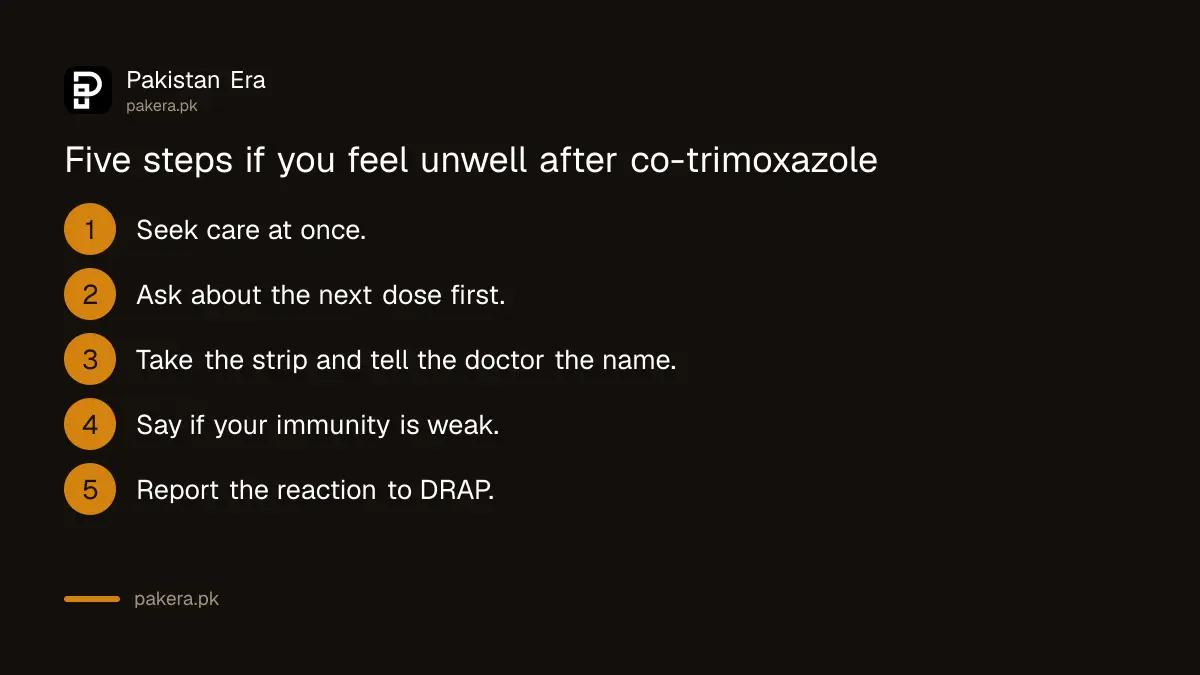
The alert's advice to patients is to consult their doctor immediately or visit a hospital if they develop multiple symptoms such as fever, very low blood pressure or a fast heartbeat after taking the drug.
- Seek care at once. Ask the doctor about the next dose before you take it.
- Go to the nearest emergency department, or call an ambulance. In Sindh, the free 1122 ambulance takes the call.
- Take the strip or box with you and tell the doctor the name, sulfamethoxazole and trimethoprim, and the time of the last dose.
- If you have a weak immune system, tell the doctor that first.
- Report the event afterwards to DRAP so the safety centre can record it.
Edhi and Chhipa also run ambulances in the big cities, and their numbers are in the Edhi and Chhipa ambulance numbers.
How to spot the medicine on your pack
The generic name is printed on the strip or box. Look for sulfamethoxazole and trimethoprim, or co-trimoxazole. Brand names differ between companies. If the label shows both names with strengths, it is this combination.
Never share antibiotics or use leftovers from a past illness. The alert is about a rare reaction, but self-treatment is a reason people take a medicine without anyone watching for it. If a medicine is not registered, DRAP's registration check will show it.
The alert names no batch or brand and does not recall the medicine. It is a labelling change and a warning.
Report the reaction and ask for a record
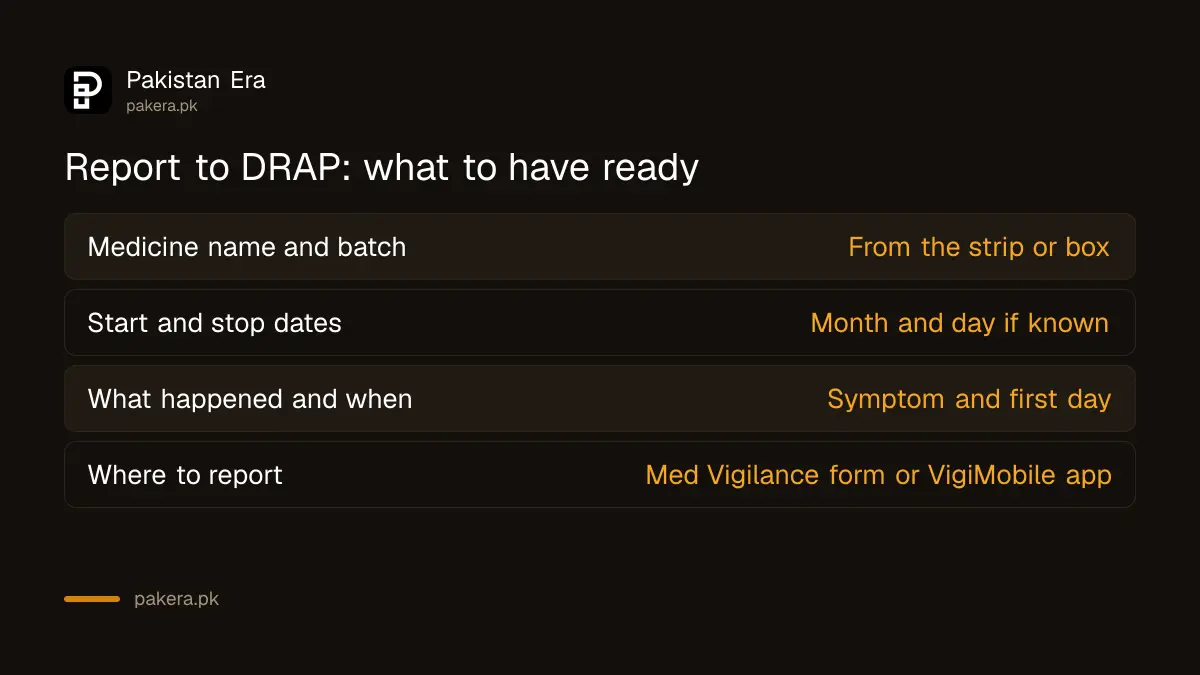
DRAP asks patients and health professionals to report reactions through its Med Vigilance e-reporting system or the VigiMobile app. The National Pharmacovigilance Centre's number is 051 9255981 and its email is npc@dra.gov.pk.
The full method is written up in how to report a medicine side effect to DRAP. Ask the hospital for a discharge summary that names the medicine. It makes your report much more useful.
Common questions
Is co-trimoxazole banned in Pakistan?
No. The alert is a safety warning and a label update. It does not withdraw the medicine.
Is this the same as an allergy to sulfa drugs?
The alert says the shock cases did not respond to standard treatment for hypersensitivity, which is an allergic reaction. That is why it describes them separately. A doctor can tell you what applies to you.
Who is most at risk?
The reported cases were mainly in immunocompromised patients, meaning people with weakened immunity.
How often does it happen?
DRAP lists the frequency as "not known". It has no figure.
Should I stop the course if I feel fine?
Take antibiotics as your doctor says. The alert asks you to seek care if multiple warning symptoms appear. If you have concerns, ask your doctor before changing anything.
Where is the original alert?
It is DRAP Safety Alert No. 64, under Safety Communication on the DRAP website, linked below.
How we verified this
What we checked, where we read it, and what we could not confirm.
We read DRAP Safety Alert No. 64 dated 6 February 2026 and DRAP's safety updates page on 12 October 2026. This is a summary of the alert and not medical advice.
About the author

Public Services and Education Journalist
Fajr Riaz is a journalist and content writer at Pakistan Era, based in Lahore. She covers the questions people meet in everyday life in Pakistan: how a public service works, what a change in the rules means, and where to find a reliable answer.