Check If Your Second Nationality Is on Pakistan's Dual Nationality List: 22 Countries From DGI&P
Check Pakistan's official dual nationality list from DGI&P: 22 countries including the UK, US, Canada and Australia, the Germany note and what the page omits.
Short answer: The Directorate General of Immigration and Passports (DGI&P) lists 22 countries with which Pakistan has dual nationality arrangements: the United Kingdom, France, Italy, Belgium, Iceland, Australia, New Zealand, Canada, Finland, Egypt, Jordan, Syria, Switzerland, the Netherlands, the United States, Sweden, Ireland, Bahrain, Denmark, Germany, Norway and Luxembourg.
A man in Birmingham, a woman in Toronto and a family in Houston ask the same thing before a visit home: do I have to give up one passport? The honest answer starts with one official list, and many search results copy it badly.
We read the DGI&P dual nationality page on 13 October 2026. The page shows a last-modified date of 9 January 2026. This guide repeats what the page says and marks what it does not say.
The official list has 22 countries
DGI&P says the Government of Pakistan has dual nationality arrangements with 22 countries. Citizens of those countries are not required to renounce their nationality while acquiring Pakistani citizenship. The table groups the same 22 names by region so you can find yours quickly.
| Region | Countries on the DGI&P list | Count |
|---|---|---|
| Europe | United Kingdom, France, Italy, Belgium, Iceland, Finland, Switzerland, Netherlands, Sweden, Ireland, Denmark, Germany, Norway, Luxembourg | 14 |
| North America | Canada, United States of America | 2 |
| Oceania | Australia, New Zealand | 2 |
| Middle East and North Africa | Egypt, Jordan, Syria, Bahrain | 4 |
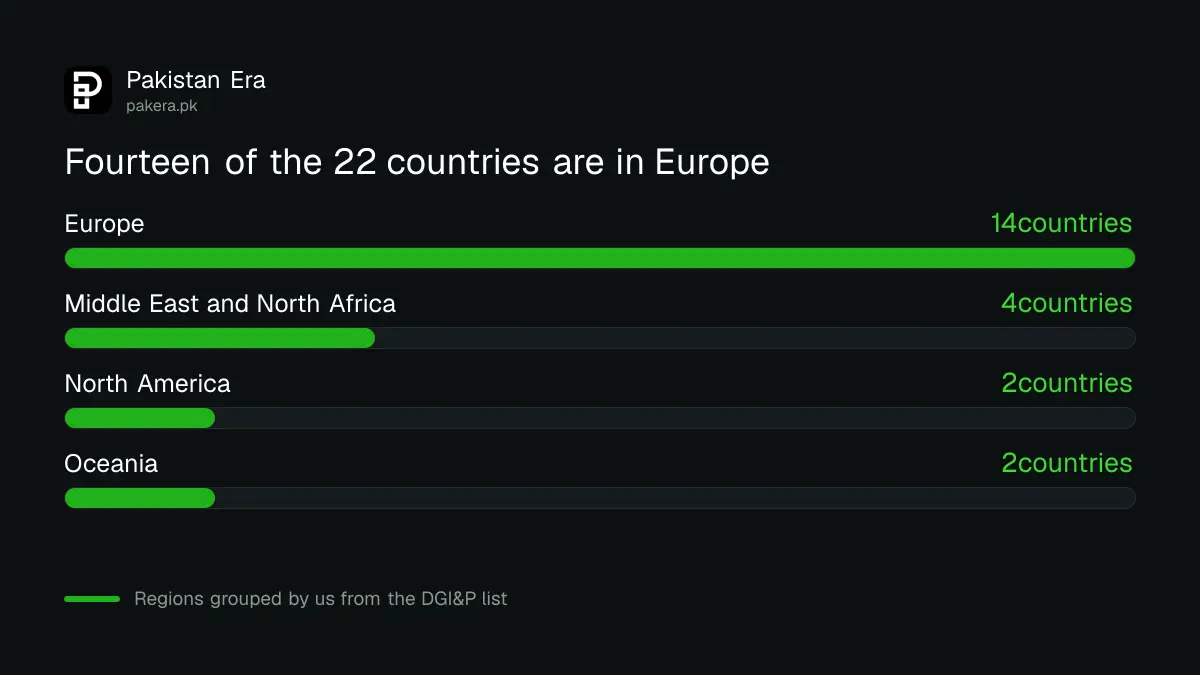
The grouping is ours. DGI&P's page gives a plain numbered list in a different order.
Germany carries a special note
DGI&P marks Germany with an asterisk. The note says it covers children of Pakistani parents who have grown up in Germany and, because they were born there, acquired German nationality in addition to their parents' nationality.
That wording is narrower than the other 21 entries. If you are a German national who is not a child of Pakistani parents, do not assume the same arrangement applies to you. Ask DGI&P in writing.
What the page says, and what it leaves out
The wording on DGI&P's page is about citizens of the listed countries who acquire Pakistani citizenship. They need not renounce their nationality. The page does not set out, line by line, what happens to a Pakistani citizen who takes a foreign nationality from a listed country, or from a country that is not listed.
So treat the list as a way to check whether your country has an arrangement. For a decision about your own passports, DGI&P is the authority. Its email on the immigration pages is immigration@dgip.gov.pk and its helpline is 051-111-344-777.
A country missing from the list has no arrangement on this page. That includes Saudi Arabia, the United Arab Emirates, Malaysia and Turkey. Renouncing Pakistani citizenship is a separate process, explained in the guide to renouncing Pakistani citizenship with Form X.
Two cautions help here. First, the list is a list of countries, not a legal opinion on your case. Second, the page is dated, and arrangements can change. If you are about to apply for a card, renew a passport or travel with a child who holds two passports, write to DGI&P first and keep its reply. A short written answer from the directorate is better than a forum post or a relative's memory of what an officer said.
Documents overseas Pakistanis use alongside the list
Two cards matter to many people on this list. The NICOP is for Pakistani citizens living abroad. The Pakistan Origin Card, or POC, is a separate card for people of Pakistani origin. Which one you need depends on your citizenship status, which is why the list alone is not enough.
The difference is set out in the comparison of NICOP and POC for overseas Pakistanis. The POC route, fee and eligibility are in the guide to applying for a Pakistan Origin Card.
An expired NICOP can also cause trouble at the airport, as described in the report on expired NICOP and boarding a flight to Pakistan.
How to check your country in five steps
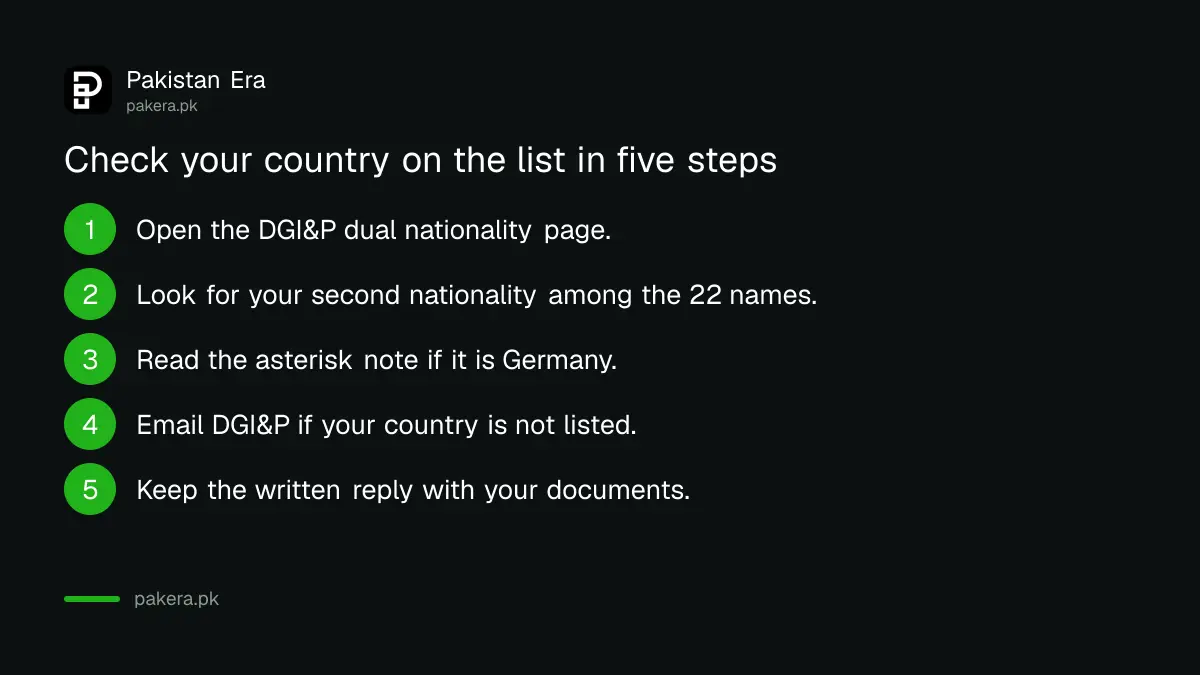
- Open the DGI&P dual nationality page and find the numbered list.
- Look for your second nationality among the 22 names.
- If it is Germany, read the asterisk note before you rely on it.
- If it is not listed, email DGI&P and ask for its position in writing.
- Keep the reply with your passport and card documents.
Common questions
How many countries are on Pakistan's dual nationality list?
22, according to DGI&P's dual nationality page, which shows a last-modified date of 9 January 2026.
Is the United States on the list?
Yes. The United States of America is number 15 on DGI&P's list. The United Kingdom, Canada, Australia and New Zealand are on it as well.
Are Saudi Arabia or the UAE on the list?
No. Neither country appears among the 22 names on the DGI&P page.
What does the asterisk next to Germany mean?
It covers children of Pakistani parents who grew up in Germany and acquired German nationality through birth there, in addition to their parents' nationality.
Does the list tell me what happens to my Pakistani citizenship if I take a foreign passport?
Not directly. The page is worded for citizens of listed countries who acquire Pakistani citizenship. Ask DGI&P by email for a written answer on your own case.
How we verified this
What we checked, where we read it, and what we could not confirm.
Last checked on 13 October 2026, Pakistan time. We read the DGI&P dual nationality page, last modified 9 January 2026 according to the page. We did not read the Pakistan Citizenship Act, 1951 for this guide, and we could not confirm how DGI&P applies the list to a Pakistani citizen who takes another nationality.
About the author

Public Services and Education Journalist
Fajr Riaz is a journalist and content writer at Pakistan Era, based in Lahore. She covers the questions people meet in everyday life in Pakistan: how a public service works, what a change in the rules means, and where to find a reliable answer.