Check If Your Experience Counts for an FPSC Post: What FPSC Reckons and What It Rejects
FPSC counts only regular, full-time, paid work after your degree result, up to the closing date. See what is excluded, the M.Phil credit and your next steps.
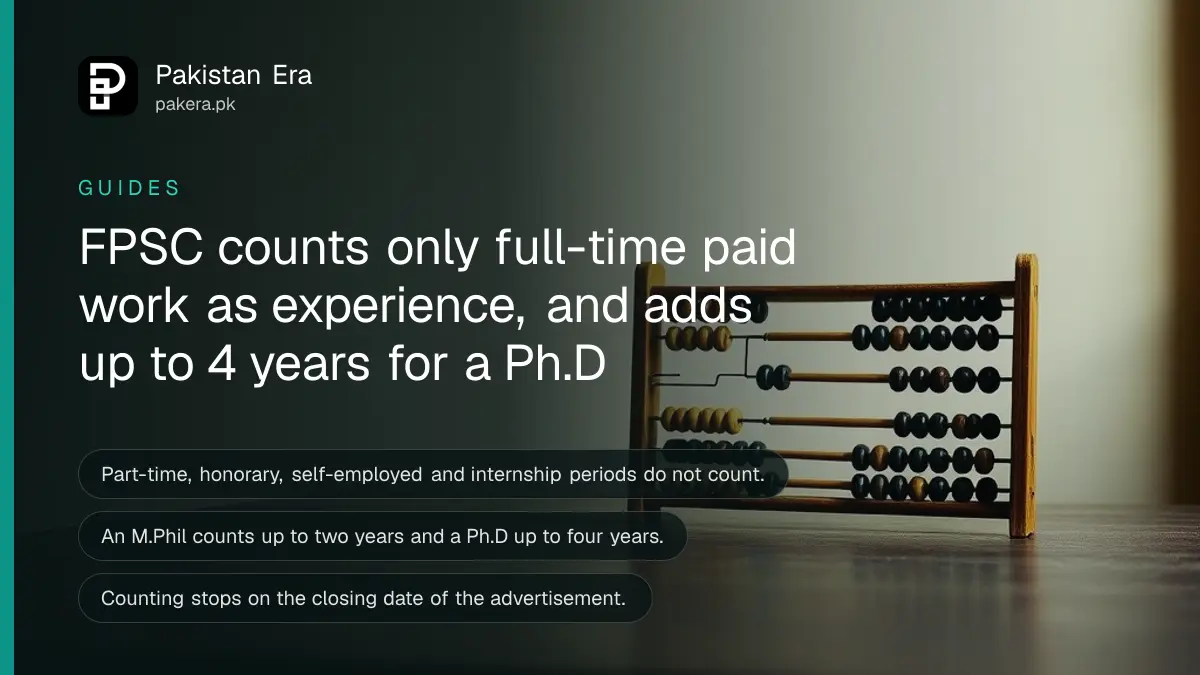
Short answer: FPSC counts only post-qualification experience: regular, full-time, paid work gained after your required degree result was officially announced, up to the closing date of the advertisement. Part-time, honorary, self-employed, apprentice and internee periods do not count, and neither do overlapping jobs. Some M.Phil and Ph.D years can be added.
Experience is where many strong applications fall. On 6 October 2026 FPSC dismissed a review petition from a candidate for an Associate Professor or Principal (BS-19) post, rejected because the candidate "did not possess the required 12 years post qualification experience on the closing date". That candidate had already been heard in person once. A second look seldom changes the arithmetic.
We read the FPSC General Instructions to Candidates, updated 12 August 2026, and the 6 October decision on 12 October 2026. This guide turns the rules into a check you can do before you apply.
Experience counts from the day your degree result was announced
The clock starts when the Controller of Examinations of your board or university officially announces the result of the minimum qualification the post asks for. Work done before that date does not count, even if it was full time and paid.
The instructions say the result declaration date on your transcript is treated as the date you completed the qualification. The counting stops on the closing date of the advertisement, not on the date of the test. A year of work that finishes after the closing date will not help.
The same closing date rule applies to your degree and any registration the post needs, such as PEC, PMDC or PNC. They must be held on or before that date.
Only regular, full-time, paid work counts
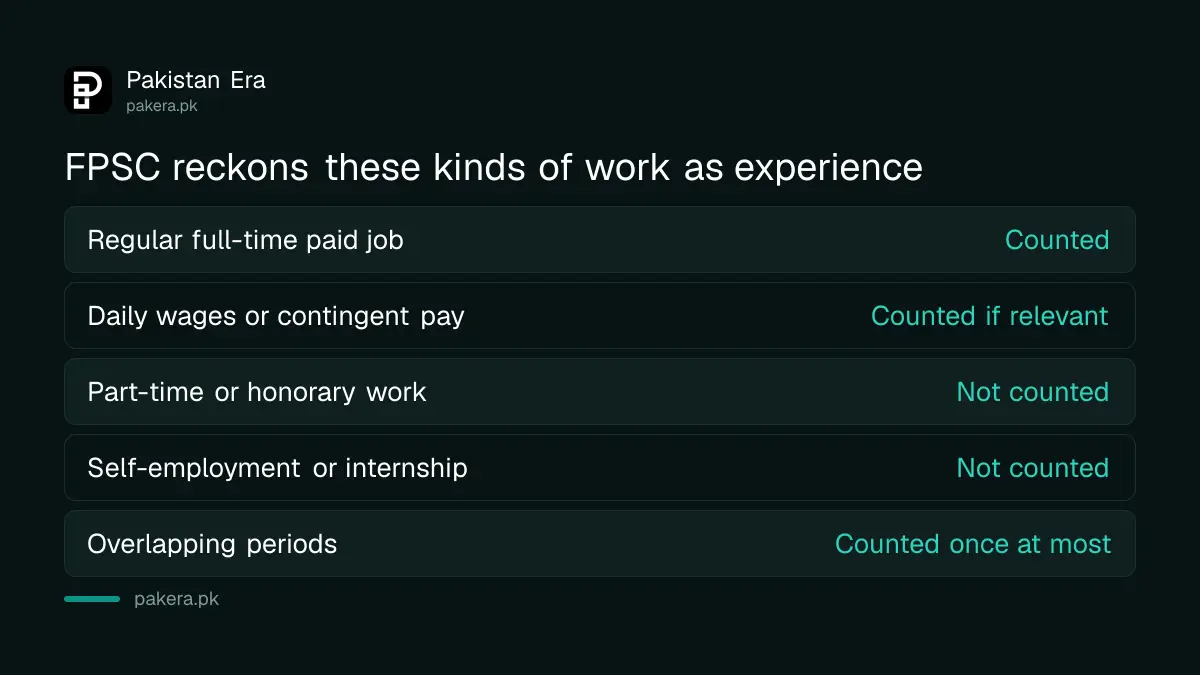
FPSC counts regular, full-time, paid jobs, and it also counts daily wages, contingent paid service and on-the-job training, if the work is relevant to the post. It does not count other kinds.
| Kind of work | Counted by FPSC? |
|---|---|
| Regular full-time paid job | Yes |
| Daily wages or contingent paid service | Yes, if relevant to the post |
| On-the-job training | Yes, if relevant to the post |
| Part-time work | No |
| Honorary or unpaid work | No |
| Self-employment | No |
| Apprenticeship or internship | No |
| Work that overlaps another period | No, the overlap is not counted |
Private employers are accepted when they are nationally or internationally well known, registered with a government department, have offices and show a proper registration or reference number, where one applies. The same goes for NGOs, banks and institutions.
M.Phil and Ph.D years can count as experience
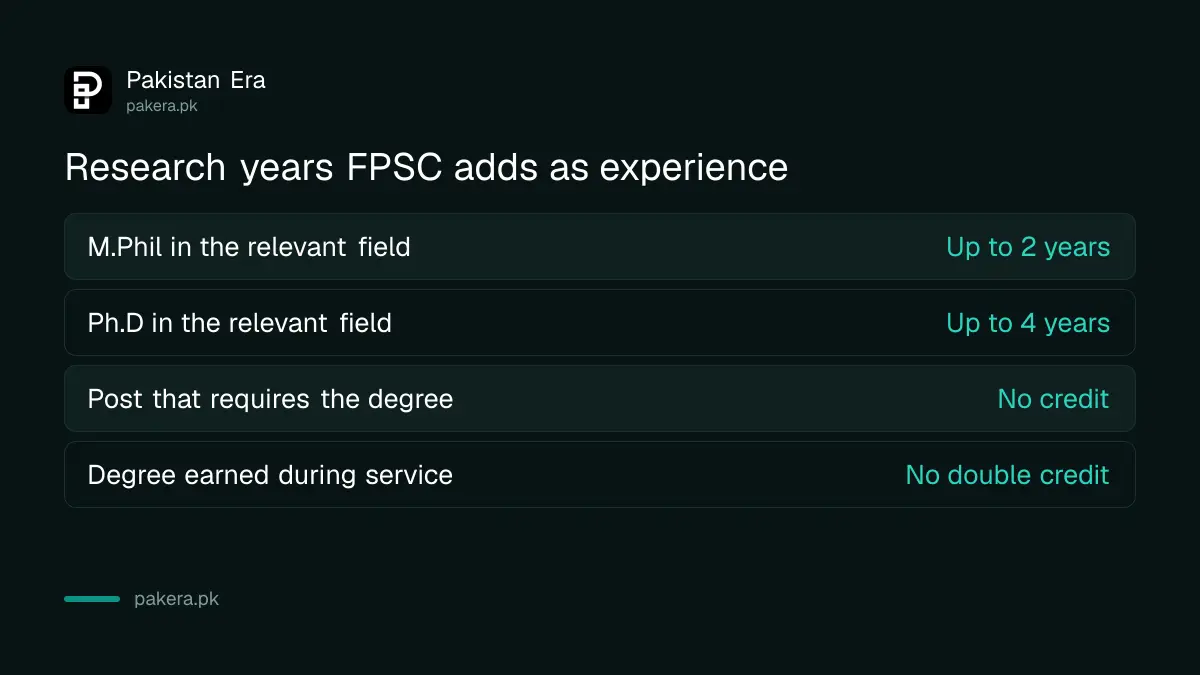
FPSC allows the time spent on an M.Phil in the relevant field as practical experience up to two years. A Ph.D counts up to four years. You cannot use it for a post that itself requires the M.Phil or Ph.D, and you cannot count the same period twice if you earned the degree during service.
That rule matters for lecturer and professor posts, where several years of experience are often asked. Work out your total in three lines: employment after the result date, plus the capped research years, minus any overlap. Compare it with the advertisement, not with a friend's case.
Your certificate must prove each claim
The experience certificate goes on FPSC's prescribed format. It must show exact start and end dates, that the job was regular, full time and paid, and the nature of the work. A government employer's officer senior to the post you want signs it. A private firm's CEO, HR director or HR manager signs, with their CNIC number, address and phone.
FPSC will not accept extra certificates sent later to fix a gap, unless it asks for them. So gather everything before you apply. Our guide to getting an experience certificate in Punjab explains how to ask an employer for one.
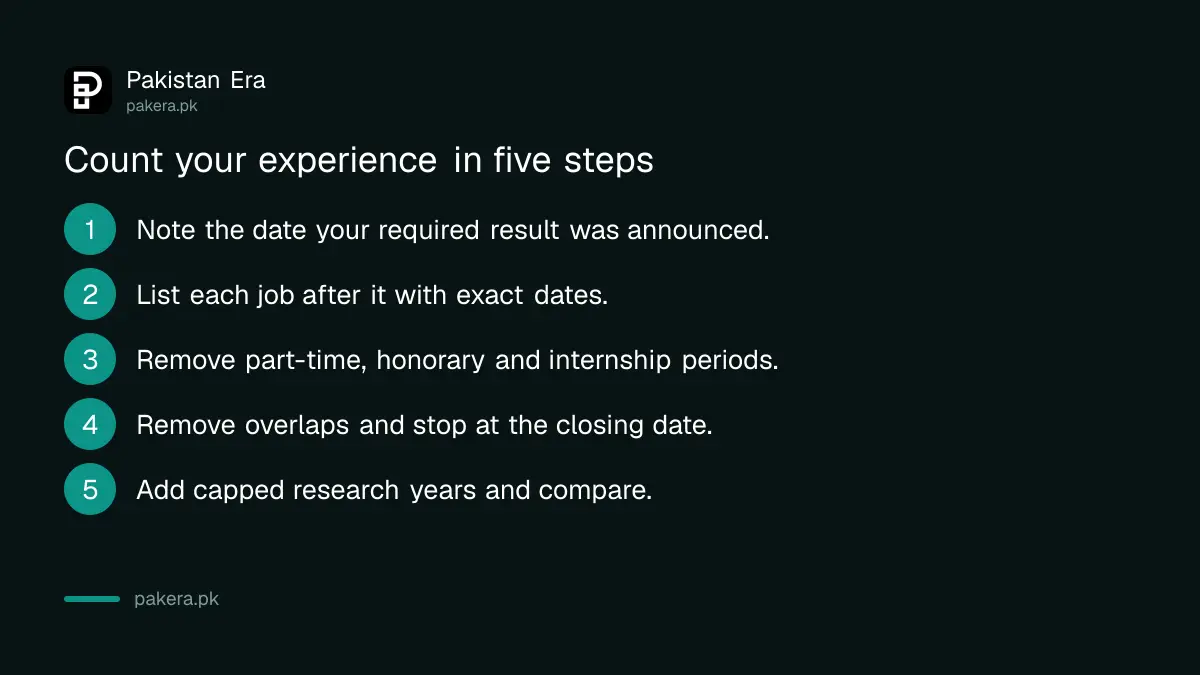
- Write down the date your required degree result was announced.
- List each job after that date, with exact start and end dates.
- Remove part-time, honorary, self-employed and internship periods.
- Remove any overlap, and cut every date off at the closing date.
- Add the capped M.Phil or Ph.D years if they apply, then compare with the advertisement.
What to do if FPSC says your experience is short
FPSC can reject for experience that is missing, not relevant, or short. You may file a representation within 30 days and are heard in person. If that fails you have 15 days for a review petition, and then 30 days to go to the High Court.
Each of the first two steps costs Rs 500. The 6 October decisions say the review petitions brought no new evidence, and they were dismissed. Our guide to how to challenge an FPSC rejection shows each stage.
Common questions
Does part-time work count for FPSC experience?
No. FPSC counts regular, full-time, paid jobs only. Part-time, honorary, self-employed and apprentice work is excluded.
When does FPSC start counting my experience?
It counts from the date the result of your required qualification was officially announced, until the closing date of the advertisement.
Can I count my M.Phil or Ph.D as experience?
Yes, up to two years for an M.Phil and four for a Ph.D in the relevant field, but not for a post that requires that degree.
Do two jobs at the same time count twice?
No. FPSC does not admit overlapping periods of experience, so the overlap is counted once at most.
Can I send a new experience certificate after applying?
Not unless FPSC asks for it. The instructions say later changes by extra certificates are not admissible.
Does daily wage work count?
Yes, daily wage and contingent paid service count if the work is relevant to the post.
How we verified this
What we checked, where we read it, and what we could not confirm.
We read the FPSC website, its General Instructions to Candidates updated 12 August 2026 and its review petition decision of 6 October 2026 on 12 October 2026. Each advertisement may set its own experience rule, so read yours.
About the author

Senior Writer, Public Services and Technology
Shahid joined us in 2024 as an author. He is a senior contributor to Pakistan's leading technology websites. He writes detailed articles, mostly covering his expertise in the latest tech, mobiles, apps, gadgets, and step-by-step guides. His ideology is to help people understand the latest trends and explain complex methods through very easy-to-understand guides.