Check the HEC Undergraduate Scholarship for Gilgit-Baltistan Students: Merit Is 10% SSC, 40% HSSC and 50% Test
HEC's undergraduate scholarship for Gilgit-Baltistan: GB domicile, HSSC, merit of 10% SSC, 40% HSSC and 50% test. See the rules while no new batch is open.
Short answer: HEC's undergraduate scholarship for Gilgit-Baltistan students needs a GB domicile and an HSSC or equivalent. Merit is 10% SSC, 40% HSSC and 50% from an HEC aptitude test, where you must score at least 50%. You can use it at any public sector university in Pakistan. We found no open batch on 13 October 2026.
A student in Skardu or Hunza who earns a place at a public university in Lahore still faces rent, food and fees. This scheme exists for that student. HEC says its aim is to give financial help to Gilgit-Baltistan students who want undergraduate study at the best public sector universities in Pakistan.
We read the programme pages on HEC's website on 13 October 2026: the introduction, eligibility, selection procedure and how to apply pages. They show a merit list for 2024-25 but no current advertisement. So this is a guide to the rules, not a notice that applications are open.
The scheme is for Gilgit-Baltistan students in public universities
HEC runs the Undergraduate Scholarship Program for the students of Gilgit-Baltistan as part of its drive to widen access in less developed areas. The page notes that Gilgit-Baltistan is the terminal point of CPEC. Awards are for undergraduate study at HEC recognised public sector universities.
HEC's page links a merit list for the 2024-25 round. That tells us a round has run before. It does not tell us when the next advertisement will come.
The page does not state the amount of the award in the part we could read. Another HEC page on this scheme, for financial support, returned an error when we tried it. We therefore give no rupee amounts.
You must meet five eligibility rules
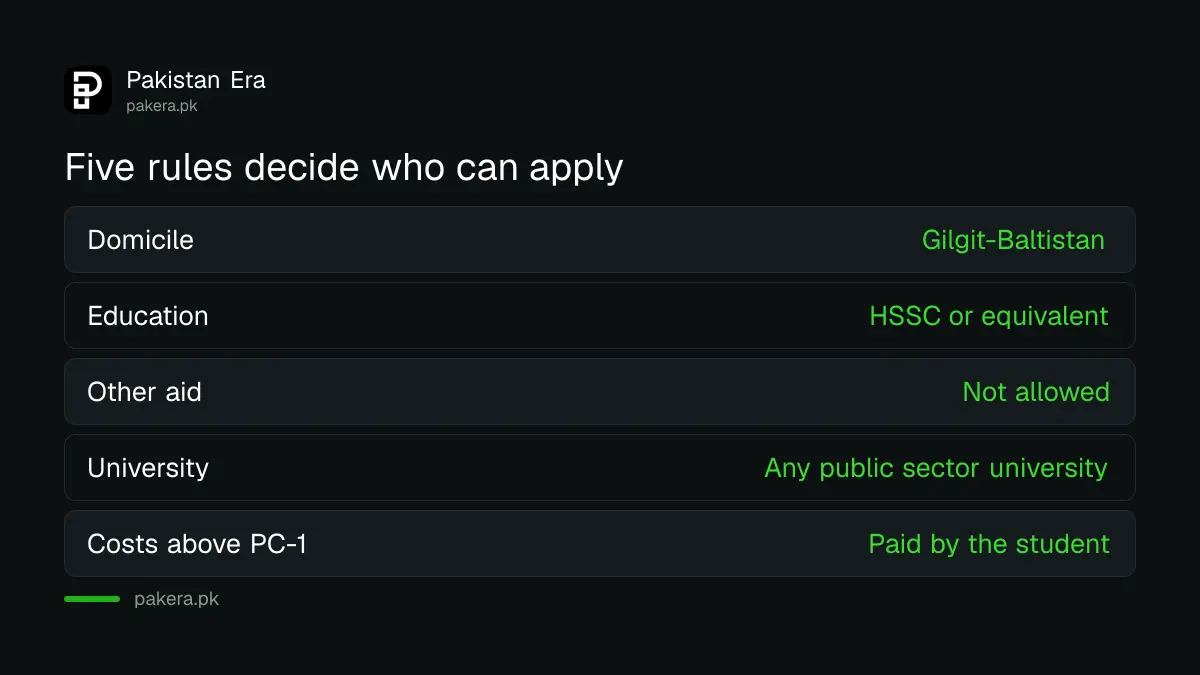
HEC asks for a domicile or local certificate of Gilgit-Baltistan and a completed HSSC or equivalent. You cannot be on another HEC or government scholarship. Awards are made irrespective of gender, caste, race and religion, and you may apply to any public university in Pakistan.
- Hold a domicile or local certificate of Gilgit-Baltistan.
- Have completed HSSC or an equivalent qualification.
- Do not be on any other HEC or government scholarship.
- If you are already in a BS, you may apply if you studied at most one academic year or session before the advertisement.
- Pay for any cost above what the programme's PC-1 allows.
The last rule is easy to miss. HEC says the student must cover expenses over and above the cost given in the PC-1, the government's approved project document. If your university charges more than the scheme pays, the gap is yours.
Merit counts 10% SSC, 40% HSSC and 50% the test
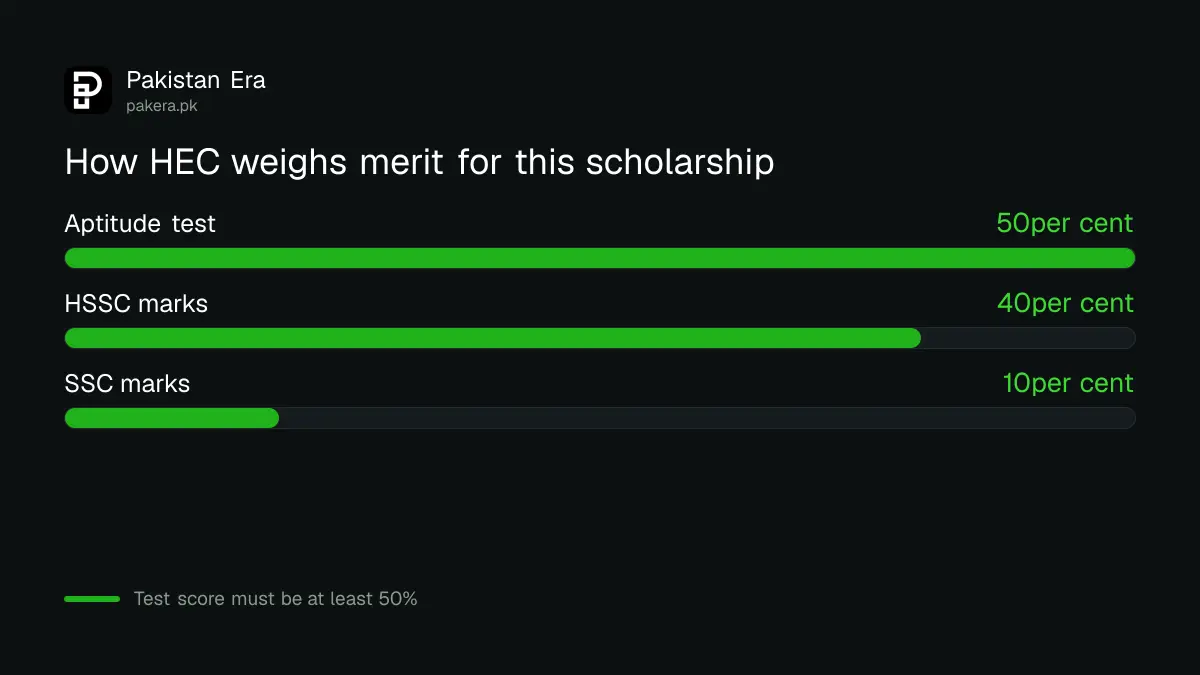
HEC says the Scholarship Aptitude Test is arranged by HEC through its testing council, and applicants must secure at least 50% marks in it. Merit is then SSC 10%, HSSC 40% and the test 50%. The test carries half the weight.
| Part of merit | Weight |
|---|---|
| SSC (matric) marks | 10% |
| HSSC (inter) marks | 40% |
| HEC Scholarship Aptitude Test | 50% |
| Minimum in the test | 50% marks |
Here is a made up example to show the arithmetic. A student with 90% in SSC, 80% in HSSC and 70% in the test gets 9 plus 32 plus 35, which is 76 out of 100. A student with 95% in SSC, 70% in HSSC and 80% in the test gets 9.5 plus 28 plus 40, which is 77.5. The test can outweigh a weaker inter result.
The process runs from advertisement to award letter
HEC's selection page describes the order: an advertisement, the aptitude test, shortlisting on test and academic marks, verification of eligibility, and final award letters after your admission is confirmed. Everyone applies through the HEC Online Application System.
The award letter comes after you get admission. So you still compete for a seat at your chosen university on that university's own merit.
If you aim for law, the test is separate. The page on the HEC LAT for law admission explains it. For HEC's own entry test for BS programmes this year, see the HEC USAT 2026 on 25 October.
Prepare your papers now and watch HEC's pages
Because no batch is open, the best use of time is preparation. Get your domicile certificate, keep your SSC and HSSC result cards ready, and watch HEC's scholarship pages and portal for the next advertisement.
Other aid for students in less developed areas is open now. The Balochistan route is described in the page on the HEC Coastal Region scholarship, and the list of HEC scholarship deadlines in October 2026 shows what closes soon.
Be careful with offers that claim to guarantee a GB scholarship for a fee. HEC's pages that we read mention no such fee for this scheme. We did not find a test fee on these pages either.
Common questions
Who can apply for the HEC Gilgit-Baltistan undergraduate scholarship?
Students with a Gilgit-Baltistan domicile who have finished HSSC or an equivalent and are not on another HEC or government scholarship.
How is merit worked out?
SSC counts 10%, HSSC 40% and the HEC Scholarship Aptitude Test 50%.
What is the minimum score in the test?
HEC says at least 50% marks.
Which universities can I choose?
Any public sector university or institution in Pakistan, according to HEC's eligibility page.
Is an application open now?
We found no current advertisement on 13 October 2026. The pages show a merit list for 2024-25.
Can I apply if I already started a BS?
Yes, if you studied at most one academic year or session before the advertisement.
How we verified this
What we checked, where we read it, and what we could not confirm.
Last checked on 13 October 2026, Pakistan time. We read HEC's pages for the Undergraduate Scholarship Program for Gilgit-Baltistan, including eligibility, selection procedure and how to apply. We found no award amount, quota or closing date, and the financial support page did not load. We did not use the application system.
About the author

Public Services and Education Journalist
Fajr Riaz is a journalist and content writer at Pakistan Era, based in Lahore. She covers the questions people meet in everyday life in Pakistan: how a public service works, what a change in the rules means, and where to find a reliable answer.