Check the PM Fee Reimbursement Scheme for Less Developed Areas: HEC Says It Is Closed for New Registration
HEC says the PM Fee Reimbursement Scheme for less developed areas is closed for new registration. See what it covered, who was eligible and what to do instead.
Short answer: HEC's Prime Minister's Fee Reimbursement Scheme for Less Developed Areas is closed for new registration. It repaid tuition and some mandatory charges for Masters, MS/MPhil and PhD students at public universities, but not hostel, transport or bachelor degrees. Do not pay anyone to register you. Check HEC's page for any reopening.
HEC's pages on the scheme, covering its introduction, eligibility and how to apply, and its approved regions page, all show the same line: the scheme is closed for new registration.
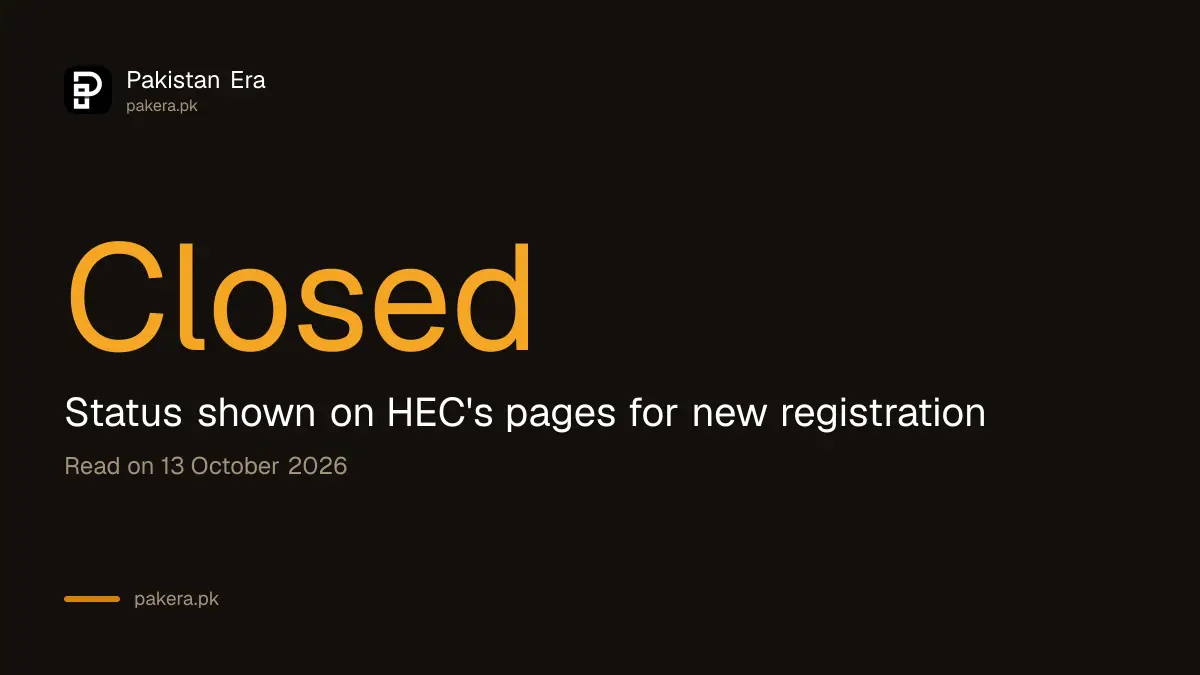
The scheme is closed for new registration
HEC's introduction and eligibility pages both say, in the same words, that the scheme is closed for new registration. The how to apply page lists no steps, documents or deadlines. If a post or an agent says you can register today, HEC's pages do not support it.
Students already enrolled in the scheme should write to HEC through the student service portal that the page links.
If you are looking for open help, the list of HEC scholarship dates closing in October 2026 is the better place to start.
It repaid fees for postgraduate study only
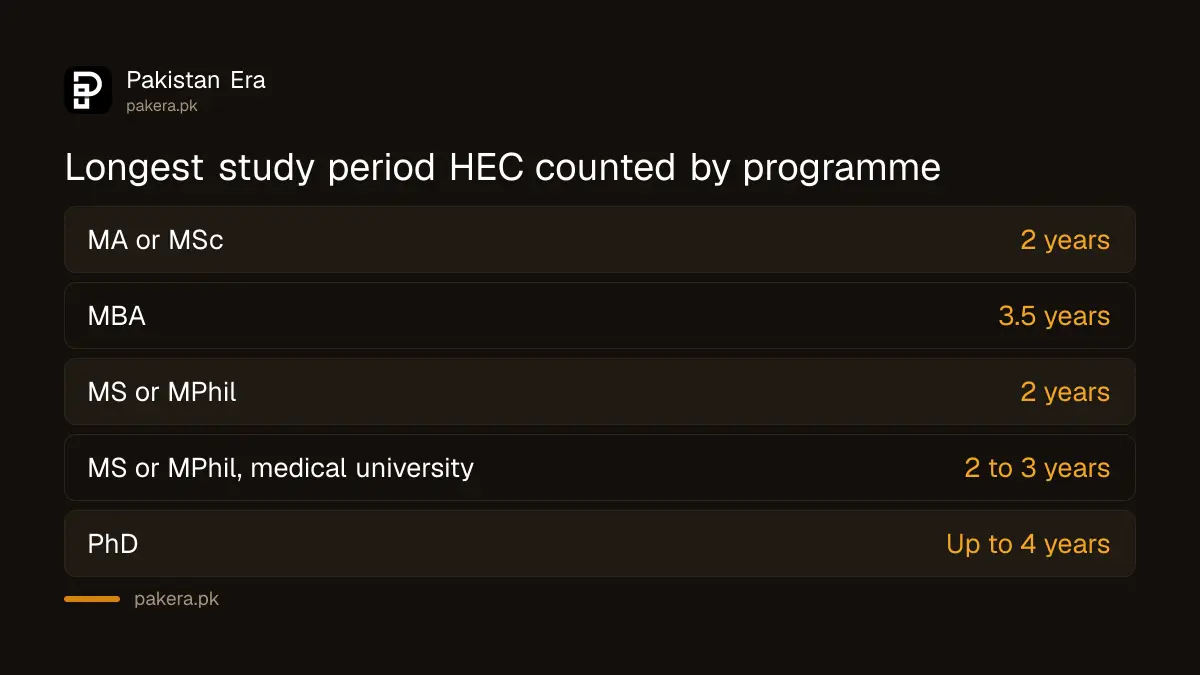
HEC says the scheme supports postgraduate study in less developed areas by reimbursing fees. It covers Masters, MS/MPhil and PhD. Bachelor degrees, including LLB, MBBS, B.E. and BBA, were not eligible, and neither were self-financed or part-time students.
| Programme | Longest period HEC counted |
|---|---|
| MA or MSc | 2 years |
| MBA | 3.5 years |
| MS or MPhil | 2 years |
| MS or MPhil at a medical university | 2 to 3 years at most |
| PhD | Up to 4 years |
HEC adds that the period is counted from the start of classes. If you take longer, the extra time is not reimbursed.
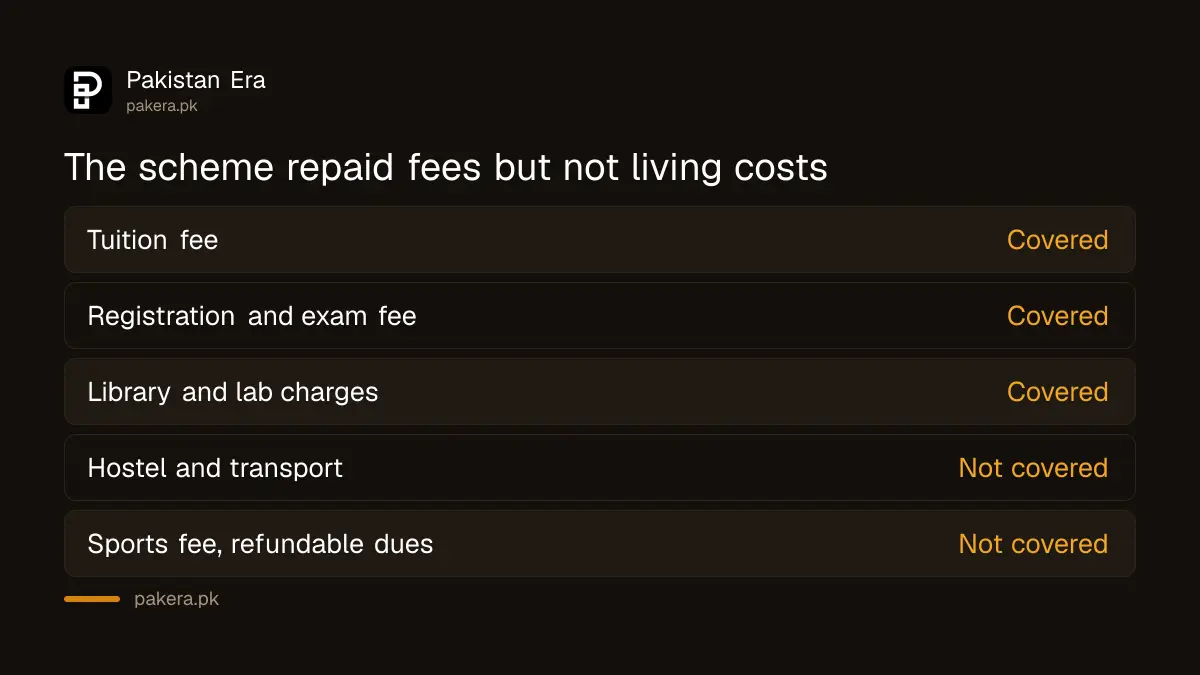
Tuition and mandatory charges were covered, hostel was not
HEC says the scheme reimburses tuition fees and on and off mandatory charges: registration or enrolment fee, admission fee for new admissions only, examination fee, non-refundable library charges and laboratory charges. Transport, hostel, sports fees and refundable dues are not covered.
A student could not, then, count on the scheme to pay rent or bus fare. Even when it was open, it was a fee refund and not a living allowance. That is different from schemes that pay a monthly stipend, such as the HEC Coastal Region scholarship in Balochistan.
Eligibility rules were strict
HEC set clear conditions. You needed a valid domicile of a specified area and admission on merit at an HEC-selected public university. Masters and MS/MPhil students studied within their province or region, while PhD students could study anywhere in Pakistan at a selected institution.
- Hold a valid domicile or local certificate of an area covered by the scheme.
- Be enrolled on merit in Masters or MS/MPhil at an HEC-selected public university in your province or region.
- For a PhD, be enrolled at an HEC-selected public institution anywhere in Pakistan.
- Not hold any other scholarship from a provincial government, foreign donor or HEC programme.
- Not have used the scheme before at the same degree level at a different institution.
Students in evening programmes with higher fees than the morning shift were also left out.
The scheme covered 114 districts in seven regions
HEC's approved regions page lists 114 districts and the refugees of Jammu and Kashmir. For Masters and MS/MPhil, students had to study at public universities in their own region. For a PhD, any public sector university in the country was allowed.
| Region | Districts named by HEC (examples) | Masters and MS/MPhil at |
|---|---|---|
| Balochistan | All listed, including Quetta, Gwadar, Kech, Khuzdar, Zhob | Public universities in Balochistan |
| Gilgit-Baltistan | Hunza-Nagar, Gilgit, Skardu, Ghanche, Ghizar, Diamir, Astore | Public universities in Gilgit-Baltistan |
| Azad Jammu and Kashmir | Ten districts plus refugees of Jammu and Kashmir | Public universities and postgraduate colleges in AJK |
| Former FATA | Bajaur, Khyber, Kurram, North and South Waziristan, Mohmand, Orakzai, and the Frontier Regions | Public universities of Khyber Pakhtunkhwa |
| Interior Sindh | 21 districts, including Tharparkar, Larkana, Sukkur, Badin | Public universities and postgraduate colleges in interior Sindh |
| South Punjab | Bahawalpur, Rahim Yar Khan, Bahawalnagar, Multan, Lodhran, Khanewal, Vehari, Dera Ghazi Khan, Muzaffargarh, Rajanpur, Layyah | Public universities and postgraduate colleges in South Punjab |
| Khyber Pakhtunkhwa, selected | 17 districts, including Chitral, Swat, Dir, Kohat, Bannu, D.I. Khan | Public universities and postgraduate colleges in Khyber Pakhtunkhwa |
| Punjab, other | Attock; Khushab, Mianwali and Bhakkar | Attock colleges; University of Sargodha and University of Education campuses for Khushab, Mianwali and Bhakkar |
Spending per person is lower in many of these districts. Our guide to the HIES 2024-25 spending groups shows the official bands for the whole country.
What to do instead while the scheme is closed
Look for schemes that are open now and match your degree level. Doctoral students have several, and the choices include the HEC IPFP for fresh PhDs and the HEC IRSIP research visit abroad.
For bachelor students, provincial funds such as the Khyber Pakhtunkhwa route in the page on the KPEF scholarship may suit better. Check each one's own deadline, because they differ.
If you want a foreign or joint degree instead, first check the programme has an HEC NOC. Law graduates from Balochistan have a separate route in the HEC scholarship for Balochistan law graduates.
Most important, keep your fee challans and result cards. If HEC reopens a window, these are the papers you will need first.
How to check the scheme status yourself
Open HEC's page for the Prime Minister's Fee Reimbursement Scheme and read the line near the top. On 13 October and 8 November 2026 it said the scheme is closed for new registration. If that line changes, the how to apply page should then list steps and documents.
- Open HEC's scheme page and read the status line first.
- Open the eligibility page and check that it shows the same status.
- Open the how to apply page. If it lists no steps or deadlines, registration is not open.
- Ignore any agent or social media post that asks for money to register you.
Check HEC's scheme page again before each admission season rather than relying on an old post.
Common questions
Is the Prime Minister's Fee Reimbursement Scheme open?
No. HEC's pages say it is closed for new registration, as of 8 November 2026.
Who was eligible?
Masters, MS/MPhil and PhD students with a domicile of a covered area, enrolled on merit at HEC-selected public universities.
Did it pay hostel fees?
No. HEC says transport, hostel, sports fees and refundable dues are not covered.
Could bachelor students apply?
No. HEC lists bachelor degrees, including LLB, MBBS, B.E. and BBA, as ineligible.
How long did it pay for a PhD?
Up to 4 years, counted from the start of classes.
Can I use it for a private university?
HEC's page says public sector universities selected by HEC, and rules out self-financed students.
How we verified this
What we checked and where we read it.
Last checked on 8 November 2026, Pakistan time. Sources, first checked 13 October 2026: HEC's pages for the Prime Minister's Fee Reimbursement Scheme, its eligibility page and its how to apply page. Also the approved regions and universities page, checked on 8 November 2026.
Free on WhatsApp
Get last dates and rule changes on WhatsApp
We post new last dates, fee changes and fixes for common problems, a few short posts a day.
Follow Pakera on WhatsAppOther followers cannot see your number.
Pakera Solves It
Which online process wasted your time this week?
A portal that will not load, a form nobody explains, a complaint that went nowhere. Tell us. Every week we pick one, solve it step by step and publish the answer.
About the author
Public Services and Education Journalist
Fajr Riaz is a journalist and content writer at Pakistan Era, based in Lahore. She covers the questions people meet in everyday life in Pakistan: how a public service works, what a change in the rules means, and where to find a reliable answer.