How to Check Which Spending Group Your Household Is In: Rs 6,711 to Rs 16,840 a Person in Pakistan
Divide your monthly household spending by people at home to find your PBS group. The poorest fifth spends up to Rs 6,711 a person, the richest Rs 16,840 plus.
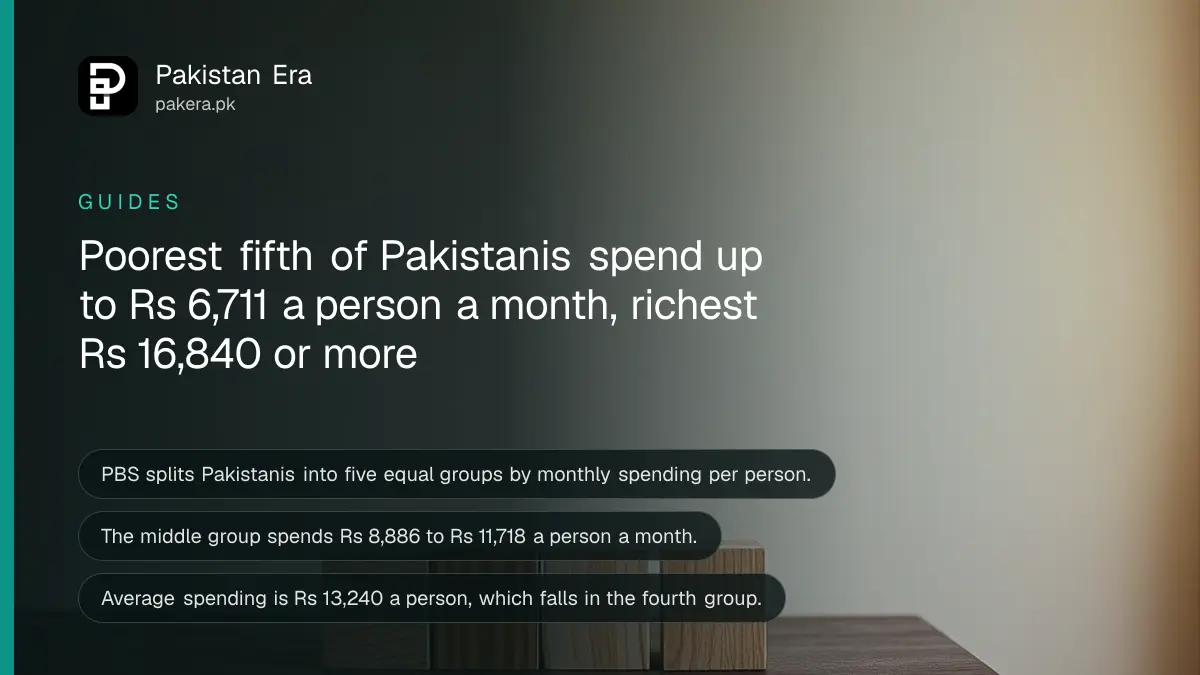
Short answer: Divide your household's monthly spending by the number of people who live in it. PBS puts the poorest fifth of Pakistanis at up to Rs 6,711 a person a month and the richest fifth at Rs 16,840 or more. The three groups in between run from Rs 6,712 to Rs 16,839.
Stories about "the poor" and "the rich" in Pakistan rarely say where the line is. The Pakistan Bureau of Statistics (PBS) does, in an appendix of its household survey. It splits the population into five equal groups by how much each person spends in a month.
We read the PBS Household Integrated Economic Survey (HIES) 2024-25 report on 13 October 2026, including Appendix A and its Table 1. This page shows how to place your own home on the scale. The cut-offs are for 2024-25 spending, so prices today are higher.
PBS splits people into five equal groups by spending
The groups are called consumption quintiles. Each holds 20 per cent of the population. The first quintile is the poorest and the fifth is the richest. PBS uses spending, not income, because it is a better guide to how well a family lives.
The survey adjusts for household size and make-up. PBS gives a simple example. Two homes may each spend Rs 3,000 a month. If one has a single person and the other has five, their welfare is very different.
The cut-offs run from Rs 6,711 to Rs 16,840 a person
PBS gives the ranges of per capita consumption expenditure in Table 1 of the appendix. They are monthly rupee amounts for each person in the home, not for the household as a whole.
| Group | Monthly spending per person |
|---|---|
| 1st (poorest fifth) | Up to Rs 6,711 |
| 2nd | Rs 6,712 to Rs 8,885 |
| 3rd (middle) | Rs 8,886 to Rs 11,718 |
| 4th | Rs 11,719 to Rs 16,839 |
| 5th (richest fifth) | Rs 16,840 and above |
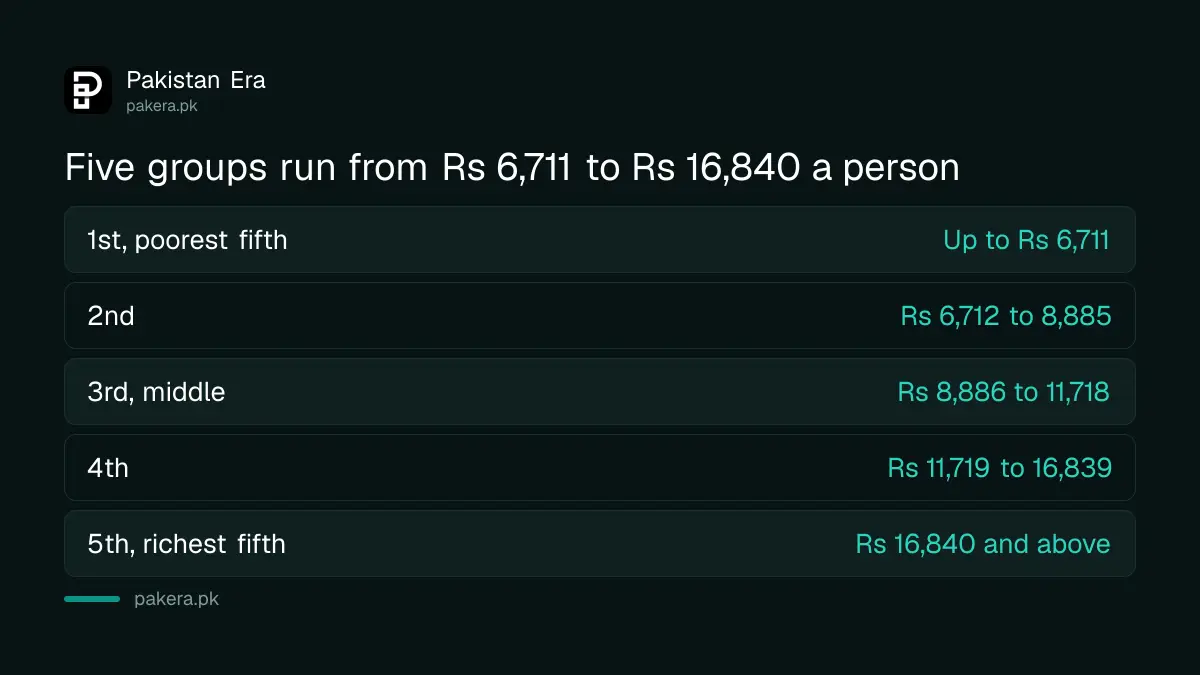
The middle of the scale sits near the third group. PBS reports average spending of Rs 13,240 a person across all of Pakistan, which falls in the fourth group because a few big spenders pull the average up.
How to find your own group in four steps
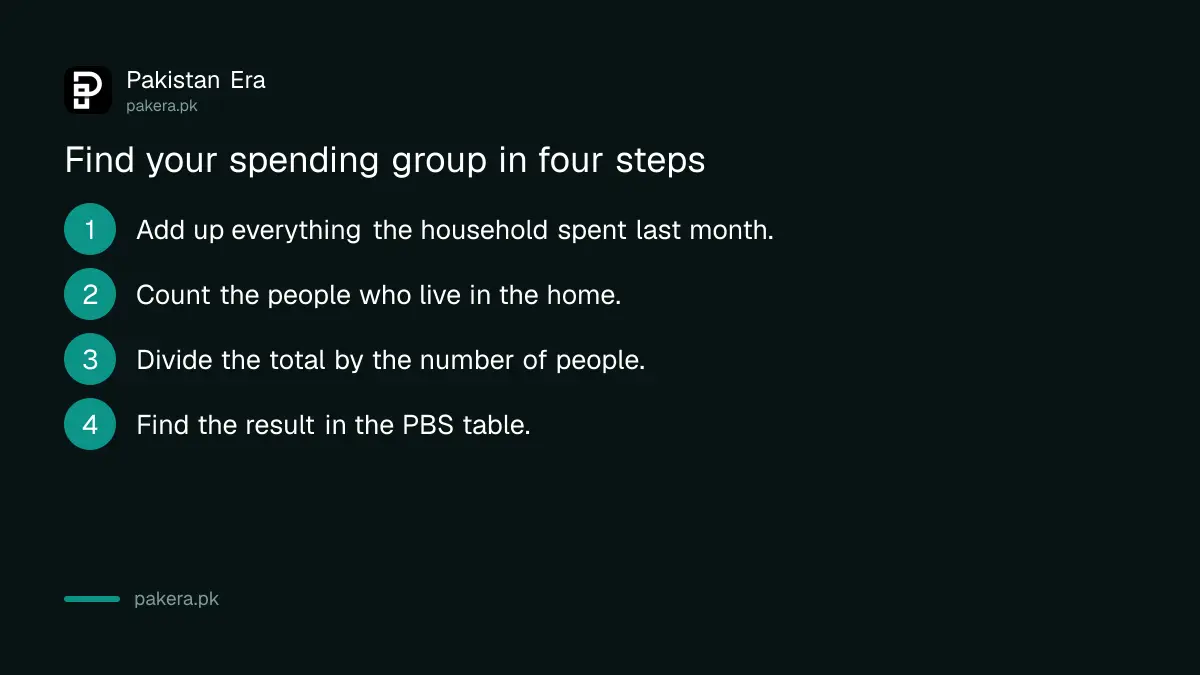
You need your monthly household spending and the number of people who live in the home. Count children and elders. Count everyone who eats from the same kitchen.
- Add up everything the household spent last month: food, rent, bills, school, transport, health and the rest.
- Count the people in the household.
- Divide the total by the number of people.
- Find the result in the table above.
Here is our own example. A family of six that spends Rs 60,000 a month spends Rs 10,000 a person. That falls in the third group, the middle. A family of four that spends the same Rs 60,000 spends Rs 15,000 a person and lands in the fourth group. Household size changes the answer.
The groups show how spending is spread, not who gets help
PBS says it builds the groups to study how social and economic life differs across welfare levels. For example, planners can look at whether poorer homes have access to education, vaccines and safe water.
The groups are not an eligibility test. Programmes like BISP use their own surveys and scores. Landing in the first group does not make a family eligible for any scheme, and landing in the fifth does not bar one.
The survey also draws the groups across the four provinces together. PBS notes that richer provinces have more people in the upper groups and poorer ones have more in the lower groups, and that villages have more people in the lower groups than cities.
Prices have moved since the survey
The survey ran from September 2024 to June 2025. Prices have changed since, and PBS has not published new cut-offs in the report we read.
A fair rule is to treat the cut-offs as a snapshot. If you want to know what a rupee from 2024-25 is worth now, use the method in the page on calculating your own inflation rate from PBS data. The page on how much prices have risen in Pakistan gives a simple rupee comparison.
Read these numbers with the household budget and income averages
The same survey reports average household spending and income. They show a different slice of the same picture. Our page on the average household budget shows the shares that go to food and housing. The page on average household income shows the income side.
Use them together. A home that is in the first or second group by spending usually puts more of its budget into food and fuel than a richer one.
Common questions
What does the 1st quintile mean in Pakistan?
It is the poorest fifth of people by monthly spending per person, up to Rs 6,711 in the 2024-25 survey.
What spending puts a person in the richest fifth?
Rs 16,840 a month or more per person, according to PBS Table 1.
Is this the same as the poverty line?
No. The groups are five equal slices of the population. The poverty line is a separate figure that we did not read in this report.
Does this decide who gets BISP?
No. Programmes such as BISP use their own surveys and scores.
Why divide by the number of people?
Because a family of six spending Rs 60,000 is not as well off per person as a family of four spending the same.
Are the numbers still current?
They are for 2024-25. Prices are higher now, so the same family would need more rupees to land in the same group.
How we verified this
What we checked, where we read it, and what we could not confirm.
Last checked on 13 October 2026, Pakistan time. We read Appendix A and Table 1 of the PBS HIES 2024-25 report. The family examples and division steps are our own arithmetic. We did not read PBS's poverty line in the report.
About the author

Public Services and Education Journalist
Fajr Riaz is a journalist and content writer at Pakistan Era, based in Lahore. She covers the questions people meet in everyday life in Pakistan: how a public service works, what a change in the rules means, and where to find a reliable answer.