Check Your Household Income Against Pakistan's Average: Rs 82,179 a Month in 2024-25
The average Pakistani household earned Rs 82,179 a month in 2024-25, says PBS. See the five income groups, urban and rural figures and where your family sits.
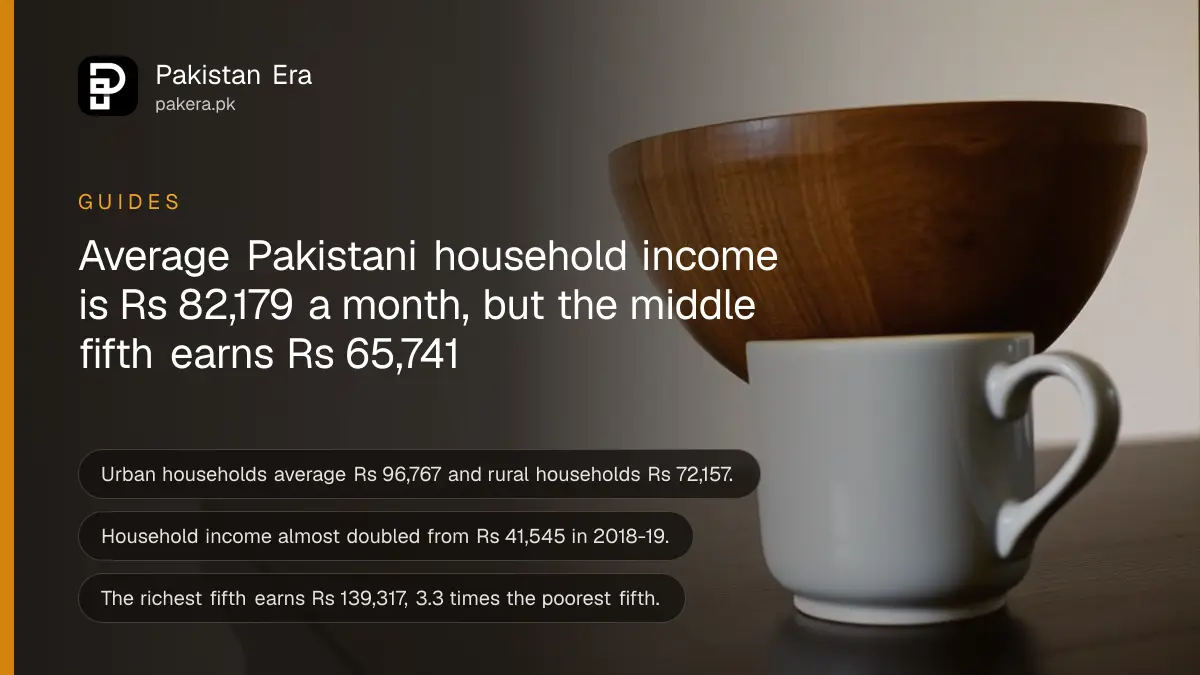
Short answer: The average Pakistani household earned Rs 82,179 a month in 2024-25, says the Pakistan Bureau of Statistics (PBS). Urban households averaged Rs 96,767 and rural households Rs 72,157. The middle fifth of households earned about Rs 65,741, so an income near Rs 66,000 is closer to typical than Rs 82,179.
Picture two neighbours comparing salaries over tea. One says the "average" family earns Rs 82,179 and feels behind. The other earns Rs 66,000 and is exactly in the middle. Both are right, because an average and a middle are not the same number. This page shows how to read the PBS table and place your own household in it.
We read the PBS Household Integrated Economic Survey (HIES) 2024-25 report on 12 October 2026, including Table 3.5.A on income by fifths of households. The PBS home page carries the same Rs 82,179 figure.
The national average is Rs 82,179 a month, nearly double 2018-19
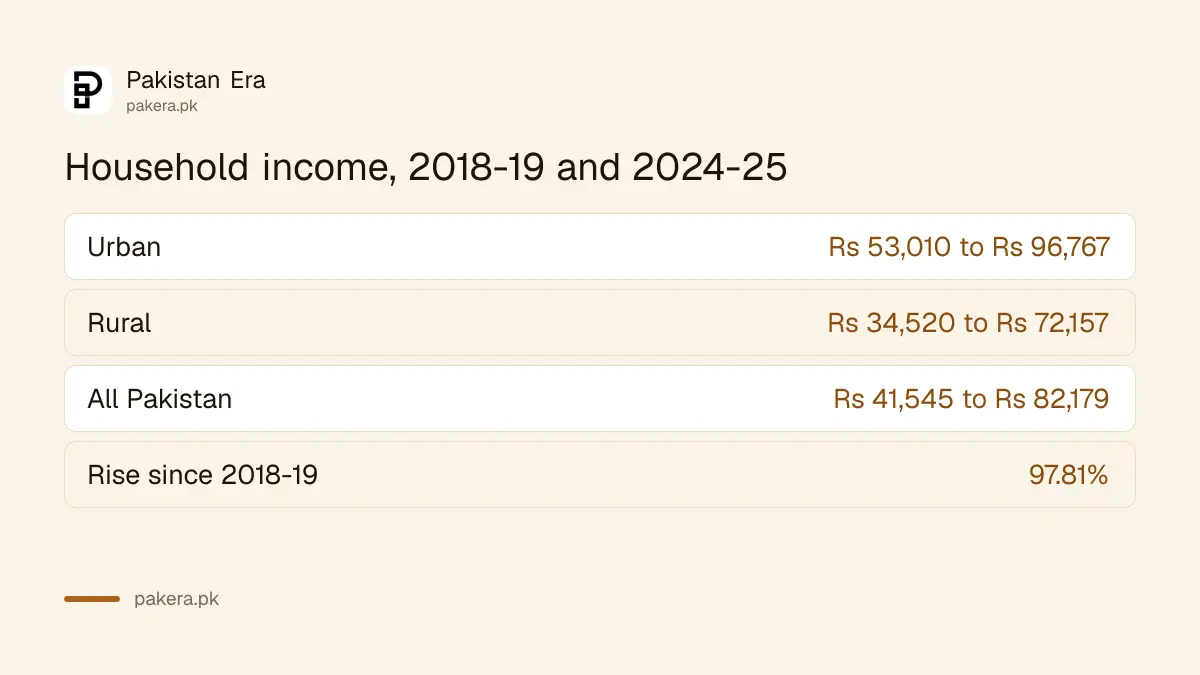
The HIES 2024-25 puts average monthly household income at Rs 82,179. In 2018-19 it was Rs 41,545. That is a rise of 97.81 per cent in six years. Prices also rose over the same period, so this is not the same as a doubling of buying power.
A household here means the people who live and eat together, not one earner. The figure counts every source of money that comes into the home: wages, farm income, business, rent, remittances and gifts.
| Area | 2018-19 | 2024-25 |
|---|---|---|
| Urban households | Rs 53,010 | Rs 96,767 |
| Rural households | Rs 34,520 | Rs 72,157 |
| All Pakistan | Rs 41,545 | Rs 82,179 |
Find your place using the five income groups
PBS sorts all households from poorest to richest and cuts them into five equal groups, called quintiles. Find the group that holds your monthly household income. The third group is the real middle of the country.
| Income group | All Pakistan | Urban | Rural |
|---|---|---|---|
| Poorest fifth | Rs 41,851 | Rs 42,412 | Rs 41,714 |
| Second fifth | Rs 55,138 | Rs 55,862 | Rs 54,618 |
| Middle fifth | Rs 65,741 | Rs 64,864 | Rs 65,897 |
| Fourth fifth | Rs 80,387 | Rs 81,022 | Rs 79,197 |
| Richest fifth | Rs 139,317 | Rs 146,920 | Rs 129,494 |
Each figure is the average inside that group, not a cut-off line. A household earning Rs 70,000 sits between the middle and fourth groups. The richest fifth earns 3.3 times the poorest fifth, by our division of Rs 139,317 by Rs 41,851.
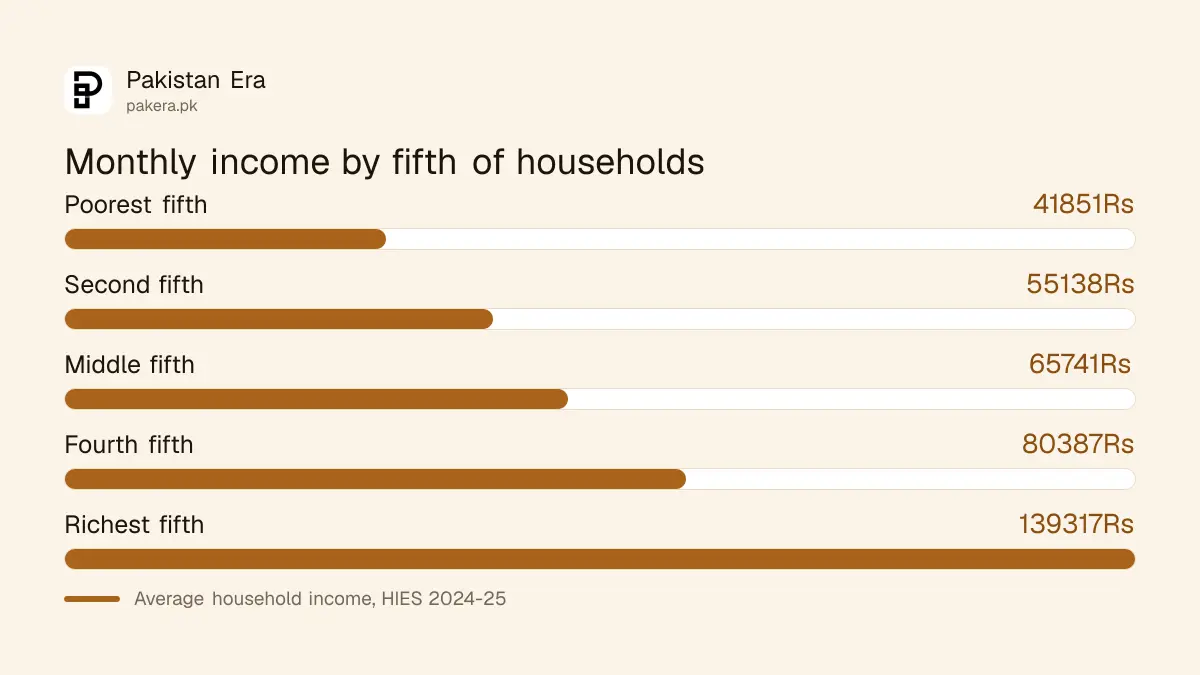
That gap grew. PBS says the richest fifth saw income rise 119.25 per cent since 2018-19, against 80.45 per cent for the poorest fifth.
Wages are 42 per cent of household income, remittances 7.77 per cent
Across Pakistan, wages and salaries supply 42.00 per cent of household income. Business and trade outside farming bring 16.25 per cent. Crops give 6.89 per cent and livestock 7.07 per cent. Foreign remittances supply 7.77 per cent, up from 4.96 per cent in 2018-19.
The split differs sharply by area. In cities wages are 50.27 per cent of income. In villages they are 34.38 per cent, and crops (11.73 per cent) and livestock (11.94 per cent) fill the gap. Our report on September 2026 remittances shows why money from abroad matters to so many homes.
- Wages and salaries: 42.00 per cent.
- Other business outside farming: 16.25 per cent.
- Foreign remittances: 7.77 per cent.
- Livestock: 7.07 per cent.
- Crop production: 6.89 per cent.
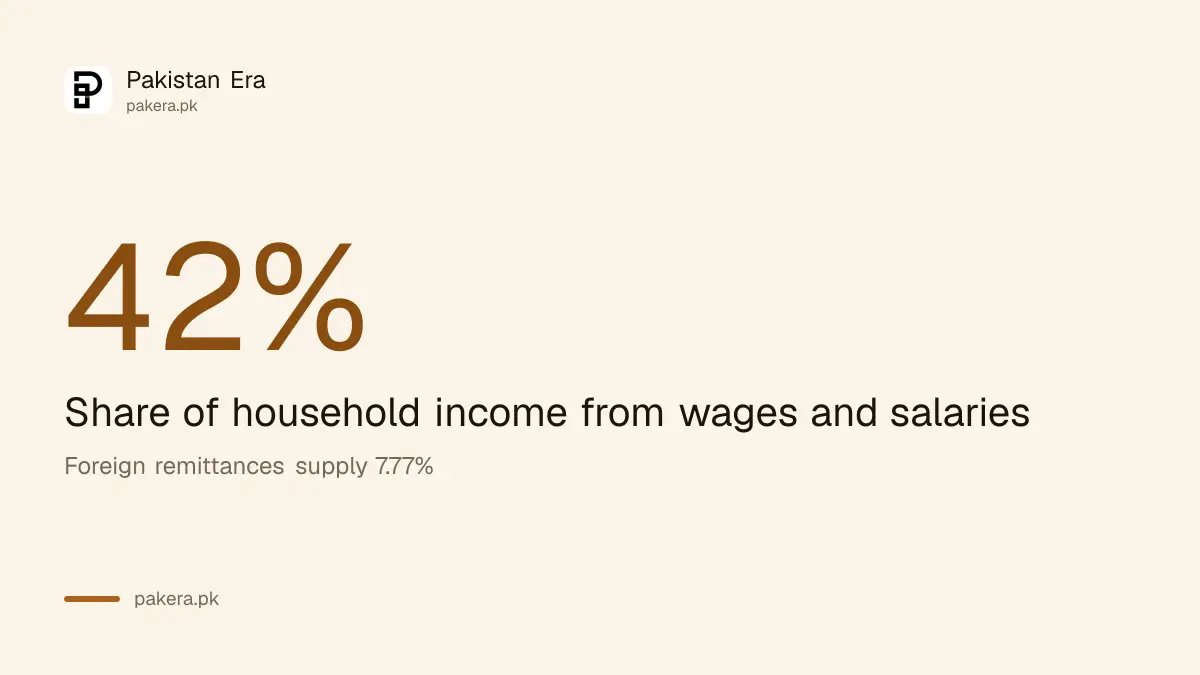
The remaining 20 per cent or so comes from owner-occupied housing value, pensions and social insurance, gifts and assistance, domestic remittances and other sources. Gifts and assistance include cash transfers received through BISP, PBS notes.
Spending averaged Rs 79,150, so the gap to income is small
The same survey puts average household spending at Rs 79,150 a month. Income of Rs 82,179 less spending of Rs 79,150 leaves Rs 3,029, by our subtraction. That is about 3.7 per cent of income before any saving or debt repayment.
For the poorest fifth the margin is thinner. Their income of Rs 41,851 compares with spending of Rs 39,998, which leaves Rs 1,853 a month.
This is why a rise in food or electricity bills lands so hard. Our note on what Rs 10,000 from 2022 is worth today shows how fast prices have moved, and the household budget effect of the oil shock shows where the next squeeze comes from.
Use the average with care, and know what the survey cannot tell you
The HIES is a sample survey. It describes groups, not your house. It relies on what households tell the survey team, and the report does not say how well business and farm income were captured.
The figures are for the survey year 2024-25. Pay and prices have moved since. And the HIES counts a household, so a home with four earners and a home with one earner are placed on the same line. Compare like with like: your total household income, not one salary.
If you want to check a minimum wage claim, read the Islamabad minimum wage shortfall guide instead. A household figure is not a wage rate.
Common questions
What is the average household income in Pakistan?
It is Rs 82,179 a month in 2024-25, says PBS. Urban households average Rs 96,767 and rural households Rs 72,157.
Is Rs 82,179 what a typical family earns?
No. It is a mean pulled up by rich households. The middle fifth of households averages Rs 65,741, which is closer to typical.
How much do the richest households earn?
The richest fifth averages Rs 139,317 a month. In cities it is Rs 146,920 and in villages Rs 129,494.
Does household income include remittances?
Yes. Foreign remittances are 7.77 per cent of household income and domestic remittances another 3.77 per cent.
Where can I read the table myself?
Open the HIES page on the PBS website, then the 2024-25 report. Income is in Table 3.5.A and spending in Table 3.6.A.
How we verified this
What we checked, where we read it, and what we could not confirm.
We read the Pakistan Bureau of Statistics HIES page and its HIES 2024-25 report on 12 October 2026. The figures are survey results for 2024-25 and may change when PBS publishes revisions. For the other official numbers on one page, see how to check inflation, reserves and remittances on official pages.
About the author

Global Affairs & Political Economy Writer
Muhammad Hatim is a book lover who started writing because he enjoys it. At Pakistan Era he writes about international relations, geopolitics and the global economy, with a particular interest in South Asia and the forces behind current events.