Check Your Household Budget Against Pakistan's Average: 37% Food, 26% Housing and Bills
The average Pakistani household spent Rs 79,150 a month in 2024-25, PBS says. See how much goes on food, housing, bills and school, and compare your budget.
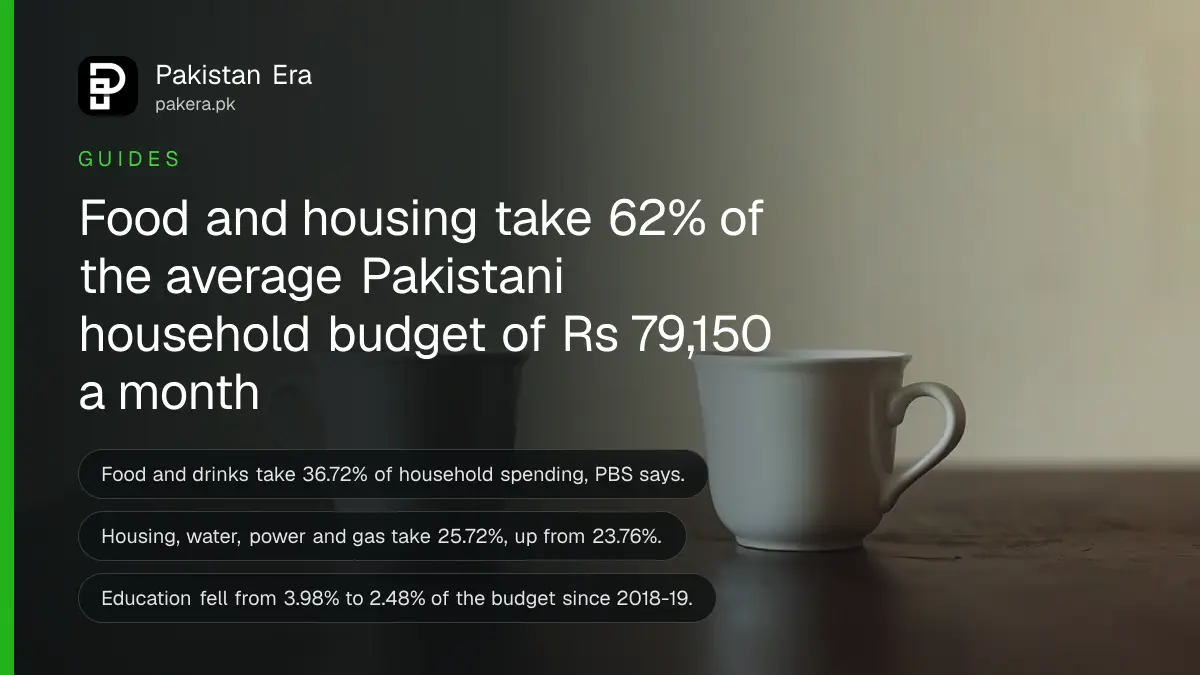
Short answer: The average Pakistani household spent Rs 79,150 a month in 2024-25, says the Pakistan Bureau of Statistics (PBS). About 36.7 per cent went on food and 25.7 per cent on housing, water, electricity and gas. Together that is 62.4 per cent, or roughly Rs 49,400 of every Rs 79,150, by our arithmetic.
Open your own notebook or phone and add up last month. Food, rent or house costs, and the electricity and gas bills usually swallow most of the page. The national survey says your family is not unusual. This page sets your numbers beside the PBS averages so you can see where you spend more than most.
We read the PBS Household Integrated Economic Survey (HIES) 2024-25 report on 12 October 2026, including its tables on spending by category and by food item.
Food and housing take 62 per cent of the household budget
PBS splits household spending into twelve groups. Food and non-alcoholic drinks are the largest at 36.72 per cent. Housing, water, electricity, gas and other fuels come second at 25.72 per cent. Nothing else reaches 7 per cent.
| Spending group | Share of budget | On Rs 79,150 a month |
|---|---|---|
| Food and non-alcoholic drinks | 36.72% | about Rs 29,060 |
| Housing, water, electricity, gas, fuels | 25.72% | about Rs 20,360 |
| Restaurants and hotels | 6.63% | about Rs 5,250 |
| Clothing and footwear | 6.28% | about Rs 4,970 |
| Transport | 6.21% | about Rs 4,920 |
| Miscellaneous goods and services | 5.25% | about Rs 4,160 |
| Health | 3.34% | about Rs 2,640 |
| Furnishing and household upkeep | 3.25% | about Rs 2,570 |
| Education | 2.48% | about Rs 1,960 |
| Communication | 1.80% | about Rs 1,420 |
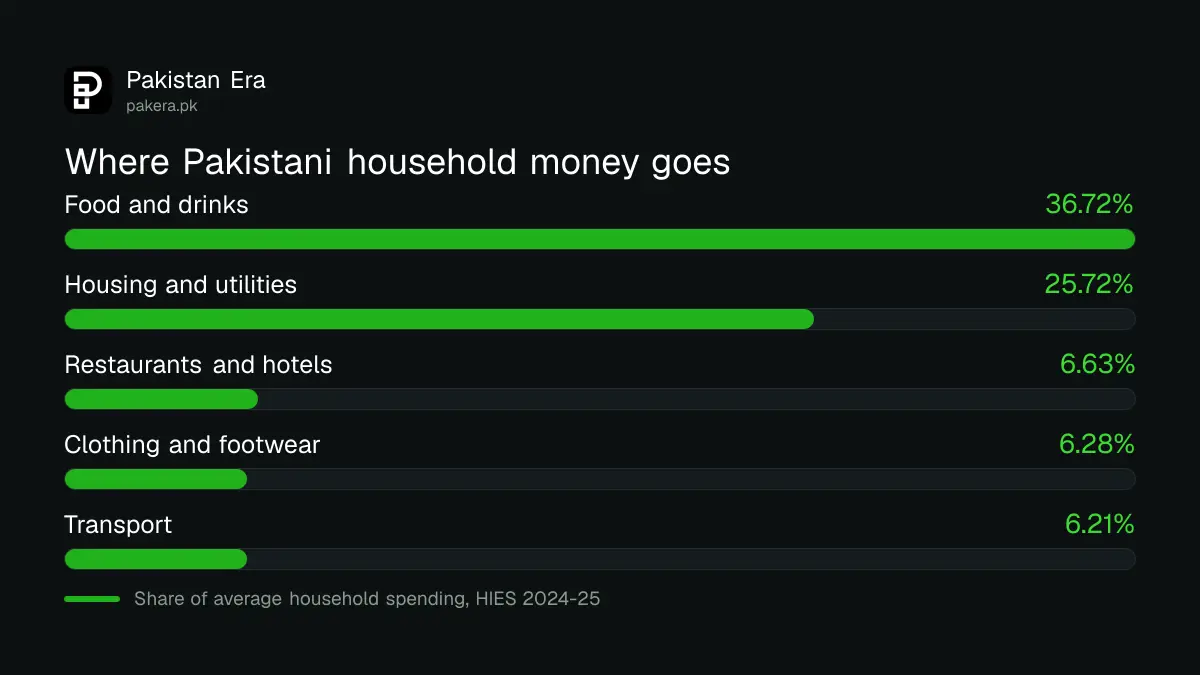
The rupee column is our multiplication of each share by Rs 79,150, rounded. It is an average. No real family spends exactly this way.
One report figure needs a flag: food is 36.72 or 36.05 per cent
The PBS report gives food as 36.72 per cent in its 2024-25 breakdown. A later sentence says food moved "from 36.72% to 36.05%" between 2018-19 and 2024-25. Those two statements cannot both describe 2024-25.
We use 36.72 per cent because the twelve shares in the 2024-25 breakdown add up to 100 per cent with it. Either way, food is a little over a third of the budget. If PBS corrects its report, we will update this page.
Housing grew its share while education fell
Housing, water, electricity, gas and fuels rose from 23.76 per cent in 2018-19 to 25.72 per cent in 2024-25. Education fell from 3.98 per cent to 2.48 per cent. Health edged up from 3.22 per cent to 3.34 per cent.
Utility bills are one reason. Our guide to home electricity slab rates in 2026 shows what a unit costs at each level of use. Education has a smaller share, but PBS does not say why. Households may spend less, or other costs may simply have grown faster.
Milk and wheat lead the food bill
Inside the food budget, milk takes 21.75 per cent and wheat and wheat flour 11.74 per cent. Vegetables are 9.10 per cent, restaurants and hotels 7.20 per cent, and vegetable ghee 5.84 per cent.
- Milk, fresh and boiled: 21.75 per cent of food spending.
- Wheat and wheat flour: 11.74 per cent.
- Vegetables: 9.10 per cent.
- Hotels and restaurants: 7.20 per cent.
- Vegetable ghee: 5.84 per cent.
Rural homes spend more on staples. Wheat is 13.41 per cent in villages against 9.57 per cent in cities, and vegetable ghee is 7.25 per cent against 4.01 per cent. City homes spend more eating out: 9.44 per cent of food spending against 5.47 per cent in villages.
That is why a flour price jump hurts village budgets first. Our weekly note on flour rising 5.69 per cent in a week shows the latest price move.
Spending rises with income, from Rs 39,998 to Rs 134,684
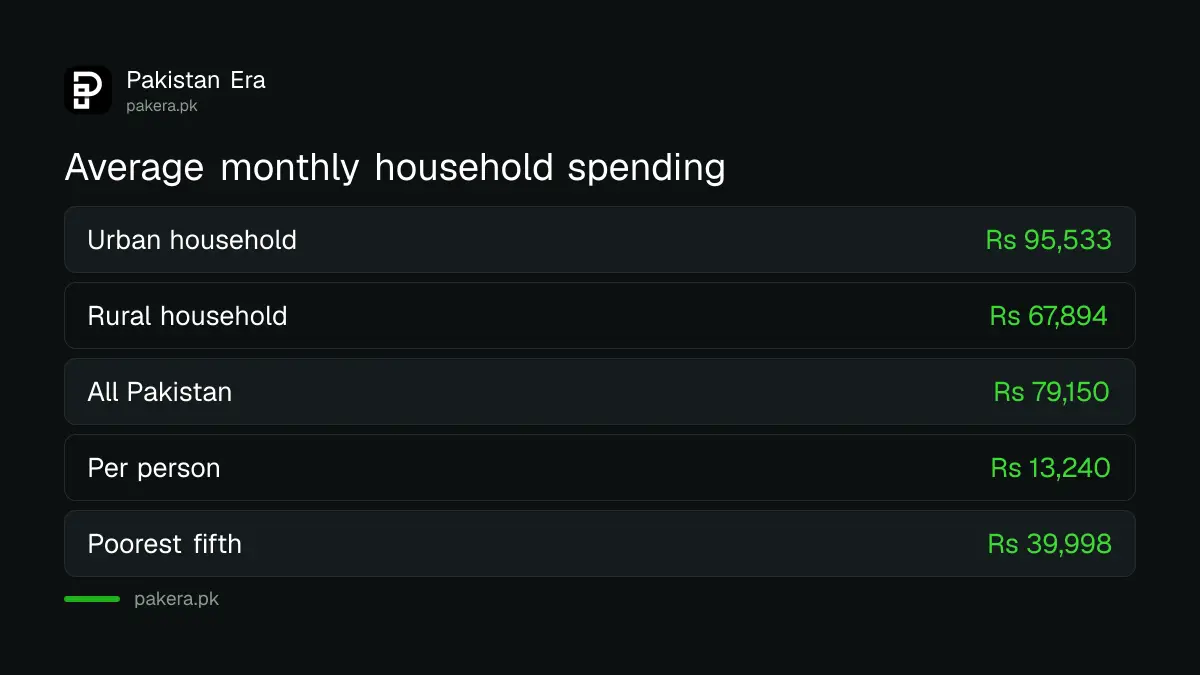
PBS also sorts households into five spending groups. The poorest fifth spends Rs 39,998 a month and the richest fifth Rs 134,684. City households average Rs 95,533 and village households Rs 67,894.
Per person, the national average is Rs 13,240 a month, up from Rs 5,959 in 2018-19. Urban individuals spend Rs 16,795 and rural individuals Rs 10,991.
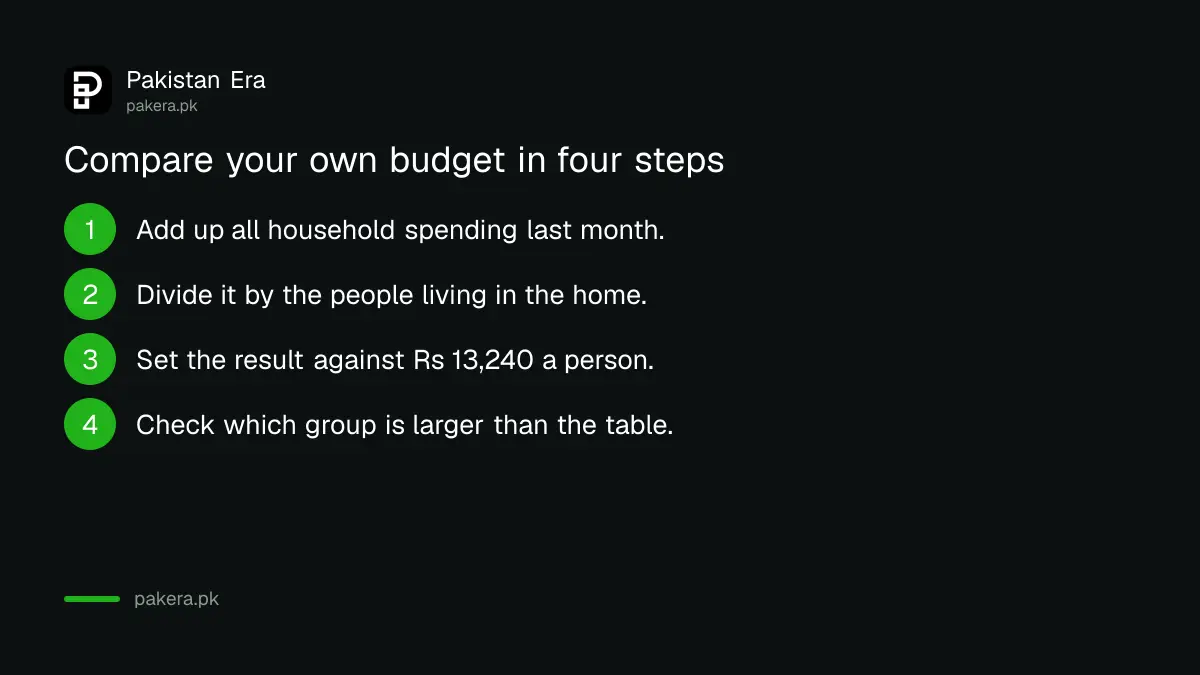
To compare yourself, divide your total monthly household spending by the number of people in the home. Then set it beside Rs 13,240. If you are far above it, look at which group in the table above is largest.
Common questions
How much does an average Pakistani household spend in a month?
It is Rs 79,150 in 2024-25, says PBS. Urban households spend Rs 95,533 and rural households Rs 67,894.
What share of the budget goes on food?
It is 36.72 per cent in the PBS 2024-25 breakdown. A later sentence in the same report mentions 36.05 per cent, so treat it as about 36 to 37 per cent.
Which spending group is second largest?
Housing, water, electricity, gas and other fuels, at 25.72 per cent. It grew from 23.76 per cent in 2018-19.
How much does one person spend per month?
The national average is Rs 13,240 a person. In cities it is Rs 16,795 and in villages Rs 10,991.
Where can I read the tables myself?
Open the HIES page on the PBS website and the 2024-25 report. Spending shares are in section 3.8 and food items in Table 3.7.A.
How we verified this
What we checked, where we read it, and what we could not confirm.
We read the Pakistan Bureau of Statistics HIES page and its HIES 2024-25 report on 12 October 2026. This is a survey average for 2024-25, not a measure of any one family. Compare it with the four inflation numbers explained to see how prices have moved since.
About the author

Global Affairs & Political Economy Writer
Muhammad Hatim is a book lover who started writing because he enjoys it. At Pakistan Era he writes about international relations, geopolitics and the global economy, with a particular interest in South Asia and the forces behind current events.