Check a Dual, Double or Joint Degree Has an HEC NOC Before You Pay in Pakistan
HEC's 9 May 2026 policy says a university needs an HEC NOC before it offers a dual, double or joint degree. Use these six checks before you pay or enrol.
Short answer: Before you pay for a dual, double or joint degree in Pakistan, ask the university for the HEC no objection certificate (NOC) for that programme. HEC's policy of 9 May 2026 says a university must get this NOC before it launches such a programme. A partner university with no HEC recognition is a red flag.
An advert says you will earn two degrees in three years, one from a Pakistani university and one from a foreign one. It sounds like a bargain. Some of these arrangements are real. Some are only a poster. HEC has now written the rules down, so you can test the offer against them.
We read the HEC press release of 9 May 2026 and the full text of the policy on the HEC website on 12 October 2026. We did not find a public list of approved collaborative programmes on the HEC pages we opened, so this guide shows what to ask for. It does not say which programmes are approved.
The policy covers three kinds of degree, and each is different
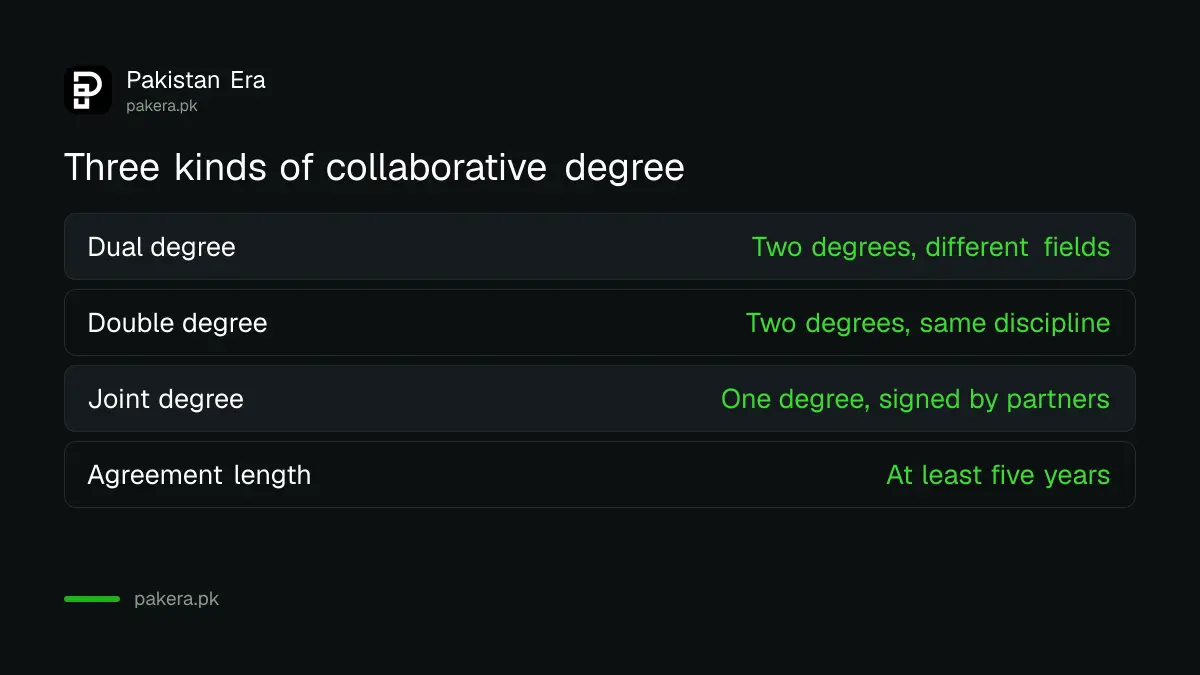
A dual degree gives two degrees in different or related fields. A double degree gives two degrees in the same discipline from partner institutions. A joint degree gives one degree, signed by all the partners. Ask which one you are being sold, because the paper you get at the end differs.
| Type | Degrees you receive | Fields | Who awards it |
|---|---|---|---|
| Dual degree | Two | Different or closely related fields | One or more partner institutions |
| Double degree | Two | The same discipline | Partner institutions |
| Joint degree | One | Any discipline | Jointly awarded and signed by all partners |
The university needs an HEC NOC before it launches
HEC says an institution must obtain its statutory approvals, sign a detailed agreement with its partner, map credits, define entry and exit rules, disclose fees, protect students and seek HEC's NOC before launching a programme. If the university cannot show the NOC, it has not finished the process.
The agreement between the partners is called a Memorandum of Commitment. It must run for at least five years and it forms part of the application sent to HEC. You can ask the admissions office for the NOC letter and its reference, and for the programme name exactly as it appears on that letter.
Check the partner university and the programme
The policy sets conditions for the partner. A foreign university must be listed in UNESCO's World Higher Education Database or be recognised in its own country. The relevant programme must also be ranked in the top 1,000 in a QS or Times Higher Education subject ranking, with a case by case route for some professional fields.
For two Pakistani institutions, both must hold valid HEC recognition. Where a professional council applies, such as the Pakistan Engineering Council, the programme must have that accreditation too. Confirm first that the university is HEC recognised, and for engineering check the programme is PEC accredited.
Read what the university must publish before you enrol
Before it starts enrolment, the university must publish clear information on its website. This includes the partner institution, the degrees awarded, the credit split, the mobility requirements, the full fee for the whole programme and the language of study. If any of these are missing, ask in writing.
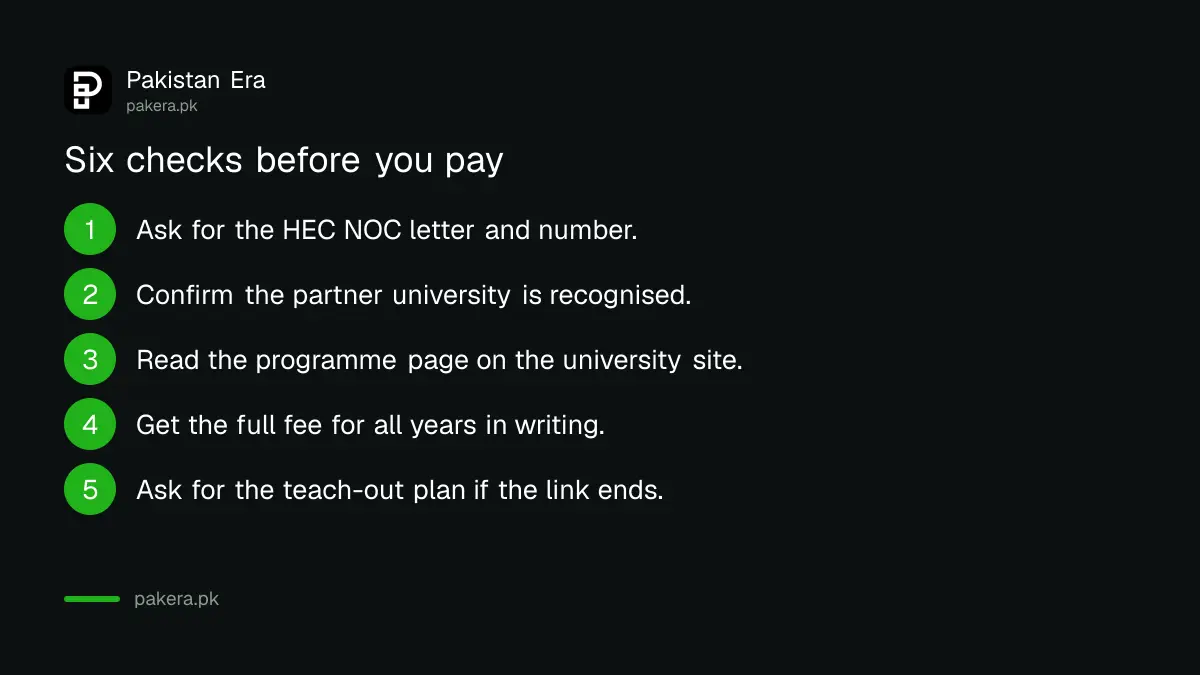
- Ask for the HEC NOC letter and its reference number.
- Find the partner's name in the UNESCO database or ask for proof of its recognition.
- Read the website page that lists the degrees, credits, mobility and language.
- Get the complete fee for the whole programme, in writing, including exam and travel costs.
- Ask what happens to you if the partnership ends: the teach-out plan.
- Ask for the diploma supplement format you will receive at the end.
The fee and exit rules protect you
The policy says the complete fee for the whole programme must be told to you before enrolment and written into the agreement. A fee increase must be capped at a rate agreed in that agreement. The universities cannot raise fees unilaterally for a cohort already enrolled.
If a programme ends, the teach-out plan must let you finish, or give you a full refund of fees paid and a transfer of credits. A partner that wants to leave must give twelve months' written notice and cannot take new students after the notice. Students who cannot finish are to get an exit pathway, such as one degree from the home institution or a certificate of coursework.
If you want to leave early and recover money, the HEC rule for a university fee refund sets a general schedule for tuition.
Foreign degrees still need HEC equivalence
The policy says a foreign-awarded degree needs HEC equivalence for it to be officially recognised in Pakistan. Ask whether the programme's foreign degree is covered, and apply when you have it. You can get HEC equivalence for a foreign degree online once you hold the degree.
Common questions
Who approved the dual, double and joint degree policy?
HEC approved it, and the HEC press release is dated 9 May 2026. It applies to public and private higher education institutions in Pakistan at undergraduate and graduate level.
Can I get two degrees at the same time?
Only through an approved collaborative programme. The policy lets degrees be awarded one after another within a shorter combined time, or with a gap, but the course contents must be covered, with exemptions for common courses.
How do I check that a programme has HEC approval?
Ask the university for the NOC letter and reference number. We did not find a public list of approved programmes on HEC pages, so you can also ask HEC directly.
How long can the programme take?
The policy says the maximum time to finish must not be more than twice the standard duration of the programme, unless the partners and HEC agree an exception.
What if the university does not answer a complaint?
Student grievances are to be resolved within sixty calendar days of filing. After that you may escalate to HEC. You can file a complaint on the HEC student grievance portal.
Does this policy cover agents who sell study abroad?
No. It covers universities. For agents, check a study abroad agent first.
How we verified this
What we checked, where we read it, and what we could not confirm.
We read the HEC press release and the policy document on hec.gov.pk on 12 October 2026. The policy text is dated 2026 and the press release 9 May 2026. We did not see a list of approved programmes, and a university's own page may add rules. Confirm the NOC with the university and with HEC.
About the author

Public Services and Education Journalist
Fajr Riaz is a journalist and content writer at Pakistan Era, based in Lahore. She covers the questions people meet in everyday life in Pakistan: how a public service works, what a change in the rules means, and where to find a reliable answer.