How to Check a University's NSCT Result Before Joining a BS Computing Degree in Pakistan
Check your NSCT result with your CNIC and read your university's pass rate on the HEC site before paying fees. See the steps, table columns and warnings.
To check an NSCT result, open the HEC announcement page, choose the individual result link and type your CNIC without dashes. To check a university, open the university-wise table and read its pass percentage. Both are free and need no login. Do this before you pay a semester fee for a BS computing degree.
The National Skill Competency Test, or NSCT, is a test the Higher Education Commission (HEC) ran for final-year computing students in 2026. Parents want to know one thing: do this university's graduates pass? The HEC tables answer part of that. This guide shows where to look and how to read what you find.
Check your own NSCT result with your CNIC
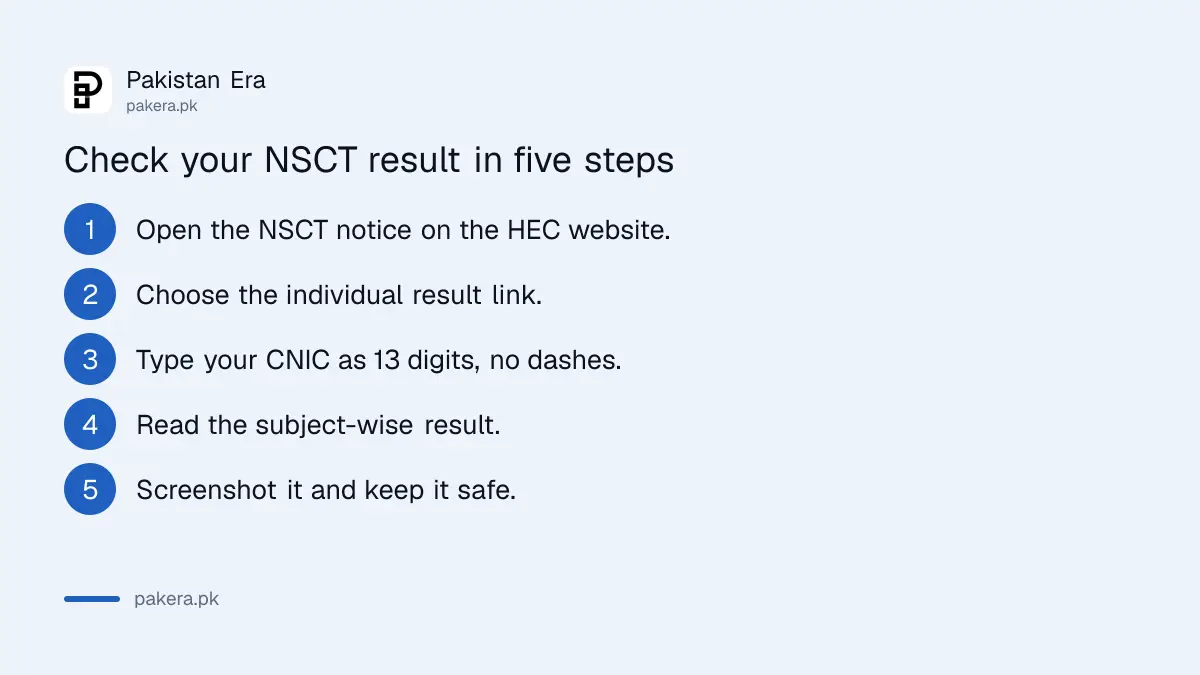
An individual result needs only a CNIC number. Open the HEC NSCT announcement page, pick the link for individual student results, enter the 13 digits with no dashes and read the subject-wise breakdown that appears.
We opened the individual result page on 8 October 2026. It asks for the CNIC "without dashes" and shows an error if the box is empty. The result lists performance by subject, including operating systems, software engineering, data structures, programming, databases, cybersecurity and artificial intelligence.
- Open the NSCT result announcement on the HEC website (hec.gov.pk, under HEC Announcements).
- Choose the link for individual students' results.
- Type your CNIC as 13 digits with no dashes or spaces.
- Read the subject-wise result and take a screenshot.
- Keep the screenshot with your degree papers.
If you are a parent checking for a child, use the child's CNIC or B-Form number only if the page accepts it. We saw a box for CNIC, so a younger student without one may not be able to look up a result. In that case, ask the university for the result slip.
Read the university-wise table before you pick a department
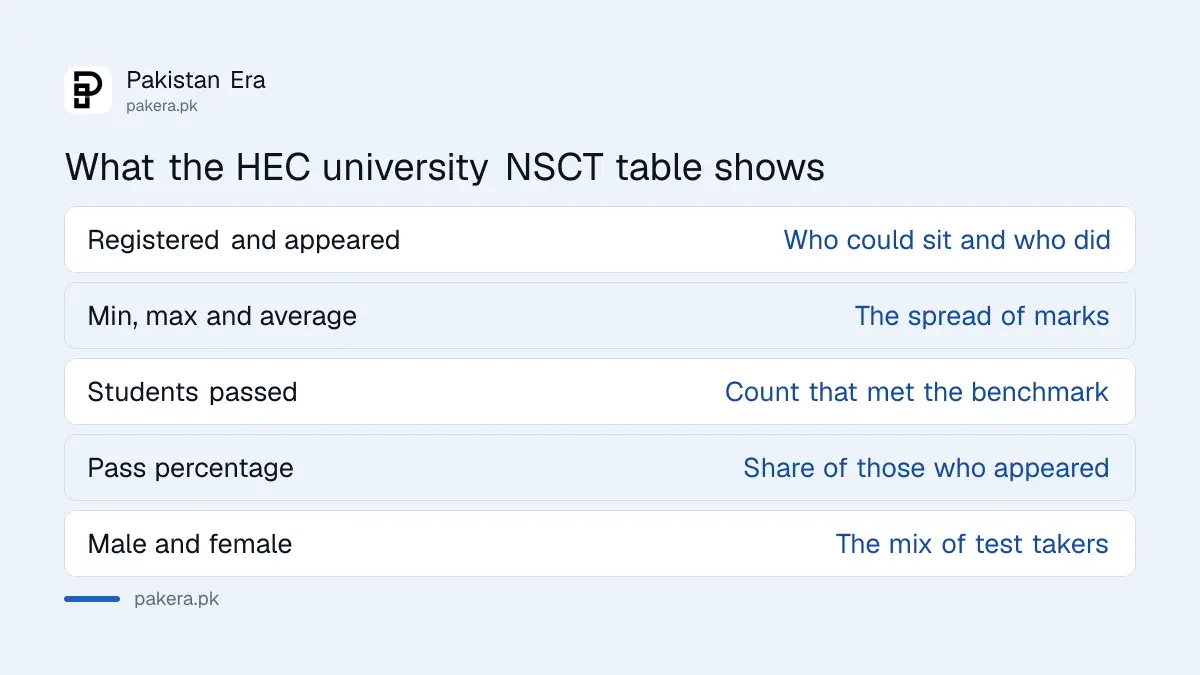
The university-wise table lists every institution whose students took the test. Look at how many registered, how many appeared, the lowest, highest and average score, how many passed and the pass percentage among those who appeared.
HEC says the test covered more than 33,000 students from the 7th and 8th semesters of computing programmes, at 165 centres in 112 cities. That is the scale behind each row, but each university's row is much smaller, so a few students can move a percentage a lot.
| Column in the table | What it tells you |
|---|---|
| Registered and appeared | How many students could have sat the test and how many did |
| Male and female | The mix of test takers |
| Minimum, maximum and average score | The spread of marks inside one university |
| Students passed | The count of students who met the pass benchmark |
| Pass percentage of those who appeared | The figure most readers compare |
Compare the pass percentage with the number who appeared. A university with 20 test takers and a university with 600 are not the same kind of evidence. Also compare the average score with the maximum. A high maximum with a low average means a few strong students and many weak results.
The page itself does not explain the scoring method or the pass mark. We looked for a note on 8 October and found none. So treat the table as a comparison between universities, not as proof of how good one graduate is.
Understand what the bottom 20 percent list means
HEC also published a list called Bottom 20% Institutions in the NSCT. It is a table of the institutions whose students scored lowest. It tells you where results were weakest, not whether a degree is valid.
When we read the list on 8 October 2026 it held 45 institutions. It shows the same columns as the main table. It gives no written reason for the classification and no method. We have not named any university here, because a list position is a statement about one test result, and you should read the exact row yourself.
A separate point is reported but was not on the HEC pages we read: that HEC stopped new admissions to computing programmes at 44 institutions on 23 June 2026, until audits and reviews finish. If a university you like is on the bottom list, ask it in writing whether its computing admissions are open, and ask HEC. Do not rely on a social media post either way.
Check accreditation and admission status before you pay a fee
An NSCT row is one signal. Before paying, confirm three more things: that the university is recognised, that the computing programme has national accreditation, and that the department is allowed to admit students this semester.
Start with whether the university is on the HEC list, using the steps in how to check if a university or campus is HEC recognised. Then check the programme itself with the guide to checking whether a BS computer science programme is NCEAC accredited. Accreditation matters at the end too, because HEC has said it will attest only NCEAC-accredited computing degrees from June 2027, as explained in the note on HEC attesting only accredited computing degrees.
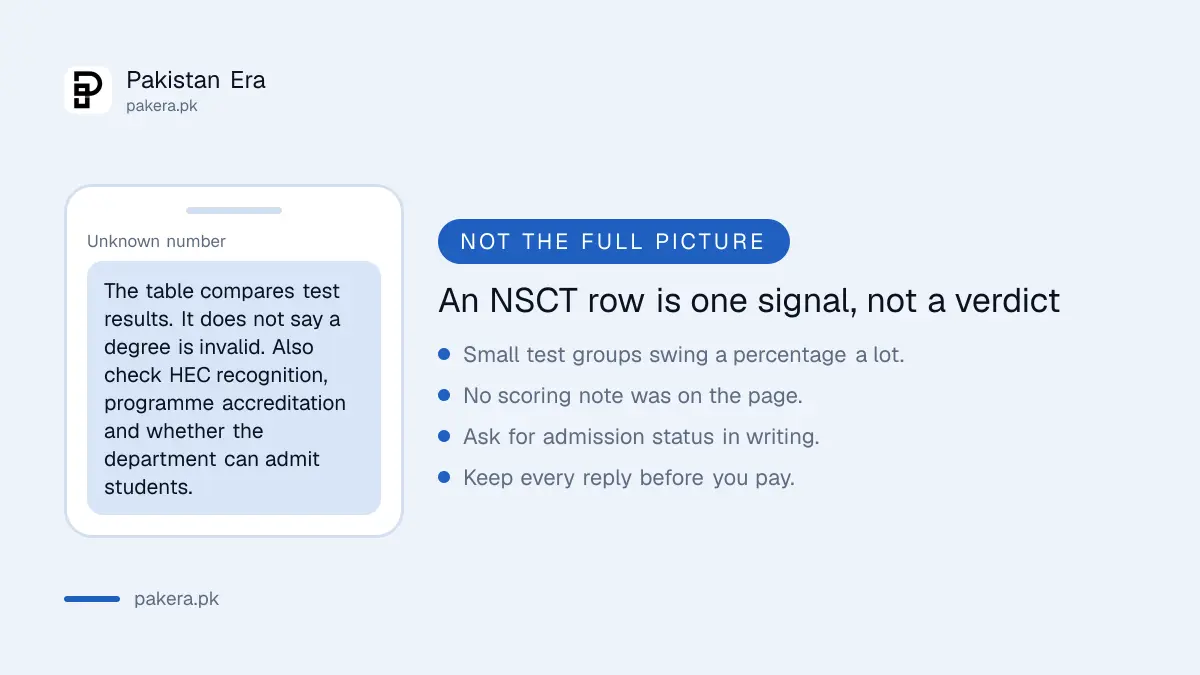
Ask the admission office for these in writing: the programme's accreditation status, the current admission notice and the fee refund rule. If a counsellor only speaks on the phone, be careful.
Common questions about the NSCT result
These short answers cover what families ask most about the HEC test, the result links and what a low pass rate means for a student who is already enrolled or about to enrol in a computing degree.
What is the NSCT?
It is a National Skill Competency Test run by HEC for computing students in the 7th and 8th semesters. It checks subjects such as programming, databases, cybersecurity and software engineering.
Do I need a login to see my NSCT result?
No login was needed when we checked. You type your CNIC without dashes on the individual result page.
Does a low university pass rate mean my degree is invalid?
No. The result table measures test performance. Degree recognition and attestation depend on HEC recognition and, for computing, accreditation. Ask the university and HEC about your case.
Can I still enrol in a university on the bottom 20 percent list?
That depends on whether its computing admissions are open. Ask the university in writing and keep its reply before you pay any fee.
Where do I find the full NSCT report?
The HEC announcement page links a complete report with analytics, a top performers list and the university tables.
How we verified this
What we checked, where we read it, and what we could not confirm.
Last checked on 8 October 2026 against pages on the HEC website: the NSCT announcement, the university-wise table, the bottom 20 percent table and the individual result page. The 44 university admission suspension of 23 June 2026 is reported and was not on those pages.
About the author

Senior Writer, Public Services and Technology
Shahid joined us in 2024 as an author. He is a senior contributor to Pakistan's leading technology websites. He writes detailed articles, mostly covering his expertise in the latest tech, mobiles, apps, gadgets, and step-by-step guides. His ideology is to help people understand the latest trends and explain complex methods through very easy-to-understand guides.