Check Whether Wi-Fi 6E and the 6 GHz Band Are Allowed in Pakistan Under PTA's 2024 Rules
PTA's 2024 Wi-Fi framework opens 2.4, 5 and the lower 6 GHz band for licence free use. See the power limits, the ban on 6 GHz links and how to check a router.
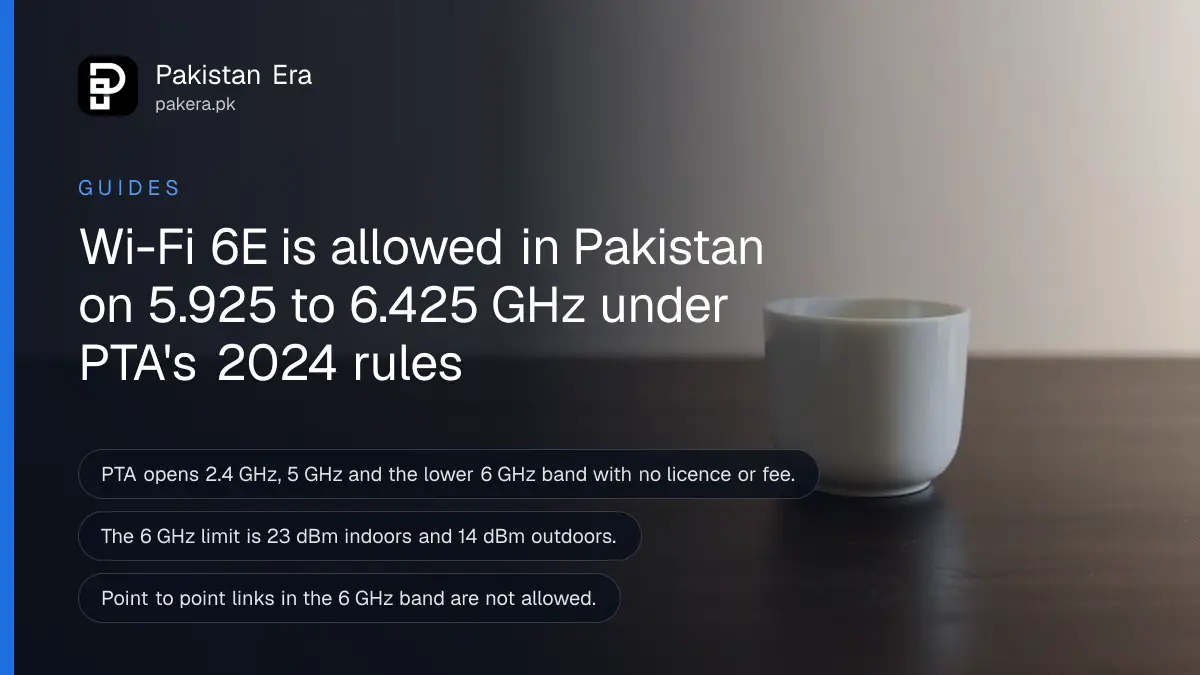
Short answer: Yes. PTA's September 2024 Wi-Fi framework opens the lower 6 GHz band, 5.925 to 6.425 GHz, for licence free use, alongside 2.4 GHz and 5 GHz. Indoor use is capped at 23 dBm, outdoor at 14 dBm, and point to point links in that band are banned. Your device still needs PTA type approval.
You see "Wi-Fi 6E" on a router box and wonder if the extra band is legal here. It is, in part. PTA has published the rules, and they are short enough to read in ten minutes.
We downloaded PTA's Framework for Wireless Local Area Network, 2024, and the Type Approval FAQ sheet on 14 October 2026 and read both. The framework is five pages.
PTA opens three Wi-Fi bands without a licence
The framework lists the 2.4 GHz, 5 GHz and 6 GHz bands for Wi-Fi. Equipment may use them with no licence and no spectrum fee, but only on a secondary basis. That means it must not disturb official services and must accept interference from them.
| Band | What PTA's framework allows |
|---|---|
| 2.40 to 2.50 GHz | 30 dBm EIRP |
| 5.725 to 5.875 GHz | 30 dBm EIRP |
| 5.925 to 6.425 GHz (6 GHz) | Indoor 23 dBm, outdoor 14 dBm, with power density limits |
| Spectrum fee | None, for commercial or non-commercial use |
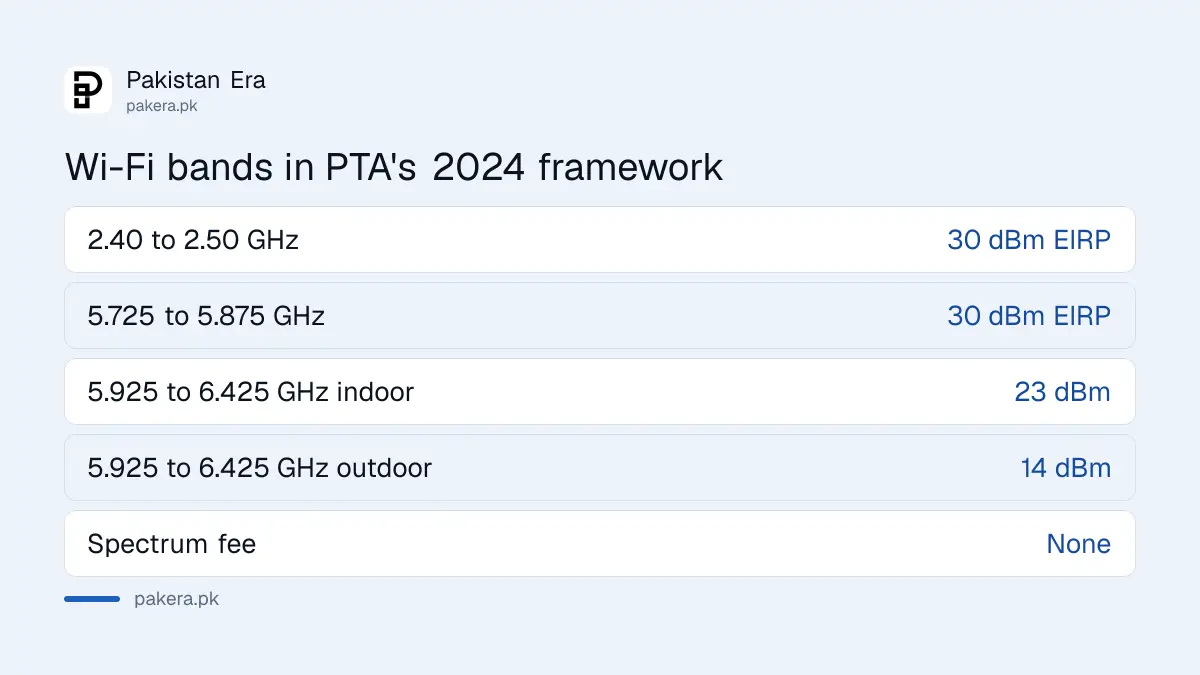
EIRP is the total radiated power including the antenna. A dBm is a unit of power: 30 dBm is 1 watt and 23 dBm is about 0.2 watt. Typical home routers sit well below these caps.
The framework table is printed in a way that makes it hard to match each limit to each band. We read the 23 dBm and 14 dBm figures, the indoor and outdoor notes and the power density limits as belonging to the 6 GHz row. If you plan a large deployment, ask PTA to confirm the row.
The 6 GHz rule is indoor first and outdoor at lower power
For 6 GHz, the framework gives two power levels: a maximum mean EIRP of 23 dBm for indoor use, with a power spectral density of no more than 10 dBm per MHz, and 14 dBm for outdoor use, with no more than 1 dBm per MHz. Narrow channels below 20 MHz may use 10 dBm per MHz.
The framework defines an indoor access point as one that is wired to mains power, has built in antennas, no battery and no weatherproof case. A router that meets that description fits the indoor level.
Point to point and point to multipoint backhaul links in 5.925 to 6.425 GHz are not allowed. So a 6 GHz wireless bridge between two buildings does not fit this framework.
The upper 6 GHz band is not covered
The framework names only 5.925 to 6.425 GHz. Many Wi-Fi 6E and Wi-Fi 7 devices can also use up to 7.125 GHz, but the framework says nothing about 6.425 to 7.125 GHz. We treat that upper part as not opened for Wi-Fi in Pakistan until PTA says otherwise.
A device sold here should respect that. If you buy abroad, check that the 6 GHz channels the router uses are inside the lower range, or ask the seller for the PTA approval number.
PTA's Type Approval FAQ sheet adds a second view. Its annex lists Wi-Fi at 5.150 to 5.350 GHz, 5.470 to 5.725 GHz and 5.725 to 5.875 GHz, and Wi-Fi 6E at 5.925 to 6.425 GHz, with no PTA licence needed. The WLAN framework table lists only 5.725 to 5.875 GHz for 5 GHz. The two PTA documents differ, so we cannot say from the text which wider 5 GHz channels are lawful. Say it plainly to the seller: you want a device with PTA approval.
How to check a Wi-Fi 6E router before you buy
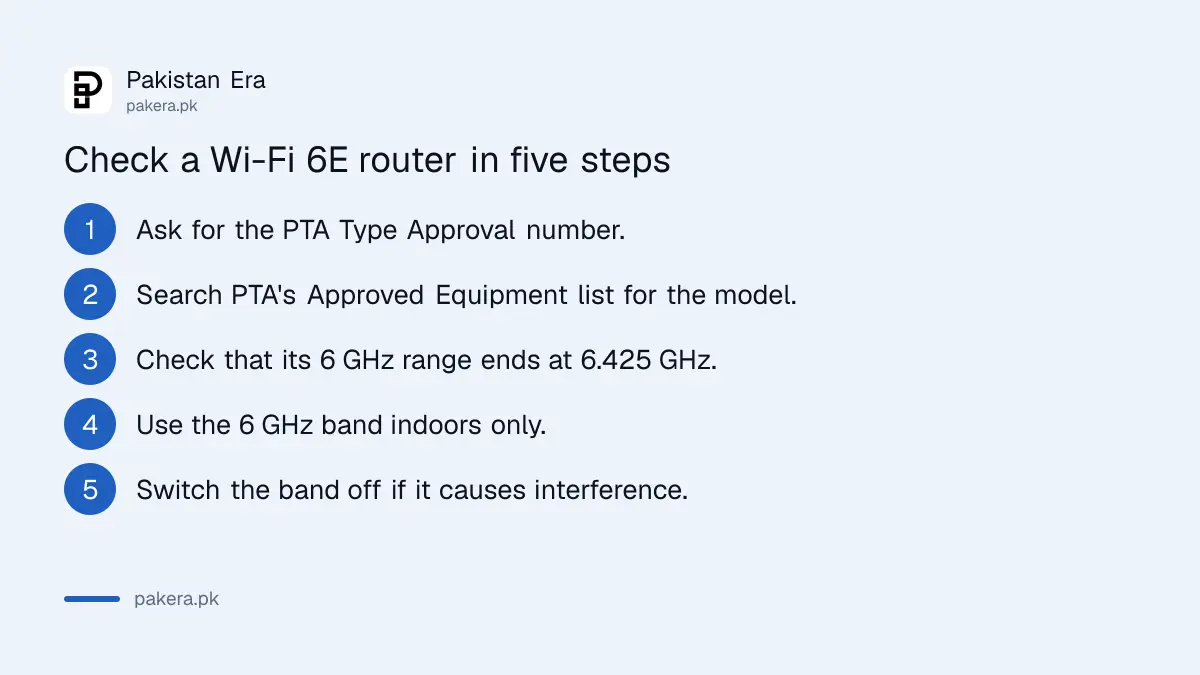
Ask for the PTA type approval number, confirm the model is listed, and check that it supports the lower 6 GHz range. PTA says all terminal equipment with unlicensed Wi-Fi capability needs approval under its type approval rules, and that each model is approved on its own.
- Ask the seller for the PTA Type Approval number and the words "Approved by PTA" on the box or in the settings.
- Search PTA's Approved Equipment list for the exact model.
- Check the product page for "6 GHz" and note whether it covers channels up to 7.125 GHz.
- Use the router indoors on 6 GHz. Do not point it through windows to another building.
- If it causes interference to any service, switch that band off. PTA says interference means you must stop.
Our guide on checking PTA type approval on a router shows where to find the register. After you buy, router placement matters more than the band, because 6 GHz signals fade faster through walls. If a device keeps dropping on the fast band, switching to 2.4 GHz is a simple fix.
What the framework means for shops and cafes
Using Wi-Fi to sell a telecom service is allowed only for licensed telecom providers. A cafe that offers free Wi-Fi is a different case and has its own record keeping rules, which we cover in PTA's rules for public Wi-Fi in a shop.
PTA can review the framework at any time. It says use is on a sharing basis with other services and that a user must follow interference fixes at once.
Common questions
Is Wi-Fi 6E legal in Pakistan?
Yes, in the lower 6 GHz band of 5.925 to 6.425 GHz, under PTA's 2024 framework, as long as the device is type approved.
Do I need a licence to run a Wi-Fi 6 router at home?
No licence or spectrum fee is needed for the listed Wi-Fi bands. The device needs PTA type approval, and you must stay within the limits.
Can I use 6 GHz outdoors?
The framework sets an outdoor level of 14 dBm, lower than the indoor 23 dBm. It bans point to point links in the 6 GHz band.
Is Wi-Fi 7 allowed in Pakistan?
The framework does not mention Wi-Fi 7 by name. It covers the 2.4, 5 and lower 6 GHz bands only, so features that rely on the upper 6 GHz range are not covered.
Who can sell Wi-Fi as a paid service?
Only a telecom provider that holds a PTA service licence, subject to the framework's conditions.
How we verified this
What we checked, where we read it, and what we could not confirm.
Last checked on 14 October 2026. Sources: PTA, Framework for Wireless Local Area Network, 2024 (September 2024, five pages), and PTA's Type Approval FAQ sheet dated 23 July 2025, both on pta.gov.pk. We did not test any router or measure a signal. The framework's table layout is ambiguous, as noted above, and PTA can revise the framework.
About the author

Technology Journalist & Multimedia Producer
Ahmad Ali is a technology journalist and multimedia producer at Pakistan Era, joining the team in October 2026. He covers consumer technology and digital life for Pakistani readers, combining research with hands-on product testing.