How to Claim an EOBI Survivor's Pension in Pakistan: Who Qualifies and the 9 Documents
An EOBI survivor pension pays the spouse at least Rs 11,500 a month for life after 36 months of insured work. The order of heirs, the form and the 9 documents.
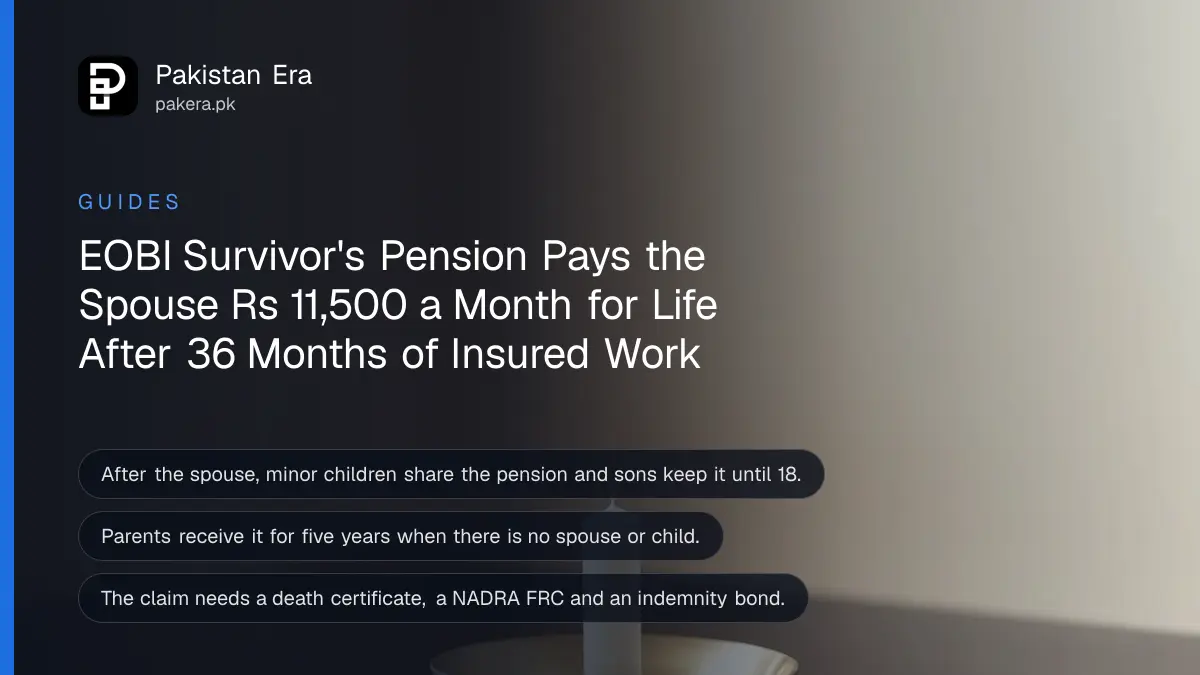
When an EOBI insured worker or pensioner dies, the surviving spouse gets a survivor's pension for life, at the same Rs 11,500 a month minimum as the old-age pension. If the worker died in service, the record must show at least 36 months of insurable employment. The claim goes to the EOBI regional office on a two-page Urdu form with nine supporting documents, led by the death certificate, an FRC from NADRA and an indemnity bond.
We read the benefits section of the Employees' Old-Age Benefits Institution (EOBI) website and downloaded its survivor pension form, issued by the Karachi City Region, on 19 October 2026. EOBI is the federal body that runs the old-age pension scheme for private sector workers under the Employees' Old-Age Benefits Act, 1976. The form is a regional one, so another region may word its checklist slightly differently; the documents are the same in substance.
The spouse gets a life pension, then minor children, then parents for five years
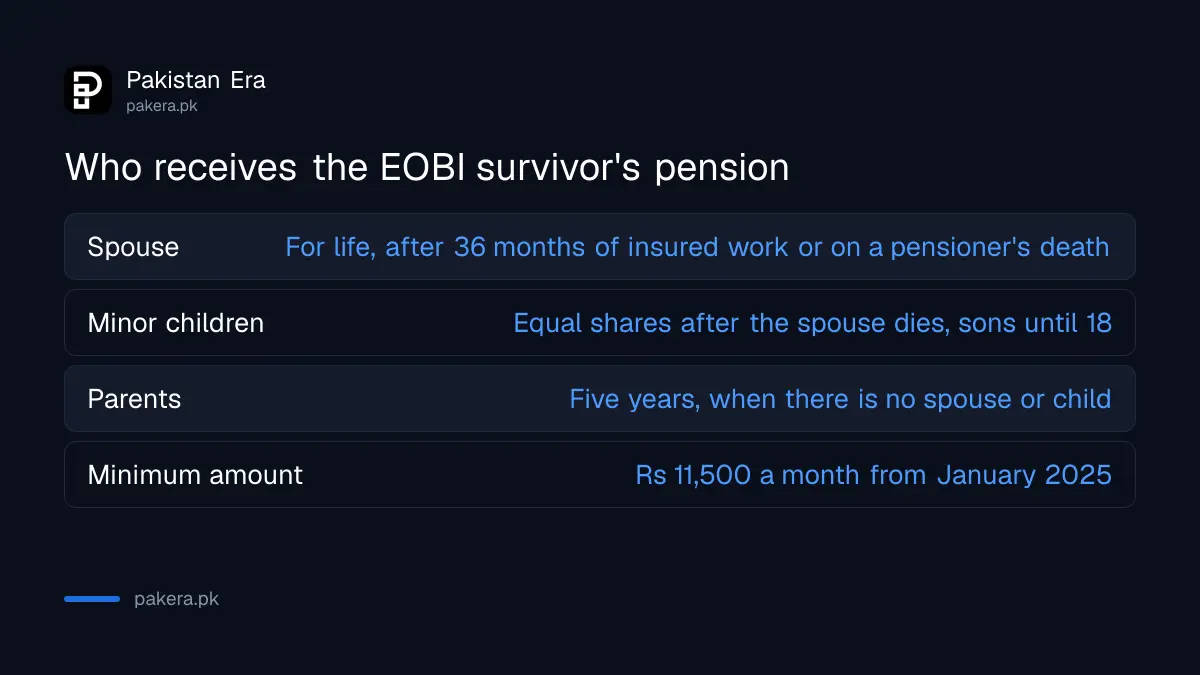
EOBI's benefits page sets out the order. If an insured person dies while in insurable employment after completing not less than 36 months of insurable employment, the surviving spouse is entitled to a life pension. If an old-age or invalidity pensioner dies, the spouse also receives a survivor's pension. The form asks the widow to swear that she has not remarried, so treat remarriage as something the office will ask about.
| Who survives | What EOBI pays | For how long |
|---|---|---|
| Spouse of a worker who died in service after 36 months' insurable employment | Survivor's pension | For life |
| Spouse of an old-age or invalidity pensioner | Survivor's pension | For life |
| Minor children, after the surviving spouse also dies | The pension shared equally | Sons until 18 |
| Parents, where there is no spouse or child | The pension | Five years |
Once the surviving spouse who was drawing the pension dies, EOBI pays it to the minor children, split equally, with a son's share running until he turns 18. If the pensioner left no spouse and no children, the parents receive the pension for five years. The minimum is the same Rs 11,500 a month from January 2025 that applies to the old-age pension, and the amount otherwise follows the formula explained in our guide to the EOBI pension most workers never claim.
If the deceased was already a pensioner, nine documents go with the form
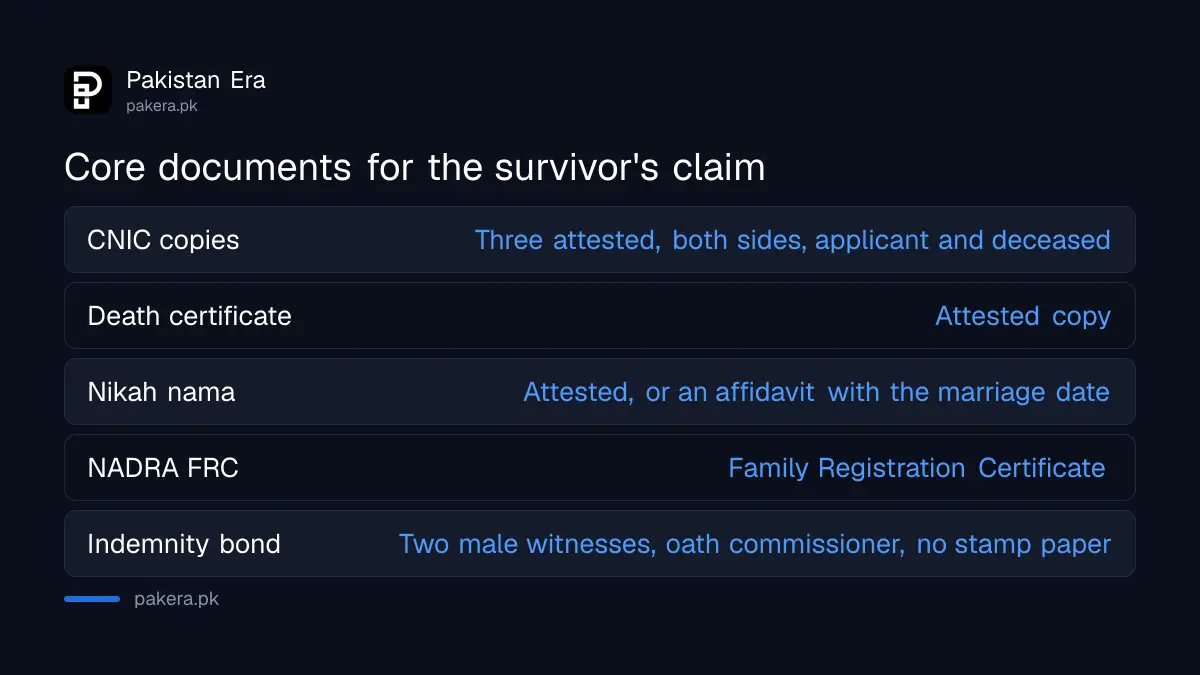
The Karachi City Region checklist for a deceased pensioner runs to nine items. Everything has to be attested by a grade 17 or higher government officer, and EOBI wants more copies than you would expect: three plus three attested copies of the applicant's and the husband's CNICs, both sides.
- Attested CNIC copies, both sides, of the applicant and the deceased, three of each.
- An attested copy of the death certificate.
- Four recent photographs of the applicant, attested by a grade 17 officer or the deceased's employer.
- An attested copy of the nikah nama showing the date of marriage; if there is none, an affidavit stating the date.
- A Family Registration Certificate (FRC) from NADRA.
- An indemnity bond signed by two male witnesses before an oath commissioner, with attested CNIC copies of both witnesses. No stamp paper is needed.
- B-forms for children under 18 and for any disabled child.
- A school certificate, attested, where a child has no B-form.
- The original pension book and the original bank ATM card.
The FRC is the one that takes time. NADRA issues it against the family tree on its record, and it has to show the deceased, the spouse and the children correctly. How to get it, and the Rs 1,000 fee, are in our page on the NADRA Family Registration Certificate. A wrong entry on the FRC stalls the claim, so fix that first.
If the worker died in service, add the EOBI card, service certificate and salary record
Where the deceased had not yet started drawing a pension, the same nine documents apply and five more are added. These prove the insurable employment, because EOBI has to reconstruct a record that the worker never had the chance to claim against.
The additions are: the original EOBI PI-03 registration card; a detailed service certificate from the employer showing the start and end dates of employment, in original; an age or date of birth certificate issued by the employer from its service record, or an attested copy of the matric certificate; a schedule of the last 12 months' salary before employment ended; and a declaration from the employer that no claim was made earlier.
The 36-month rule bites here. If the employer registered the worker late or stopped paying contributions, the record may show fewer months than the worker actually served. Check the record before you file, using the steps in our guide on how to check an EOBI registration, and ask the employer to regularise missing contributions.
The form itself asks for dates, a delay reason and a sworn statement
The two-page application is addressed to the Regional Head, EOBI. It asks for the widow's name and CNIC, the husband's name and CNIC, the name and CNIC of any second wife, the full address, the EOBI number of the deceased and any claim number, both dates of birth as on record, the date of joining the EOBI scheme and the employer, the date employment ended, the date of death, the date EOBI was told of the death, the date the death certificate was issued, and the date of application.
A box headed "request for condonation of delay" is for claims filed more than a year after the death. You give the length of the delay and the reason, and a column on the form records whether the office recommends condoning it. File within the year if you can, because the office decides the delay question before it decides the pension.
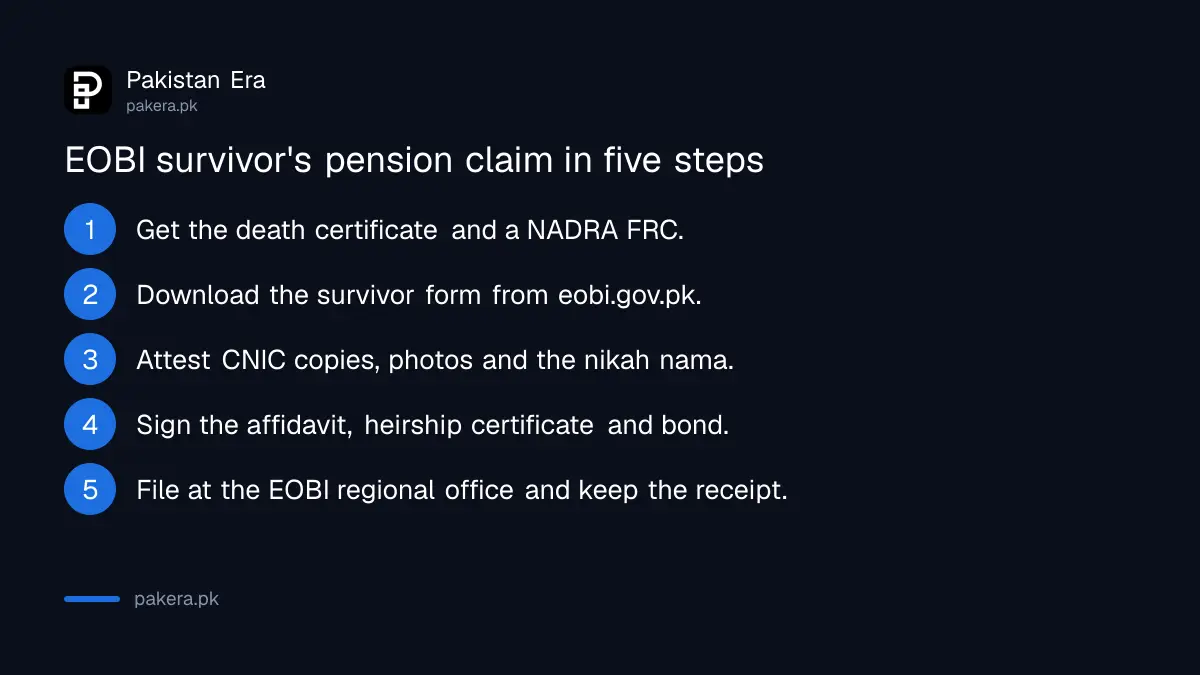
Behind the form sit three sworn papers: an affidavit that the applicant is the only widow, has not remarried and will not involve EOBI in any dispute; a heirship certificate (wirasat nama) naming every legal heir and their relationship, attested by a grade 17 officer or the UC chairman; and the indemnity bond to the Chairman EOBI, with a schedule of heirs, signatures of all heirs, two guarantors with CNICs and an oath commissioner's attestation.
File at the regional office, then keep the pensioner's proof of life current
The form is submitted at the EOBI regional office that holds the deceased's record, which is normally the region where the employer was registered. Four officers sign it off: the Assistant Director (BTS), the Assistant Director (A&A), the Deputy Regional Head and the Regional Head, so expect a few weeks rather than a few days. Keep a receipted copy of everything you hand in.
Once the survivor's pension starts, the new pensioner has to keep her CNIC valid and her bank account in her own name active, because EOBI pays into that account and pauses payment when the record stops matching. The original ATM card and pension book of the deceased go back to EOBI with the claim, so expect a fresh pension book or card in the widow's name.
If the employer was in Punjab and registered with the provincial welfare fund, a separate death grant may also be due, and the two do not cancel each other. The Rs 1 million workers' death grant in Punjab has its own form and its own deadline.
Common questions
Who is entitled to an EOBI survivor's pension?
The surviving spouse of an insured worker who died in service after at least 36 months of insurable employment, or of a person already drawing an old-age or invalidity pension. The spouse receives it for life.
How much is the survivor's pension?
The minimum is Rs 11,500 a month, the same floor EOBI applies to the old-age pension from January 2025. Above the minimum it follows the pension formula on the deceased's record.
What happens to the pension when the widow dies?
It passes to the minor children in equal shares, with a son's share continuing until he turns 18. If there is no spouse and no child, the parents receive it for five years.
Which documents are compulsory?
Attested CNIC copies, the death certificate, four photographs, the nikah nama or an affidavit, a NADRA FRC, an indemnity bond with two witnesses, B-forms for minors, and the original pension book and ATM card. A worker who died in service also needs the EOBI PI-03 card, a service certificate, an age certificate, 12 months' salary record and an employer declaration.
Is there a deadline to claim?
The form has a separate box for claims filed more than a year after the death, where you must explain the delay and the office decides whether to condone it. File within a year to avoid that step.
Does the widow need stamp paper for the indemnity bond?
No. The Karachi City Region checklist states that the bond needs two male witnesses and attestation by an oath commissioner, but no stamp paper.
How we verified this
What we checked, where we read it, and what we could not confirm.
Last checked 19 October 2026. The eligibility rules, the 36-month condition, the order of spouse, children and parents, the five-year limit for parents and the Rs 11,500 minimum come from the benefits section of the EOBI website, read on 19 October 2026. The document checklist, the form fields, the delay box, the affidavit, the heirship certificate and the indemnity bond come from the EOBI survivor pension form issued by the Karachi City Region and linked from the same site. We could not verify whether other regions use a different checklist, and we could not read a processing time anywhere on the site, so none is stated as fact.
About the author

Public Services and Education Journalist
Fajr Riaz is a journalist and content writer at Pakistan Era, based in Lahore. She covers the questions people meet in everyday life in Pakistan: how a public service works, what a change in the rules means, and where to find a reliable answer.