Right of Way, Light and Air From a Neighbour in Pakistan: The 20 Year Rule
Twenty years of open use gives a right of way or light in Pakistan under the Easements Act 1882. See necessity rights, how to sue and why not to demolish.
In Pakistan, you gain a legal right to use a path over a neighbour's land, or to receive light and air through your windows, once you have used it openly, peacefully and as of right for 20 years without a break. If the neighbour blocks it, you sue for compensation or an injunction. You may not remove the obstruction yourself.
This is the law of easements. An easement is a right that the owner of one plot has over another person's plot. The rules are in the Easements Act, 1882, which applies across Pakistan. We read its full text on the Pakistan Code portal on 22 October 2026. The Act covers many disputes that start with a locked gate, a new wall or a blocked drain between two houses.
An easement is a right over the neighbour's land that serves your land
Section 4 defines it. The owner or occupier of land has a right, because of that land, to do something on another person's land, or to stop something being done there. The land that benefits is the dominant heritage. The land that bears the burden is the servient heritage.
The Act's own example is a house owner who has a right of way over his neighbour's land to reach the house. The right belongs to the house, not to the person. If you sell the house, the right passes to the buyer under section 19.
Twenty years of open use creates an absolute right
Section 15 says that where light or air to a building, support from another's land, or a right of way has been peacefully and openly enjoyed as an easement and as of right, without interruption, for twenty years, the right becomes absolute. The period must end within two years before the suit.
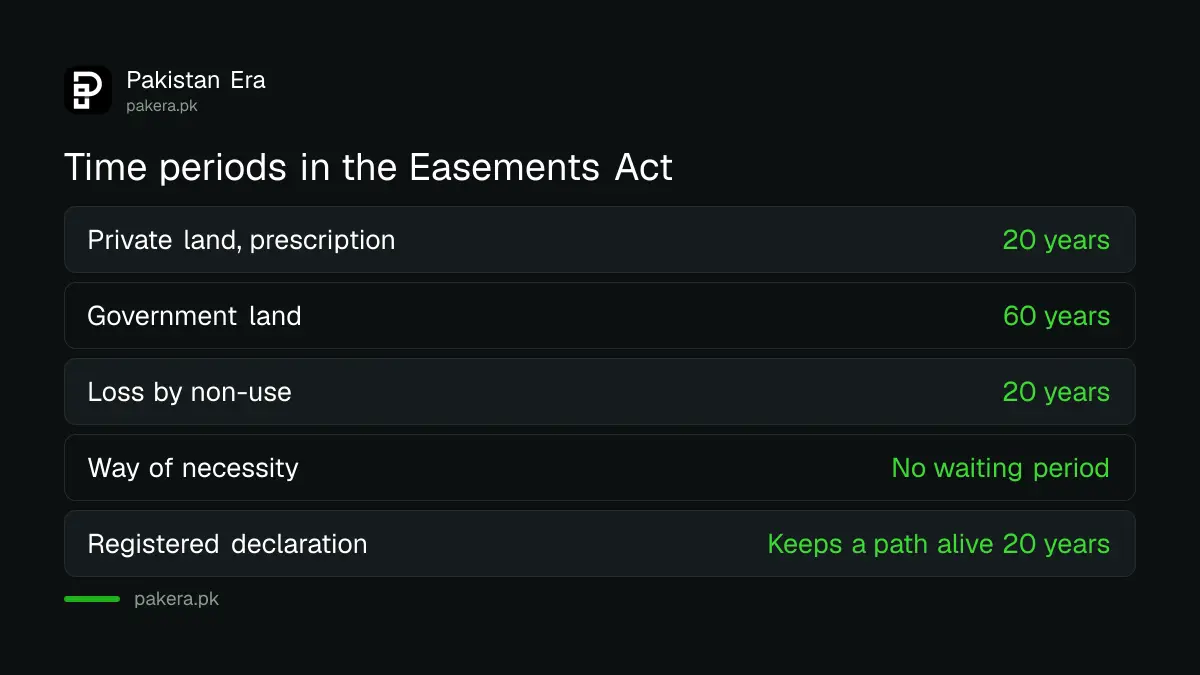
Three details sink most claims. Use that depends on the owner's permission is not "as of right". Use under a lease does not count as an easement. And where the servient land belongs to the Government, the period is sixty years, not twenty. If you walked across a neighbour's field for ten years and he later blocks it, you do not yet have the right.
A right of way of necessity exists when a plot has no other access
Section 13 gives a right without any waiting period. If a seller sells land that can only be reached across his remaining land, the buyer gets a way over it. The same applies when joint property is divided and one share is landlocked.
Section 14 lets the owner of the land crossed choose the route, but it must be reasonably convenient for the person using it. If he refuses to set it out, the user may do so. A way of necessity ends when the necessity ends, for example when the user later buys another plot that gives access. For a divided family plot, the land partition guide for Punjab shows how shares are marked.
Light and air to a house can be protected, but an open plot cannot claim them
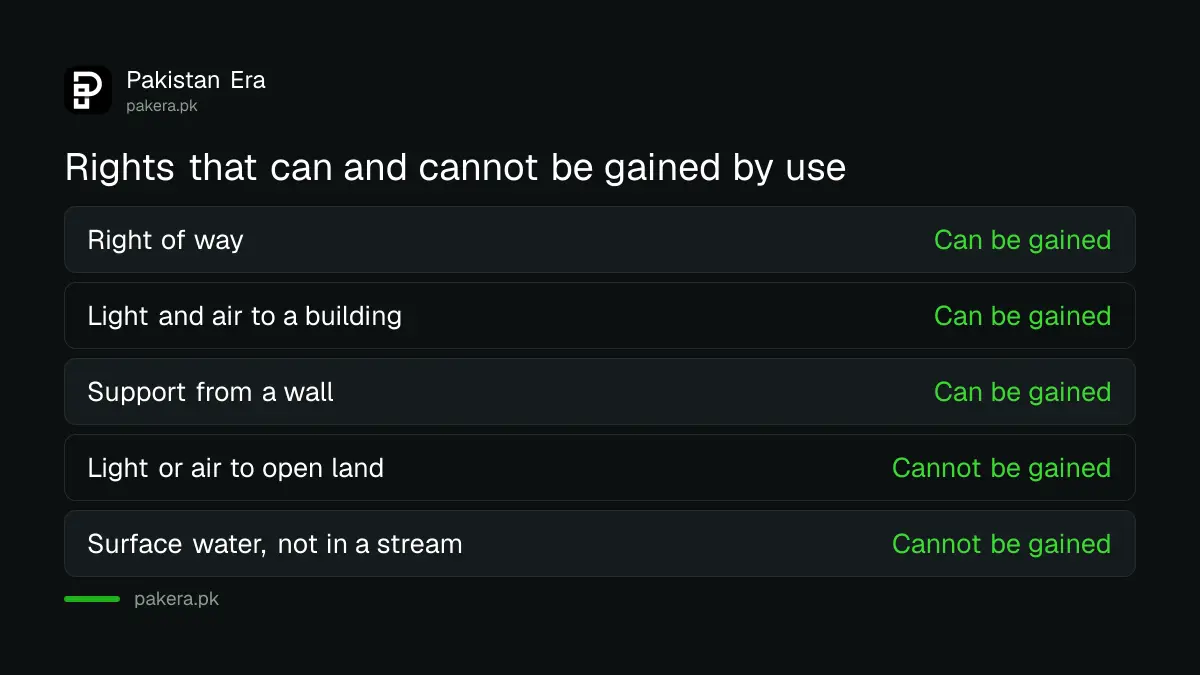
Section 15 covers access to light and air for a building. Section 17 says you cannot gain by prescription a right to the free passage of light or air to an open space of ground, or a right to surface water not flowing in a stream, or to underground water not in a defined channel.
Section 33 sets the test for a claim. The disturbance must cause substantial damage. For light, that means it materially interferes with physical comfort or prevents your business from running as well as before. For air, it is enough that it materially interferes with physical comfort, even if it does not harm health.
| Right | How it is gained | Section |
|---|---|---|
| Right of way | 20 years of open use as of right, or necessity on sale or partition | 13, 15 |
| Light and air to a building | 20 years of use without interruption | 15 |
| Support from a neighbour's wall | 20 years, or on sale of adjoining buildings | 13, 15 |
| Light or air to open land | Cannot be gained by prescription | 17 |
| Surface water not in a stream | Cannot be gained by prescription | 17 |
If the neighbour blocks the right, sue for compensation or an injunction
Section 33 allows the owner or occupier of the dominant land to sue for compensation. Section 35 allows an injunction, a court order, if the easement is actually disturbed or the threatened act would necessarily disturb it. Section 36 says the dominant owner cannot himself remove a wrongful obstruction.
That last rule matters. Breaking down a neighbour's wall yourself weakens your case and invites a counter-claim. File in a civil court and ask for a temporary order. The general rules for such orders are in the temporary injunction guide. The time to sue is set by the Limitation Act schedule, so act promptly.
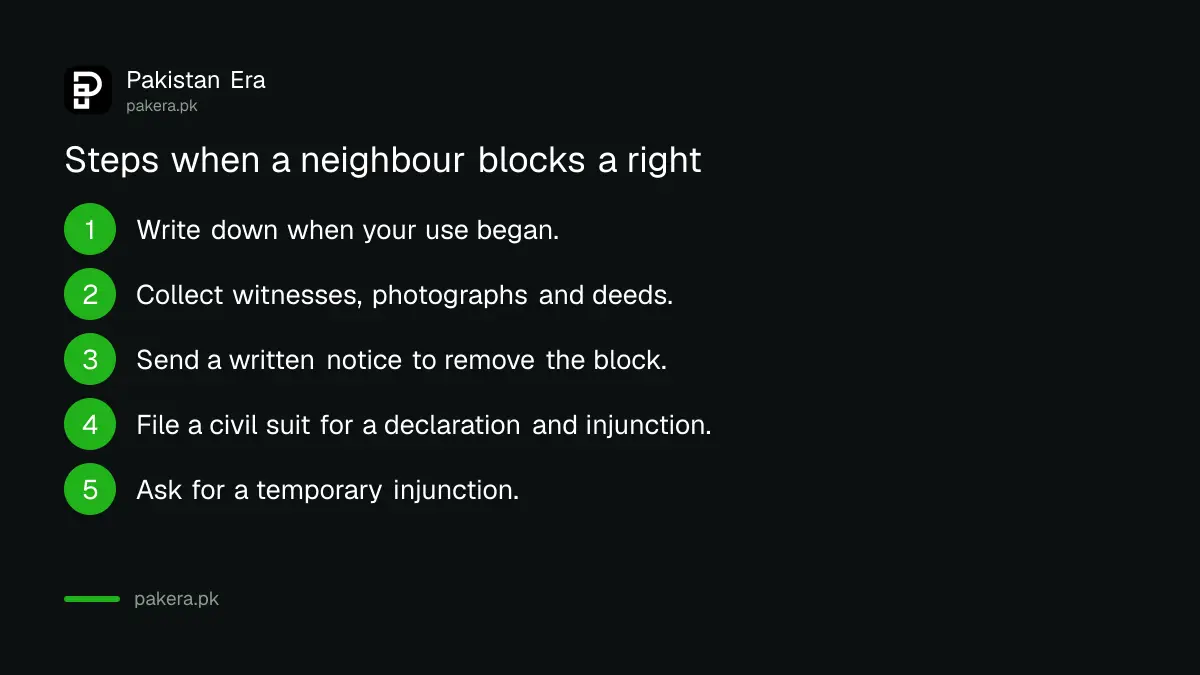
- Write down when and how you started using the path, light or drain.
- Collect witnesses, photographs and any sale deed that mentions the access.
- Send a written notice to the neighbour asking him to remove the block.
- File a civil suit for a declaration, compensation and an injunction.
- Ask for a temporary injunction while the case runs.
An easement ends after 20 years of non-use or when one person owns both plots
Section 47 says a continuous easement is extinguished when it totally stops being enjoyed for an unbroken twenty years. Section 46 ends it when one person becomes absolute owner of both plots. Section 38 ends it when the dominant owner releases it, and section 41 ends a necessity easement when the necessity goes.
For a discontinuous right such as a path, the owner can register a declaration under the Registration Act, 1908 to keep it alive for a further twenty years. The registration rules are in the registration guide.
Common questions
How long must I use a path to claim a right of way?
Twenty years of open, peaceful use as of right and without interruption under section 15. For Government land it is sixty years.
Can my neighbour build a wall that blocks my window light?
Not if you have a right to the light, by 20 years' use or by sale. You must show substantial damage. If you do not have the right, he may build.
Can I break the obstruction myself?
No. Section 36 says the dominant owner cannot himself abate a wrongful obstruction. Go to court.
Does a tenant gain an easement?
Use as a lessee does not count towards a prescriptive right for the lessee's own property, according to the examples in section 15 and section 12.
Does selling my house end the right of way?
No. Section 19 passes the easement to the new owner of the dominant house.
What if the use was allowed by a favour?
Permission defeats the claim. Use must be as of right, not by leave of the owner.
How we verified this
What we checked, where we read it, and what we could not confirm.
Last checked 22 October 2026. We read the full text of the Easements Act, 1882 on the Pakistan Code portal, including sections 4 to 19, 33 to 36 and 37 to 47. We did not read any court judgment, provincial amendment or local building bye-law, and none of the examples above come from decided cases. This page is general information, not legal advice.
About the author

Senior Writer, Public Services and Technology
Shahid joined us in 2024 as an author. He is a senior contributor to Pakistan's leading technology websites. He writes detailed articles, mostly covering his expertise in the latest tech, mobiles, apps, gadgets, and step-by-step guides. His ideology is to help people understand the latest trends and explain complex methods through very easy-to-understand guides.