How to Claim Maintenance From Your Husband Through a Union Council in Pakistan
A wife can ask the Union Council Chairman to fix her maintenance and issue a certificate. See who applies, what to bring, how to appeal and how it is recovered.
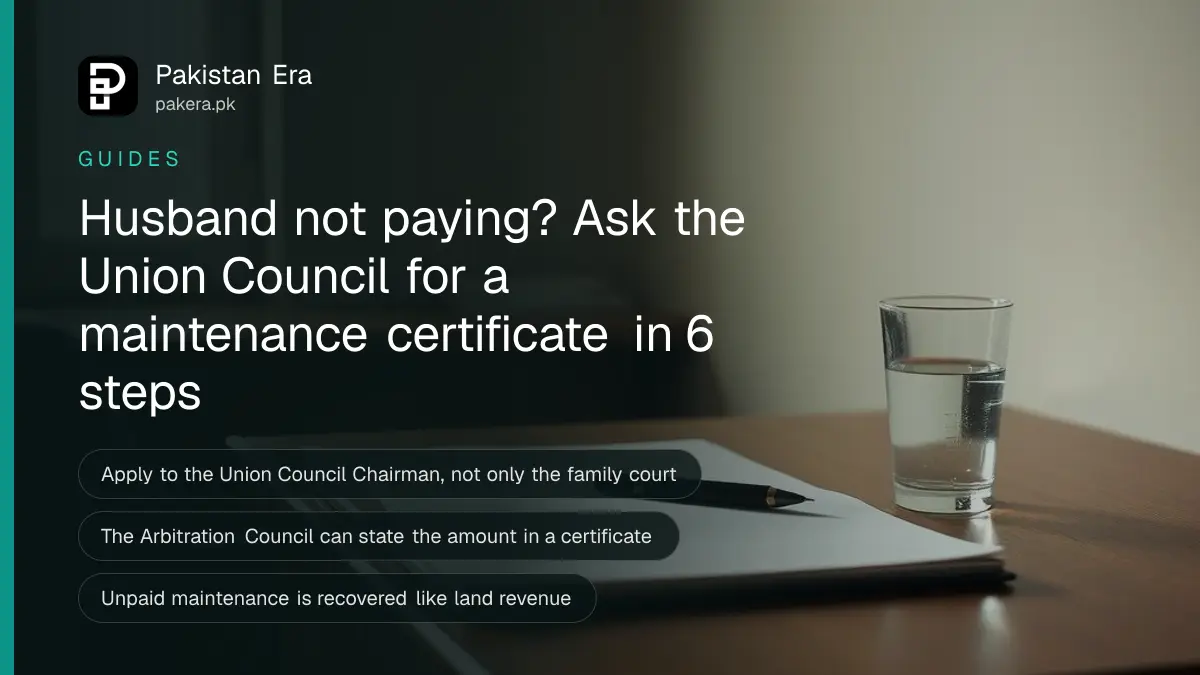
A wife in Pakistan whose husband does not support her can apply to the Chairman of the Union Council. He forms an Arbitration Council, which can issue a certificate that fixes the monthly maintenance. If the husband does not pay, the amount is recovered like land revenue. This sits beside the family court route, not instead of it.
The rule is section 9 of the Muslim Family Laws Ordinance, 1961. We read the full text on the Pakistan Code portal on 8 October 2026. Most people only hear about the family court. This second door is cheaper in time and paper, and many wives never use it.
The Ordinance does not give an amount or a fee. It leaves both the form and the fee to "the prescribed" provincial rules, and we did not read those. Ask the Chairman's office for the current ones before you go.
Who can apply and for what
A wife can apply if her husband fails to maintain her adequately. Where a man has more than one wife, any of them can apply if he fails to maintain them equitably, meaning fairly between them.
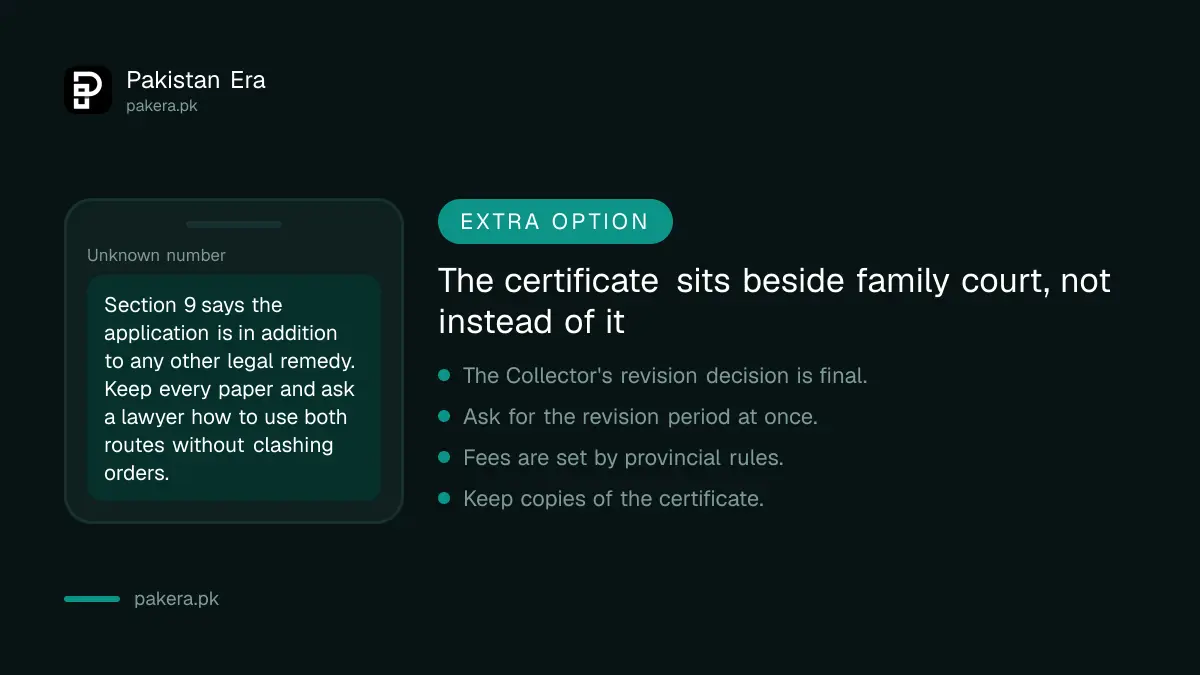
The section opens with the words "in addition to seeking any other legal remedy". So applying to the Chairman does not stop you from also going to a family court. It is an extra option, not a trap.
Maintenance means the money for a wife's food, clothing and housing. The Ordinance does not list the items. The Arbitration Council decides the figure.
The application goes to the Chairman
You apply to the Chairman. He is the Chairman of the Union Council, or a person the government appoints to do that job. If the Union Council is missing or has changed in your area, ask the local government office which officer acts as Chairman.
The Chairman must then set up an Arbitration Council. It has the Chairman plus one representative of each side. If one side fails to name a representative in the prescribed time, the Council goes ahead without that person.
Bring what shows the problem and the family's needs:
- Your CNIC and your husband's CNIC number.
- The nikah nama, or its registration details.
- Proof of the date he stopped supporting you.
- Your monthly costs, such as rent, food, medicine and school fees for children.
- Any proof of his work or income.
The Council can issue a maintenance certificate
The Arbitration Council can issue a certificate that states the amount the husband must pay as maintenance. This is the document you will use if he stops paying later.
The Ordinance does not set a time limit for the Council to decide. It also says the ordinary rules of civil procedure and the Arbitration Act do not apply to an Arbitration Council. So expect a simple hearing, not a court trial.
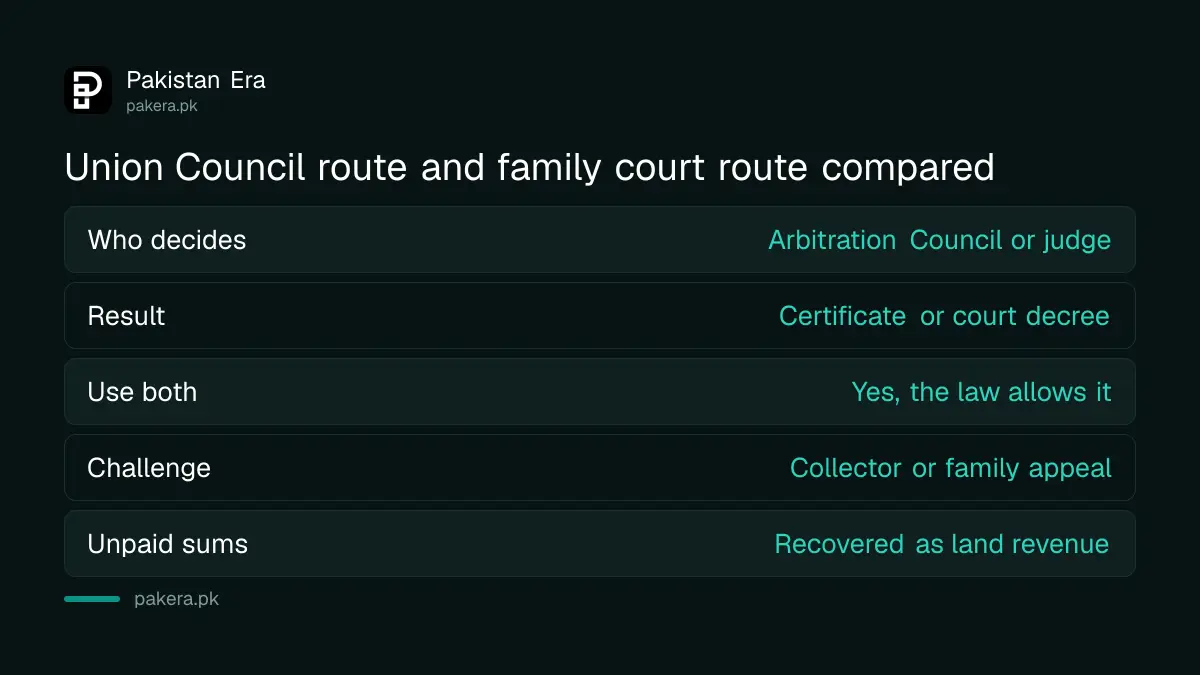
| Question | Union Council route | Family court route |
|---|---|---|
| Who decides | Arbitration Council led by the Chairman | A family court judge |
| Result | Certificate stating the amount | A court order or decree |
| Can you use both | Yes, the law says "in addition to" other remedies | Yes |
| Challenge | Revision to the Collector | Appeal under the family court law |
The family court route in Punjab has its own rules, including interim maintenance from the first hearing. They are explained in the guide to claiming maintenance in a Punjab family court.
Either spouse can ask the Collector to review the certificate
The husband or the wife can ask for a revision of the certificate. The application goes to the Collector, in the prescribed manner, within the prescribed period and with the prescribed fee. The Collector's decision is final and no court can question it.
That finality is the main reason to prepare well. Put your figures in writing before the Council meets, not afterwards.
Ask for the revision period on the day you get the certificate. We did not find it on an official page, so we do not state a number of days.
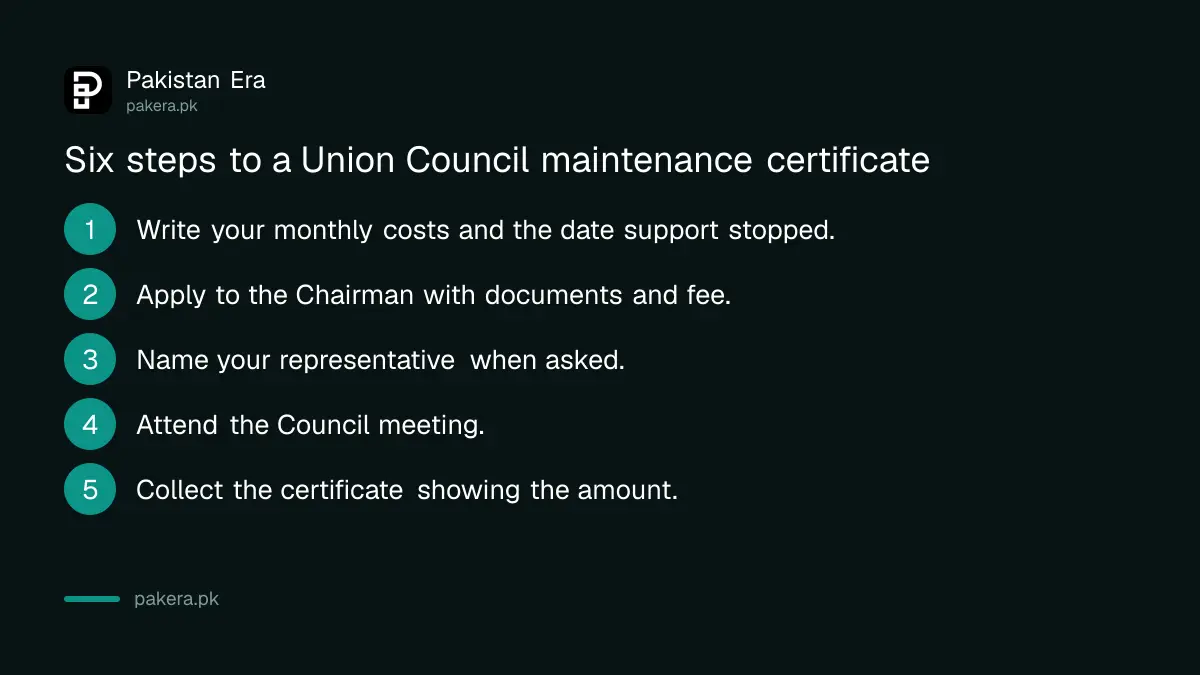
- Write down your monthly costs and the date support stopped.
- Apply to the Chairman with your documents and the fee.
- Name your representative when asked.
- Attend the Council meeting.
- Collect the certificate showing the amount.
- Note the date and the revision period.
Unpaid maintenance is recovered as land revenue
If the husband does not pay what the certificate or the Collector's decision requires, the amount is recoverable as arrears of land revenue. In plain words, the revenue authorities can collect it the way they collect unpaid land tax.
Keep the certificate safe and make copies. Ask the Chairman's office which revenue officer handles recovery in your district.
If the money is only part of the problem, other remedies exist. Children's care is covered in the guide to child custody in family court. A wife who cannot afford a lawyer can read about free legal aid in Punjab. Unpaid dower is a separate claim, explained in the guide to recovering dower.
Common questions about Union Council maintenance
Can I go to family court if I already applied to the Chairman?
Yes. Section 9 says the application is in addition to any other legal remedy. A lawyer can tell you how to avoid mixed orders.
How much maintenance will the Council fix?
The law gives no formula. The Council decides the amount that it finds reasonable from the evidence. Bring clear figures for your costs.
What does it cost to apply?
The Ordinance says the prescribed fee, if any, and leaves the amount to provincial rules. We did not find an official figure, so ask the Chairman's office.
What if my husband ignores the notice?
The Council can proceed without his representative if he fails to name one within the prescribed time. Keep proof that he was told.
Does this work for a husband with two wives?
Yes. Any wife can apply if he does not maintain the wives equitably.
How we verified this
What we checked, where we read it, and what we could not confirm.
Last checked 8 October 2026. Sections 2, 3 and 9 of the Muslim Family Laws Ordinance, 1961 were read on the Pakistan Code portal. Provincial rules on fees, forms and time limits were not read. This article is general information, not legal advice.
About the author

Public Services and Education Journalist
Fajr Riaz is a journalist and content writer at Pakistan Era, based in Lahore. She covers the questions people meet in everyday life in Pakistan: how a public service works, what a change in the rules means, and where to find a reliable answer.