How to Claim Workers' Compensation for Injury or Death at Work in Balochistan
Claim workers' compensation in Balochistan after a mine, port or site accident. Rs 500,000 for death, the five year limit, the Commissioner, steps and appeals.
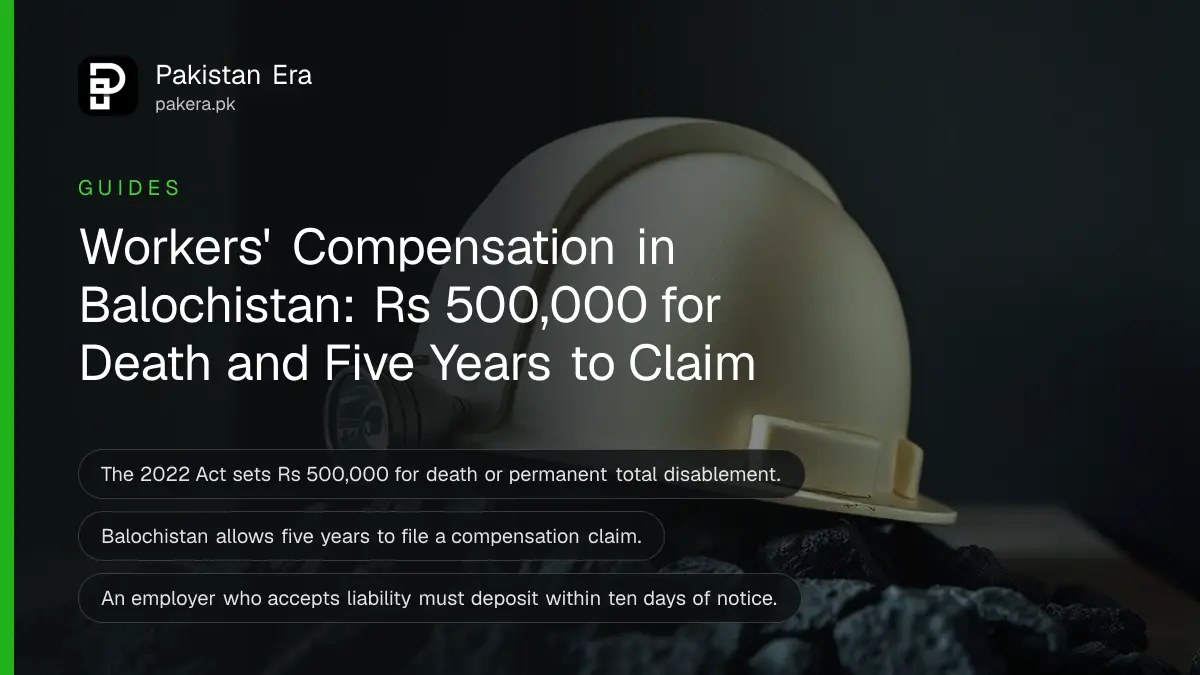
In Balochistan, an injured worker, or the family of a worker who died at work, claims compensation before the Commissioner for Workers' Compensation under the Balochistan Workers' Compensation Act, 2022. Schedule IV sets Rs 500,000 for death or permanent total disablement. The claim must be filed within five years of the accident or the death, longer than in other provinces.
Coal mines near Quetta, the port at Gwadar and building sites on every new road carry most of the province's workplace accidents. The 2022 Act names all three in its list of covered work, and it puts the cost of an injury on the employer.
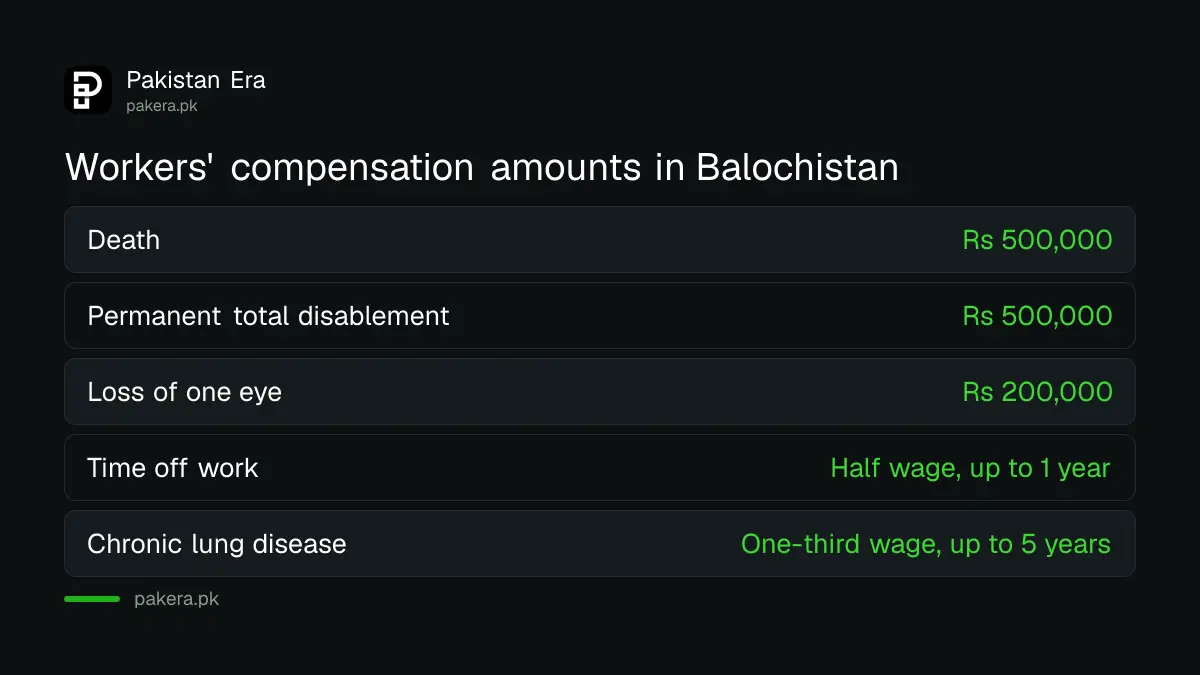
| Outcome | Compensation under the Balochistan Act |
|---|---|
| Death | Rs 500,000, deposited with the Commissioner |
| Permanent total disablement | Rs 500,000 |
| Loss of one eye, the other normal | 40%, Rs 200,000 |
| Temporary disablement | Half the monthly wage, up to one year |
| Chronic lung disease after a year | One-third of the monthly wage, up to five years |
The 2022 Act covers mines, ports, factories and construction
The Balochistan Workers' Compensation Act, 2022 defines a worker through Schedule II. It covers people employed in mines and below-ground work, factories using power with 10 or more workers, loading and unloading at Gwadar port, ships, and the construction, repair or demolition of buildings, dams, roads and tunnels.
Casual workers hired for something other than the employer's business are left out. A worker lent to another firm is covered by whoever is using the worker at the time of the accident. The government can add hazardous jobs to Schedule II by notification.
Section 3 makes the employer liable for an injury by accident arising out of and in the course of work. As in the other provinces, there is no liability for an injury that keeps the worker off for four days or less. For injuries short of death, there is also none where the accident came directly from drink or drugs against the employer's clear instruction, wilful disobedience of a safety rule, or removal of a safety guard.
Mining diseases are covered. Schedule III lists silicosis, anthraco-silicosis and lung disease from coal dust and stone quarry dust among the occupational diseases.
Five years to claim, and the employer has ten days to deposit
The Balochistan Act gives the longest window in the country. A claim must be filed within five years of the accident, or within five years of the date of death. When the Commissioner asks about a fatal accident, an employer who accepts liability must deposit the compensation within ten days of the notice.
| Rule | Balochistan 2022 | Sindh 2015 | KP 2013 |
|---|---|---|---|
| Death compensation | Rs 500,000 | Rs 500,000 | Rs 300,000 |
| Time to file a claim | 5 years | 3 years | 3 years |
| Employer deposit after notice | 10 days | 30 days | 30 days |
| Funeral costs from compensation | Up to 10% of the amount | Up to Rs 20,000 | Up to Rs 20,000 |
Notice still matters here: tell the employer about the accident as soon as practicable, even though the filing window is long.
File the claim with the Commissioner in six steps
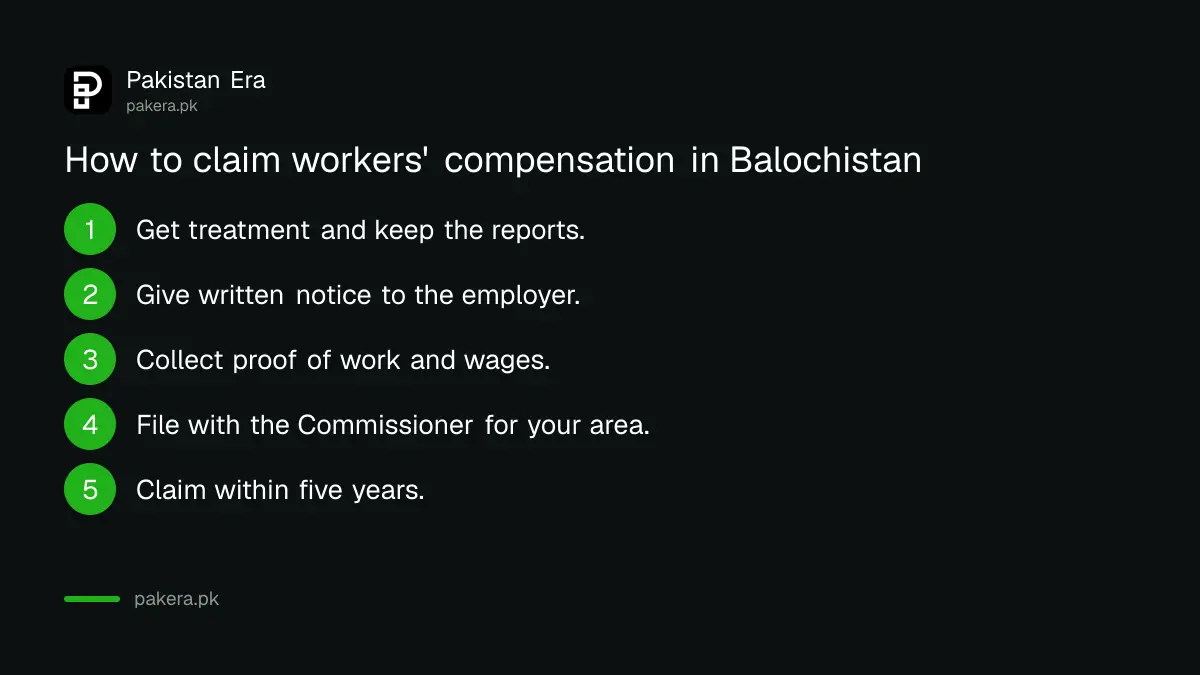
Send the employer written notice with the worker's name, address, the cause of the injury and the date. Then file an application with the Commissioner for Workers' Compensation for the area, stating the facts, the relief you want and when notice was served.
- Get medical treatment, and keep every report and slip.
- Give written notice to the employer, mine manager or contractor: name, address, cause and date.
- Collect proof of work: wage slips, attendance records, a contractor's card or co-workers who will confirm it.
- Find the Commissioner for Workers' Compensation for your area through the Labour and Manpower Department office in your district.
- File the application. A worker who cannot write can ask for it to be prepared under the Commissioner's direction.
- Attend hearings and the free medical examination the employer must offer.
A late notice is not fatal if the worker died at the site, if the employer already knew, or if the Commissioner accepts the reason for the delay.
Death money is deposited with the Commissioner for the family
An employer cannot settle a death privately. Section 8 says death compensation must be deposited with the Commissioner, and a direct payment is not compensation. The Commissioner pays funeral costs of up to 10 per cent of the amount and divides the rest among the dependants.
Advances of up to Rs 50,000 to the family are allowed and later deducted. The Balochistan Act also widens the first group of dependants: a widow, minor sons, unmarried daughters, a widowed mother and a divorced daughter who was wholly dependent qualify as of right. Others must show they depended on the worker's earnings.
Section 42 bars discrimination on grounds including sex, religion, ethnic background, sect, disability, trade union membership and place of birth when a claim is decided. That matters for migrant miners from other districts and provinces.
Social security, penalties and appeals
Where a worker already receives temporary disablement benefit under the provincial social security law, Schedule IV says the employer does not pay it again. Employers who ignore the Act's duties face fines of Rs 20,000 to Rs 50,000. Appeals go to the Tribunal within 60 days.
An appeal needs a substantial question of law, and for most orders at least Rs 50,000 in dispute. An employer who appeals a lump sum award must deposit it with the Commissioner first. A claim with the Commissioner and a civil suit for damages cannot both be pursued.
Harassment at a mine or a site is a separate complaint, handled as set out for workplace harassment in Balochistan. The WWF also pays a death grant to registered workers' families, covered under the WWF death grant rules.
Common questions
How much compensation is paid for a death in a Balochistan mine?
Rs 500,000 under Schedule IV of the Balochistan Workers' Compensation Act, 2022, deposited with the Commissioner.
How long do I have to claim in Balochistan?
Five years from the accident, or five years from the date of death.
Are coal miners covered for lung disease?
Yes. Schedule III lists silicosis, anthraco-silicosis and lung disease from coal dust as occupational diseases.
Can a contractor's worker claim from the mine owner?
The Act covers workers employed in any mining operation or work connected with it. Name both the contractor and the owner in the application and let the Commissioner decide liability.
Who is a dependant under the Balochistan Act?
A widow, minor sons, unmarried daughters, a widowed mother and a wholly dependent divorced daughter, plus listed relatives who depended on the worker's earnings.
Where do appeals go?
To the Tribunal under the Balochistan Industrial Relations Act, within 60 days of the Commissioner's order.
How we verified this
What we checked and where we read it.
Last checked 24 November 2026. We read the Balochistan Workers' Compensation Act, 2022 (Bill No. 36 of 2022, passed 14 November 2022, notified 24 November 2022) on the Provincial Assembly of Balochistan website: sections 2, 3, 8, 10, 11, 22, 25, 36 and 42 and Schedules I to IV. The comparison table uses the Sindh Workers' Compensation Act, 2015 and the Khyber Pakhtunkhwa Workers' Compensation Act, 2013. The Rs 200,000 figure for loss of an eye is the Schedule I percentage applied to Rs 500,000. The government can revise the Schedule IV amounts by notification after tripartite consultation. Labour laws for the province are listed by the Labour and Manpower Department.
Free on WhatsApp
Get last dates and rule changes on WhatsApp
We post new last dates, fee changes and fixes for common problems, a few short posts a day.
Follow Pakera on WhatsAppOther followers cannot see your number.
Pakera Solves It
Which online process wasted your time this week?
A portal that will not load, a form nobody explains, a complaint that went nowhere. Tell us. Every week we pick one, solve it step by step and publish the answer.
About the author

Tax, Bills and Technology Writer
Ali Akhtar is a young and curious voice here at Pakistan Era. He is currently pursuing his A-Levels and has a growing interest in Pakistan’s changing industrial landscape and educational trends. Ali likes to write in a way that helps him explain and explore the world around him. His writing reflects the perspective of the new generation navigating the evolving trends of Pakistan where technology, youth innovation, and shifting opportunities are reshaping the country’s future.