Husband Married Again Without Permission in Punjab: How the First Wife Files a Complaint
Husband married again without Arbitration Council permission in Punjab? File a complaint in the Family Court: Rs 500,000 fine, up to a year, full dower now.
If your husband married again in Punjab without written permission from the Arbitration Council, you can file a criminal complaint against him directly in the Family Court. On conviction the Punjab law sets simple imprisonment of up to one year and a fine of Rs 500,000. He must also pay your whole dower at once, both prompt and deferred.
Section 6 of the Muslim Family Laws Ordinance 1961 says no man may marry again during an existing marriage without the Arbitration Council's prior written permission. Punjab raised the penalty in 2015, from a fine of up to Rs 5,000 to a fixed fine of Rs 500,000 with up to a year in jail. In the same year Punjab made the Family Court the magistrate for these offences, so a first wife does not have to go to the police first.
This page explains the steps and the papers. It is not legal advice. A complaint against a husband has effects on the whole family, so speak to a family lawyer before you file.
The law requires written permission before a second nikah
The husband must apply to the union council Chairman, give his reasons, and say whether his existing wife or wives agree. An Arbitration Council, with a representative of each wife, decides. A second marriage made without this permission must not be registered.
So the first question is simple: was permission granted before the second nikah? Ask the union council where your husband applied, or where the second nikah took place, for its record. The full permission process is set out in getting permission for a second marriage.
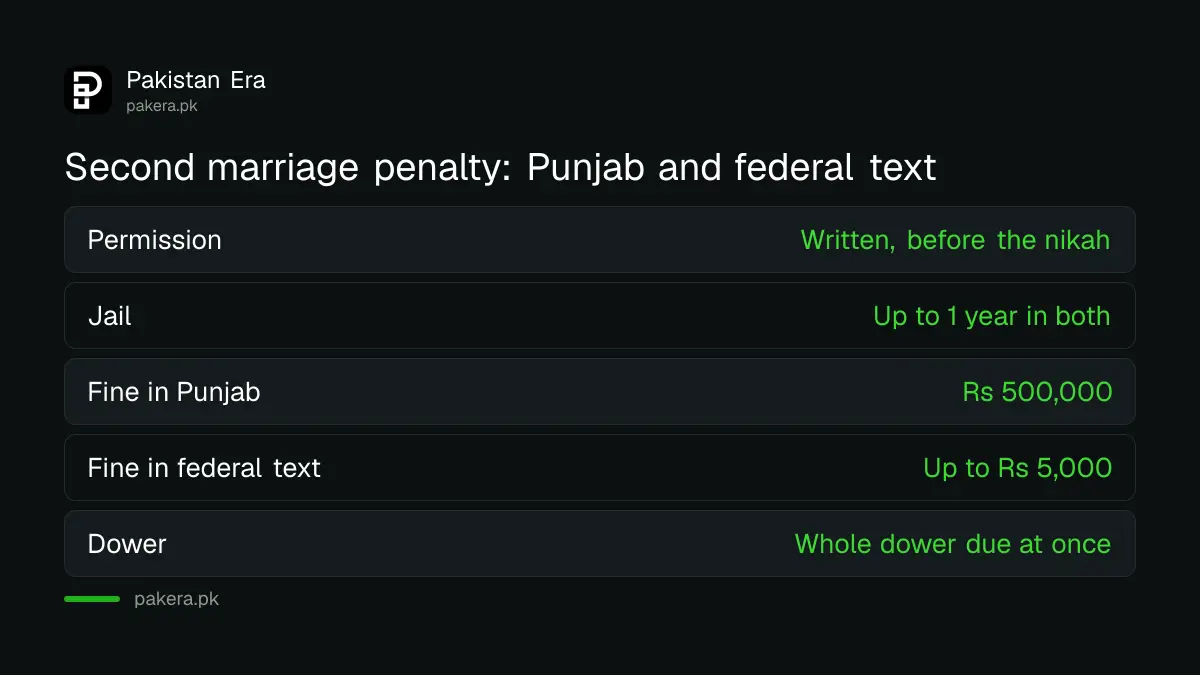
| Point | Federal text (Islamabad) | Punjab since 2015 |
|---|---|---|
| Permission needed | Yes, in writing, before the nikah (section 6(1)) | Same |
| Jail | Simple imprisonment up to 1 year | Simple imprisonment up to 1 year |
| Fine | Up to Rs 5,000, or jail, or both | Rs 500,000, with the jail term |
| Dower to existing wife | Whole dower payable at once (section 6(5)(a)) | Same |
| Who tries the complaint | Magistrate | Family Court acting as Judicial Magistrate (section 20, Family Courts Act) |
The first wife can complain straight to the Family Court
Section 20 of the Family Courts Act, as amended in Punjab, makes the Family Court a Judicial Magistrate of the first class for offences under the 1961 Ordinance. It acts on a complaint from the union council, the Arbitration Council or the aggrieved party, and holds a summary trial.
The aggrieved party is usually the existing wife. A summary trial is a shorter criminal procedure under Chapter XXII of the Code of Criminal Procedure. You file a written complaint with your evidence, the court summons the husband, and it hears both sides.
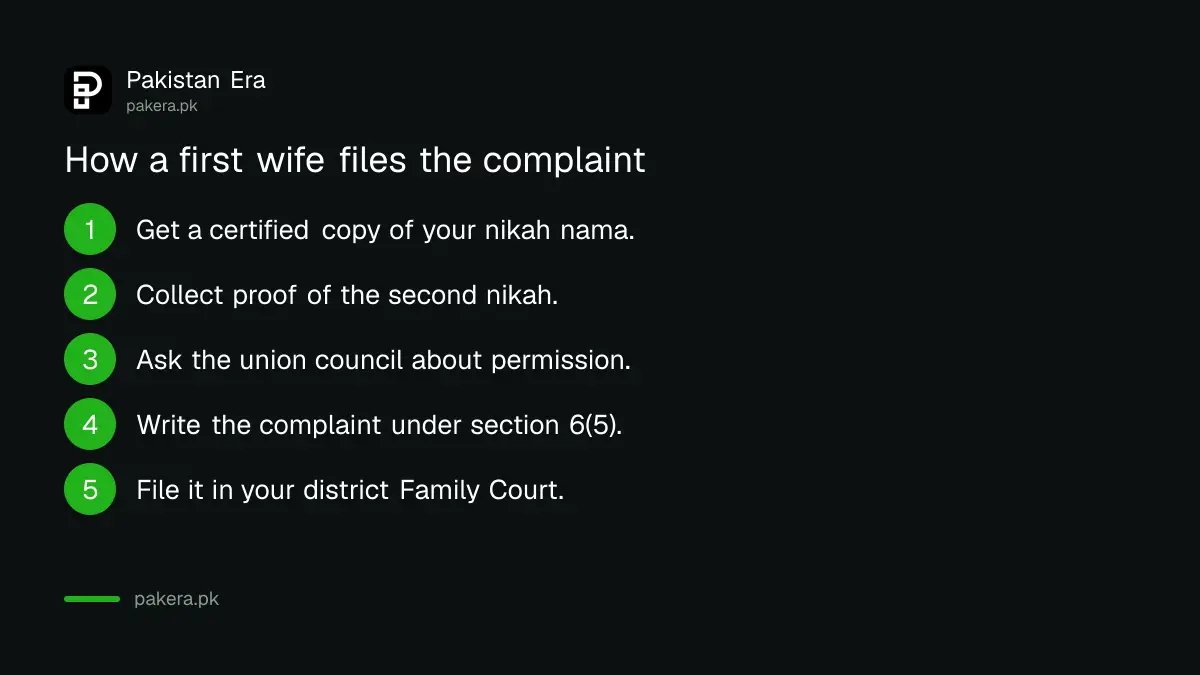
- Get a certified copy of your own nikah nama from the union council.
- Get proof of the second nikah: a copy of its nikah nama, a NADRA family record that shows the second wife, or witness names.
- Ask the union council in writing whether any permission under section 6 was given, and keep its reply.
- Prepare a written complaint under section 6(5) with dates, places and the names of witnesses.
- File it in the Family Court of your district, which acts as magistrate under section 20.
- Attend the hearings. If you also want the dower or a divorce, ask your lawyer to file those claims as well.
Section 6(5)(b) says "on conviction upon complaint", so the case starts only when someone complains. Do not wait long; evidence and witnesses fade.
Your whole dower becomes payable at once
Section 6(5)(a) says a man who marries again without permission must pay his existing wife the entire dower immediately, prompt and deferred. If he does not pay, it is recoverable as arrears of land revenue, the same way unpaid government dues are collected.
Deferred mehr is normally payable only on divorce or death. A second marriage without permission brings it forward. If he refuses, a Family Court suit for dower is the usual route, as set out in recovering dowry and haq mehr in Punjab.
You can also seek a divorce or equal maintenance
The complaint punishes the husband but does not end the marriage. If you want that, the Dissolution of Muslim Marriages Act 1939 lets a wife seek dissolution because the husband took an additional wife in breach of the 1961 Ordinance.
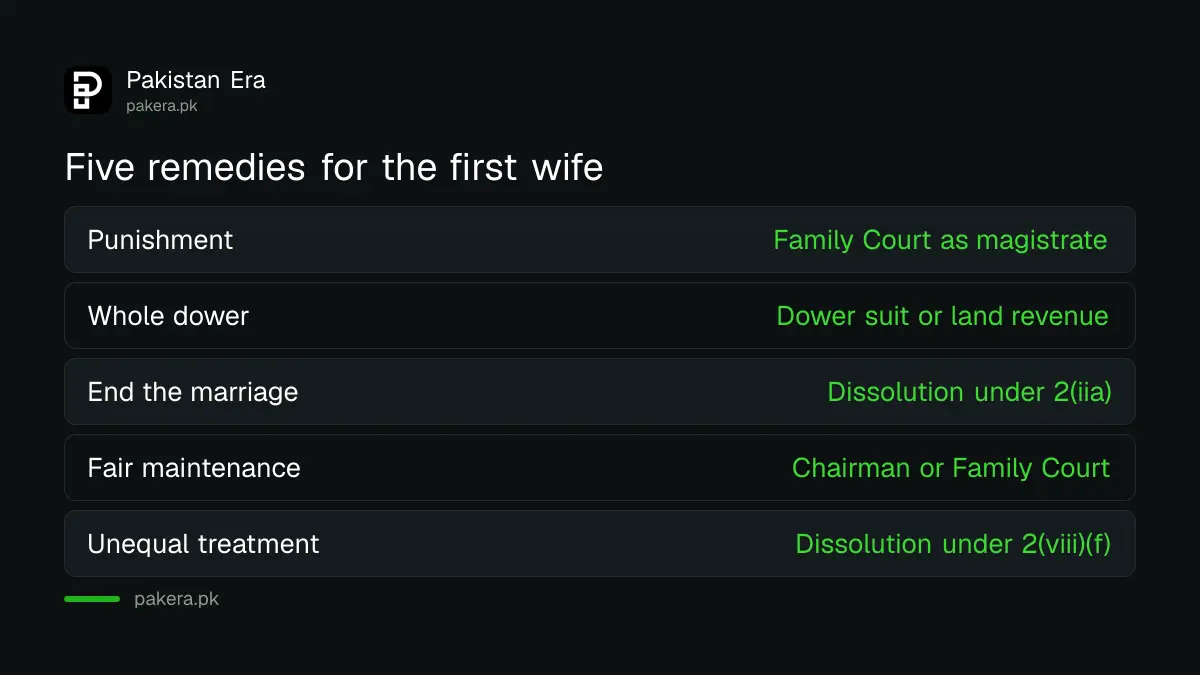
| What you want | Where to go | Law |
|---|---|---|
| Punishment for marrying without permission | Family Court as magistrate | Section 6(5)(b), 1961 Ordinance; section 20, Family Courts Act |
| Whole dower now | Family Court dower suit, or recovery as land revenue | Section 6(5)(a) |
| End the marriage | Family Court dissolution suit | Section 2(iia), Dissolution of Muslim Marriages Act 1939 |
| Fair maintenance alongside the other wife | Union council Chairman or Family Court | Section 9, 1961 Ordinance |
| Unequal treatment as a ground for divorce | Family Court | Section 2(viii)(f), 1939 Act |
Section 9 of the Ordinance lets wives apply to the Chairman when a husband with more than one wife does not maintain them equitably. The Family Court route for maintenance is set out in claiming maintenance in a Punjab Family Court, and the other dissolution grounds in a wife's grounds for divorce under the 1939 Act.
Problems first wives meet, and the fixes
Most problems are about proof of the second nikah or of missing permission. Union council records, NADRA family records and witnesses solve most of them. Free legal aid is available if you cannot pay a lawyer.
- You do not know where the second nikah happened. A NADRA family registration certificate can show a second wife linked to the husband, and gives a starting point.
- The second marriage was registered anyway. Section 6(1) bars registration without permission. Get a certified copy, as it proves the marriage and its date.
- He says you agreed. Consent of the existing wife is something the Arbitration Council considers. Without the Council's written permission, the requirement is not met.
- You cannot afford a lawyer. The district legal empowerment committee can assign one, as set out in getting a free lawyer in Punjab.
Common questions
What is the punishment for a second marriage without permission in Punjab?
Simple imprisonment of up to one year and a fine of Rs 500,000, under section 6(5)(b) as amended by the Punjab Muslim Family Laws (Amendment) Act 2015. He must also pay the whole dower at once.
Do I need to go to the police first?
No. In Punjab the Family Court acts as a Judicial Magistrate for offences under the 1961 Ordinance and takes the complaint of the aggrieved party directly.
Is the second marriage void if no permission was taken?
The Ordinance punishes the husband and bars registration. It does not say the marriage is void. Ask a lawyer about your case.
Can the second wife complain too?
Section 20 lets the aggrieved party complain. Whether a second wife counts as aggrieved in her own case is a question for a lawyer.
Does the penalty apply outside Punjab?
The Rs 500,000 fine is Punjab's. The federal text of the Ordinance, which applies in Islamabad, sets a fine of up to Rs 5,000 or jail of up to one year, or both. Other provinces may have their own amendments.
Can I get my deferred mehr now even if we stay married?
Yes. Section 6(5)(a) makes the entire dower, prompt and deferred, payable immediately when he marries again without permission.
How we verified this
What we checked and where we read it.
Last checked 24 November 2026. We read sections 6 and 9 of the Muslim Family Laws Ordinance 1961 on the Pakistan Code, the Punjab Muslim Family Laws (Amendment) Act 2015, which replaced section 6(5)(b) for Punjab, section 20 of the Family Courts Act 1964 as amended in Punjab, and section 2 of the Dissolution of Muslim Marriages Act 1939 on the Pakistan Code. The Ordinance sets no separate deadline for the complaint, and court practice on evidence differs by district.
Free on WhatsApp
Get last dates and rule changes on WhatsApp
We post new last dates, fee changes and fixes for common problems, a few short posts a day.
Follow Pakera on WhatsAppOther followers cannot see your number.
Pakera Solves It
Which online process wasted your time this week?
A portal that will not load, a form nobody explains, a complaint that went nowhere. Tell us. Every week we pick one, solve it step by step and publish the answer.
About the author

Global Affairs & Political Economy Writer
Muhammad Hatim is a book lover who started writing because he enjoys it. At Pakistan Era he writes about international relations, geopolitics and the global economy, with a particular interest in South Asia and the forces behind current events.