How to Get Permission for a Second Marriage in Pakistan From the Arbitration Council
A second marriage in Pakistan needs written Arbitration Council permission first. See who to apply to, what to state, how to appeal and the section 6 penalty.
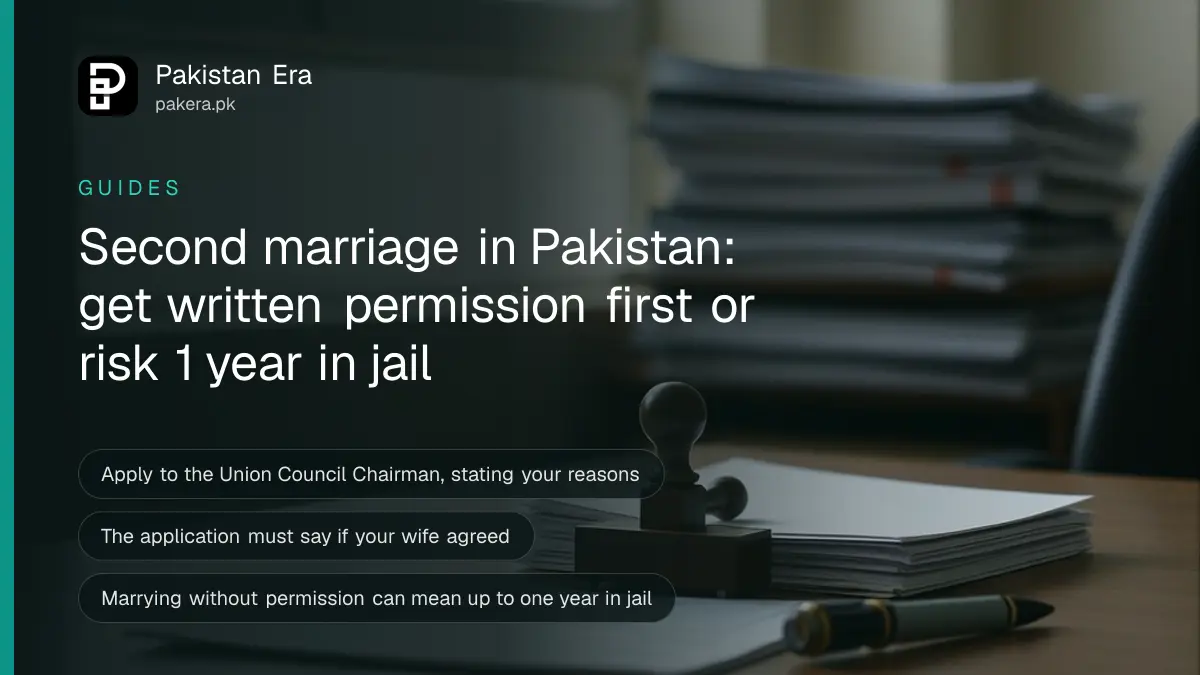
A married man in Pakistan needs written permission from an Arbitration Council before he marries again. He applies to the Chairman of the Union Council, names his reasons and says whether his wife agrees. Without that permission the second marriage cannot be registered, and he can be punished.
This is section 6 of the Muslim Family Laws Ordinance, 1961. It applies to all Muslim citizens of Pakistan, wherever they live. We read the full text on the Pakistan Code portal on 8 October 2026, and everything below about the law comes from it.
The Ordinance leaves the form, the fee and the time limits to rules made by each province. We could not read those rules, so we do not state any fee or number of days here. Ask the Chairman's office for the current ones.
The law needs written permission before the second nikah
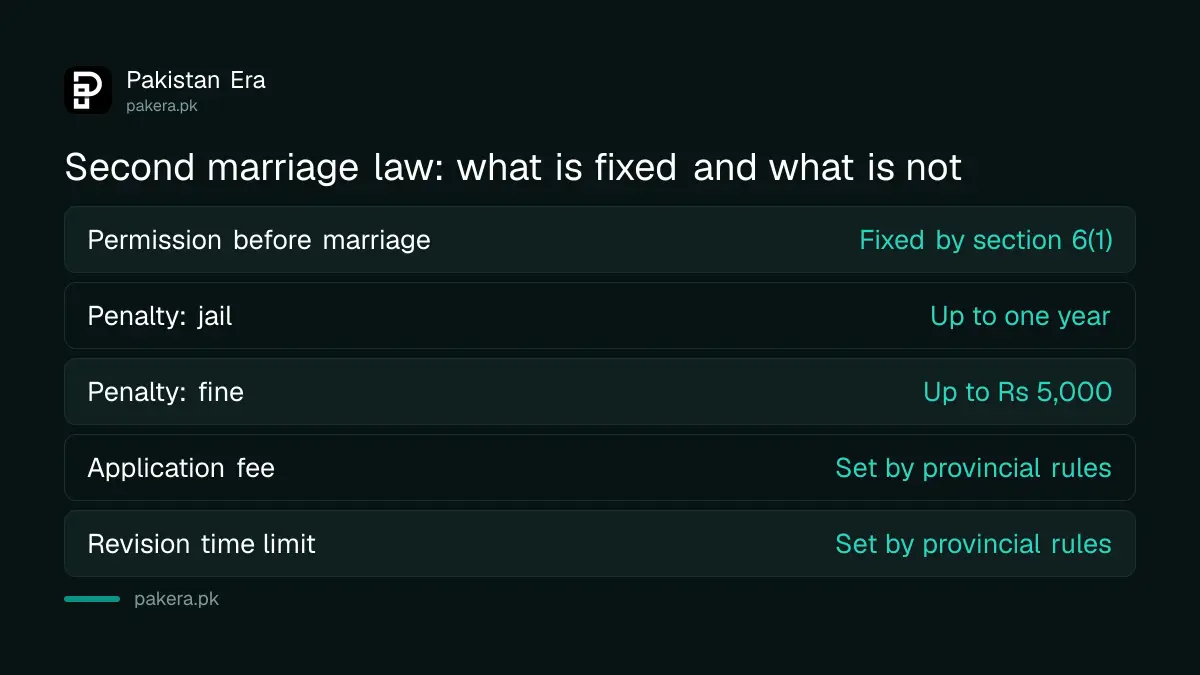
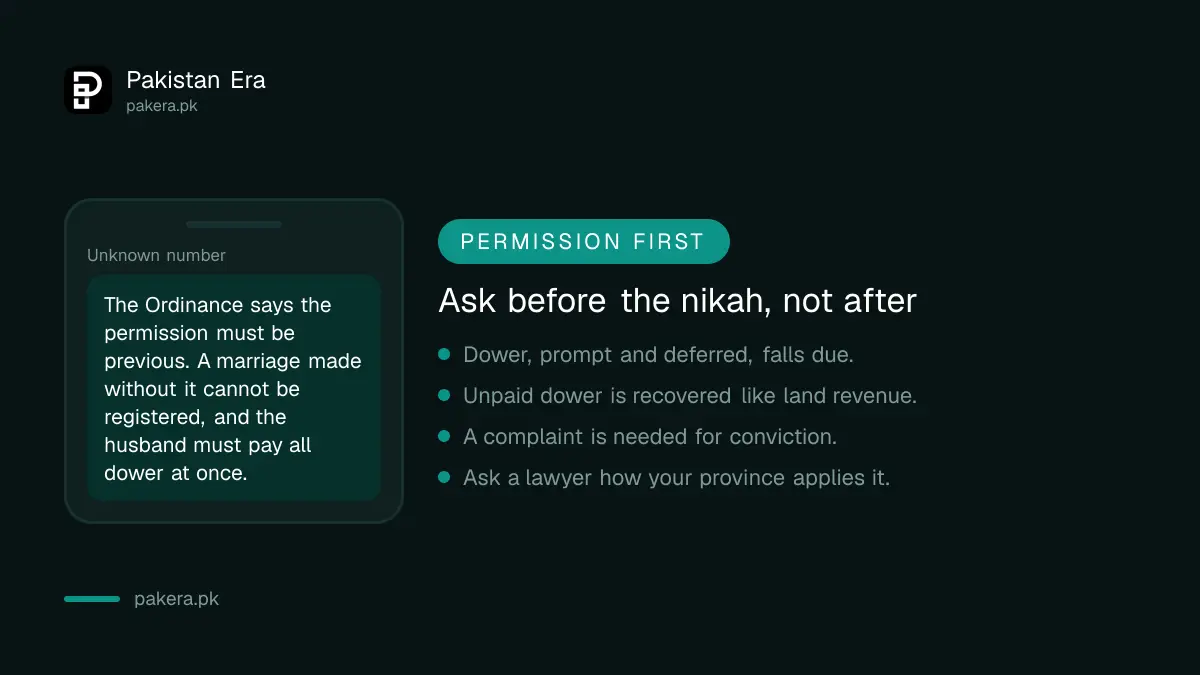
Section 6(1) says no man may marry again during an existing marriage without the previous written permission of the Arbitration Council. A second marriage made without it cannot be registered under the Ordinance.
The word "previous" matters. The permission comes first, then the nikah. Asking afterwards does not fix the problem.
An Arbitration Council is a small body. It has the Chairman and one representative for each side. The Chairman is the Chairman of the Union Council, or a person the government appoints for that job in some areas, such as cantonments. If the Chairman himself is the applicant, or cannot act, the Council elects one of its Muslim members to act as Chairman.
The application goes to the Chairman with reasons
The man submits an application to the Chairman, in the prescribed manner and with the prescribed fee. It must state the reasons for the proposed marriage and whether the existing wife or wives have agreed to it.
Those two items are the heart of the file. A vague reason is weak. A medical report, a court order or a written statement from the wife is stronger than a bare claim.
Keep copies of everything you hand over. Ask for a receipt that shows the date.
| What the application must contain | Where the law says it |
|---|---|
| Written application to the Chairman | Section 6(2) |
| The prescribed fee | Section 6(2), amount set by provincial rules |
| Reasons for the proposed marriage | Section 6(2) |
| Whether the existing wife or wives consented | Section 6(2) |
Each side names a representative and the Council decides
After the application arrives, the Chairman asks the husband and each existing wife to name a representative. The Council then meets. It may grant permission if it is satisfied the proposed marriage is "necessary and just".
The Council can attach conditions. It must write down its reasons for the decision, whether it says yes or no.
If a party fails to name a representative within the prescribed time, the Council is formed without that person and can still decide. So a wife who ignores the notice does not stop the process. If you are an existing wife and you get such a notice, name someone you trust and attend.
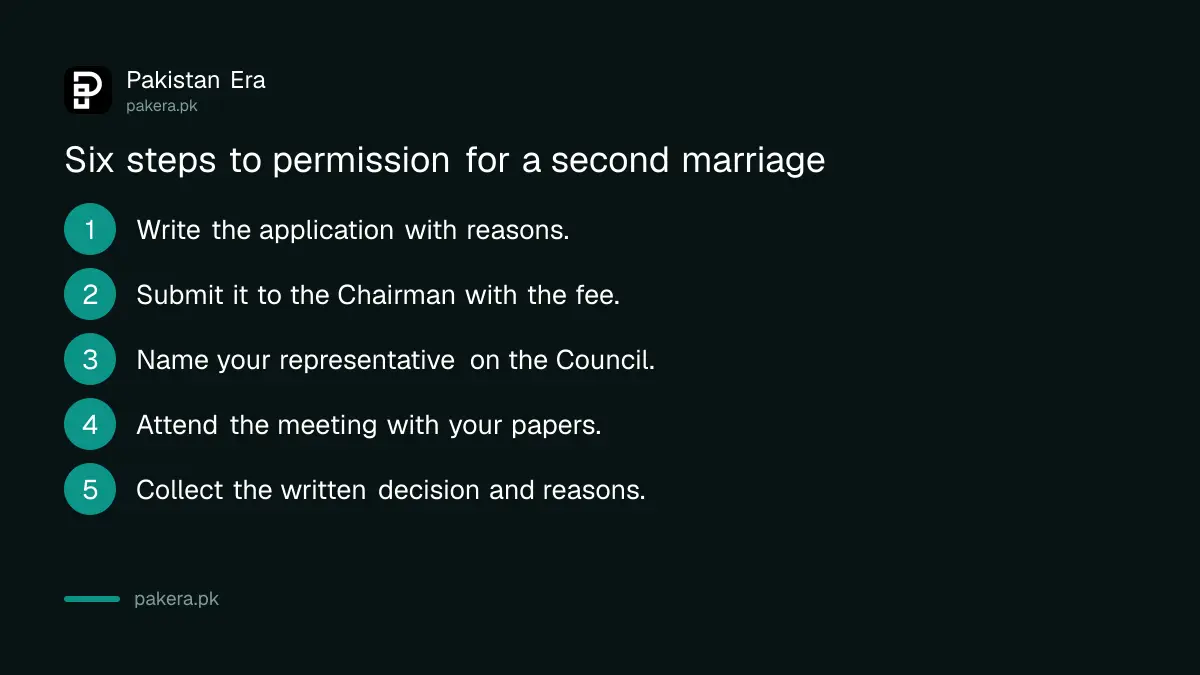
- Write the application with the reasons and the consent position.
- Submit it to the Chairman of the Union Council with the fee.
- Name your representative when the Chairman asks.
- Attend the Council meeting with your documents.
- Collect the written decision with its reasons.
- Marry only after you hold the written permission.
Either side can ask the Collector to review the decision
Section 6(4) lets any party apply for revision to the Collector. The application must be made in the prescribed manner, within the prescribed period and with the prescribed fee. The Collector's decision is final and cannot be questioned in any court.
The time limit for revision is set by provincial rules, and we did not read them. Do not wait. Ask for the period on the day you receive the decision, and write it on your calendar.
Marrying without permission has a fixed penalty
A man who marries again without permission must pay the whole dower to the existing wife or wives at once. That means both the prompt and the deferred dower. If he does not pay, it is recovered as arrears of land revenue.
On conviction after a complaint, he can also get simple imprisonment of up to one year, a fine of up to Rs 5,000, or both. The penalty applies to the man. A complaint is needed, so the court does not act on its own.
If you are a wife in this position, the steps for claiming unpaid dower are in the guide to recovering dower in Punjab. The marriage itself and its registration are covered in the guide to registering a nikah in Pakistan.
What the Ordinance does not say
The text does not set a deadline for the Council to decide, and it does not say a wife's refusal ends the matter. The Council weighs whether the marriage is "necessary and just". We also could not confirm how each province runs these Councils today, because the Union Council system has changed over the years.
If your district has no working Union Council, ask the local government office which officer acts as Chairman. If a lawyer is needed, a free option may exist. See the guide to free legal aid in Punjab.
Common questions about permission for a second marriage
Is a second marriage legal in Pakistan without permission?
The Ordinance says it cannot be registered and sets a penalty. It does not say in so many words that the nikah itself is void. A lawyer can tell you how courts have treated that in your province.
Who is the Chairman?
He is the Chairman of the Union Council, or a person appointed by the government to do the job. In cantonments the federal government appoints, and elsewhere the provincial government does.
Does the first wife have to agree?
The application must say whether she consented. The law does not make her consent the only test. The Council decides whether the marriage is necessary and just.
What is the fee for the application?
The Ordinance says "the prescribed fee" and leaves the amount to provincial rules. We did not find the amount on an official page, so ask the Chairman's office.
Can I challenge the Council's decision?
Yes. You can apply to the Collector for revision within the prescribed period. His decision is final.
How we verified this
What we checked, where we read it, and what we could not confirm.
Last checked 8 October 2026. The text of sections 2, 5 and 6 of the Muslim Family Laws Ordinance, 1961 was read on the Pakistan Code portal. Provincial rules on fees, forms and time limits were not read, so none are stated. This article is general information, not legal advice.
About the author

Senior Writer, Public Services and Technology
Shahid joined us in 2024 as an author. He is a senior contributor to Pakistan's leading technology websites. He writes detailed articles, mostly covering his expertise in the latest tech, mobiles, apps, gadgets, and step-by-step guides. His ideology is to help people understand the latest trends and explain complex methods through very easy-to-understand guides.