EOBI, WWF and Social Security in Pakistan: Every Worker Benefit Compared, and Which Office to Call
EOBI pays pensions from Rs 11,500, WWF pays scholarships and marriage grants, social security pays for illness. See which a worker gets and who to call.
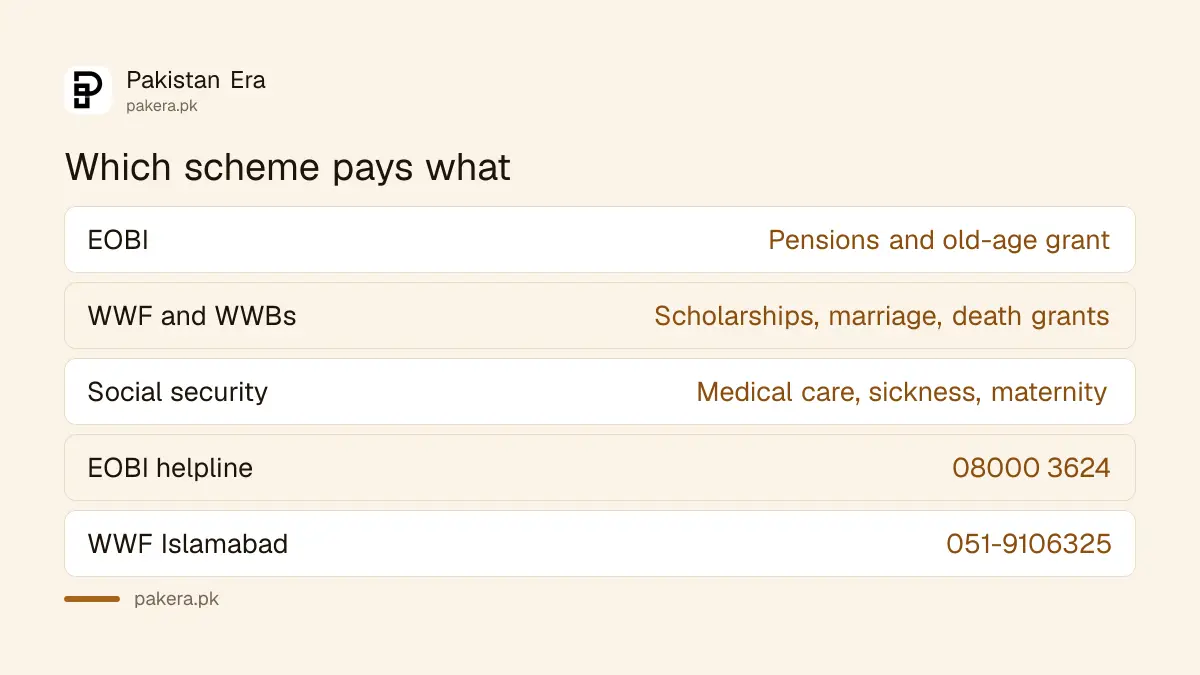
A registered factory worker in Pakistan can draw on three separate schemes: EOBI pays an old-age pension of at least Rs 11,500 a month, the Workers Welfare Fund (WWF) and provincial boards pay scholarships, marriage and death grants, and provincial social security pays for medical care and sickness or injury. Each has its own office, its own rules and its own phone line. Asking one for another's benefit wastes weeks.
Most workers know one of the three and miss the other two. We read EOBI's benefits page and WWF's eligibility and claim pages on 1 November 2026. This guide lines them up side by side so you know which door to knock on.
Three bodies, three different kinds of help
EOBI is about retirement and disability income. WWF and the Workers Welfare Boards are about lump-sum grants and children's education. Social security is about health and lost wages during illness, pregnancy or injury. All three depend on the employer registering you and paying in.
| Scheme | What it pays | Main condition | First contact |
|---|---|---|---|
| EOBI | Old-age, invalidity and survivors' pensions; old-age grant | Age 60 (55 for women and mine workers) and years of contributions | 08000 3624 (08000 EOBI) |
| WWF and provincial WWBs | Scholarships, marriage grant, death grant, Hajj ballot, housing | Industrial worker registered with EOBI or social security; 3 years' service for scholarships and marriage grants | WWF 051-9106325 or your provincial board |
| Provincial social security (PESSI, SESSI and others) | Medical care, sickness, maternity and injury benefits | Registered with the provincial institution through the employer | Your provincial institution |
EOBI pays a pension from 60, or a lump sum if you fall short
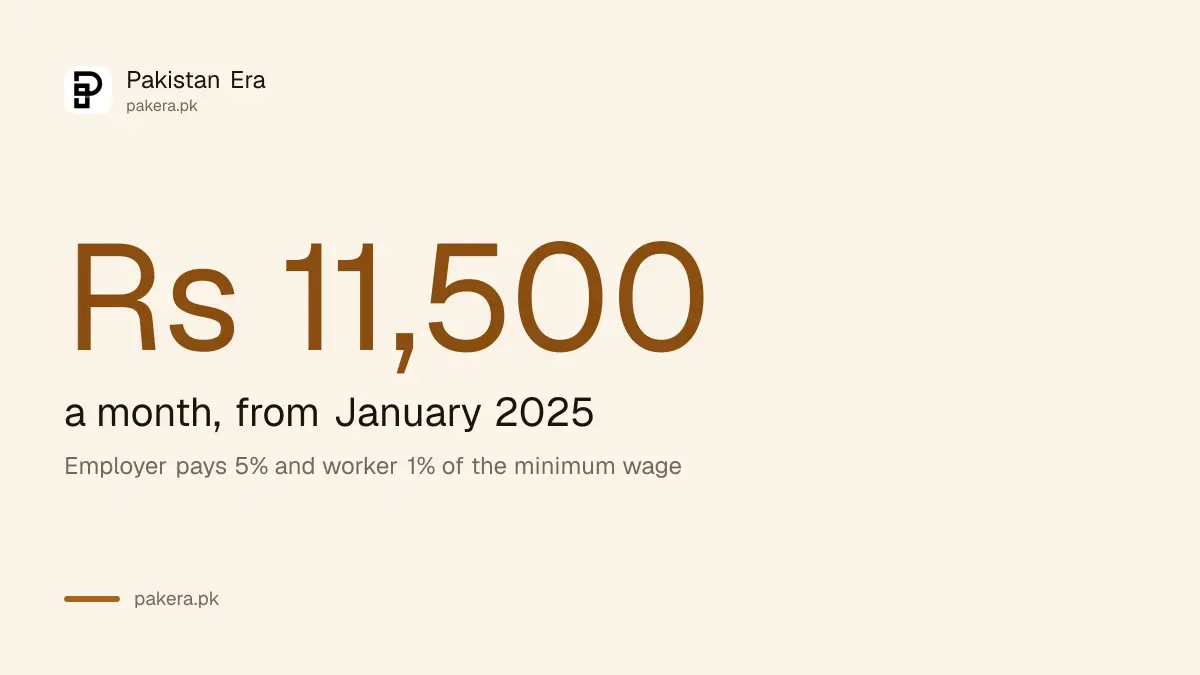
EOBI's page sets the minimum old-age pension at Rs 11,500 a month from January 2025, with higher amounts by formula. Men qualify at 60 and women and mine workers at 55. Workers with between two and fifteen years of contributions get a one-time old-age grant instead.
EOBI also lists an invalidity pension. It needs at least five years of contributions since joining, and at least three of the five years before the disability. A survivors' pension goes to the spouse if an insured worker dies after at least 36 months of insured employment.
The money comes from the employer and the worker. EOBI says employers pay 5% of the minimum wage and employees 1% of the minimum wage. So a worker earning more than the minimum still pays in on the minimum wage figure.
Whether your employer has registered you is the first thing to check. The steps are in the EOBI registration check by CNIC.
WWF and the provincial boards pay grants, not pensions
The Workers Welfare Fund pays lump sums and education costs. Its online system lists six services: fee scholarships, educational grants, marriage grants, death grants, Hajj grants and houses or flats by ballot. Islamabad-based industries apply to WWF; provincial workers apply to their own board.
For scholarships, WWF pays the fee direct to the school and adds a monthly stipend after matric of Rs 3,500, Rs 4,500 or Rs 5,500 by level. The full rates are in the WWF scholarship rates and documents.
WWF's own conditions tie it back to the other two schemes. The worker must be registered with EOBI or social security. So a worker missing from EOBI's records often finds the WWF claim stuck too. One registration problem can block two schemes at once.
Social security covers health and lost wages
Provincial social security institutions, such as PESSI in Punjab and SESSI in Sindh, provide medical treatment and cash benefits when a registered worker cannot work. They are separate from EOBI, even though both cards are issued through the employer.
In Punjab, the card and what it covers are explained in the PESSI social security card steps. In Sindh, sickness, maternity and injury pay are covered in the SESSI benefits claim process.
Check all three in this order
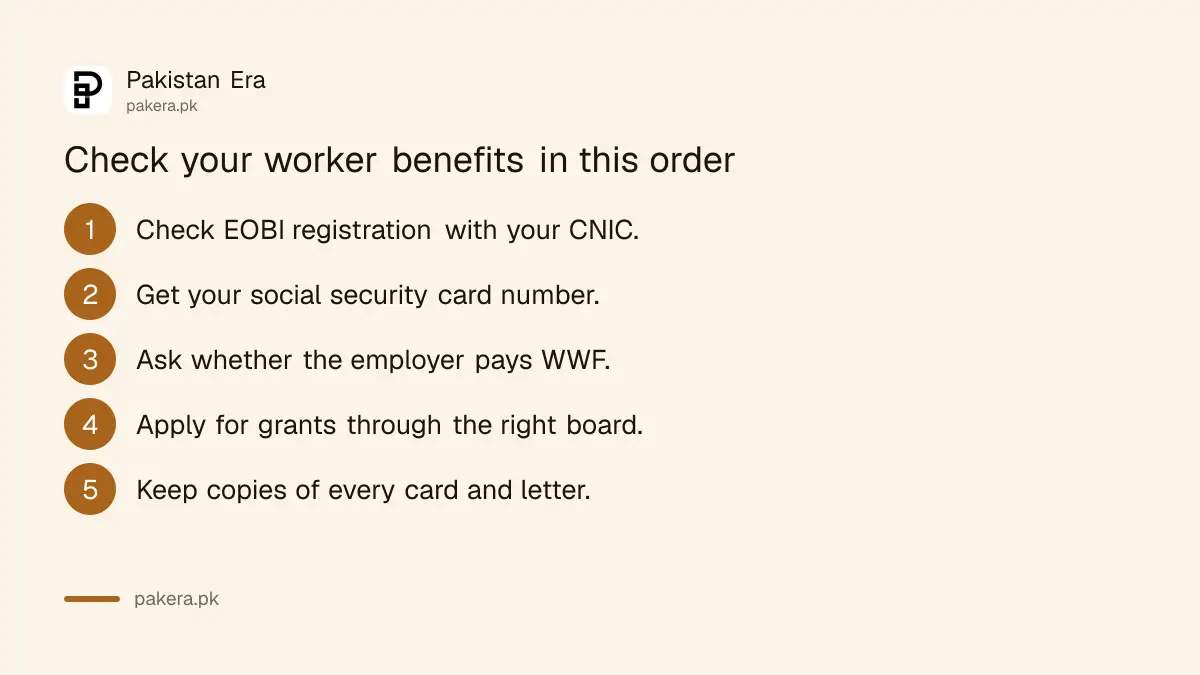
Start with EOBI, because WWF and the boards ask for it. Then confirm social security, which matters if you fall ill. Then look at WWF or your board for any grant you are owed. The order saves repeat visits.
- Check your EOBI registration with your CNIC.
- Ask HR for your social security card or number.
- Ask HR whether the employer pays the WWF contribution.
- Apply for any WWF grant through the right board.
- Keep copies of every card and appointment letter.
If your employer never registered you, that is the real problem, and none of the three schemes can fix it alone. EOBI's helpline 08000 3624 runs from 8 am to 4 pm, Monday to Friday, according to its website.
Common questions
Is EOBI the same as the Workers Welfare Fund?
No. EOBI pays pensions. WWF and the provincial Workers Welfare Boards pay grants such as scholarships, marriage and death grants.
What is the minimum EOBI pension?
Rs 11,500 a month from January 2025, according to EOBI's website.
Can I get EOBI and a WWF grant together?
Yes, they are separate schemes. In fact WWF requires the worker to be registered with EOBI or social security.
What if I have less than 15 years of EOBI contributions?
EOBI pays a one-time old-age grant to workers with at least two but under fifteen years of contributions at retirement age.
How much does a worker pay to EOBI?
EOBI says employees pay 1% of the minimum wage and employers 5%.
Which helpline do I call for a marriage grant?
Not EOBI. Call WWF on 051-9106325 for Islamabad industries, or your provincial Workers Welfare Board.
How we verified this
What we checked, where we read it, and what we could not confirm.
Last checked 1 November 2026. We read EOBI's home and benefits text at eobi.gov.pk (minimum pension, ages, grant and pension conditions, contribution rates, helpline hours), and WWF's scholarship eligibility, claim procedure and MIS pages on wwf.gov.pk. Social security details are summarised from our own PESSI and SESSI pages; we did not re-read those institutions' sites, which did not open from our connection. We did not test any helpline.
About the author

Public Services and Education Journalist
Fajr Riaz is a journalist and content writer at Pakistan Era, based in Lahore. She covers the questions people meet in everyday life in Pakistan: how a public service works, what a change in the rules means, and where to find a reliable answer.