WWF Scholarship 2026 for Workers' Children in Pakistan: Stipend Rates, Documents and MIS Steps
WWF pays a worker's child's fees direct to the school, plus Rs 3,500 to Rs 5,500 a month after matric. See who qualifies, the papers and the MIS claim steps.
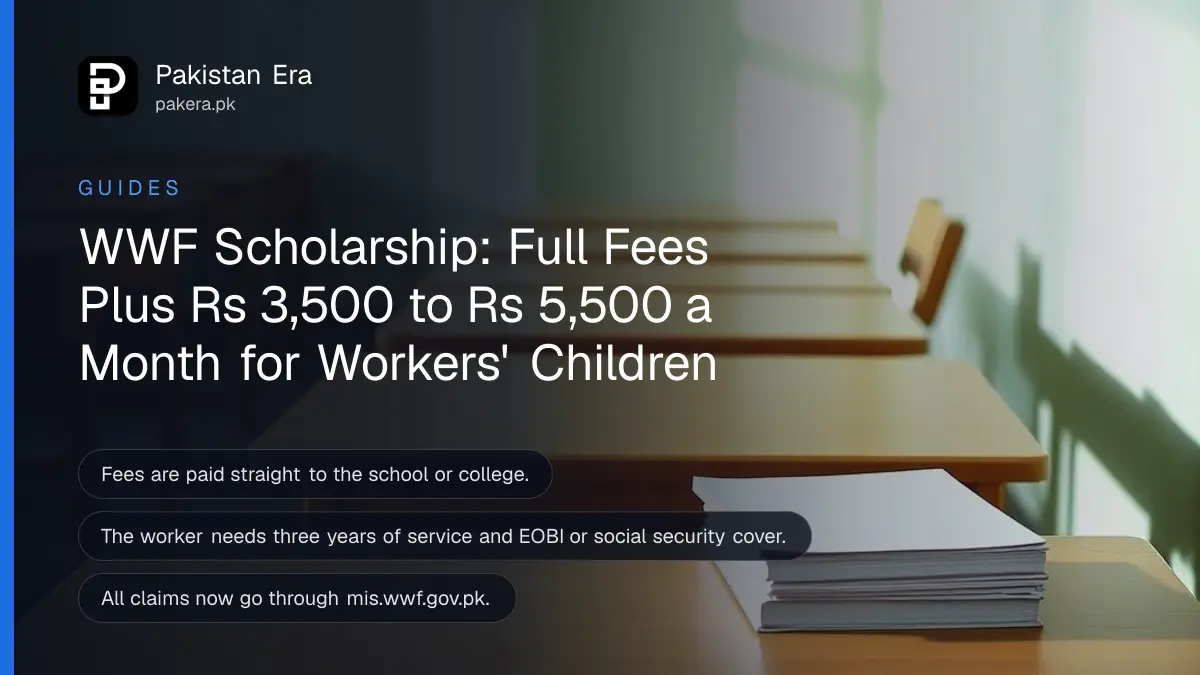
The Workers Welfare Fund (WWF) scholarship pays the full fee of a registered industrial worker's child straight to the school, plus a monthly stipend of Rs 3,500 for intermediate, Rs 4,500 for a bachelor's degree and Rs 5,500 for a master's, medical or engineering degree. Claims now go only through WWF's online system at mis.wwf.gov.pk. Paper approval is no longer accepted.
A factory worker in Islamabad with a daughter starting her first year at college usually asks one thing: will WWF pay, and how much? We read WWF's scholarship policy, eligibility rules, claim procedure and fee rates on wwf.gov.pk on 1 November 2026. This page sets out the federal WWF scheme. Workers in a province apply through their provincial board, covered further down.
WWF pays the fee in full and adds a fixed monthly stipend after matric
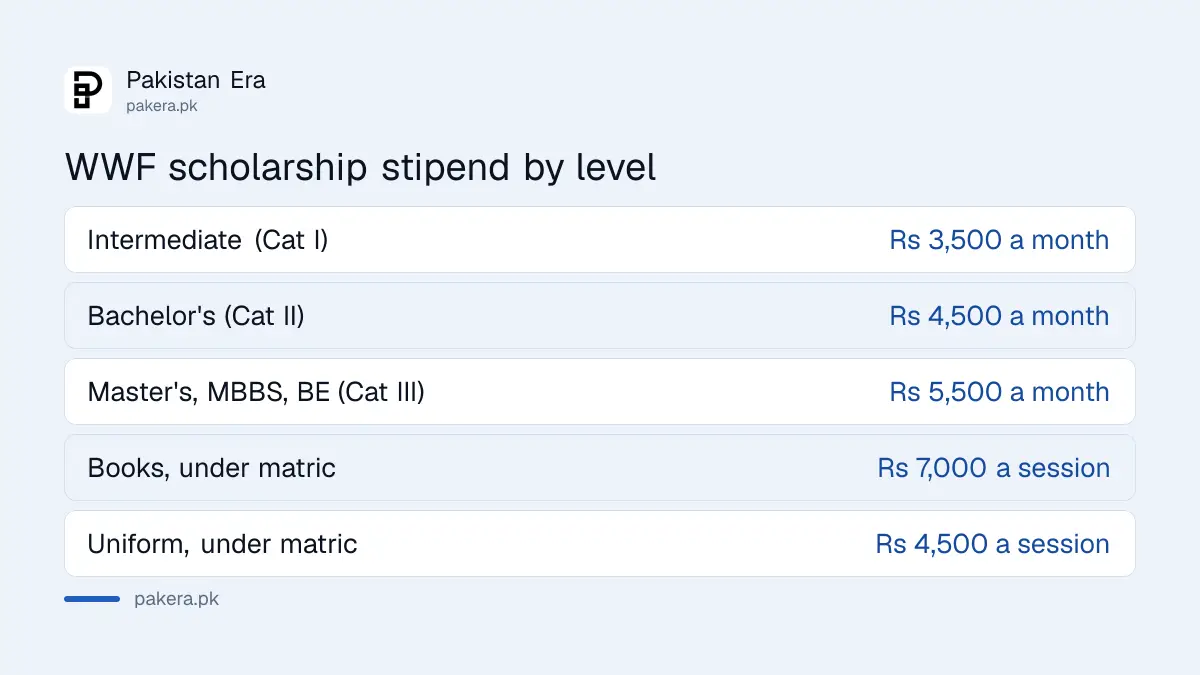
For children below matric, WWF pays admission and tuition fees and gives fixed sums for books, uniform and transport. After matric it pays all listed fees and a monthly stipend by category. The fee goes to the institution, not to the worker.
| Level | What WWF pays | Amount |
|---|---|---|
| Category I: intermediate, cadet college, public school, registered technical institute | Fees plus stipend | Rs 3,500 a month |
| Category II: bachelor's degree recognised by HEC | Fees plus stipend | Rs 4,500 a month |
| Category III: master's, or an engineering or medical degree | Fees plus stipend | Rs 5,500 a month |
| Books and stationery, under matric | Fixed sum | Rs 7,000 a session |
| Uniform, under matric | Fixed sum | Rs 4,500 a session |
The fee items WWF covers are admission, tuition, registration, examination, library, lab and computer fees, plus transport, hostel and mess charges. It does not pay fines, subscriptions, charity funds or any refundable or non-refundable security.
Transport money depends on the distance from home to school
WWF's rate table sets transport money by distance for under-matric students. Nothing is paid up to half a kilometre. The rate rises to Rs 3,000 for more than 7 km, inside an annual cap of Rs 18,000 under matric.
- Up to 0.5 km: nothing
- 0.5 to 3 km: Rs 1,000
- 4 to 7 km: Rs 2,000
- More than 7 km: Rs 3,000
The same table lists a maximum of Rs 10,000 a year for post-matric students. The table is laid out loosely on the page, so we read the transport rates as monthly figures within those annual limits. Ask the Education section to confirm your child's figure before you rely on it.
The monetisation form asks for the distance in kilometres and a print or screenshot of the route on Google Maps. So measure it properly. A guess that does not match the map will slow the claim down.
Only registered industrial workers with three years of service qualify
The worker must fit the definition in the Industrial Relations Act 2012, be registered with EOBI or social security, have at least three years of total service and still be in service when applying. The employer must be registered and paying into WWF.
WWF's eligibility page lists these conditions for the establishment:
- It falls under the WWF Ordinance or the Companies Profits (Workers' Participation) Act 1968.
- It is registered under the Factories Act 1934, the Mines Act 1923 or the Shops and Establishment Ordinance 1969.
- It is registered with EOBI or a social security institution.
The child must be the worker's own child and enrolled on merit. Children of a worker who died in service can still apply, but only if the widow or legal heirs have already received the WWF death grant. The rules for that grant are in the WWF death grant and marriage grant requirements.
Here is the catch most families miss. The federal WWF Education section says it serves workers of Islamabad-based industries. A worker in Lahore or Karachi goes to the provincial Workers Welfare Board, which runs its own scheme. In Punjab that is the PWWF scholarship for workers' children.
University students face extra conditions
For bachelor's and higher degrees, the student must pass any entry test HEC requires, study an HEC-approved course and finish within HEC's minimum time. The discipline cannot be changed once registered, and WWF funds only one postgraduate course.
WWF also says scholarships normally stop at postgraduate level. Anything beyond that needs case-by-case approval from the Chairman of the board or the Secretary of WWF. If a student falls behind the HEC time frame, the case can be reviewed only with written reasons verified by the university.
Claims go through mis.wwf.gov.pk in three stages
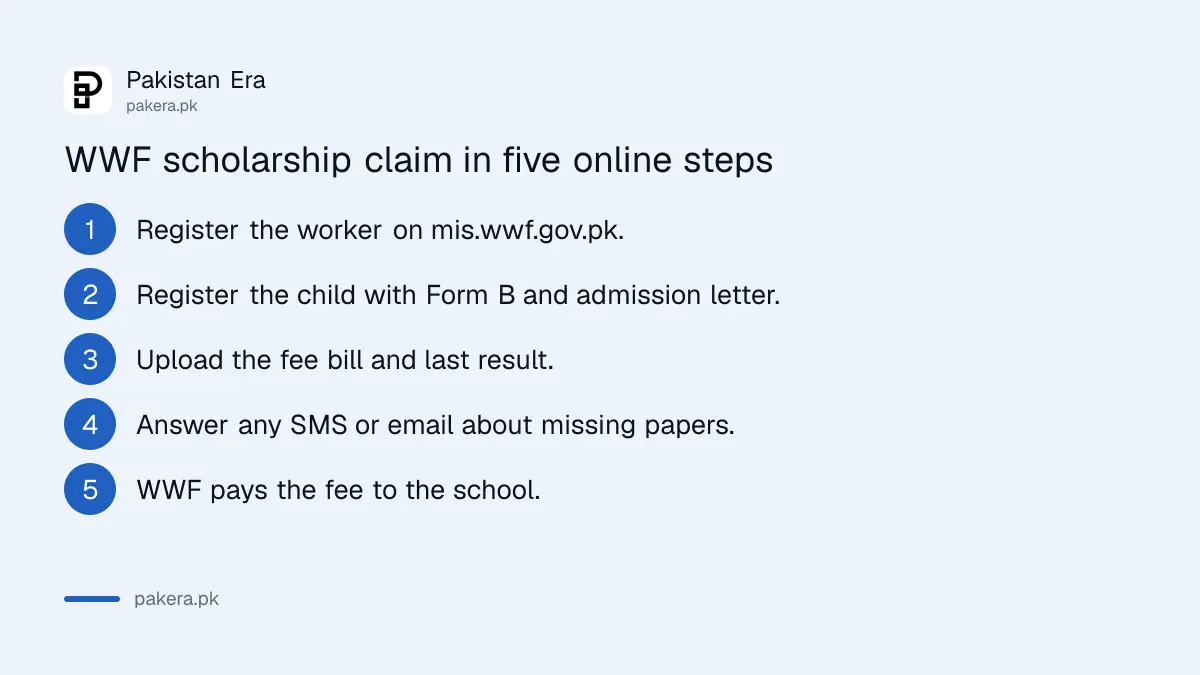
The worker registers first, then registers each child, then uploads the claim. WWF says it will send SMS or email at each stage and when there is a problem with the papers. The whole educational claim is meant to take 15 days.
- Register the worker on mis.wwf.gov.pk with the CNIC number, a photo, the EOBI or social security card and the appointment letter.
- Register the child with a CNIC, Form B or Family Registration Certificate from NADRA, a photo, and the admission letter or fee challan.
- Upload the claim: the fee bill or invoice, the last class or semester result, and the exact location of the institution and the home.
- Answer any discrepancy message by SMS or email quickly.
- WWF pays the fee to the institution, and uniform, books and transport money to the worker's account.
When we opened mis.wwf.gov.pk on 1 November 2026, its front page showed the words "Registration Closed". WWF did not say whether this means new worker registration is paused or only one window has shut. A worker already registered should still be able to log in. A new worker should call the Education section before assuming the door is shut.
Tracking a claim after it is submitted works through the same system. The WWF MIS claim status steps set out the 15 day timeline stage by stage.
The paper checklist still decides whether a claim passes
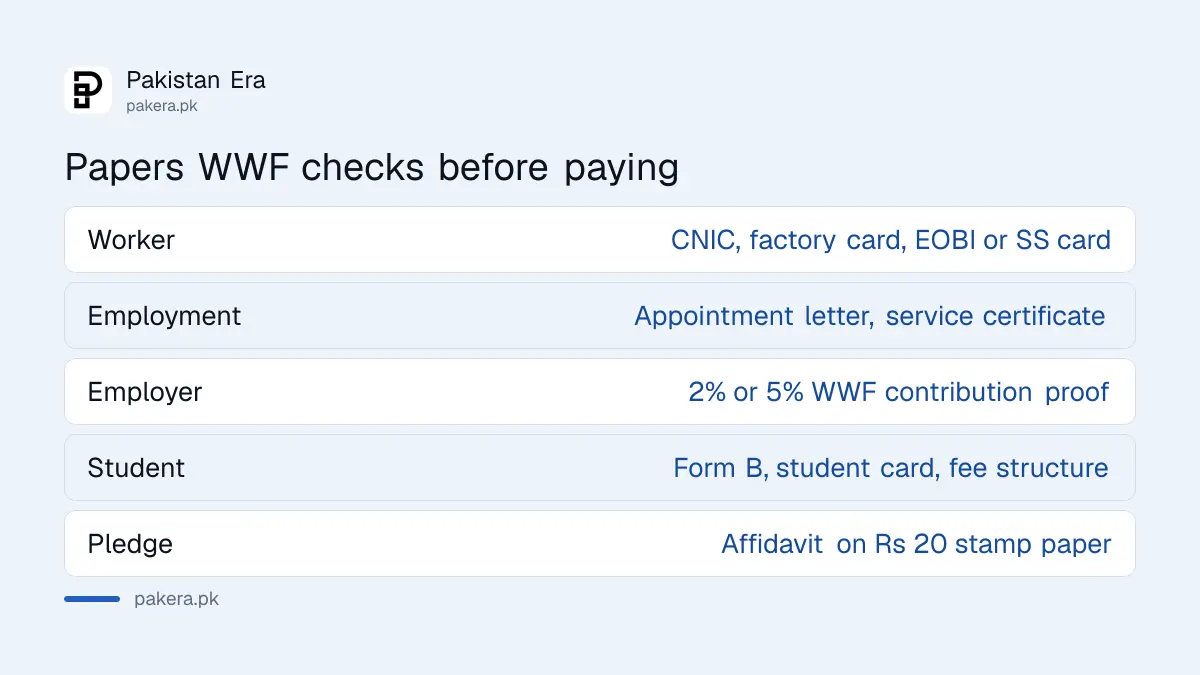
WWF's scrutiny checklists list every document the Education section ticks off. A missing employer attestation or contribution receipt is the most common reason a claim stalls. Collect these before you start the online form.
From the post-matric checklist, the worker's side needs:
- CNIC copy and factory card, attested by the employer
- EOBI or social security number
- Appointment letter and a service certificate on the factory's letterhead
- Proof the employer paid the 2% or 5% WWF contribution
- Factory registration under the Factories Act or Mines Act
- An original affidavit
- Salary slips and payroll from the first appointment and the current month
- A bank account number with IBAN, or a cheque copy
The student's side needs the Form B or CNIC, the student card, start and end dates of the programme, the fee structure, and the institution's attestation. Medical, dental, DPT and Pharm-D students also need an attested merit list. Engineering students need proof of PEC affiliation.
First-time applicants must also give an affidavit on Rs 20 stamp paper. In it the student promises to refund all costs if they leave the course halfway. That clause has teeth, so read it before signing.
WWF has paid Rs 228 million in Islamabad education claims since moving online
WWF's own welfare database shows 4,244 educational claims worth Rs 228.45 million processed through its system since January 2024. That works out to roughly Rs 53,800 a claim on average, by our arithmetic.
The same page counts 384 registered establishments, 2,910 workers and 5,667 children in Islamabad. The MIS front page gives a wider total of 47,246 scholarships and 3,818 panel institutes, which appears to include the provincial boards. Either way, the scheme is real money. The rules are strict, not the budget.
Common questions
How much is the WWF scholarship stipend?
Rs 3,500 a month for intermediate, Rs 4,500 for a bachelor's degree, and Rs 5,500 for a master's, engineering or medical degree, on top of fees.
Does WWF pay school fees directly?
Yes. WWF says fee claims are paid directly to the school or college. Books, uniform and transport money go to the worker by online transfer.
Can a private school student get the WWF scholarship?
Yes, if the school is registered or affiliated with the government, its board or HEC. Proof of that affiliation must be attached.
How long does WWF take to approve an education claim?
WWF's published service timeline gives 15 days from receipt to payment.
I work in Karachi. Do I apply to WWF Islamabad?
No. WWF's Education section serves workers of Islamabad-based industries. Workers in a province apply to their provincial Workers Welfare Board.
What if the worker has died?
The children can still apply, but only after the widow or legal heirs have received the WWF death grant.
How we verified this
What we checked, where we read it, and what we could not confirm.
Last checked 1 November 2026. We read WWF's scholarship eligibility criteria, scholarship policy, SOPs for educational claims (fee items and rates), procedure for claims through MIS, and welfare database pages on wwf.gov.pk, plus its post-matric and under-matric scrutiny checklists, the 2025-26 monetisation form and the service timelines PDF from the same site. We opened mis.wwf.gov.pk, which showed "Registration Closed" and its scholarship totals. The average claim is our arithmetic. We could not confirm whether the transport rates are monthly, what "Registration Closed" covers, or the current provincial board rates, and we did not submit a claim.
About the author

Public Services and Education Journalist
Fajr Riaz is a journalist and content writer at Pakistan Era, based in Lahore. She covers the questions people meet in everyday life in Pakistan: how a public service works, what a change in the rules means, and where to find a reliable answer.