Court Fee in Punjab: 7.5 Per Cent of Your Claim, Capped at Rs 15,000, and Free Up to Rs 25,000
Court fee on a civil suit in Punjab is 7.5% of the claim, capped at Rs 15,000, and nil up to Rs 25,000 or in criminal cases. Fixed fees and how to pay inside.
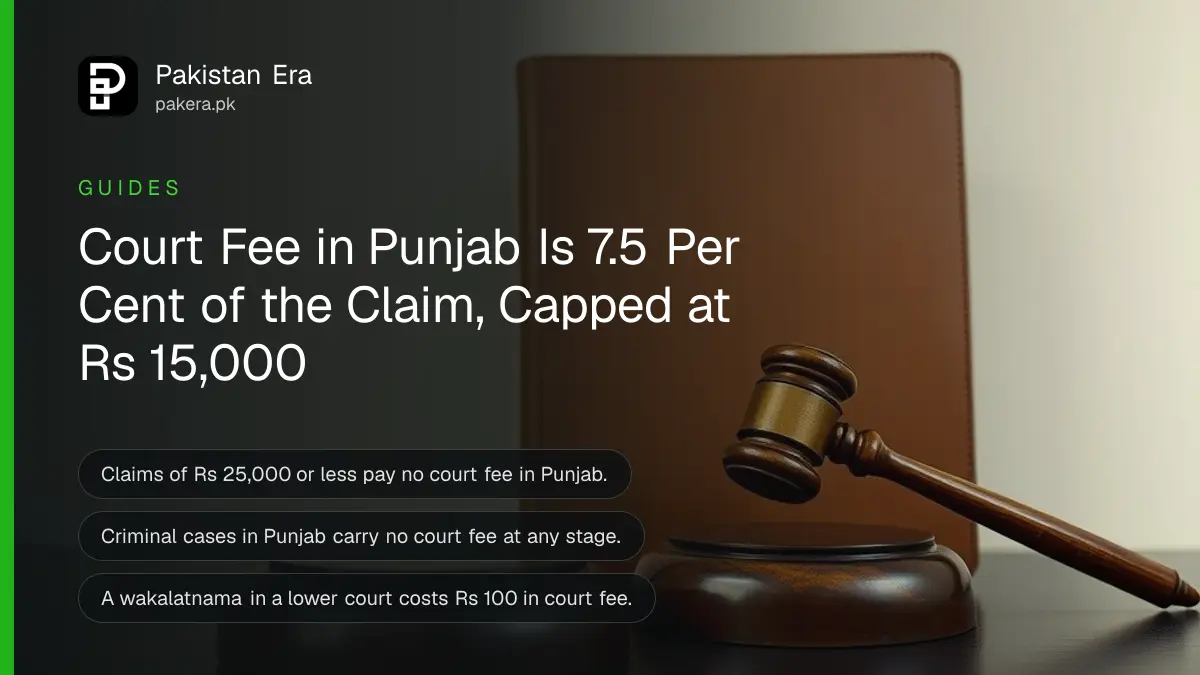
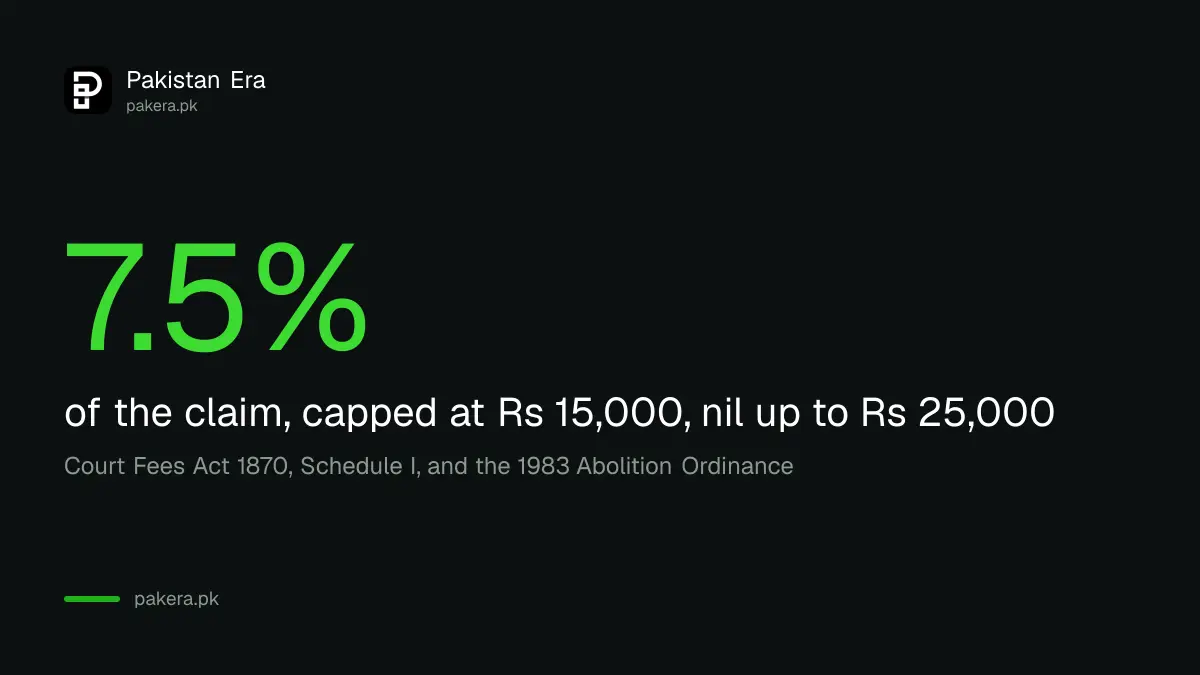
Court fee on a civil suit in Punjab is 7.5 per cent of the amount or value you claim, up to a maximum of Rs 15,000. A claim of Rs 25,000 or less pays no court fee at all, and neither does any criminal case. So a suit to recover Rs 100,000 pays Rs 7,500, and any claim of Rs 200,000 or more pays the Rs 15,000 cap.
These rates come from Schedule I of the Court Fees Act 1870 as it applies in Punjab, and the Punjab Court Fees (Abolition) Ordinance 1983. Fixed fees for applications, wakalatnamas, caveats and copies were raised by the Punjab Finance Act 2024. All of them are below, with a worked example for each.
Civil suits pay 7.5 per cent, capped at Rs 15,000
A plaint, a memorandum of appeal or a written statement with a counter-claim pays 7.5 per cent of the amount or value in dispute. The fee stops rising at Rs 15,000. The amount is rounded to the nearest 50 paisas. This is the ad valorem fee in Schedule I, Article 1.
| Amount or value claimed | Court fee in Punjab |
|---|---|
| Rs 25,000 or less | No court fee |
| Rs 50,000 | Rs 3,750 |
| Rs 100,000 | Rs 7,500 |
| Rs 150,000 | Rs 11,250 |
| Rs 200,000 | Rs 15,000 |
| Rs 5 million or more | Rs 15,000 (cap) |
The cap makes a big difference for large claims. A suit over a Rs 10 million house pays the same Rs 15,000 as a suit over Rs 200,000. The same 7.5 per cent rule, with the same cap, applies to the memorandum of appeal when the case goes up to the district court or the Lahore High Court.
Claims up to Rs 25,000 and criminal cases pay nothing
The Punjab Court Fees (Abolition) Ordinance 1983 says no court fee is charged in any criminal case, or in any civil case where the value or relief claimed is Rs 25,000 or less. The exemption covers every stage of the case and every court, including revenue courts.
So a complaint in a criminal court, a bail petition or a criminal appeal carries no court fee in Punjab. A small money claim, such as a Rs 20,000 unpaid wage or deposit, is also free. You still pay your own lawyer if you hire one. People who cannot afford a lawyer can ask for one free through the legal aid committees in Punjab.
Family court cases follow their own rule. A suit for dissolution of marriage, maintenance, dowry or custody in a family court pays a small fixed fee, set out in the family court case guide.
Section 7 sets the value for each type of suit
The 7.5 per cent is worked out on a value that depends on the suit. Section 7 of the Act sets how. For money, it is the amount claimed. For maintenance or other yearly payments, it is ten times one year's claim. For land and houses, it is usually the market value.
| Type of suit | Value used for the fee |
|---|---|
| Recovery of money, damages or compensation | Amount claimed |
| Maintenance, annuity or other yearly sum | Ten times the yearly amount |
| Movable property with a market value | Market value on the plaint date |
| Possession of a house or garden | Market value |
| Possession of land with profits | Fifteen times the last year's net profit |
| Declaration of title based on a sale, gift, exchange or mortgage | Value of the property |
| Injunction, accounts, or declaration with consequential relief | Value you state in the plaint |
For an injunction, the plaintiff states the value of the relief in the plaint, and the fee follows that figure. A suit for possession under section 9 of the Specific Relief Act, for someone thrown out of property without due process, pays half the normal fee. A suit to stop a property sale is usually valued this way.
Fixed fees: Rs 100 to Rs 1,000 for applications, copies and caveats
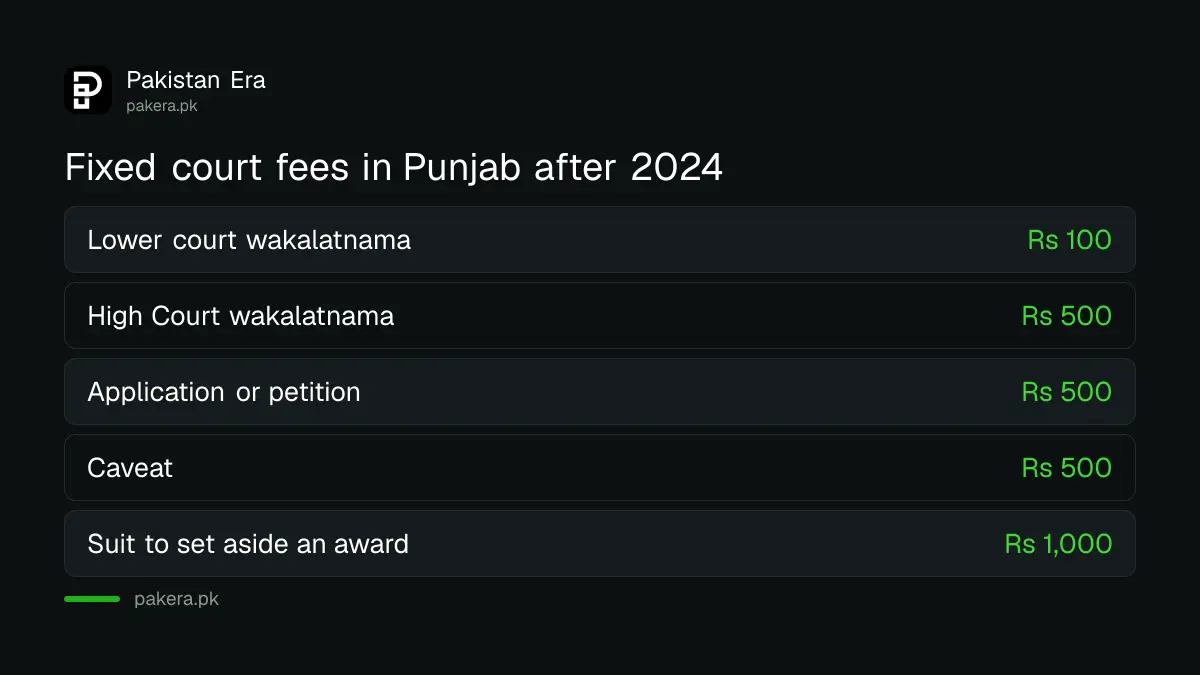
Schedule II sets fixed court fees for papers that are not valued in money. The Punjab Finance Act 2024 raised most of them sharply. A wakalatnama in a lower court is now Rs 100, an application or petition is Rs 500, and a caveat is Rs 500.
| Paper | Court fee |
|---|---|
| Wakalatnama in a civil, criminal or revenue court | Rs 100 |
| Wakalatnama in the High Court or Board of Revenue | Rs 500 |
| Application or petition to a civil or revenue court | Rs 500 |
| Application to the High Court | Rs 500 |
| Caveat | Rs 500 |
| Suit for a declaration with no other relief | Rs 500 |
| Suit that cannot be valued in money | Rs 500 |
| Suit to set aside an arbitration award | Rs 1,000 |
| Copy of a lower court judgment or order | Rs 100 |
| Copy of a High Court judgment, or of a decree | Rs 500 |
| Application to sue or appeal as a pauper | Rs 2 |
A review of a judgment pays half the plaint fee if filed within 90 days of the decree, and the full fee after that. Anyone who cannot pay can ask the court for leave to sue as a pauper, for a Rs 2 fee, and the court decides whether to allow it.
Probate and succession certificates in court pay 2 to 4 per cent
Probate of a will or letters of administration from a court pays 2 per cent of the property's value between Rs 1,000 and Rs 10,000, 3 per cent up to Rs 50,000, and 4 per cent above that. A court succession certificate pays 2 per cent of the debts or securities it covers.
These percentages have no cap, so on a large estate the court fee can be high. NADRA also issues succession certificates in Punjab, for a flat fee rather than a percentage. Compare the two routes in the Punjab succession certificate guide before you choose.
How to pay court fee in Punjab
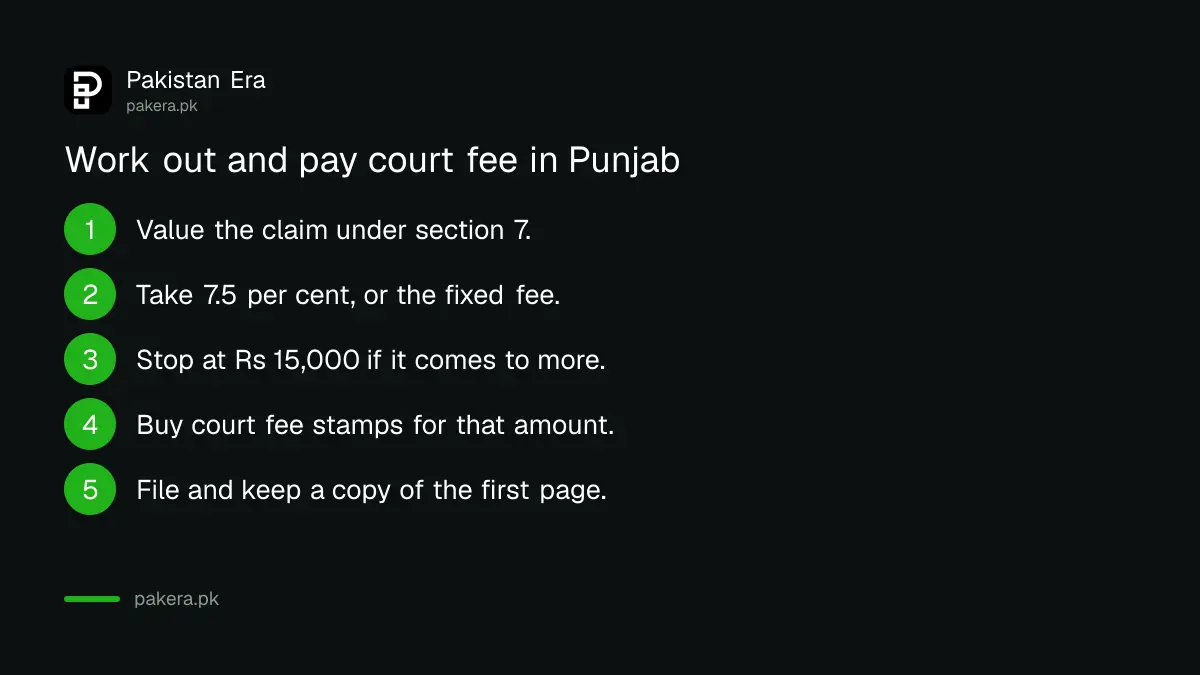
Section 25 of the Act says court fee is collected by stamps. You pay the fee in court fee stamps of the right value and attach them to the plaint, appeal or application before you file it.
- Work out the value of your claim under section 7, using the table above.
- Take 7.5 per cent of that value, or the fixed fee for your paper.
- Stop at Rs 15,000 if the 7.5 per cent comes to more.
- Buy court fee stamps for that amount and attach them to the paper.
- File it with the court office and keep a copy of the stamped first page.
If you pay too little, the paper is not valid until the shortfall is made up. Section 28 lets the judge allow you to add the missing stamps later, and the case then goes on as if the fee had been paid in full. Do not wait for that. A short fee can delay the first hearing.
Common questions
What is the court fee for a civil suit in Punjab?
7.5 per cent of the amount or value claimed, up to a maximum of Rs 15,000. Claims of Rs 25,000 or less pay nothing.
What is the maximum court fee in Punjab?
Rs 15,000 on a plaint, appeal or counter-claim under Schedule I. Probate and succession certificates in court are charged by percentage with no cap.
Is there court fee in criminal cases in Punjab?
No. The Punjab Court Fees (Abolition) Ordinance 1983 removes court fee from every criminal case, at every stage.
What is the court fee on a wakalatnama in Punjab?
Rs 100 in a civil, criminal or revenue court below the High Court, and Rs 500 in the Lahore High Court or the Board of Revenue.
How is court fee worked out on a maintenance suit?
On ten times the yearly amount claimed, under section 7. A maintenance suit in a family court follows the family court rules instead.
What if I cannot afford the court fee?
Apply to the court for leave to sue as a pauper. The application costs Rs 2, and the court decides whether you qualify.
How we verified this
What we checked and where we read it.
Last checked 14 November 2026. We read the Court Fees Act 1870 in the Punjab text on the Punjab Code portal of the Law and Parliamentary Affairs Department, including Schedule I, Schedule II, section 7, section 25 and section 28, with the footnotes showing the fixed fees substituted by the Punjab Finance Act 2024, published on 27 June 2024. The Rs 25,000 and criminal case exemptions come from the Punjab Court Fees (Abolition) Ordinance 1983 on the same portal. The worked examples are our arithmetic. This page applies to Punjab only and is not legal advice.
About the author

Tax, Bills and Technology Writer
Ali Akhtar is a young and curious voice here at Pakistan Era. He is currently pursuing his A-Levels and has a growing interest in Pakistan’s changing industrial landscape and educational trends. Ali likes to write in a way that helps him explain and explore the world around him. His writing reflects the perspective of the new generation navigating the evolving trends of Pakistan where technology, youth innovation, and shifting opportunities are reshaping the country’s future.