Crossed Cheque, Account Payee and Or Bearer: What They Mean on a Cheque in Pakistan
What a crossed cheque, Account Payee and or bearer mean in Pakistan, and the six cheque terms SBP says your bank must explain when you open an account.
Short answer: A crossed cheque has two parallel lines or the words "Account Payee" on it. It tells the bank the money should go into an account, not be paid out in cash over the counter. Ask your bank to explain "crossing", "not negotiable" and "or bearer" when you open an account. SBP says it must.
Your cousin writes you a cheque for Rs 200,000 and drops it on the way. If it is an open cheque, whoever finds it may try to cash it. If it is crossed, the bank is meant to pay it into an account. That one difference decides how much risk the cheque carries.
We read SBP's Guidelines of Business Conduct for Banks, which its Consumer Protection Department publishes, and SBP's cheque layout FAQ for banks. Both explain crossing in simple terms. The guidelines copy on SBP's site cites circulars up to 2014, so ask your bank for its current terms before you rely on any detail here. SBP also says its definitions are "not precise, legal or technical".
A crossed cheque is meant for an account, not cash
SBP defines a crossed cheque as one marked with an instruction on how it is to be redeemed. The common instruction is that it must be deposited into a bank account and not cashed over the counter. The marking is usually two parallel lines, or the words "Account Payee".
SBP says that by crossing a cheque, the writer can protect it from being stolen and cashed. This is the main reason to cross a cheque you hand to someone else. An open cheque with no crossing is easier for a thief to turn into cash.
The FAQ for banks adds two practical points. A special crossing stamp may be placed in the top left corner on the front of the cheque. Banks may also print, write or stamp "Payees Account Only" when a cheque is crossed.
"Not negotiable" and "or bearer" have their own meaning
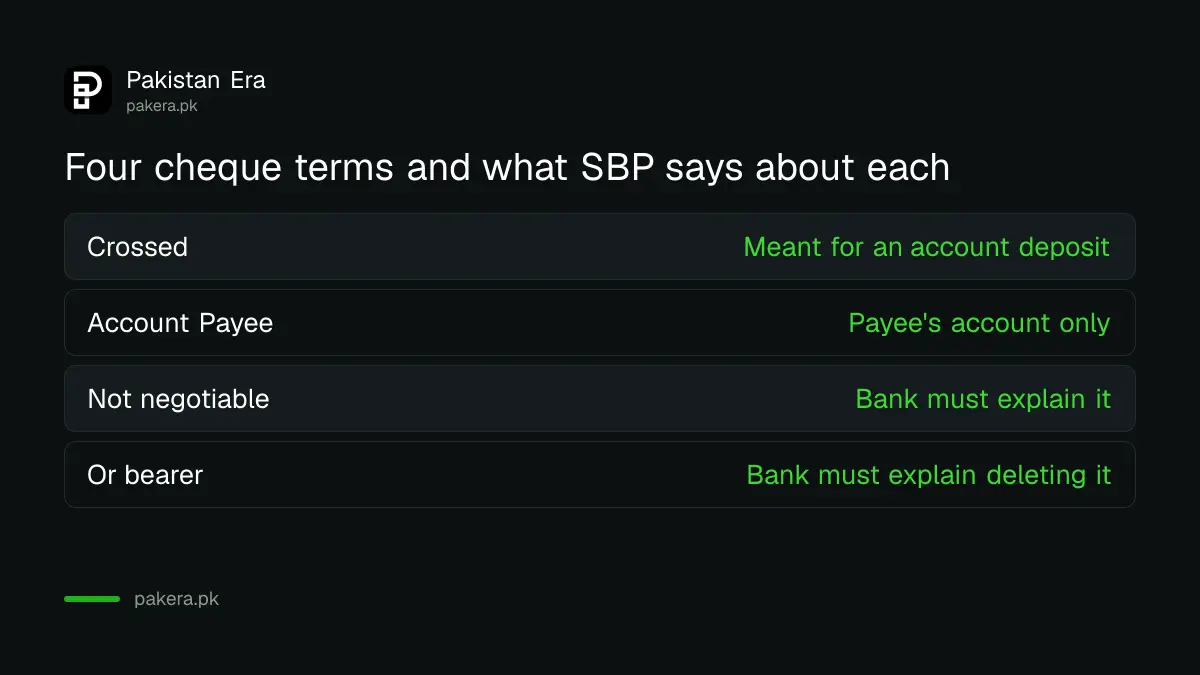
SBP's guidelines list three cheque terms a bank must explain to a customer before the account opens: the effect of crossing a cheque, the meaning of "not negotiable" and "account payee only", and the significance of deleting "or bearer" when these words appear on a cheque.
SBP does not define these terms in full in that text. The legal effect comes from the Negotiable Instruments Act, which we did not read for this page, so we do not state it here. What matters for you is the right to an explanation. Ask the bank to tell you in plain words.
Many printed cheques carry "or bearer" after the payee's name. Crossing out "or bearer" is one of the steps the guidelines expect banks to explain. Ask the bank what it changes on your cheque book before you do it.
What your bank must explain before you open an account
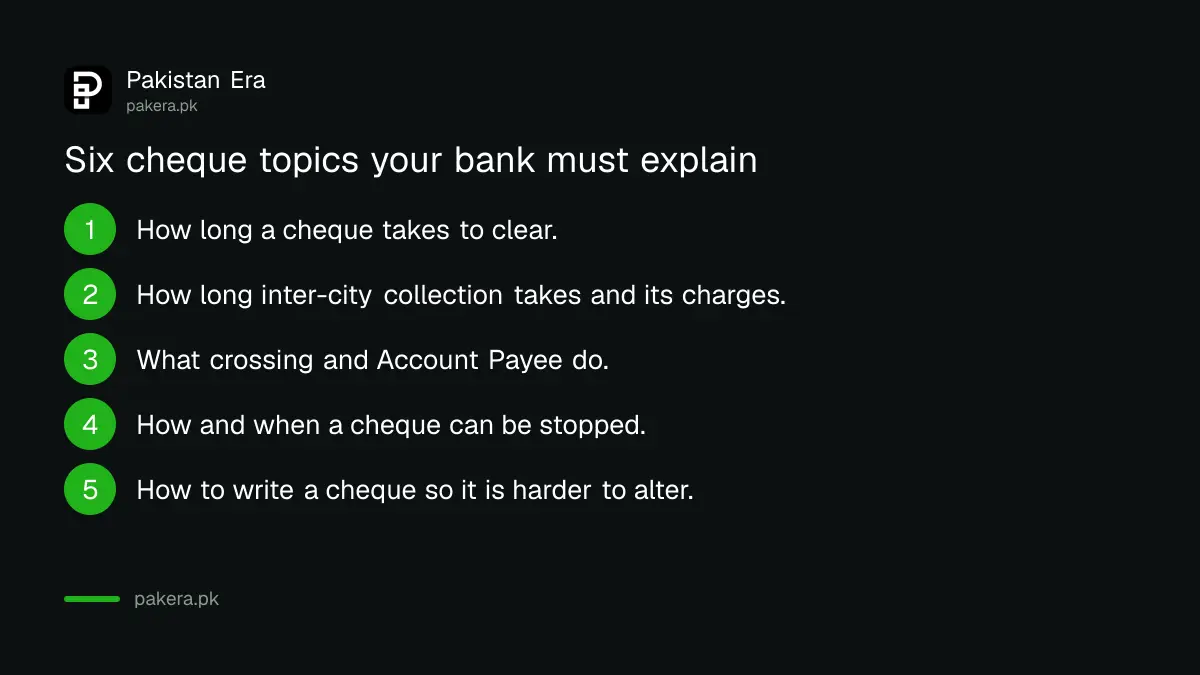
SBP's guidelines say that before an account is opened the bank will advise the customer about several cheque matters. These are in the same list as the account type and the rules for closing an account.
- The time for clearing a cheque and how it may be specially cleared.
- The time for inter-city cheque collection and its charges.
- The effect of crossing, "not negotiable", "account payee only" and deleting "or bearer".
- How and when a cheque may be stopped.
- How to make out a cheque so it is harder to change without permission.
- What happens if a cheque is dishonoured, including post-dated and stale cheques, return charges and any legal effect of a bounce for lack of funds.
If your branch did not explain these, you can ask for them now. The bank is expected to give "general descriptive information" on request. If it will not, the route to complain is in the page on the SBP Sunwai complaint portal.
Open, crossed and bank cheques compared
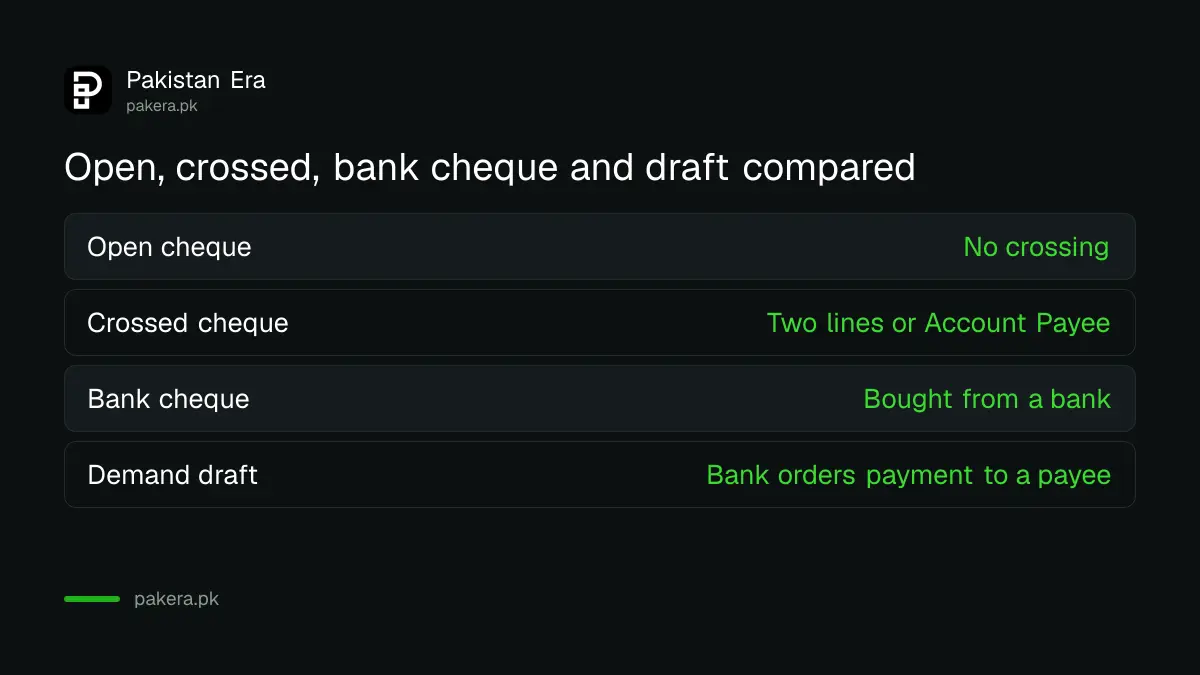
| Type | What it is | Cash over the counter |
|---|---|---|
| Open cheque | No crossing or marking | Can be possible |
| Crossed cheque | Two lines or "Account Payee" | Meant not to be paid in cash |
| Bank cheque | Bought from a bank, drawn on its account | Check the bank's terms |
| Demand draft | Bank orders another bank to pay a named person | Paid to the named payee |
SBP defines a bank cheque as one purchased from a bank and drawn on that bank's account. A demand draft is an order from a bank to pay a certain sum to a named person. Both are defined in the guidelines, but cash payment rules for them come from the bank's own terms, so ask before you rely on one.
Cross a cheque and keep it safe
SBP also publishes a customer guide on cheque book security. These habits are common practice, not quotes from it: keep the cheque book locked, tell the bank at once if a leaf goes missing, and never sign a blank cheque.
If you write a cheque and the person needs to deposit it, cross it. If you must give cash, use a bank counter and a receipt. The guide to what to do when a cheque bounces shows the steps if the payment fails, and the page on ordering a cheque book explains how to get a fresh one.
A bank can also tell you how to stop a cheque you have lost. SBP says the bank will explain how and when a cheque may be stopped, so call the helpline printed on your cheque book the same day.
Common questions
What is a crossed cheque in Pakistan?
It is a cheque marked with two parallel lines or the words "Account Payee". SBP says the common instruction is that it must be deposited in an account, not cashed over the counter.
Does crossing a cheque make it safe from theft?
It lowers the risk. SBP says crossing helps protect a cheque from being stolen and cashed. It does not make a stolen cheque worthless, so keep your cheque book safe too.
What does "or bearer" mean on a cheque?
SBP says banks must explain the significance of deleting "or bearer". It does not define it in full. Ask your bank, and do not change the wording until it has explained.
Can I ask my bank to explain these terms?
Yes. SBP's guidelines say the bank will explain crossing, "not negotiable", "account payee only", stop payment and bounced cheques before an account opens, and give general information on request.
Where is the crossing stamp placed?
On the top left of the front of the cheque, SBP's FAQ says. Other stamps go on the back.
Is a post-dated cheque explained by the bank too?
Yes. SBP lists post-dated and stale cheques among the items the bank will explain, with return charges and the legal effect of a bounce.
How we verified this
What we checked, where we read it, and what we could not confirm.
Last checked on 13 October 2026, Pakistan time. We read SBP's Guidelines of Business Conduct for Banks, the definitions of crossed cheque, bank cheque and demand draft and clauses 3.4.2 and 4.3, and SBP's cheque layout FAQ. The guidelines copy cites circulars up to 2014 and may have been updated since. We did not read the Negotiable Instruments Act, so we do not state the legal effect of "not negotiable" or "or bearer", or how long a cheque stays valid. SBP's customer guide on cheque book security would not open as a file, so the safety habits above are common practice, not quoted from it.
About the author

Public Services and Education Journalist
Fajr Riaz is a journalist and content writer at Pakistan Era, based in Lahore. She covers the questions people meet in everyday life in Pakistan: how a public service works, what a change in the rules means, and where to find a reliable answer.