Pakistan's Islamabad Clean Air Compact 2026: The 4 Commitments, 5 Sector Plans and What Is Still Missing
Pakistan's federal and provincial agencies adopted the Islamabad Clean Air Compact. See its 4 commitments, 5 sector plans, the carbon credit estimate and gaps.
Pakistan's federal and provincial environment agencies have adopted the Islamabad Clean Air Compact, a shared plan to fight air pollution with time-bound action, stricter enforcement, regular emissions inventories and a review meeting every year. It was agreed at the close of the two-day Pakistan National Clean Air Conference, which the Pakistan Environmental Protection Agency (Pak-EPA) reported on 2 November 2026. It sets a framework. It does not yet set dates, budgets or named responsibilities.
We read Pak-EPA's own report of the conference, "Clean Air Compact calls for federal-provincial coordination, time-bound action", on environment.gov.pk on 5 November 2026. Pak-EPA ran the event with the World Bank, the Asian Development Bank, UNICEF and GIZ, the German development agency. Below is what the compact commits to, what each sector roadmap proposes, and what you should not expect from it this winter.
The compact commits agencies to four things
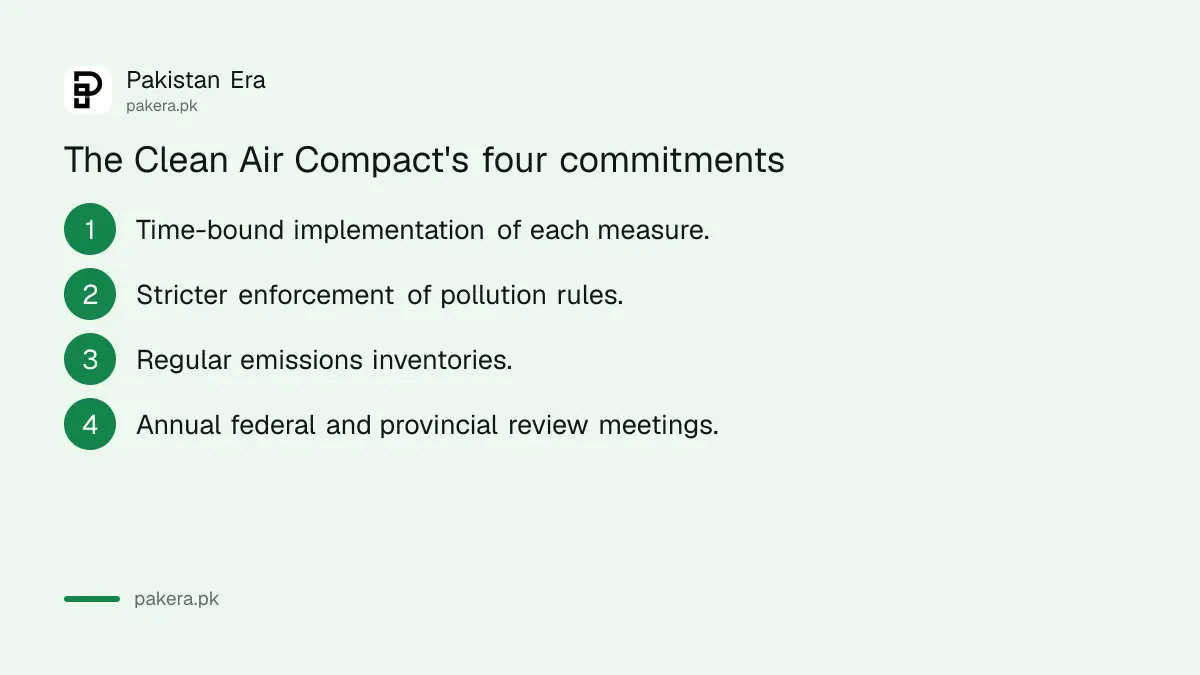
Pak-EPA's report says the compact commits federal and provincial bodies to a "collaborative framework" built on four points: time-bound implementation, stricter enforcement, regular emissions inventories and annual review meetings. Provincial environment agencies, including those of Azad Jammu and Kashmir and Gilgit-Baltistan, took part.
| Commitment | What it means in plain words |
|---|---|
| Time-bound implementation | Each measure should come with a deadline |
| Stricter enforcement | Existing pollution rules applied more firmly |
| Regular emissions inventories | Repeated counts of who pollutes and how much |
| Annual review meetings | Federal and provincial bodies check progress every year |
An emissions inventory is a list of pollution sources, such as traffic, kilns and crop burning, with an estimate of how much each one adds. Without it, a government cannot tell which ban will clean the air most.
Deadlines and responsibilities are not set yet
Pak-EPA's own report is frank about the gap. It says the "detailed implementation timelines and responsibilities of individual institutions will be critical to assessing progress". It also says the compact's effect will depend on turning proposals into funded programmes with named owners and measured targets.
So, as of 5 November 2026, the compact is a promise of how agencies will work together. It is not a new law, a notified rule or a budget. Nothing in it changes this winter's smog orders, which in Punjab come from the province's own plan. The Punjab pre-smog action plan is where this season's actions sit.
The governance roadmap presented at the conference split the work by time:
- Short term: legal and regulatory frameworks, better coordination between institutions, and annual budget allocations.
- Medium and long term: a national secretariat, stronger provincial oversight, public-private partnerships and better data governance.
Five sector roadmaps came out of the conference
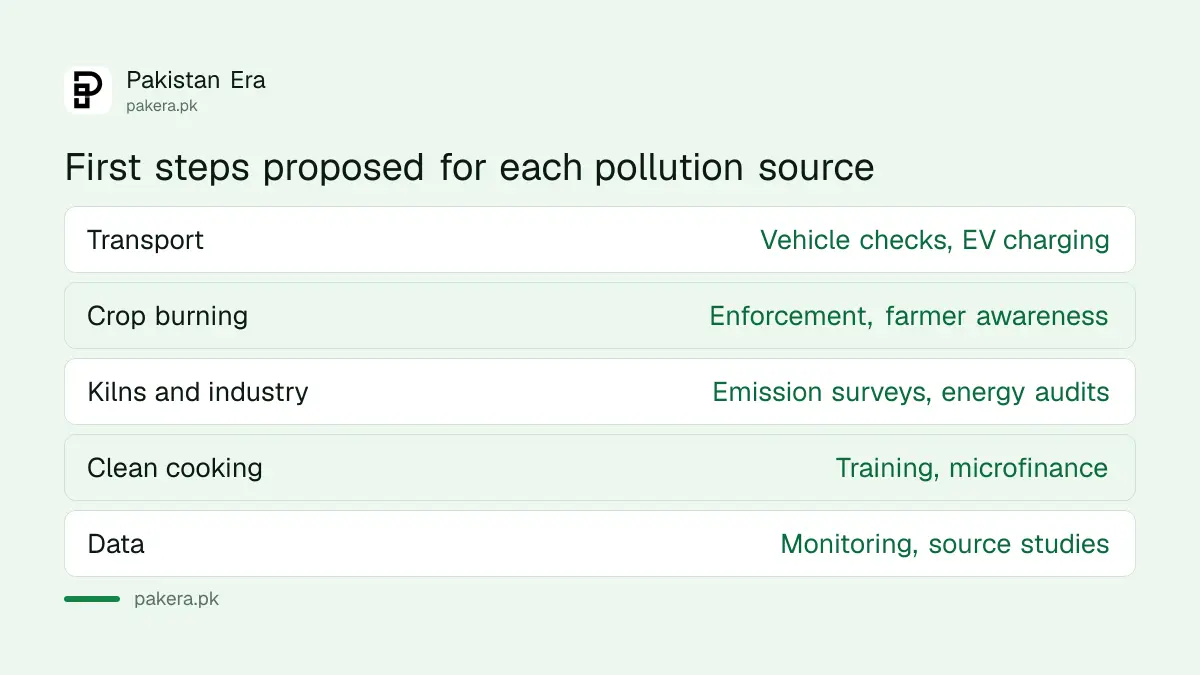
The conference produced phased proposals for transport, crop and waste burning, industry and brick kilns, clean cooking and data, with finance handled separately. Each starts with cheaper steps and moves to bigger investments later. The table sums up the first steps for each, in the words of Pak-EPA's report.
| Area | Short-term proposals | Later proposals |
|---|---|---|
| Transport | Better vehicle inspection, EV charging, emissions data, electric ride-sharing | Mass transit, metro and rail, freight moved to rail, EV battery waste rules |
| Crop and waste burning | Stronger enforcement and farmer awareness | Crop-specific machines, residue value chains, farmer finance |
| Industry and brick kilns | Fuel and emissions surveys, continuous monitoring standards, energy audits | Modern kilns, independent compliance checks, incentives for filters |
| Clean cooking | Awareness, household training, reliable fuel supply, microfinance | Quality standards and testing facilities |
| Data | Monitoring, source studies, emissions inventories, modelling | Real-time source tracking |
Brick kilns are one area where Punjab already inspects sites this winter, using the checklist in the EPA Punjab kiln and factory inspection rules. The compact's kiln proposals go further, towards continuous emissions monitoring, which means meters that record a chimney's smoke all the time rather than on inspection day.
Better data comes first, officials told the conference
Wajid Ijaz of the Environment Protection and Climate Change Department told the conference that reliable data was central to air quality decisions. He said good data lets authorities target real pollution sources "rather than impose broad restrictions without sufficient evidence".
That point matters to anyone who has lived through a smog season of sudden closures. Pakistan's official readings are still patchy. Pak-EPA publishes Islamabad's AQI table on some days and not others, and its September 2026 Islamabad air report found fine dust over the limit on 23 of 30 days. Pak-EPA's Director General, Syed Abrar Hussain, called for planning before the smog season and stronger monitoring.
Money is the open question
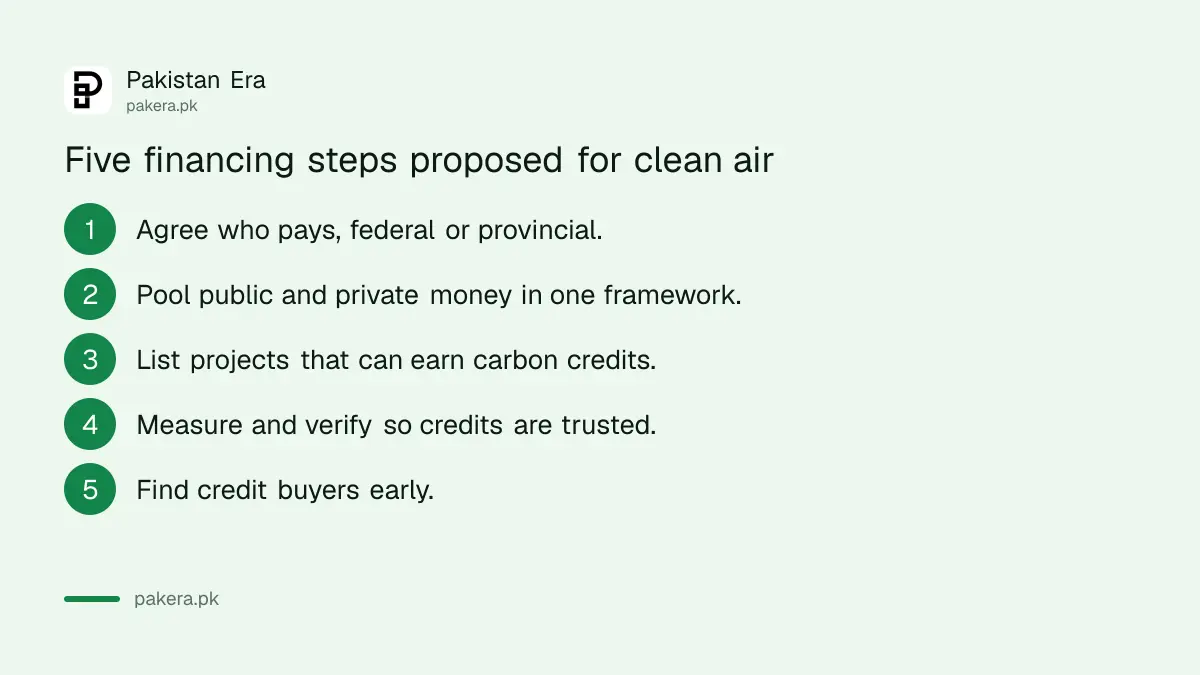
Financing was named as a major challenge. The Asian Development Bank's Andrew McCarthy proposed a National Clean Air Financing Framework that would combine public budgets, fiscal transfers, climate finance, donor money and private investment. A World Bank speaker called for projects that can earn carbon credits.
A presentation at the conference put numbers on that idea. It estimated 984,050 carbon credits, or 35.6 million tonnes of carbon dioxide equivalent, over 10 years, worth $5.9 million to $8.85 million. A carbon credit is a certificate for one tonne of greenhouse gas avoided, which a polluter elsewhere can buy. These are estimates from one presentation, not commitments.
- Agree who pays: federal, provincial or shared, in a consensus statement.
- Set up a national financing framework that pools public and private money.
- Build a list of projects that can earn carbon credits.
- Set up measurement, reporting and checking so credits are trusted.
- Talk to credit buyers early to prove there is demand.
Pak-EPA's spokesperson, Dr Zaigham Abbas, asked development partners to back the National Clean Air Policy 2023 with practical steps against pollution at source. The policy already exists. The compact is about putting it into action. Weather can still undo good plans, and the NDMA smog outlook for November and December expects the risk to rise in December.
Common questions
What is the Islamabad Clean Air Compact?
A shared framework adopted at Pakistan's National Clean Air Conference, committing federal and provincial agencies to time-bound action, stricter enforcement, emissions inventories and annual reviews.
Is the compact a law?
No. Pak-EPA's report describes it as a framework for cooperation. It is not a notified rule and sets no fines.
Does it change smog rules this winter?
Not by itself. This season's smog orders come from provincial plans, such as Punjab's.
Who organised the conference?
Pak-EPA, with the World Bank, the Asian Development Bank, UNICEF and GIZ.
When will the deadlines be set?
Pak-EPA's report does not say. It notes that detailed timelines and each body's duties are still to be defined.
How much money could carbon credits raise?
A conference presentation estimated $5.9 million to $8.85 million over 10 years. It is an estimate, not a pledge.
How we verified this
What we checked, where we read it, and what we could not confirm.
We read Pak-EPA's news item "Clean Air Compact calls for federal-provincial coordination, time-bound action", posted on environment.gov.pk on 2 November 2026, on 5 November 2026. It says the conference "concluded on Thursday" without giving the date. All quotes and figures are from that report. We did not see the text of the compact itself, which Pak-EPA had not posted when we checked.
About the author

Public Services and Education Journalist
Fajr Riaz is a journalist and content writer at Pakistan Era, based in Lahore. She covers the questions people meet in everyday life in Pakistan: how a public service works, what a change in the rules means, and where to find a reliable answer.