Disabled Population in Pakistan: Census 2023 Figures by Province
Pakistan's 2023 census counted 7.45 million disabled people, 3.10% of the population. See each province, the types of difficulty and the men and women split.
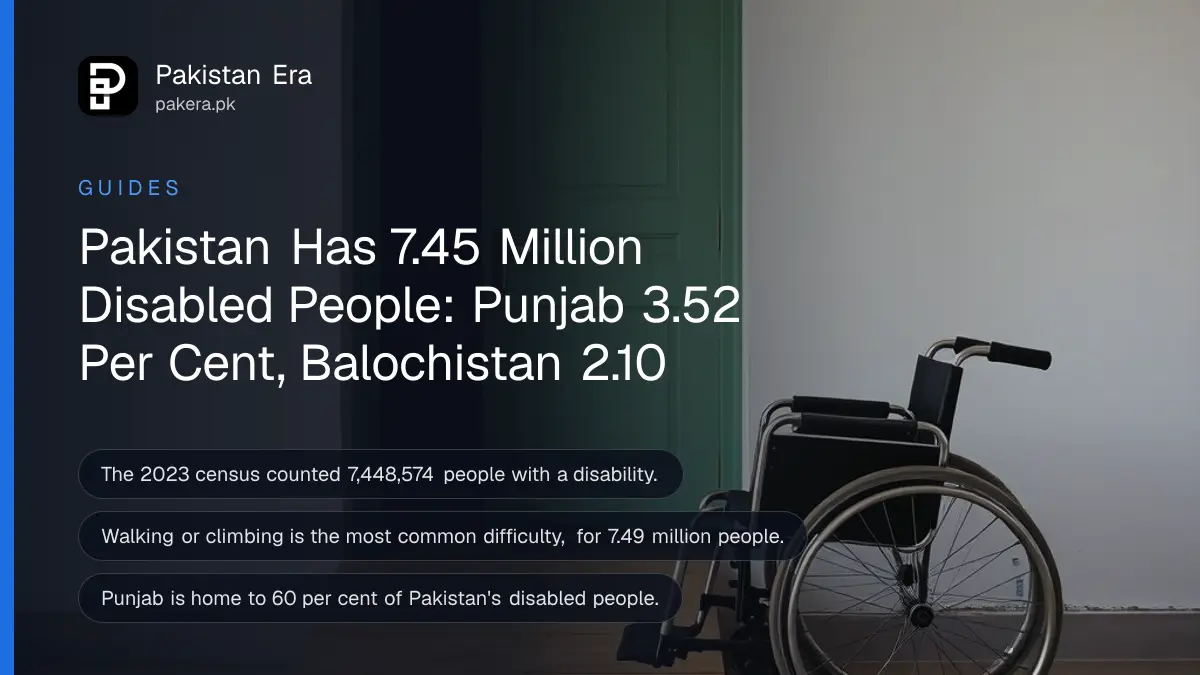
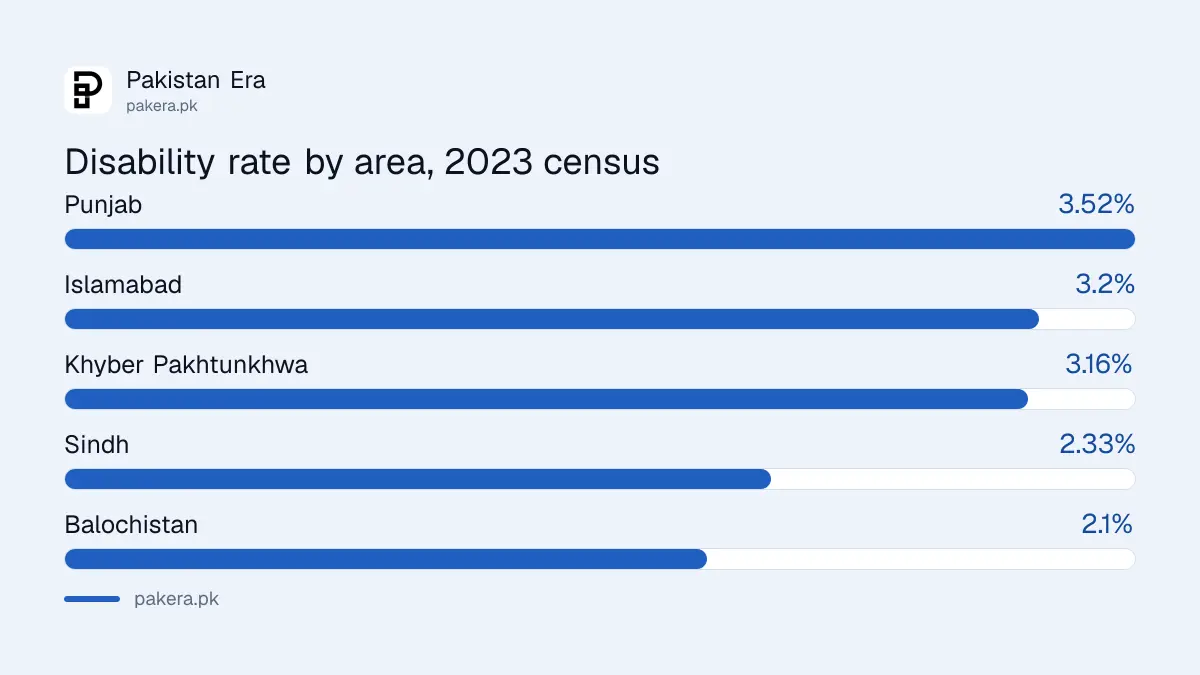
Pakistan's 2023 census counted 7.45 million people with a disability, 3.10 per cent of the population. A wider group of 23.17 million people, 9.64 per cent, reported some difficulty with seeing, hearing, walking, remembering, communicating or self-care. Punjab has the highest disability rate at 3.52 per cent and Balochistan the lowest at 2.10.
We went through the Pakistan Bureau of Statistics (PBS) disability tables for every province. Below are the province figures, the types of difficulty, the gap between men and women, and the documents a disabled person can get with these rights in mind.
| Area | People with a disability | Disability rate | Any functional difficulty |
|---|---|---|---|
| Pakistan | 7,448,574 | 3.10% | 9.64% |
| Punjab | 4,487,038 | 3.52% | 10.61% |
| Islamabad | 73,022 | 3.20% | 8.12% |
| Khyber Pakhtunkhwa | 1,285,273 | 3.16% | 8.38% |
| Sindh | 1,297,882 | 2.33% | 9.24% |
| Balochistan | 305,359 | 2.10% | 6.40% |
About 3 in every 100 Pakistanis have a disability
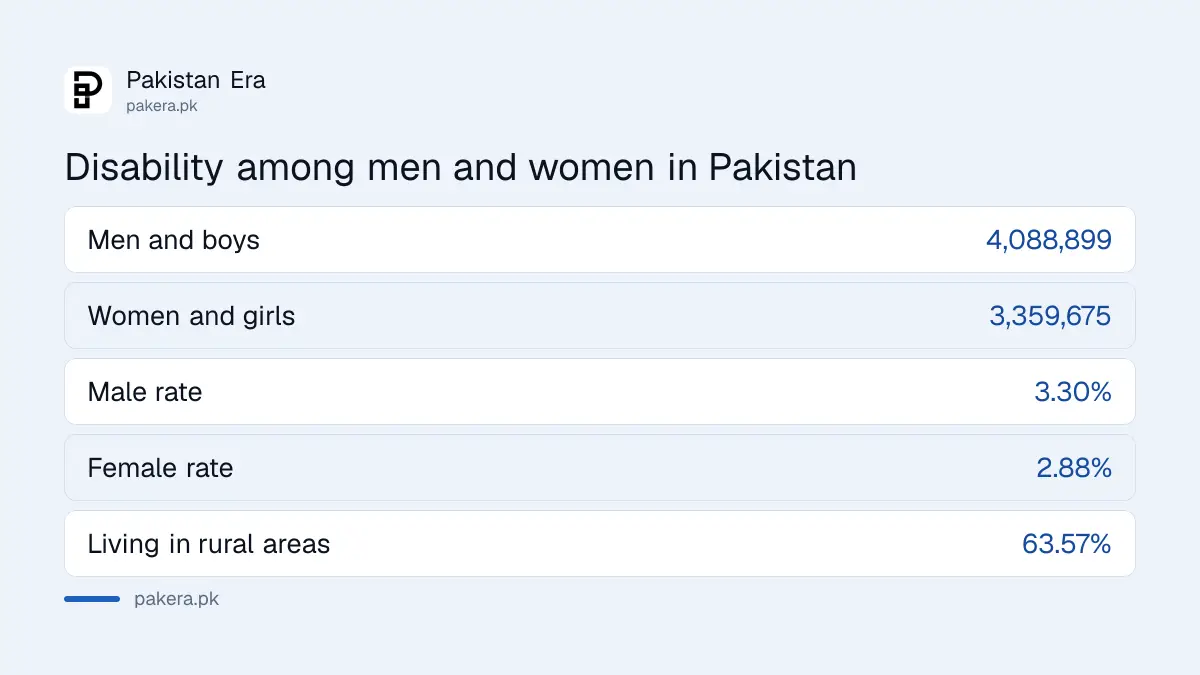
The census found 7,448,574 people with a disability: 4,088,899 men and boys and 3,359,675 women and girls. The rate is 3.30 per cent for males and 2.88 per cent for females. Most disabled people, 63.57 per cent, live in rural areas.
This is the first full count of disability in a Pakistani census. The 1981 and 1998 censuses asked only a sample of households and found 0.49 and 2.38 per cent. The 2017 census did not ask the question at all.
How the census decides who is disabled
The census used the Washington Group questions, a short set also used in the census in the UK and many other countries. Each person was asked how much difficulty they have in six areas. A person counts as disabled if they said "a lot of difficulty" or "cannot do it at all" in at least one area.
- Seeing.
- Hearing.
- Walking or climbing steps.
- Remembering or concentrating.
- Self-care, such as washing, dressing, holding or writing.
- Communicating, such as understanding or being understood.
The 23.17 million figure is wider. It also counts people who said they have "some difficulty". So 7.45 million is the number to use for disability, and 23.17 million shows how many people face some daily limit.
Walking is the most common difficulty
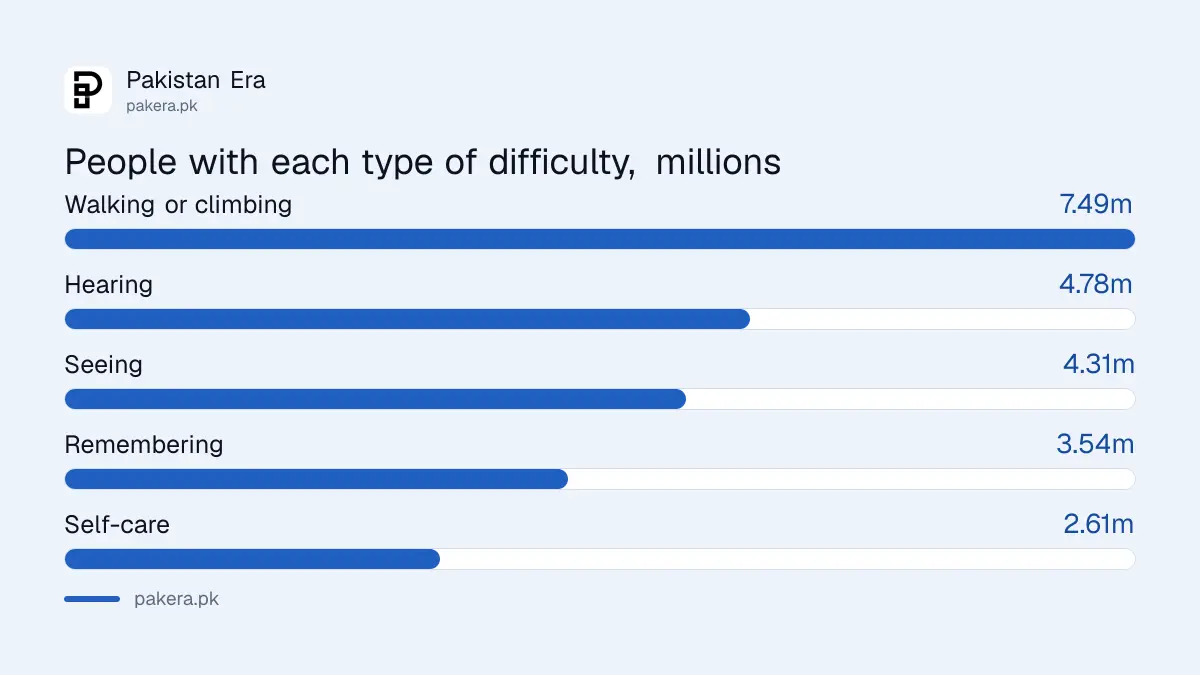
Difficulty walking or climbing affects 7.49 million people, 3.12 per cent of Pakistanis. Hearing difficulty is next at 4.78 million, then seeing at 4.31 million. One person can report more than one difficulty, so these numbers add up to more than the total.
| Type of difficulty | People | Share of population | Men | Women |
|---|---|---|---|---|
| Walking or climbing | 7,493,240 | 3.12% | 4,008,994 | 3,484,246 |
| Hearing | 4,778,218 | 1.99% | 2,520,248 | 2,257,970 |
| Seeing | 4,314,433 | 1.79% | 2,285,068 | 2,029,365 |
| Remembering or concentrating | 3,538,180 | 1.47% | 1,899,015 | 1,639,165 |
| Self-care | 2,611,695 | 1.09% | 1,362,575 | 1,249,120 |
| Communicating | 2,584,399 | 1.07% | 1,419,295 | 1,165,104 |
Punjab has 6 in 10 of Pakistan's disabled people
Punjab has 4.49 million disabled people, 60.2 per cent of the national total by our arithmetic. Sindh and Khyber Pakhtunkhwa each have about 1.3 million. Balochistan has 305,359.
In most areas, the rate is higher in villages than in cities. Rural Punjab is at 3.69 per cent against 3.29 per cent in its cities. Sindh is the exception: its cities have a slightly higher rate (2.44 per cent) than its villages (2.20 per cent).
Men report a disability more often than women in every province. The gap is widest in Punjab, at 3.81 per cent for males against 3.22 per cent for females, and in Islamabad, at 3.56 against 2.79. In Sindh the two are close, at 2.39 and 2.28 per cent.
Rural women are at 3.00 per cent and urban women at 2.70 per cent. For men the figures are 3.42 per cent in villages and 3.11 per cent in cities.
| Area | Rural rate | Urban rate |
|---|---|---|
| Punjab | 3.69% | 3.29% |
| Islamabad | 3.58% | 2.74% |
| Khyber Pakhtunkhwa | 3.23% | 2.78% |
| Sindh | 2.20% | 2.44% |
| Balochistan | 2.18% | 1.91% |
What these numbers mean for a disabled person
Federal and provincial laws reserve jobs and benefits for people with disabilities. Most of them start with an official disability certificate. These are the steps most families take.
- Get a disability certificate from the district assessment board, then a special CNIC with the disability logo from NADRA.
- In Punjab, apply through the DPMIS online disability certificate system, and check the Himmat Card for cash help.
- Use the job quota for disabled persons when applying for government jobs.
- Compare financial help for disabled persons by province before you apply.
Common questions
How many disabled people are there in Pakistan?
The 2023 census counted 7,448,574 people with a disability, 3.10 per cent of the population of 240.46 million.
Which province has the highest disability rate?
Punjab, at 3.52 per cent. Islamabad is at 3.20, Khyber Pakhtunkhwa 3.16, Sindh 2.33 and Balochistan 2.10.
Are more men or women disabled in Pakistan?
More men. The rate is 3.30 per cent for males and 2.88 per cent for females, and men are 54.89 per cent of all disabled people.
What is the most common disability in Pakistan?
Difficulty walking or climbing, reported by 7.49 million people. Hearing and seeing come next.
Why are there two numbers, 7.45 million and 23.17 million?
7.45 million is people with a lot of difficulty or who cannot do an activity at all. 23.17 million also includes people with some difficulty.
Did the 2017 census count disabled people?
No. The 2017 census dropped the question. The 2023 census was the first to ask every household.
How we verified this
What we checked and where we read it.
We checked these figures on 25 November 2026 in the PBS census page: the National Census Report 2023, section 4.5 with Tables 4.17, 4.18 and 4.19 and Figures 4.9 and 4.10, and census Table 16 (disability and functional limitation by region and gender) at national and provincial level. The question set follows the Washington Group on Disability Statistics.
Province shares of the national total and the rural and urban rates by province are our own arithmetic on Table 16. The province counts in Table 16 add up exactly to the national 7,448,574.
Free on WhatsApp
Get last dates and rule changes on WhatsApp
We post new last dates, fee changes and fixes for common problems, a few short posts a day.
Follow Pakera on WhatsAppOther followers cannot see your number.
Pakera Solves It
Which online process wasted your time this week?
A portal that will not load, a form nobody explains, a complaint that went nowhere. Tell us. Every week we pick one, solve it step by step and publish the answer.
About the author

Senior Writer, Public Services and Technology
Shahid joined us in 2024 as an author. He is a senior contributor to Pakistan's leading technology websites. He writes detailed articles, mostly covering his expertise in the latest tech, mobiles, apps, gadgets, and step-by-step guides. His ideology is to help people understand the latest trends and explain complex methods through very easy-to-understand guides.