How to Drive Safely in Hail and Thunderstorm in Pakistan: NDMA's Road Advice
NDMA's 9 October advisory says to stop safely in hail, stay in the car and not cross flooded roads. Read the road steps for hail, lightning and hill drives.
Short answer: NDMA's advisory of 9 October 2026 tells drivers in hail to stop under a bridge or a roofed area, or off the road, keep the seatbelt on and not drive in heavy hail. It also warns that 6 inches of moving water can knock a person off their feet, and says not to cross submerged roads or bridges.
A hailstorm turns a normal road into a risk in under a minute. Visibility falls, the surface turns slippery and other drivers brake without warning. Pakistan is in a rain and hail spell until 15 October, so the advice is useful now.
We read the National Disaster Management Authority (NDMA) weather advisory dated 9 October 2026, all eight pages, on 12 October 2026. Everything below comes from its safety section, put into plain steps for a driver.
In hail, stop in a safe place and stay in the car
NDMA says to pull over safely, stop under a bridge, a roofed area or off the road, and stay inside with the seatbelt fastened. It also says not to drive in heavy hail, because visibility drops and the road becomes slippery.
The advisory adds that if you are caught outside a vehicle, you should cover your head and neck with a bag, jacket or helmet. It says to stay away from windows indoors, because hail can shatter glass.
Do not stop in the middle of a fast lane, and do not stop under a tree. NDMA says trees and poles attract lightning and do not protect well from hail.
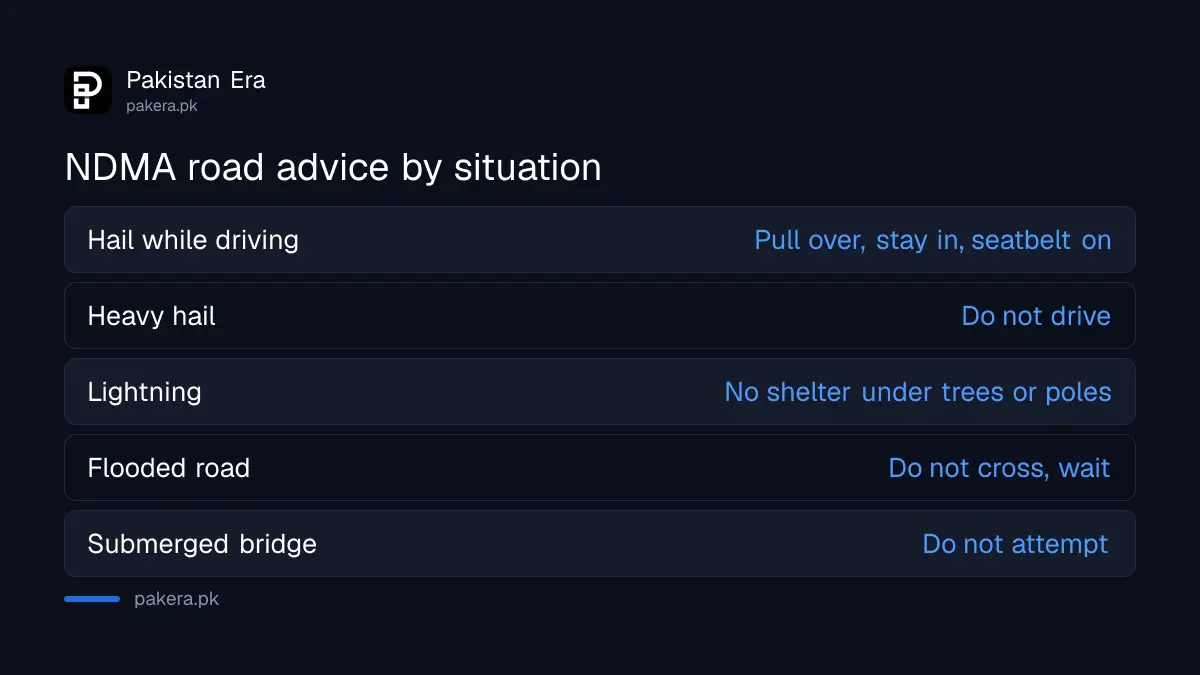
| Situation | What NDMA's advisory says |
|---|---|
| Hail while driving | Pull over safely, stay in with the seatbelt on |
| Heavy hail | Do not drive, visibility drops and roads turn slippery |
| Lightning | No shelter under trees or poles, avoid open fields |
| Flooded road | Do not cross, wait for the flow to normalise |
| Submerged bridge | Do not attempt, it may be damaged or unstable |
Do not cross water you cannot see the bottom of
The advisory says to avoid walking or driving through flooded areas, and gives the reason: 6 inches of moving water can knock you off your feet. It tells people not to risk crossing a drain or road where water flows over it, and to wait for the flow to settle.
It also says not to enter a ponded road that is under construction. Water hides potholes and open drains. A road that you drive every day can look different after an hour of rain.
Keep children away from nullahs, potholes and drainage lines, the advisory adds. The same page warns people not to repair electrical equipment, especially exposed lines, in rain.
Hill drives need a local driver and a later start
NDMA tells travellers to avoid self-driving in unfamiliar or hilly areas during rain, and to use local drivers who know the terrain. It also says to avoid trekking, hiking or camping during heavy rain, because landslides and flash floods become more likely.
For the hill routes, the Pakistan Meteorological Department (PMD) landslide warning for 10 to 13 October named Murree, Naran and Hunza. Read it in our report on the PMD landslide warning. Road conditions in the north are covered in how to check road status for Naran, Swat and Chitral.
The advisory also says to choose hotels or guest houses on higher ground, away from rivers and lakes, and to ask staff about emergency exits and evacuation.
Before you leave, check these five things
Check the forecast for your route, the road status, your tyres, your wipers and your fuel. These are not NDMA's words; they are what the advisory's logic points to. NDMA itself stresses planning travel around weather and traffic.
- Read PMD's forecast for each district on your route, including the night section.
- Check whether the motorway or hill road is open.
- Keep at least 20 feet from rivers and nullahs when you stop, as NDMA advises.
- Carry clean drinking water and food, as the advisory says.
- If hail starts, stop safely and wait until it passes.
The forecast for the coming days is in our report on the PMD rain and thunderstorm forecast for 12 to 14 October.

What the weather may do to the road and to your car
NDMA lists the likely impacts: wind, hail and lightning may damage weak structures, electric poles, billboards, vehicles and solar panels. Hail may damage crops in the plains of Punjab and Khyber Pakhtunkhwa. Day temperatures may drop 2 to 4 C.
That list is why parking matters. Park away from billboards, loose boards and weak walls. Cover the vehicle if time allows, as the advisory says. The speed rules still apply after the rain, and the limits are in the guide on motorway speed limits in Pakistan.
Common questions
Should I keep driving in a hailstorm?
No. NDMA says not to drive in heavy hail. Pull over safely, under a bridge or a roofed area, and wait with the seatbelt on.
Is it safe to shelter under a tree?
No. NDMA says trees and poles attract lightning and do not protect well from hail. Stay in a vehicle or a sturdy building instead.
Can I drive through a flooded road in a car?
NDMA says to avoid driving through flooded areas and not to cross submerged roads or bridges. It does not give a safe depth for a car.
How much water can knock a person over?
NDMA says 6 inches of moving water can knock you off your feet. Do not wade across a flow, even a shallow one.
Should tourists still go north this week?
NDMA advises planning around weather, avoiding trekking and camping in heavy rain, and using local drivers in hilly areas. Check the district forecast and road status before you decide.
Who should I call in an emergency?
Use the local rescue number first. NDMA's own website lists a helpline of 051-111-157-157 for national coordination.
How we verified this
What we checked, where we read it, and what we could not confirm.
We read NDMA's weather advisory dated 9 October 2026 on 12 October 2026, at ndma.gov.pk/advisories. The advisory covers 10 to 15 October. We did not test any of the steps on a road, and a newer advisory may replace it.
About the author

Tax, Bills and Technology Writer
Ali Akhtar is a young and curious voice here at Pakistan Era. He is currently pursuing his A-Levels and has a growing interest in Pakistan’s changing industrial landscape and educational trends. Ali likes to write in a way that helps him explain and explore the world around him. His writing reflects the perspective of the new generation navigating the evolving trends of Pakistan where technology, youth innovation, and shifting opportunities are reshaping the country’s future.