Eid Milad-un-Nabi Holiday Is Wednesday 26 August 2026
The Cabinet Division notified Wednesday 26 August as the holiday. The observance follows the moon sighting and can fall a day either side.
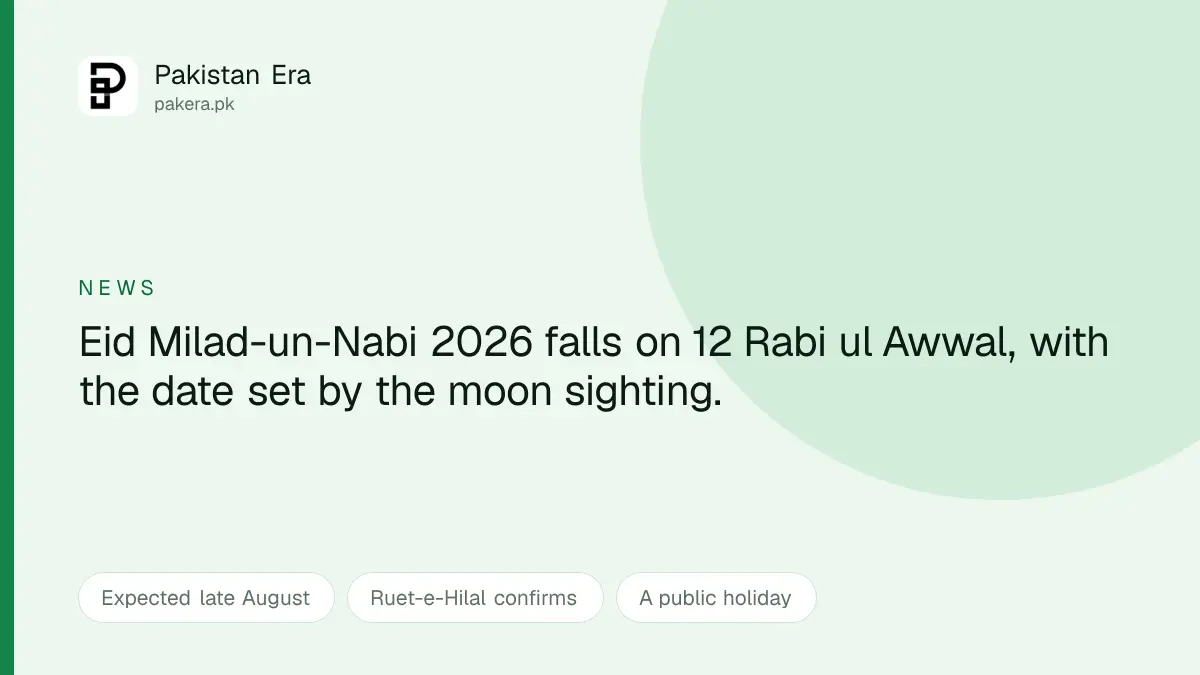
Two answers to this question are both correct at once, and confusing them is why the searches repeat every year.
Correction, 26 August 2026. This page originally said the holiday was Tuesday 25 August. The Cabinet Division notified it on 21 August for Wednesday 26 August 2026, and Punjab and Sindh both notified the same day. We had published before the notification and did not update it in time. The date above is now the notified one.
The public holiday is fixed. The federal government has declared Wednesday 26 August 2026 as the public holiday for Eid Milad-un-Nabi, 12 Rabi ul Awwal 1448 AH. Offices and banks close that day.
The observance is not fixed the same way. Eid Milad-un-Nabi falls on 12 Rabi ul Awwal, and Rabi ul Awwal begins when the moon is sighted at the end of Safar. If the sighting moves the month's start by a day, the 12th moves with it, and the observance can land on 24 or 26 August while the notified holiday stays on the 25th.
So plan work and travel around 26 August. Treat the observance date as confirmed only after the announcement. Here is how that determination is actually made, and what else moves with it.
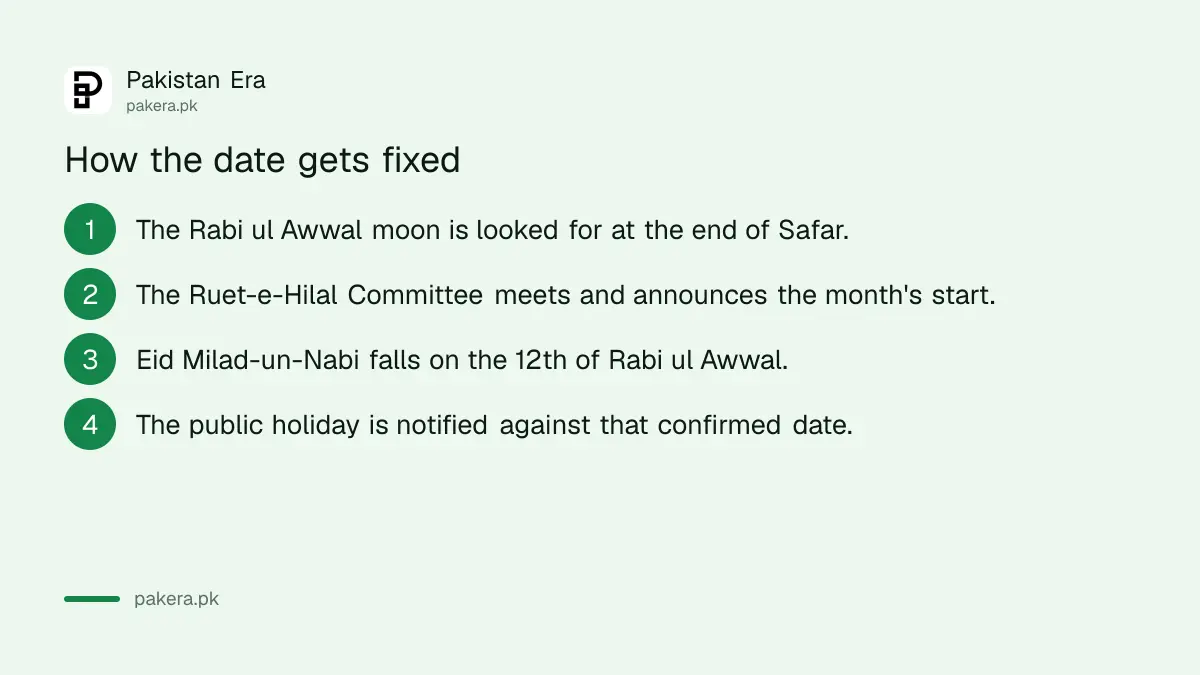
Why nobody can give you a certain date yet
The Islamic calendar is lunar. A month begins when the new crescent is sighted, not when a printed calendar says it should be, and in Pakistan that determination is made by the Ruet-e-Hilal Committee, which meets at the end of the outgoing month.
So the sequence is fixed even when the date is not: the Rabi ul Awwal moon is looked for at the end of Safar, the committee announces the month's start, and Eid Milad-un-Nabi falls on the 12th day of that month. Shift the month's start by one day and the observance shifts with it.
That is why expected dates published in advance are honest estimates rather than errors. The government can notify a holiday months ahead because an office calendar needs a fixed date to work at all, and the Ruet-e-Hilal Committee can still announce something a day either side of it. Both bodies are doing their job correctly.
The practical consequence: 26 August is the day you are not at work, and the committee's announcement is the answer on the observance. If you want the rest of the month's calendar, we set out every day off in the August holidays piece, including why 14 August being a Friday matters.
Why the date moves backwards every year
The question underneath most searches of this kind, and it has a clean answer.
A lunar year runs about eleven days shorter than the Gregorian year. So every Islamic observance drifts roughly eleven days earlier against the western calendar annually, which is why Ramadan has moved across the seasons within living memory, and why an Eid that fell in September a few years ago falls in August now.
It also means you cannot fix these dates in advance the way you can fix 14 August, which stays put because it is anchored to the Gregorian calendar. We wrote about the other side of that in why Pakistan celebrates on the 14th, where the date is fixed and the argument is about which fixed date is correct.
What else moves with Rabi ul Awwal this year
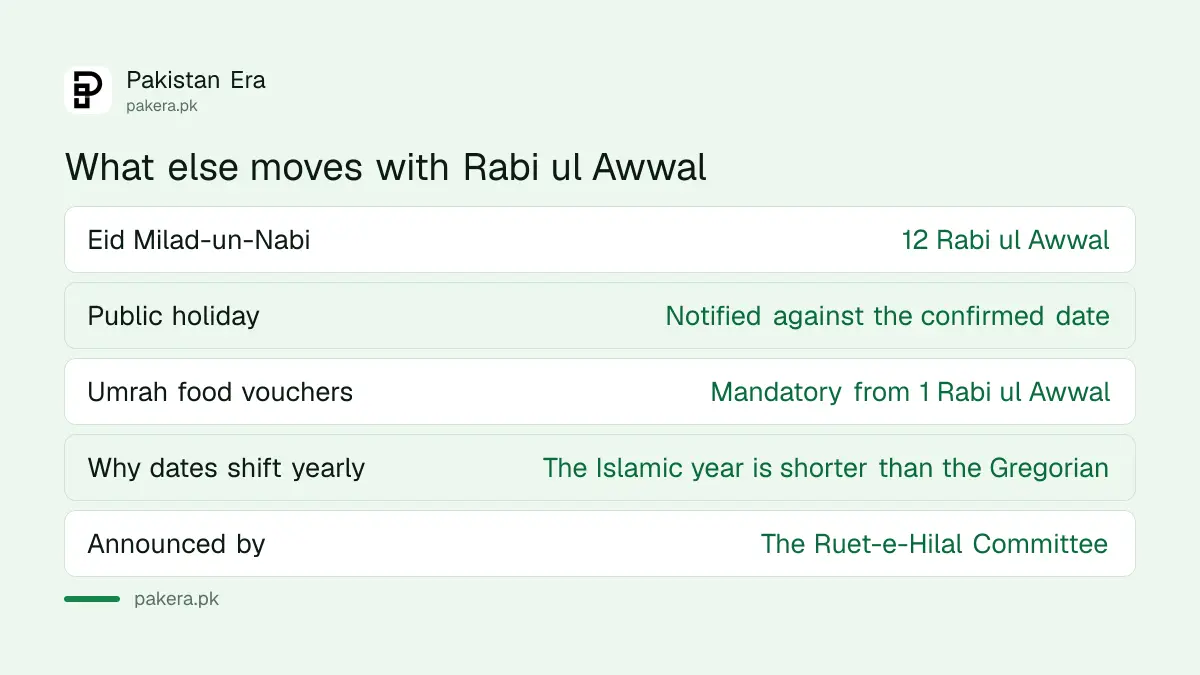
One thing in particular, and it costs money.
Saudi Arabia's mandatory food voucher for Umrah pilgrims takes effect from 1 Rabi ul Awwal, adding roughly 20 riyals a day to the visa cost for pilgrims from Pakistan, India, Egypt and Bangladesh. We covered it in the Umrah voucher piece, and the practical point is the same as here: the trigger is a lunar date, so anyone booking around the changeover should confirm with their agent which regime applies to their travel.
| What | When |
|---|---|
| Rabi ul Awwal begins | On the moon sighting, expected mid to late August |
| Umrah food voucher becomes mandatory | 1 Rabi ul Awwal |
| Eid Milad-un-Nabi | 12 Rabi ul Awwal |
| Public holiday | Notified against the confirmed date |
Why the expected dates you see differ by a day
You will find calendars, apps and websites listing slightly different dates for the same observance, and that is not carelessness. It is the difference between calculation and sighting.
Astronomical calculation can say precisely when the new moon occurs and when the crescent becomes theoretically visible from a given place. Sighting asks whether it was actually seen, which depends on weather, horizon and the observer. Countries and committees weigh those differently, which is why Pakistan, Saudi Arabia and communities elsewhere sometimes mark the same observance on different days.
For planning purposes the rule is simple: a calculated date is a good estimate to pencil in, and the committee's announcement is what you write in ink. Anyone presenting a lunar date as certain weeks ahead is telling you about their calculation, not about the calendar.
The holiday, and planning around it
Eid Milad-un-Nabi is a public holiday in Pakistan, notified against the confirmed date once the month begins. Offices, banks and schools close, and the notification typically follows the committee's announcement rather than preceding it.
The practical consequence for anyone with a deadline: if you have paperwork, payments or an application due around late August, do not plan it for the days either side of an unconfirmed holiday. That includes the things we have written about this month with their own clocks running, from the 30 September tax deadline to Chevening applications, where a closed bank or a shut office on an unexpected day costs you a working day you were counting on.
And if you are travelling north in that window, the holiday traffic on those routes is its own consideration, which our northern areas checklist covers alongside the monsoon risk.
Questions readers are asking
When is Eid Milad-un-Nabi 2026 in Pakistan?
On 12 Rabi ul Awwal, expected in late August. The exact Gregorian date depends on when the Rabi ul Awwal moon is sighted and is announced by the Ruet-e-Hilal Committee.
Why can nobody confirm the date in advance?
Because the Islamic month begins on a moon sighting rather than a calculated calendar. An expected date is an estimate until the committee announces the start of the month.
Who announces the date in Pakistan?
The Ruet-e-Hilal Committee, which meets at the end of the preceding month to determine whether the new crescent has been sighted.
Is it a public holiday?
Yes, notified against the confirmed date once the month has begun. Offices, banks and schools close on the day.
Why does the date change every year?
The lunar year is about eleven days shorter than the Gregorian year, so Islamic dates move roughly that much earlier against the western calendar each year.
Does anything else change with Rabi ul Awwal?
Yes. Saudi Arabia's mandatory food voucher for Umrah pilgrims takes effect from 1 Rabi ul Awwal, adding about 20 riyals a day to visa costs, so pilgrims booking around the changeover should confirm which regime applies.
About the author

Public Services and Education Journalist
Fajr Riaz is a journalist and content writer at Pakistan Era, based in Lahore. She covers the questions people meet in everyday life in Pakistan: how a public service works, what a change in the rules means, and where to find a reliable answer.