Electricity Theft Punishment in Pakistan: Every PPC Section, Jail and Fine for Homes, Shops and Farms
Electricity theft punishment in Pakistan under 462-H to 462-M PPC: jail and fines for homes, shops, factories and farms, non-bailable, and who files the case.
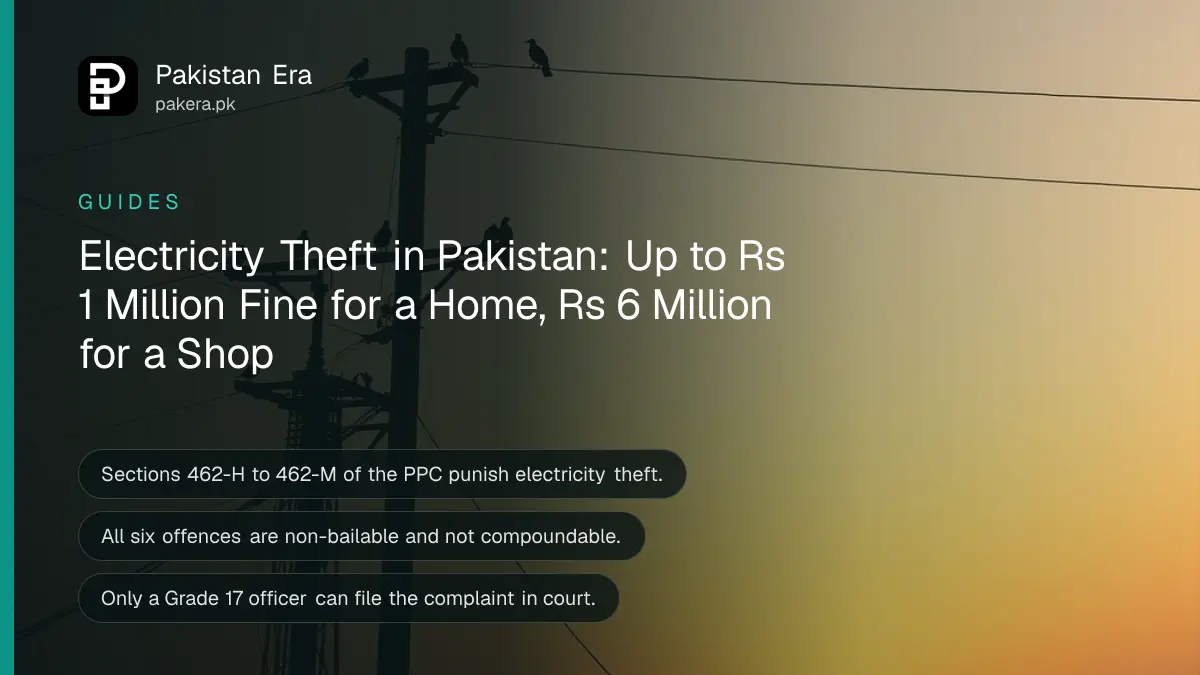
Electricity theft in Pakistan is a crime under sections 462-H to 462-M of the Pakistan Penal Code, with up to 2 years and a Rs 1 million fine for a home connection, up to 3 years and Rs 6 million for a shop or factory, and up to 7 years for damaging power lines. Every one of these offences is non-bailable and cannot be settled by compromise. The full table, by type of consumer, is below, along with the rule that only a power company officer can start the case.
We read Chapter XVII-B of the Pakistan Penal Code (PPC), added by Act No. VI of 2016, and the matching rows of the Code of Criminal Procedure (CrPC) Second Schedule, on Pakistan Code on 1 November 2026.
Six PPC sections punish electricity theft, by type of consumer
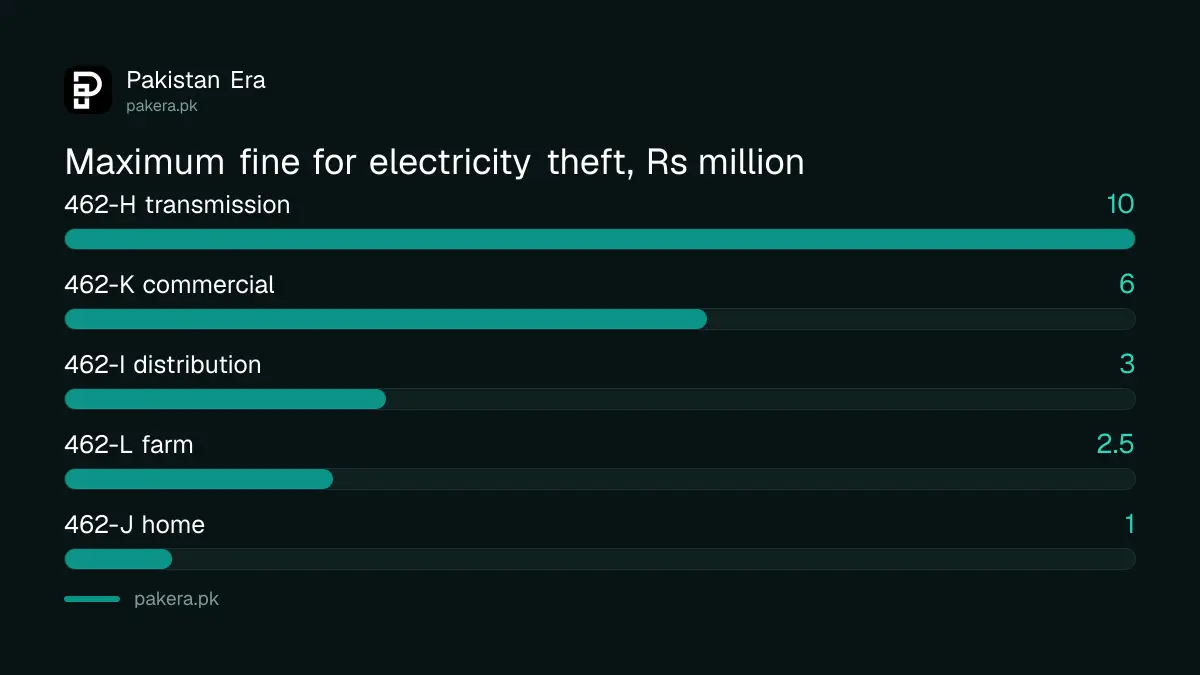
The PPC splits theft by who does it and where. Tapping a transmission line is 462-H. Tapping a distribution line is 462-I. Meter tampering is 462-J for homes, 462-K for shops and factories and 462-L for farms. Damaging lines or meters is 462-M.
| Section | What it covers | Maximum jail | Maximum fine |
|---|---|---|---|
| 462-H | Tapping or tampering with transmission lines | 3 years, rigorous | Rs 10 million |
| 462-I | Tapping or tampering with distribution lines | 3 years, rigorous | Rs 3 million |
| 462-J | Meter tampering or illegal connection, domestic consumer | 2 years | Rs 1 million |
| 462-K | Meter tampering or illegal connection, industrial or commercial | 3 years | Rs 6 million |
| 462-L | Meter tampering or illegal connection, agricultural consumer | 2 years | Rs 2.5 million |
| 462-M | Damaging lines, meters or equipment to disrupt supply | 7 years, rigorous | At least Rs 3 million |
Sections 462-H to 462-L allow jail, or a fine, or both. Section 462-M is different: it requires both jail and a fine of at least Rs 3 million.
Meter tampering covers more than a hooked wire
Sections 462-J to 462-L list the acts that count. They include reconnecting a meter the company cut off, using a tampered meter, a current reversing device or a loop connection, using power on a cheaper tariff than allowed, and connecting to company lines without consent.
Helping someone do any of these is the same offence. So an electrician who fits a reversing device, or a landlord who lets a tenant run a hook, can be charged too. Moving a domestic meter to run a shop is the "cheaper tariff" case in the law.
All six offences are non-bailable and cannot be compromised
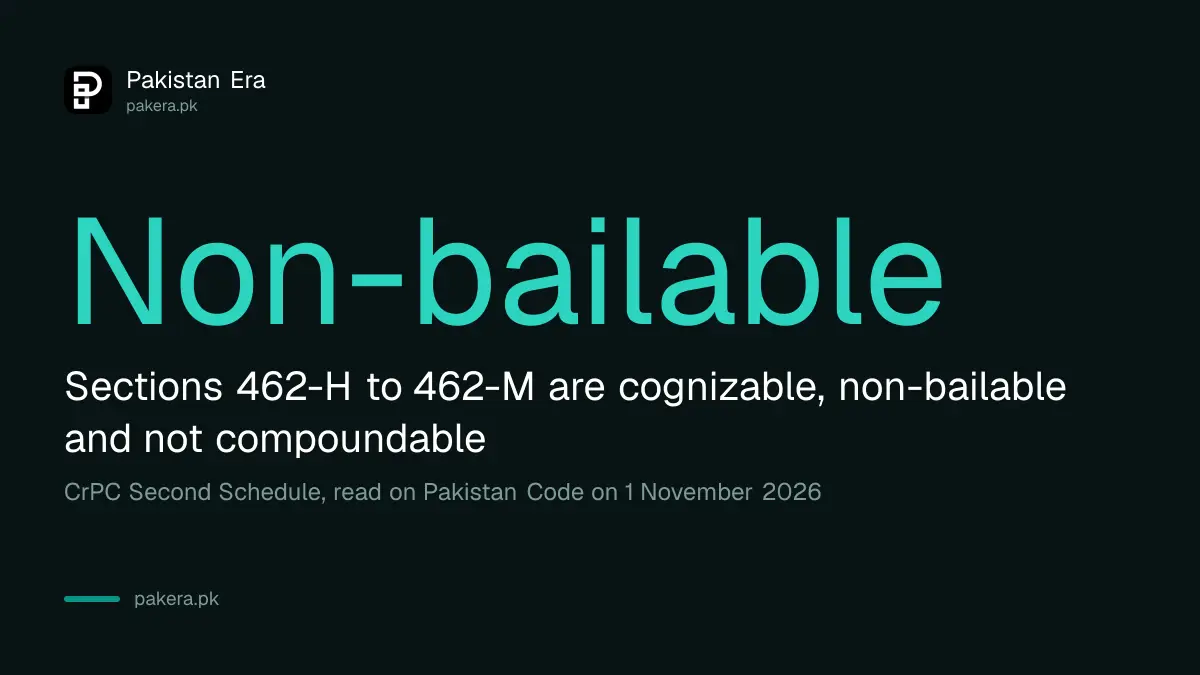
The CrPC Second Schedule marks sections 462-H to 462-M as cognizable, non-bailable and not compoundable, triable by a Court of Session. Police can arrest without a warrant, and the case cannot end in a private settlement with the power company.
Non-bailable does not mean bail is impossible. Every one of these offences carries less than ten years, so it falls below the bar in section 497 of the CrPC, and courts can grant bail. How bail works is set out in getting bail in Pakistan.
Only a Grade 17 officer can start the case
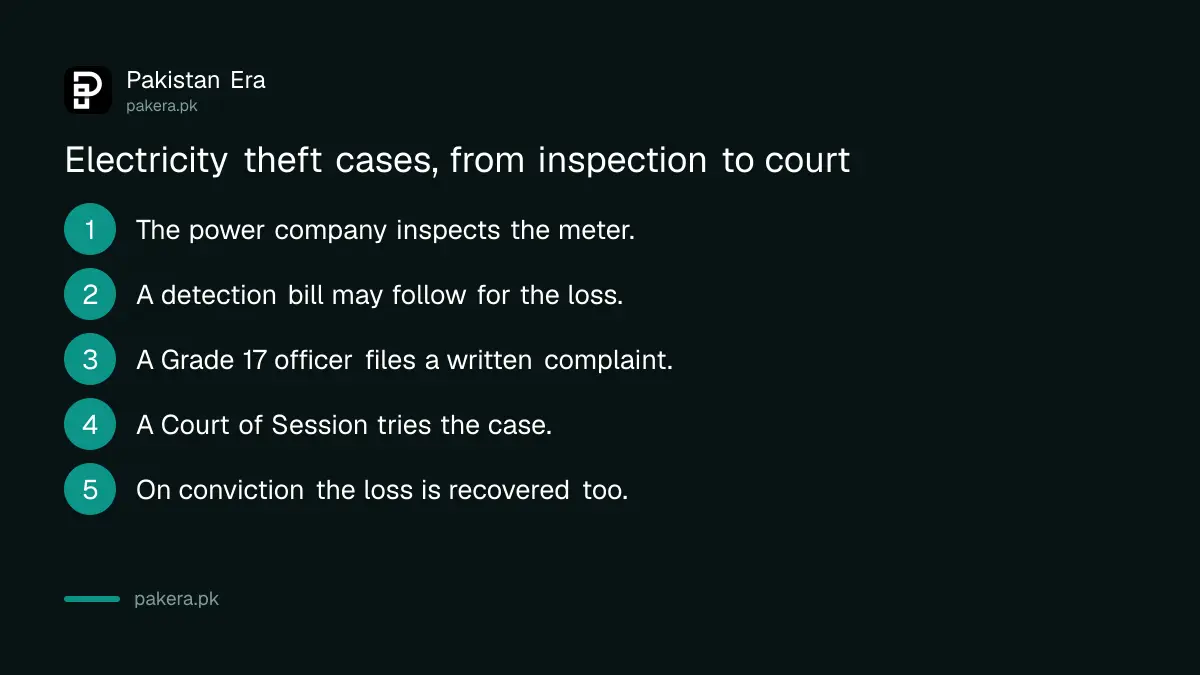
Section 462-O says a court shall not take up these offences except on a written complaint, with reasons and full details, by an authorised officer of Grade 17 or above from the government or the power company. A neighbour's report alone does not start a prosecution.
A tip still matters, because it leads the power company to inspect. The ways to report theft or meter tampering are listed in reporting electricity theft. The complaint that goes to court, though, must come from an authorised officer and must be in writing.
The power company also recovers the loss
Section 462-N makes anyone convicted under 462-H to 462-M pay an amount equal to the financial loss caused to the government or the distribution company. Unpaid penalties, fines and loss can be recovered as arrears of land revenue, the method used for unpaid land tax.
This is separate from the "detection bill" a company sends after an inspection. The detection bill is a billing matter under NEPRA's rules, explained in the NEPRA consumer service manual changes. The criminal fine and the loss recovery come from a court.
What to do if you are accused of electricity theft
Do not sign an admission at the site. Ask for a copy of the inspection report, photograph your meter and seals, and keep your recent bills. If an FIR is registered, get a copy and check which section is used, because a domestic consumer should not be charged under the commercial section.
- Ask the inspection team for their names and a copy of the report.
- Photograph the meter, its seals and the wiring before anything is removed.
- Keep your last 12 bills and any payment receipts.
- If a detection bill arrives, dispute it in writing with the company.
- If an FIR is filed, get a copy and check the section number.
- See a lawyer about bail before the first hearing.
Section 462-J is for domestic consumers, with a fine of up to Rs 1 million. Section 462-K, for commercial users, allows up to Rs 6 million. The difference is large enough to be worth checking on the FIR. Other FIR sections are explained in the PPC sections list.
Common questions
What is the punishment for electricity theft in Pakistan?
For a home, up to two years in jail or a fine of up to Rs 1 million, or both, under section 462-J. For a shop or factory, up to three years or Rs 6 million under 462-K.
Is electricity theft bailable?
No. Sections 462-H to 462-M are non-bailable under the CrPC schedule. They carry less than ten years, so a court can still grant bail.
Can a theft case be settled with WAPDA or the company?
Not as a criminal case. The CrPC schedule marks these offences not compoundable. A billing dispute over a detection bill is separate and can be settled with the company.
Who can file an electricity theft case?
Only an authorised officer of Grade 17 or above from the government or the distribution company, by a written complaint with reasons, under section 462-O.
What is the punishment for damaging a power line?
Up to seven years of rigorous imprisonment and a fine of at least Rs 3 million under section 462-M.
How we verified this
What we checked, where we read it, and what we could not confirm.
We read sections 462-G to 462-P of the Pakistan Penal Code and the matching rows of the CrPC Second Schedule on pakistancode.gov.pk on 1 November 2026. We did not check provincial amendments, and we did not check whether any distribution company has published its own list of authorised Grade 17 officers. This page is a reference, not legal advice.
About the author

Global Affairs & Political Economy Writer
Muhammad Hatim is a book lover who started writing because he enjoys it. At Pakistan Era he writes about international relations, geopolitics and the global economy, with a particular interest in South Asia and the forces behind current events.