EU Deforestation Rules for Pakistani Leather, Tyre and Furniture Exporters: 30 December 2026
EU deforestation rules start 30 December 2026 for large and medium firms. See which Pakistani leather, tyre and furniture goods may be covered and what to do.
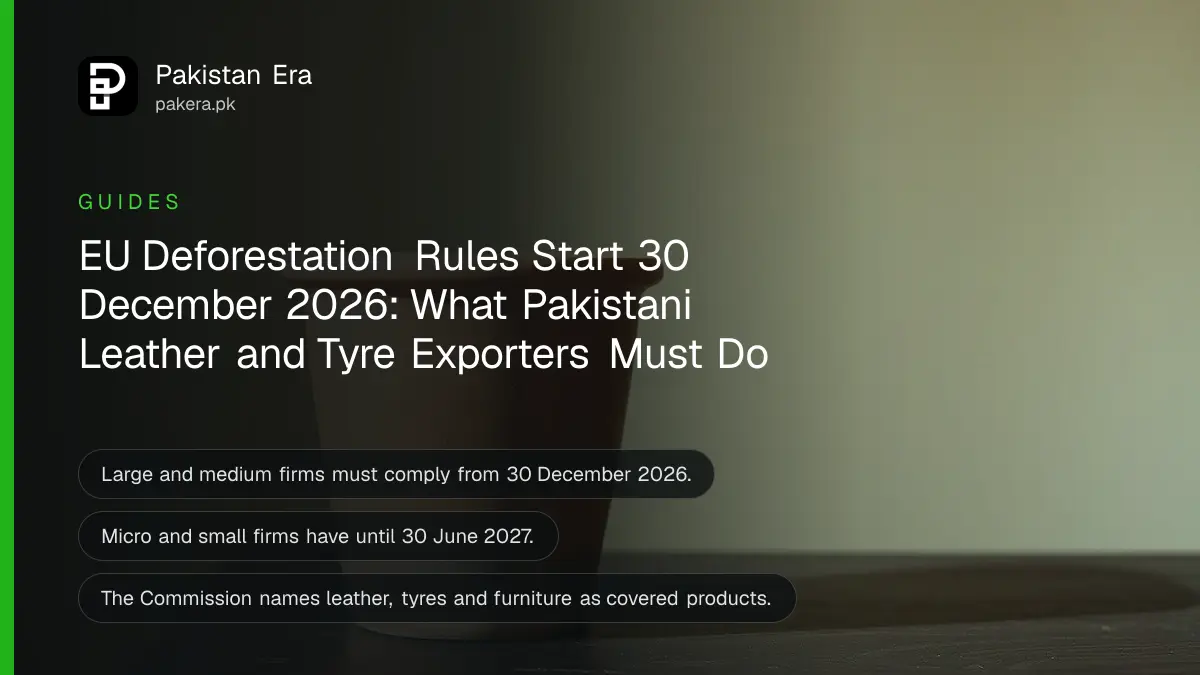
From 30 December 2026, large and medium companies that sell leather, tyres, rubber, wood or furniture into the EU must be able to prove the goods do not come from recently deforested land. Micro and small companies get until 30 June 2027. That gives Pakistani exporters about 76 days from today to ask their EU buyers what proof they need.
The rule is the EU Deforestation Regulation, called EUDR for short. The EU amended it in December 2024 and again in December 2025 with simplification measures. We read the European Commission's EUDR page on 15 October 2026, and every date and rule below comes from it. If you sell leather jackets, leather gloves, tyres or wooden furniture to Europe, the date matters to you.
EUDR makes sellers prove their goods did not cause deforestation
The Commission says any operator or trader placing certain commodities on the EU market must be able to prove the products do not come from recently deforested land or cause forest degradation. The law is Regulation (EU) 2023/1115.
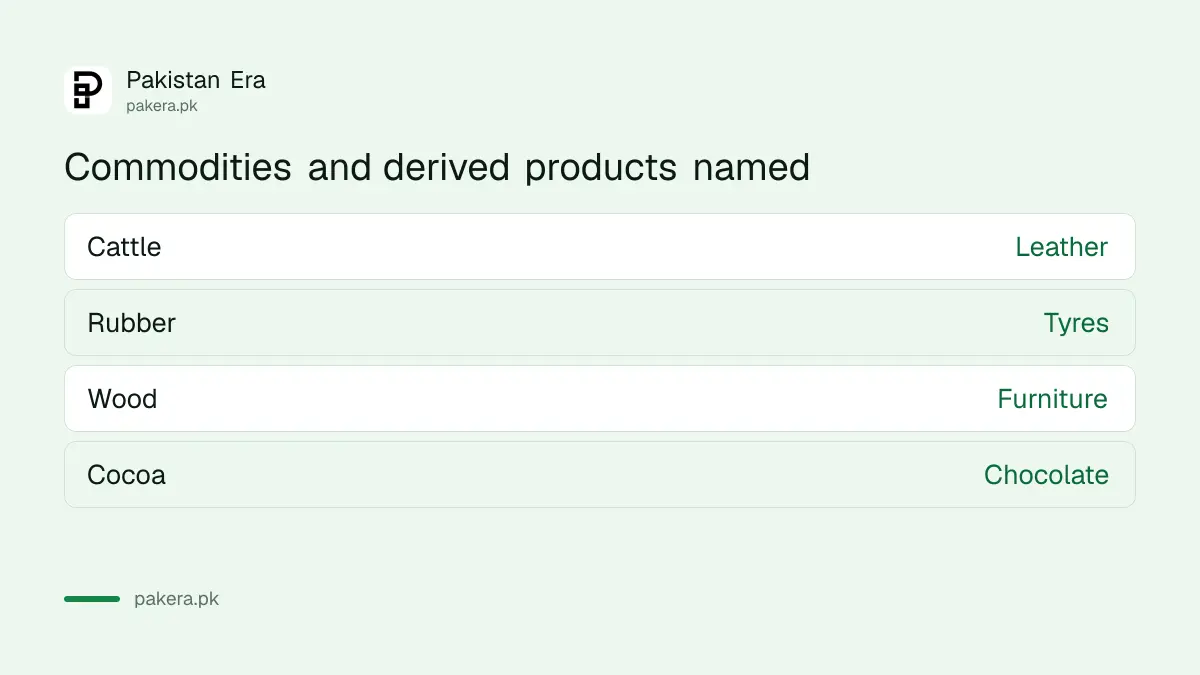
The Commission names the commodities as cattle, wood, cocoa, soy, palm oil, coffee and rubber, plus some products made from them. It lists leather, chocolate, tyres and furniture as examples of those derived products.
For a Pakistani seller, the EU buyer is usually the "operator" with the legal duty. But the buyer can only prove the origin if you tell it where your raw material came from. We expect buyers to ask for that, though the Commission page does not say what documents a buyer will request.
Large and medium firms start on 30 December 2026
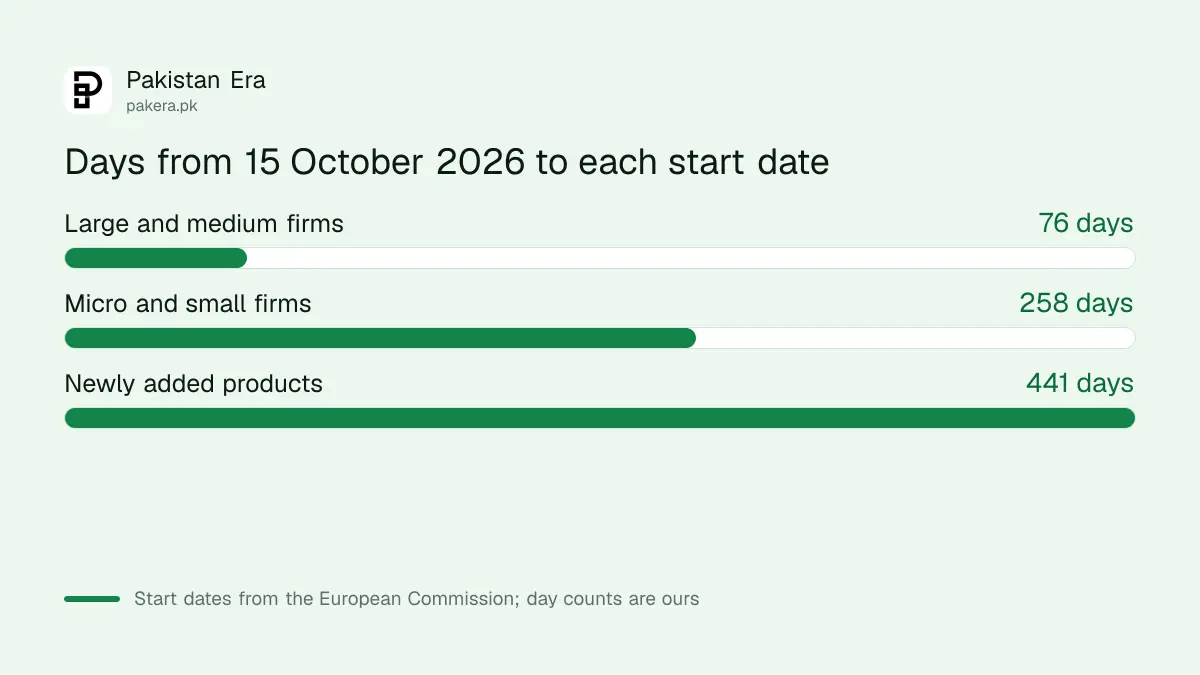
The Commission lists three start dates. Large and medium operators start on 30 December 2026. Micro and small operators start on 30 June 2027. Micro and small operators already covered by the old EU Timber Regulation also start on 30 December 2026.
| Who | Start date | Days from 15 October 2026 (our count) |
|---|---|---|
| Large and medium operators | 30 December 2026 | 76 |
| Micro and small operators | 30 June 2027 | 258 |
| Micro and small operators already under the old timber rule | 30 December 2026 | 76 |
| Newly added products (soluble coffee, some palm oil derivatives, frozen cattle tongues) | 30 December 2027 | 441 |
The size categories apply to operators, the firms that place goods on the EU market. A small Pakistani workshop can still feel pressure in December if its EU buyer is a large firm.
Leather, tyres and furniture are named as covered products
The Commission says the main drivers of deforestation are cattle, wood, cocoa, soy, palm oil, coffee and rubber, and products such as leather, chocolate, tyres and furniture. Pakistani leather, tyre and furniture makers selling to Europe should treat themselves as possibly in scope.
| Commodity | Example derived products named by the Commission |
|---|---|
| Cattle | Leather |
| Rubber | Tyres |
| Wood | Furniture |
| Cocoa | Chocolate |
Not every leather or wood product will be inside the law. The covered goods are set by customs code in the Regulation's annex, which we did not open. Ask your buyer to confirm the code for each product before you assume you are covered or safe.
Five steps to take before 30 December
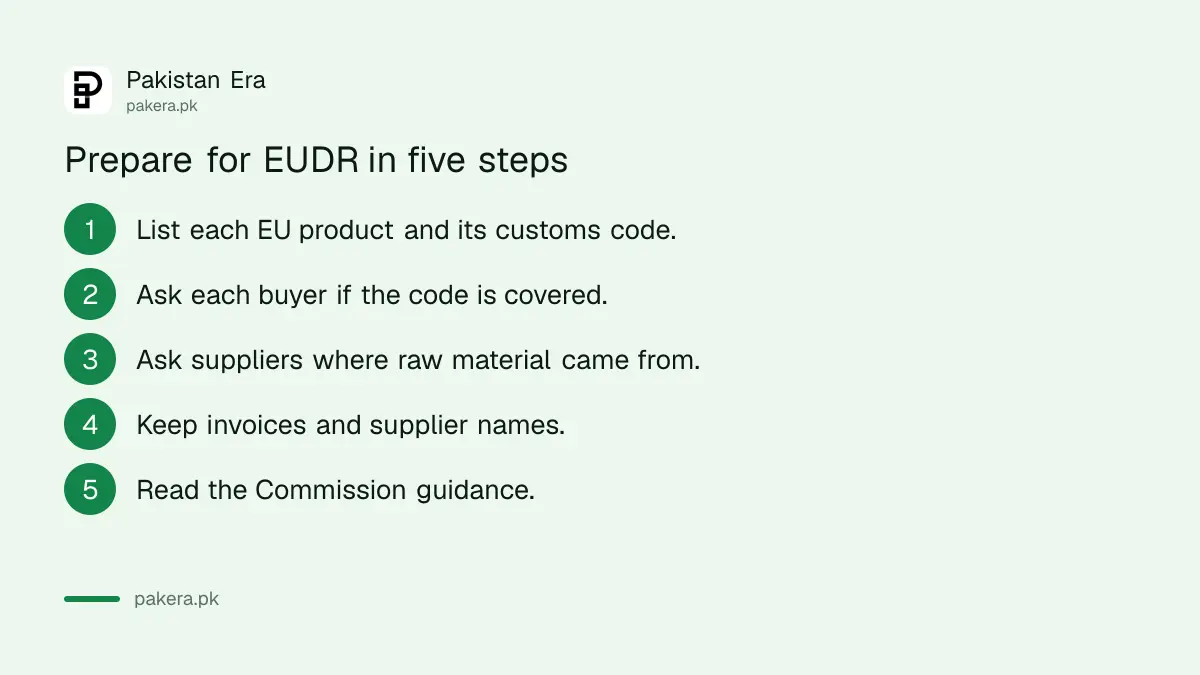
Start with your buyer. Ask whether your product code is covered, which size category the buyer falls into, and what origin proof it wants. Then trace your own raw material back one step and keep dated records.
- List every product you sell to the EU, with its customs code.
- Ask each EU buyer whether the code is covered and when it must comply.
- Ask your suppliers where the hides, rubber or wood came from.
- Write down the answers and keep invoices and supplier names.
- Read the Commission's EUDR guidance and register for its Information System if your buyer asks you to.
The Commission says its Information System under Article 33 opened on 4 December 2024, with user registration open since November 2024. Whether a Pakistani exporter needs to register depends on the supply chain, so ask the buyer.
Country risk ratings decide how hard the checks are
The Commission says an Implementing Regulation sorts countries by their risk of deforestation for the covered commodities. We did not find Pakistan's rating on the page we opened, so we do not state it. Check the Commission's benchmarking list before you plan.
The Commission also runs an EU observatory with public maps and data on forest cover change, and a Team Europe Initiative with an initial €70 million to help partner countries move to deforestation-free supply chains.
Pakistan's other EU trade rules are separate. The GSP+ reapplication rules from 2027 cover tariffs, and direct weekly shipping from Karachi to Europe affects how goods travel. EUDR is about where raw material comes from. If you are not yet registered, register as an exporter on WeBOC and TDAP first.
Common questions about the EU Deforestation Regulation
Does the EUDR apply to Pakistani exporters?
It applies to operators and traders placing covered goods on the EU market. Your EU buyer is usually the operator, but it will need origin information from you.
When does it start?
30 December 2026 for large and medium operators and 30 June 2027 for micro and small ones, as listed by the Commission.
Is leather covered?
The Commission names leather as a product derived from cattle. Check the exact customs code with your buyer, because the covered list is set by code.
Are tyres and furniture covered?
The Commission names tyres, from rubber, and furniture, from wood, as derived products. The exact codes decide whether your goods are inside.
Has the date changed before?
The Commission says it amended the Regulation in December 2024 and December 2025. Its page lists the current start dates, so confirm them again before you act.
Where is the official guidance?
On the Commission's EUDR page, which links the legal text, guidance, country benchmarking and the Information System.
How we verified this
What we checked, where we read it, and what we could not confirm.
Last checked 15 October 2026. Dates, commodities, derived products, the Information System and the Team Europe Initiative come from the European Commission's Regulation on Deforestation-free Products page, which we opened that day. The day counts are our own arithmetic. We did not open the Regulation's annex of customs codes or Pakistan's risk rating, so confirm both with your buyer.
About the author

Global Affairs & Political Economy Writer
Muhammad Hatim is a book lover who started writing because he enjoys it. At Pakistan Era he writes about international relations, geopolitics and the global economy, with a particular interest in South Asia and the forces behind current events.