How to Check a Fake PTA, NCCIA or Bank Call With a Spoofed Number in Pakistan
A call claims to be PTA, NCCIA, your bank or Easypaisa and threatens to block your SIM? See how to spot the spoofed number, check it safely and report it.
If a caller says your SIM, bank account or wallet will be blocked unless you act now, hang up. PTA warns that fraudsters spoof 111 style UAN numbers and pretend to be PTA, NCCIA, banks or Easypaisa and JazzCash. No genuine agency or bank asks for your OTP, CNIC, PIN or fingerprint over a call or message.
Then call the real number from the company's own app or website, not the one that called you. Report the call to PTA on 0800-55055 or at complaint.pta.gov.pk. Both come from PTA's advisory as reported, and we explain below how we checked them.
Hang up on any call that threatens to block your SIM or wallet
A genuine bank or regulator does not scare you into a decision in one minute. Scam calls do. They say your SIM will be blocked in two hours, your CNIC is linked to a crime or your wallet shows a suspicious transfer. The pressure is the trick.
PTA's public advisory, issued on 7 January 2026, says these callers target one time passwords (OTPs), CNIC details, ATM PINs, biometric data and banking logins. We read the advisory as reported by others, and PTA's own page would not load for us on 8 October 2026, so treat the wording as reported.
Do three things at once: stop talking, say nothing about codes and end the call. Do not press any number the caller gives you.
A familiar looking number does not prove who is calling
A UAN, or Universal Access Number, is the 111 style number that big companies use. Fraudsters can make their call appear to come from such a number. This is called spoofing. So "the screen showed my bank's number" proves nothing.
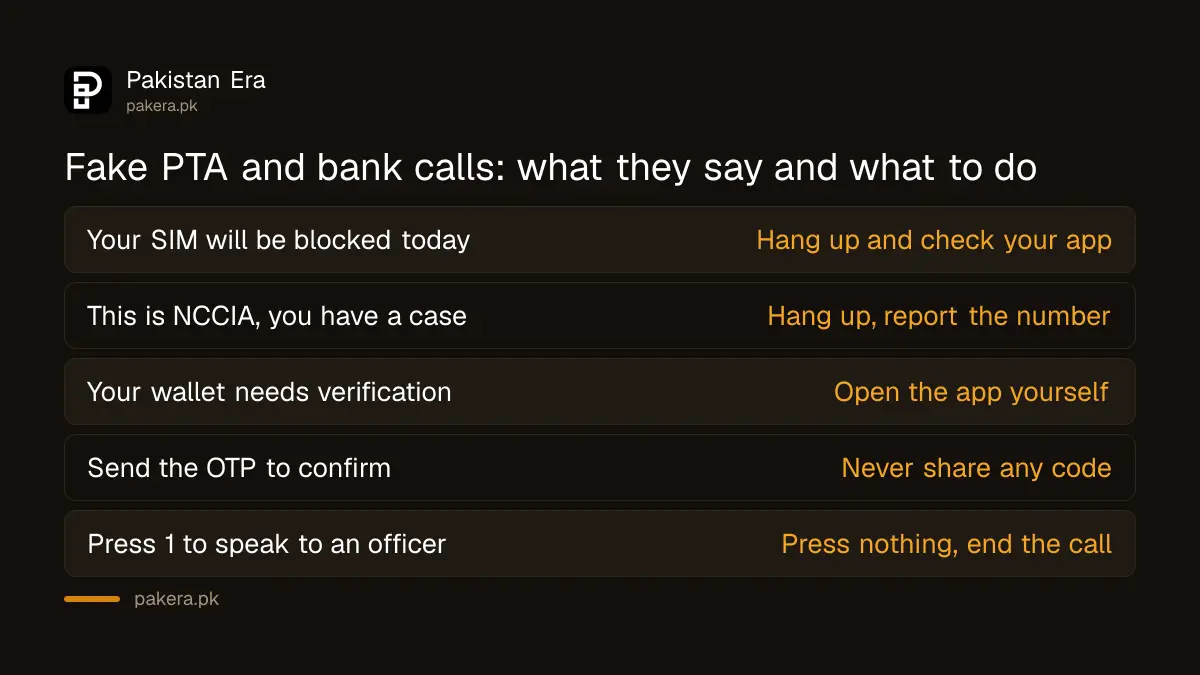
| What the caller says | What to do |
|---|---|
| "Your SIM will be blocked today" | Hang up, then check status in your operator's app |
| "This is NCCIA, you have a case" | Hang up, no agency settles a case by phone call |
| "Your Easypaisa or JazzCash needs verification" | Open the wallet app yourself, never share the code |
| "Send the OTP to confirm" | Never share it, with anyone, for any reason |
| "Press 1 to speak to an officer" | Do not press anything, end the call |
Check the claim by calling back on a number you find yourself
To check a claim, do not use any number the caller or the SMS gave you. Open your bank or wallet app, or type the website address yourself, and find the helpline there. Call that number and ask whether they contacted you.
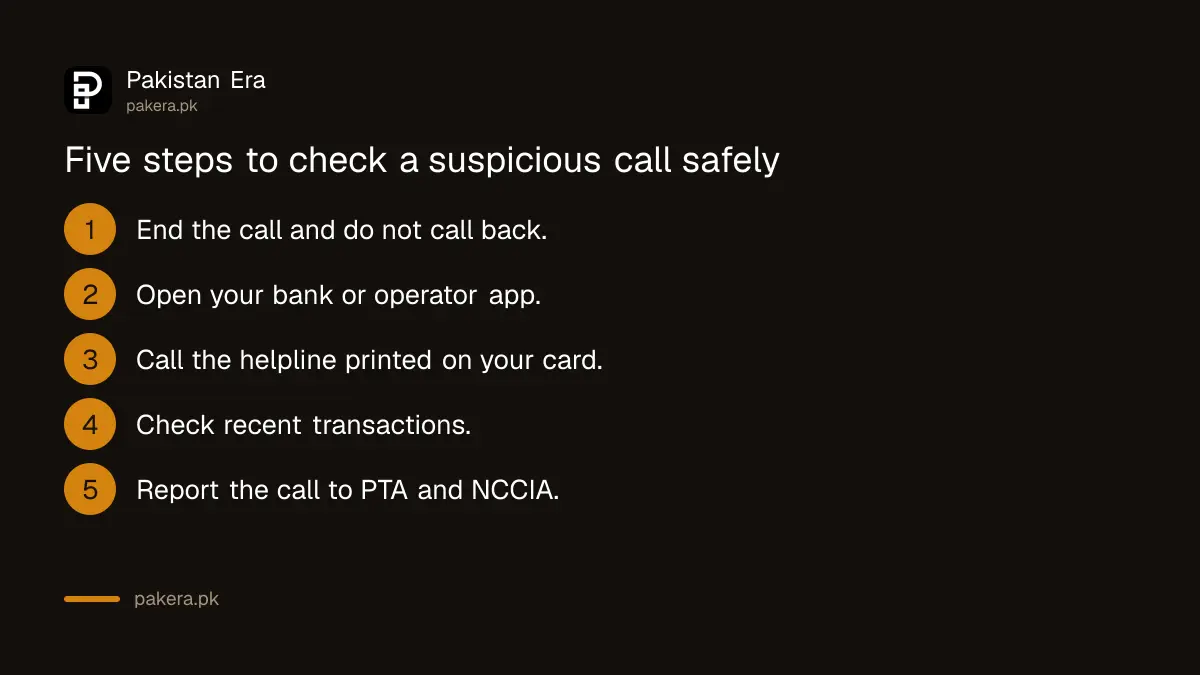
- End the call and do not call the number back.
- Open your bank, wallet or operator app and look for any alert there.
- Call the helpline printed on your card or shown in the app.
- Check your balance and recent transactions for anything you did not do.
- Report the call, as described below.
For an SIM issue, you can also check how many SIMs sit on your name using the steps to check SIMs registered on your CNIC. A real notice about your SIM will show there too.
Report the call to PTA and NCCIA
Reporting helps others, because reported numbers can be traced and blocked. PTA's advisory, as reported, lists three channels. The PTA complaint portal is complaint.pta.gov.pk. The PTA helpline is 0800-55055. The NCCIA cyber fraud complaint portal is complaint.nccia.gov.pk.
We have used PTA's complaint steps before, and the guide to making a PTA telecom complaint shows the screens. For forwarding a scam SMS, the short code is explained in the notes on stopping spam SMS and calls through PTA. The NCCIA portal sat behind a security check when we opened it, so we could not read its form. The steps to report a cybercrime to the NCCIA list what to have ready.
Keep a screenshot of the call log with the time and number. Write down what the caller said.
If you already shared a code, act within the hour
Sharing a code does not end your options, but speed matters. Call your bank or wallet helpline from its official number and ask them to block the account. Change your PIN and password. Then put the complaint in writing.
For a wallet, the steps to get money back after an unauthorised Easypaisa or JazzCash transfer explain the written complaint and the time limits. Be honest about the code. A shared code can make a refund harder, but it is still worth reporting. If the scam came as a text about a fine, compare it with the pattern in the guide to the fake e-challan SMS scam.
If you lose a SIM or suspect a SIM swap, the guide to locking your SIM with a PIN adds a layer.
Common questions about fake PTA and NCCIA calls
Does PTA call people to block their SIM?
PTA's advisory, as reported, warns that scammers pretend to be PTA. Do not act on a call. Check your SIM status through your operator's app or a PTA channel you open yourself.
Can a scammer really show my bank's number on my screen?
Yes. This is called spoofing, and PTA's advisory warns about spoofed UAN numbers. A familiar number on the screen is not proof.
Is it safe to share my CNIC number on a call?
No. Do not share your CNIC, OTP, PIN or fingerprint on an unsolicited call or message. Say you will call back on the official number.
Where do I report a fake call?
As reported from PTA's advisory, use complaint.pta.gov.pk, the helpline 0800-55055, or the NCCIA portal at complaint.nccia.gov.pk. Keep screenshots.
What if I pressed a link in the message?
Do not enter any details on the page. If you did, change your passwords and call your bank or wallet helpline from its official app at once.
How we verified this
What we checked, where we read it, and what we could not confirm.
Last checked 8 October 2026. The warning about spoofed UAN numbers, the list of targeted details and the three reporting channels come from PTA's public advisory of 7 January 2026, as reported by others. PTA's own pages would not load for us on 8 October 2026, and the NCCIA complaint site showed a security check, so we could not read either at source. We did not call any of the numbers. Confirm the portals and helpline on the official PTA and NCCIA sites before you rely on them.
About the author
Public Services and Education Journalist
Fajr Riaz is a journalist and content writer at Pakistan Era, based in Lahore. She covers the questions people meet in everyday life in Pakistan: how a public service works, what a change in the rules means, and where to find a reliable answer.