How to File a Right to Information Request in Sindh and Appeal if Refused
File a right to information request in Sindh: who to write to, the 15 working day limit, no request fee, internal review and a free appeal to the Commission.
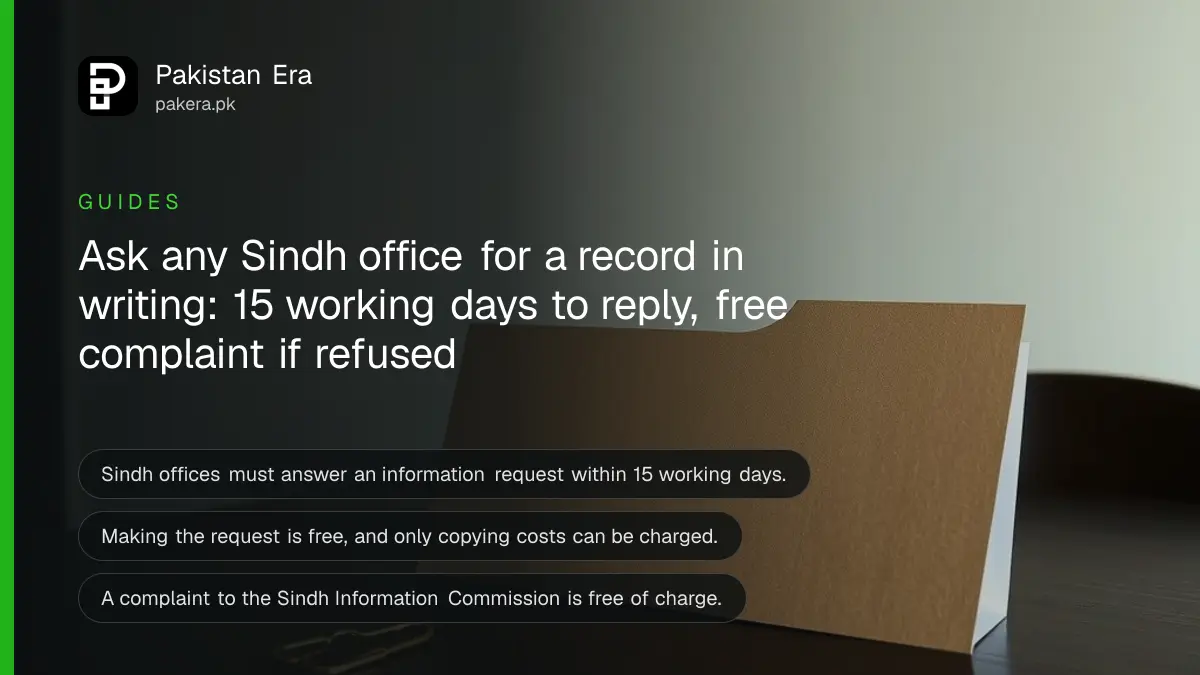
Short answer: Write to the designated information officer of the Sindh office that holds the record, describe the record clearly, and keep the stamped receipt. The office must reply within 15 working days, or 25 if the record is hard to find. If it refuses or stays silent, you can ask for an internal review and complain to the Sindh Information Commission, free of charge.
A family in Karachi pays for a building plan and hears nothing for months. Nobody will say what happened to the file. In Sindh, the law lets any citizen ask for that file in writing, and it sets a clock the office has to follow.
We read the Sindh Transparency and Right to Information Act, 2016 (Sindh Act No. XV of 2017) on the Sindh Laws portal on 13 October 2026. Everything below comes from that text. We did not file a request ourselves, so the steps are the Act's steps, not a test of how every office behaves.
A written request to the designated official starts the clock
Your request goes to the designated official of the public body, an officer of grade 16 or above. You can write it in any form. The office must acknowledge it. You only have to describe the information well enough for staff to find it.
Public bodies in Sindh include departments, autonomous bodies, local governments, courts, tribunals, the Chief Minister's Secretariat and the Provincial Assembly. Any citizen of Pakistan, or a company registered in Pakistan, can apply. The Act does not ask you to give a reason for the request.
Name the document, the year and the office. "The approved building plan for plot 12, Block C, sanctioned in 2024" works better than "all papers about my plot". Ask for a certified copy if you plan to use it in court or with a bank.
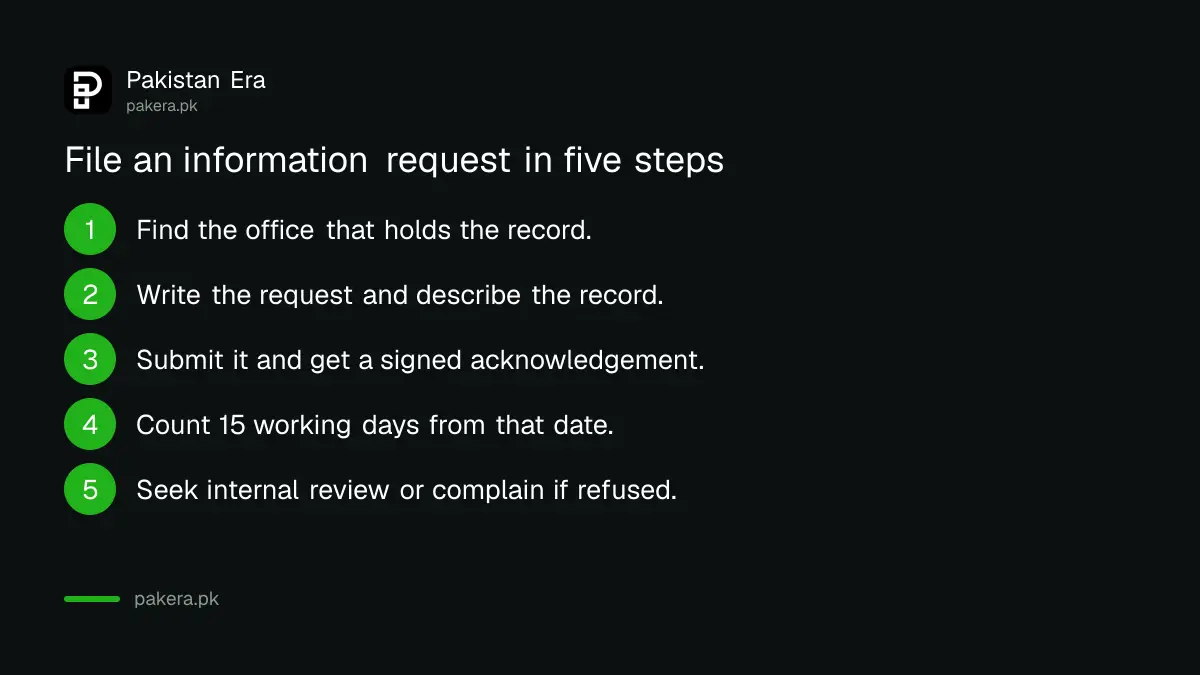
- Find the office that holds the record and ask for its designated official.
- Write the request with the record name, date range and your address.
- Submit it by hand, by post or by email, and get a signed acknowledgement.
- Note the date, then count 15 working days.
- If there is no reply, move to internal review and then the Commission.
You get 15 working days, plus 10 if the record is hard to find
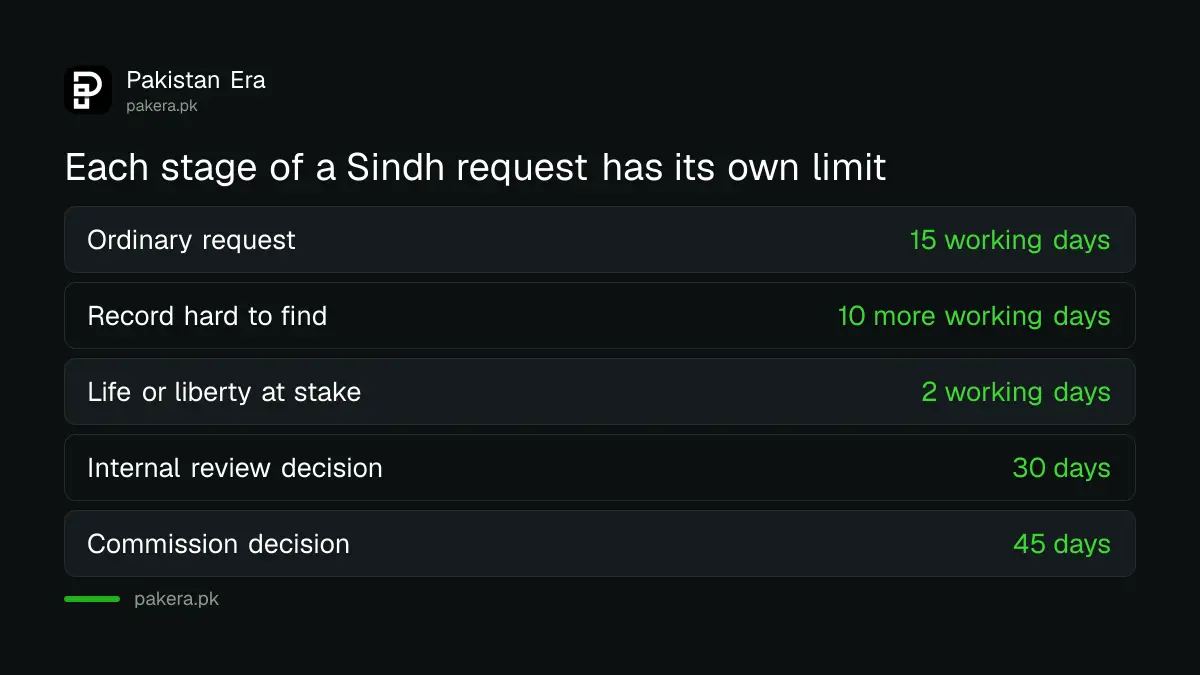
The designated official must answer within 15 working days. If the information is not readily available, the officer tells you and takes another 10 working days. Information needed to protect a person's life or liberty must come within two working days.
Working days exclude weekends and public holidays, so 15 working days is about three weeks on the calendar. The Act also says the supplied copy must carry a dated, signed and stamped certificate that it is a true copy.
| Situation | Time limit in the Act |
|---|---|
| Ordinary request | 15 working days |
| Record not readily available | 10 more working days |
| Life or liberty at stake | 2 working days |
| Internal review request | Within 60 days of the decision or silence |
| Internal review decision | Within 30 days |
| Commission decision on a complaint | Within 45 days |
Fees cover copying and posting only
The public body cannot charge a fee for making the request. It may charge only the cost of copying or sending the information, using a schedule set by the Sindh Information Commission. We could not find that schedule, so ask for the cost in writing.
That matters because some offices quote a "file charge" that has no basis in the Act. If you are quoted a figure, ask which schedule it comes from. An amount above the set fee is itself a ground for complaint to the Commission.
A refusal can be reviewed inside the office, then complained about
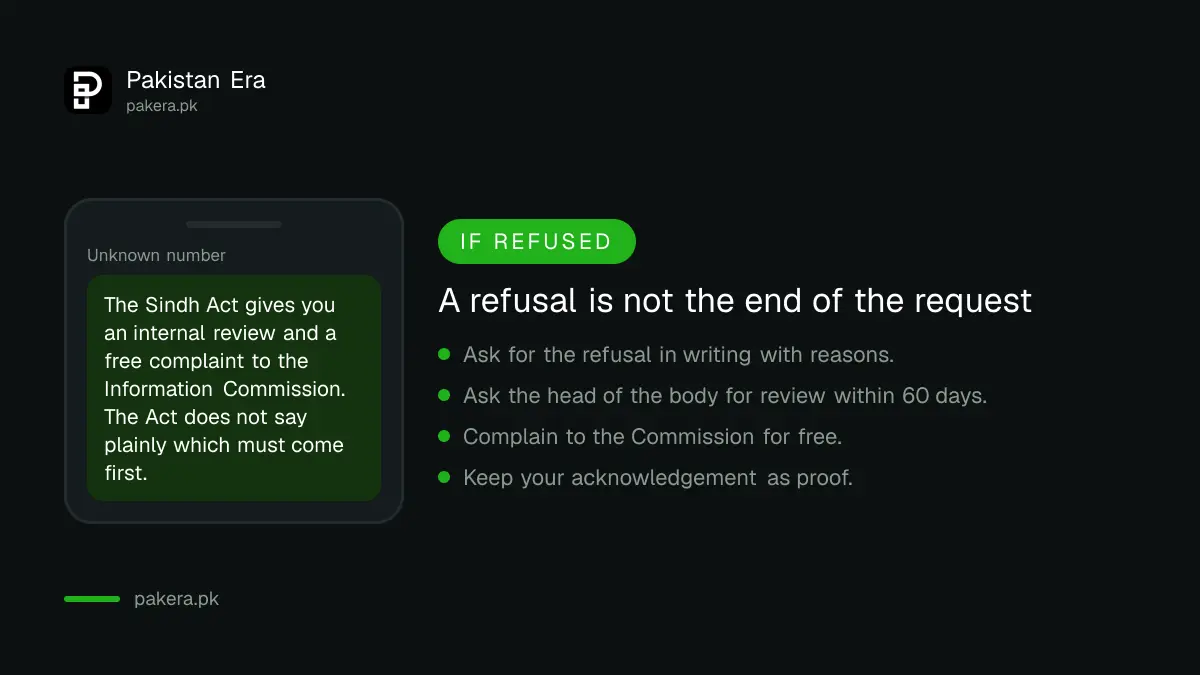
If the official refuses, the refusal must give reasons and tell you that you can seek an internal review. You ask the head of the body in writing within 60 days. The head must decide within 30 days.
The Act also lets anyone who believes a request was not handled properly complain to the Sindh Information Commission. Complaints are free, and the Commission must decide within 45 days. Grounds include wrongful refusal, delay, false or incomplete information, an excess fee and destroyed records.
The Act does not say plainly whether the internal review must come before a complaint. If the refusal letter names a route, follow it and keep a copy. In a complaint, the applicant carries the burden of showing that the officer broke the Act, so attach your acknowledgement and any reply.
The Commission can order disclosure and has the powers of a civil court. It can recommend action against an officer, and can fine an officer up to 10 percent of basic pay for refusing without cause. Destroying a record that is under request is an offence with up to two years and six months in prison. Misusing information with bad intent can bring a fine of Rs 100,000.
Some records are exempt, and the exemptions are listed
The Act lists what an office may withhold, such as records that harm national defence, public order, privacy, the economy before a tax change, or the fair marking of an exam. Even then, the Commission can order release if the public interest is greater.
If only part of a document is exempt, the rest must be given. Information that was withheld must be declassified after ten years. So a refusal of a whole file because "one page is sensitive" is open to challenge.
Use the right to information for records a public body holds, such as a sanctioned building plan, tender results or the beneficiary list of a scheme. For a problem with a service, an ombudsman complaint may be faster, as in the steps to file a complaint with the Sindh Ombudsman. For land papers, first try the routes in how to check land records in Sindh online, and for a Karachi building, see how to check whether a building is SBCA approved before filing a request.
Common questions
Who can file a right to information request in Sindh?
Any citizen of Pakistan, or a legal person registered in Pakistan, can file. The Act does not require you to live in Sindh or to explain why you want the record.
Is there a form or a fee?
You can apply in any form, and there is no fee for making the request. You pay only the copying or posting cost set by the Commission's schedule.
How long does the office have to reply?
It has 15 working days, and 10 more if the record is not readily available. If a life or liberty is at stake, the answer is due in two working days.
What if the office ignores my request?
Silence counts as a failure to reply. You can ask the head of the body for an internal review within 60 days, and you can complain to the Sindh Information Commission without a fee.
Can an office refuse because the file is "confidential"?
Only if the record fits a listed exemption, and the officer must give the reason. Any part that is not exempt must still be disclosed.
Does the same law cover federal offices in Sindh?
No. This Act covers bodies of the Sindh government and local governments. Federal bodies in Karachi fall under a different federal law.
How we verified this
What we checked, where we read it, and what we could not confirm.
Last checked on 13 October 2026, Pakistan time. We read the full text of the Sindh Transparency and Right to Information Act, 2016 as published on the Sindh Laws portal. We could not confirm the Commission's current address, helpline or fee schedule from an official page, so none is quoted. The order of steps is our own plain-language reading of the Act.
About the author

Senior Writer, Public Services and Technology
Shahid joined us in 2024 as an author. He is a senior contributor to Pakistan's leading technology websites. He writes detailed articles, mostly covering his expertise in the latest tech, mobiles, apps, gadgets, and step-by-step guides. His ideology is to help people understand the latest trends and explain complex methods through very easy-to-understand guides.