How to Get or Renew a CNIC at a Punjab e-Khidmat Markaz: Rs 400 to Rs 2,500
Apply for a new, duplicate or renewed CNIC at a Punjab e-Khidmat Markaz: fees from Rs 400 to Rs 2,500, delivery in 12, 30 or 45 days, and the papers to carry.
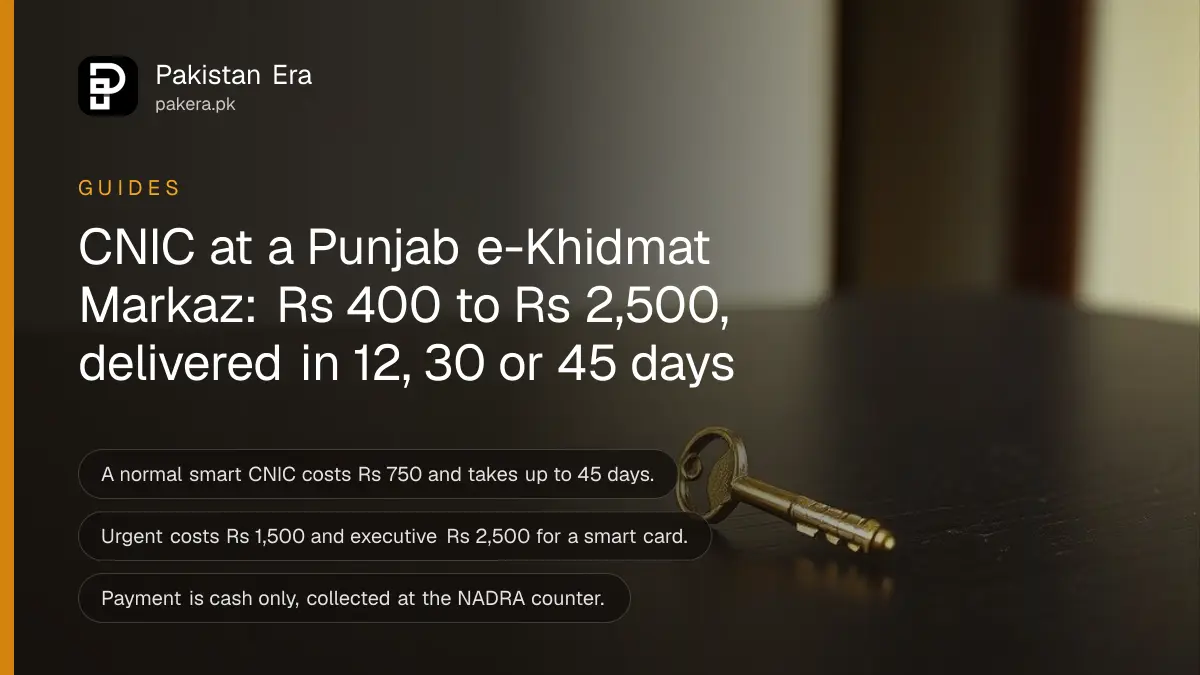
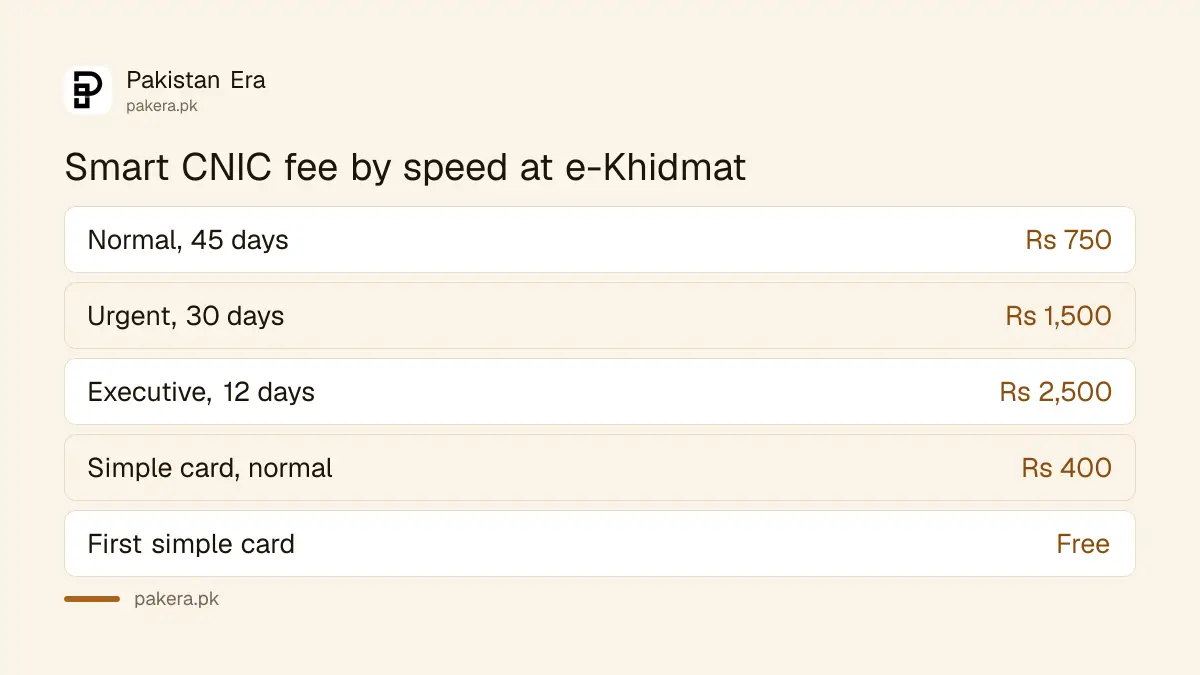
Short answer: A Punjab e-Khidmat Markaz lists a smart CNIC at Rs 750 normal, Rs 1,500 urgent and Rs 2,500 executive. A simple card costs Rs 400 for a duplicate, renewal or change. Delivery is up to 45, 30 or 12 days. Pay cash at the NADRA counter.
Many people in Punjab book a NADRA centre far from home. The e-Khidmat Markaz is another door to the same service. NADRA issues the card, but the Markaz page lists the papers and fees in one place.
We read the CNIC page of the Punjab e-Khidmat service on 14 October 2026. The figures below are the page's own. Other sites quote different fees, so we say so where it matters.
The fee depends on the card type and the speed you choose
The e-Khidmat page gives a fee for each type and speed. A smart card is Rs 750 normal, Rs 1,500 urgent and Rs 2,500 executive. A simple card is Rs 400 for a duplicate, renewal or change, and free as a new first card at the normal speed.
| Type | Normal | Urgent | Executive |
|---|---|---|---|
| New, simple | Rs 0 | Rs 1,150 | Rs 2,150 |
| New, smart | Rs 750 | Rs 1,500 | Rs 2,500 |
| Duplicate, simple | Rs 400 | Rs 1,150 | Rs 2,150 |
| Duplicate, smart | Rs 750 | Rs 1,500 | Rs 2,500 |
| Renewal or change, simple | Rs 400 | Rs 1,150 | Rs 2,150 |
| Renewal or change, smart | Rs 750 | Rs 1,500 | Rs 2,500 |
Our guide to NADRA fees for every document compares fees across sources. Where figures differ, the counter receipt is the final word.
Delivery takes up to 45, 30 or 12 days
The page sets maximum delivery times by service category. Normal is up to 45 days. Urgent is up to 30 days. Executive is up to 12 days. These are ceilings from the page, not promises for each card.
If you need the card for a visa, a job form or a bank, choose the speed that fits your date, and do not count on early delivery. The page says NADRA issues the card, so delay after the date is a NADRA matter. Use the NADRA helpline 1777 and complaint portal to chase it.
Carry the papers for your exact case
The page lists different papers for new, duplicate, renewal and change cases. A new card needs the parents' CNICs, the child registration certificate and both parents in person as witnesses. A renewal needs the expired CNIC and a blood relative as witness.
For a lost card, read how to handle a lost CNIC before you go. For an expired card, see how to renew an expired CNIC.
- New card: CNICs of parents, the CRC, and a witness by father and mother in person.
- Duplicate card: your old CNIC if you have it, the FIR for a lost card if available, and a blood relative witness in person.
- Renewal: the expired CNIC and a blood relative witness, or an attested affidavit from a gazetted officer.
- Renewal with a correction: add the document that proves the correction.
- Marital status change: the nikah nama and the husband as witness.
Payment is cash at the NADRA counter
The page says the fee is cash only and is collected at NADRA counters. Do not pay a tout, a photocopy shop or any person outside the centre. Keep the receipt, because it carries the tracking number for your application.
Service timing for the CNIC desk is Monday to Saturday, 9 am to 4 pm, with a break from 1 pm to 2 pm. On Friday the Markaz closes from 12:30 pm to 2:30 pm. Arrive early on Monday and Saturday, when queues are usually longest.
To follow your application after you pay, see how to track your CNIC status.
The same page covers the juvenile card
The page for the NADRA juvenile card lists the same fee table and delivery times as the CNIC page. A child under 18 gets this card instead of a CNIC. The papers are the same list, with the parents as witnesses.
If you want the child's card, read how to apply for a NADRA juvenile card for the age rules and how long the card stays valid.
Keep the receipt and know where to complain
Keep the NADRA receipt until the card is in your hand. It carries the tracking number. If the maximum delivery time passes with no card, complain to NADRA with that number and your CNIC details.
The e-Khidmat page says the call centre may ring you for feedback after the service. Treat that as a survey only. Never share a code, a PIN or a card number with a caller, even one who says he is from NADRA.
If a counter asks for a fee that does not match the table above, ask for the official fee list in writing. Then compare it with the amount on your receipt. A difference is worth a complaint.
Common questions
How much is a smart CNIC at a Punjab e-Khidmat Markaz?
The page lists Rs 750 at the normal speed, Rs 1,500 urgent and Rs 2,500 executive.
How much is a simple CNIC renewal?
The page lists Rs 400 normal, Rs 1,150 urgent and Rs 2,150 executive for a simple card.
How long does delivery take?
The page sets a maximum of 45 days for normal, 30 for urgent and 12 for executive.
Can I pay by card or bank?
No. The page says the fee is cash only and is collected at NADRA counters.
Do I need a witness?
Yes for most cases. The page asks for a blood relative in person, or an attested affidavit from a gazetted officer for a renewal.
Who issues the card?
The page says NADRA issues the CNIC. The Markaz only receives the application.
How we verified this
What we checked, where we read it, and what we could not confirm.
Last checked on 14 October 2026, Pakistan time. We read the CNIC page of the Punjab e-Khidmat service on ekhidmat.punjab.gov.pk and the home page of NADRA. We did not queue at a Markaz, and the NADRA page we read gave no fee table, so the fees above are the e-Khidmat page's figures. Other sites quote different fees. Confirm the amount at the counter before you pay.
About the author

Tax, Bills and Technology Writer
Ali Akhtar is a young and curious voice here at Pakistan Era. He is currently pursuing his A-Levels and has a growing interest in Pakistan’s changing industrial landscape and educational trends. Ali likes to write in a way that helps him explain and explore the world around him. His writing reflects the perspective of the new generation navigating the evolving trends of Pakistan where technology, youth innovation, and shifting opportunities are reshaping the country’s future.