How to Get the Sindh Zakat Guzara Allowance: Rs 1,000 a Month on a Sindh Bank ATM Card
Sindh zakat guzara allowance pays Rs 1,000 a month, Rs 6,000 every six months, on a Sindh Bank ATM card. See who qualifies and how to apply to your committee.
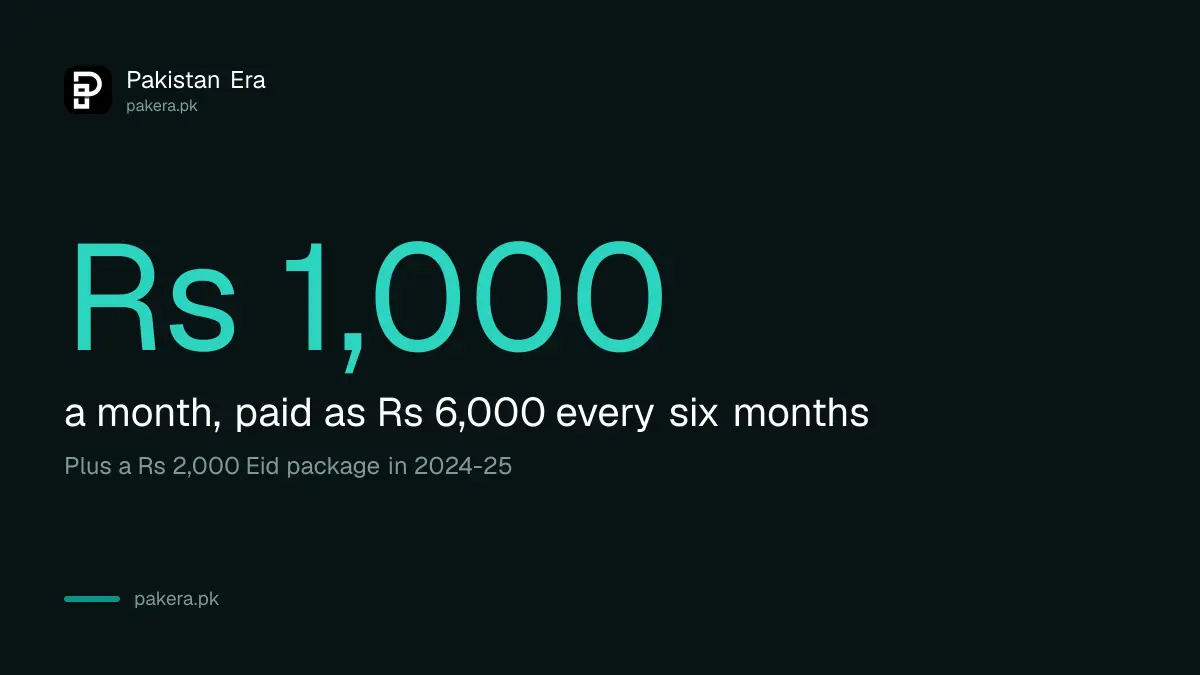
The Sindh zakat guzara allowance is Rs 1,000 a month, paid as Rs 6,000 every six months onto a Sindh Bank ATM card after biometric verification. You apply to the Local Zakat and Ushr Committee of your area, which checks that you are a poor adult Muslim with no income and no other government aid. One person per household can get it, and the list is reviewed every year between 1 July and 15 August.
Sindh budgeted Rs 1.32 billion for 110,000 guzara allowance beneficiaries across 29 districts in 2024-25, plus a Rs 2,000 Eid package for each of them. We read the Guzara Allowance Through ATM Card page and the Sindh Zakat Disbursement Procedure of the Auqaf, Religious Affairs, Zakat and Ushr Department on 19 October 2026.
The rate is Rs 1,000 a month, issued six months at a time
The procedure sets the guzara allowance at Rs 1,000 per month per mustahiq, the word for a person entitled to zakat. The Sindh Zakat Council raised it from Rs 500 at its meeting of 19 February 2013. Payment covers the full currency period of your istehqaq certificate, so a six month certificate means Rs 6,000 in one go.
The 2024-25 district allocation confirms the arithmetic. Rs 1,320,000,000 for 110,000 beneficiaries is Rs 12,000 a head for the year, which is Rs 1,000 a month. The separate Eid package, Rs 220,000,000 for the same 110,000 people, is Rs 2,000 each. Both are our division of the department's published totals.
| Item | Amount | Source |
|---|---|---|
| Monthly rate | Rs 1,000 | Disbursement procedure, clause 3 |
| Paid per six months | Rs 6,000 | Procedure, clauses 2.3 and 2.6 |
| Yearly total | Rs 12,000 | Our arithmetic from the 2024-25 allocation |
| Eid package | Rs 2,000 once | 2024-25 allocation page |
| Beneficiaries budgeted | 110,000 in 29 districts | 2024-25 allocation page |
The procedure says payment will not be cut to a lower amount to fit in more people. If the budget runs short, fewer names are selected, in order of priority and the district poverty survey, rather than everyone getting less.
You qualify if you are a poor adult Muslim with no job and no other government aid
The eligibility clause has three tests. You are an adult Muslim living below the poverty line, with greater preference to widows and disabled persons. You are unemployed and poor. And you are not a habitual beggar. Non-Muslims are not covered, because zakat is collected only from Muslims.
Before the committee certifies you, you sign a declaration that you receive no financial assistance from any other government poverty programme and that you have no source of income or employment. That rules out a household already on a BISP Kafaalat payment, which is why the committee asks. The steps to check BISP eligibility by SMS on 8171 tell you where you stand before you sign.
Only one mustahiq is selected from one household. A widow and her adult son in the same house cannot both draw it.
Apply in writing to your Local Zakat and Ushr Committee, which decides your istehqaq
Istehqaq means entitlement. The Local Zakat and Ushr Committee of your permanent residence decides it, and no application counts unless it is entered in the committee's register or database. The procedure says the most deserving applicants are taken first, in order of priority and the district poverty survey.
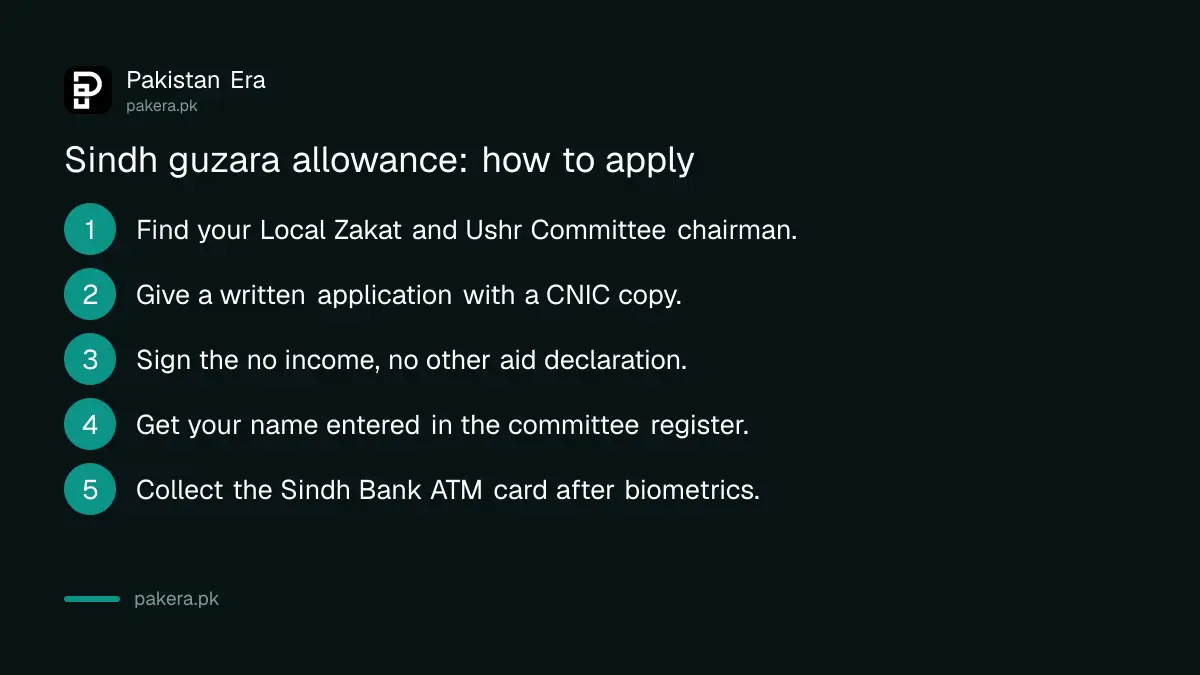
- Find the chairman of the Local Zakat and Ushr Committee for your union council or ward.
- Give a written application with your CNIC copy and a note of your circumstances, such as widowhood or disability.
- Sign the declaration that you have no income, no job and no other government aid.
- Make sure your name is entered in the committee's register. Ask for the entry number.
- Wait for the istehqaq certificate. The selected list is displayed publicly and objections are heard.
The district committee keeps a database of every beneficiary and a register of renewed certificates. The list of mustahiqeen is reviewed every year between 1 July and 15 August, so an application made in spring may only be considered at that review.
Payment comes on a Sindh Bank ATM card after your thumb is verified
The department's allocation page heading says the 2024-25 guzara allowance is disbursed through Sindh Bank ATM cards after biometric verification. The older procedure text describes crossed cheques or an e-Sahulat card handed over in front of local notables such as the imam and the school head. The ATM card is the current method.
The procedure also bars middlemen. Clause 2.5 says zakat paid clerks or any other person must not be involved in paying the guzara allowance, and cheques or cards must not be delivered through them. If someone asks for a share of your Rs 6,000 to "release" the card, that is against the department's own rules.
Clause 2.4 tells the district to keep in touch with banks so beneficiaries have no difficulty opening accounts. A bank that refuses is to be reported to the district chairman and the Chief Administrator Zakat at once. The rules for blind, disabled and senior customers at banks apply at the branch too.
Karachi West has the biggest share and Tando Muhammad Khan the smallest
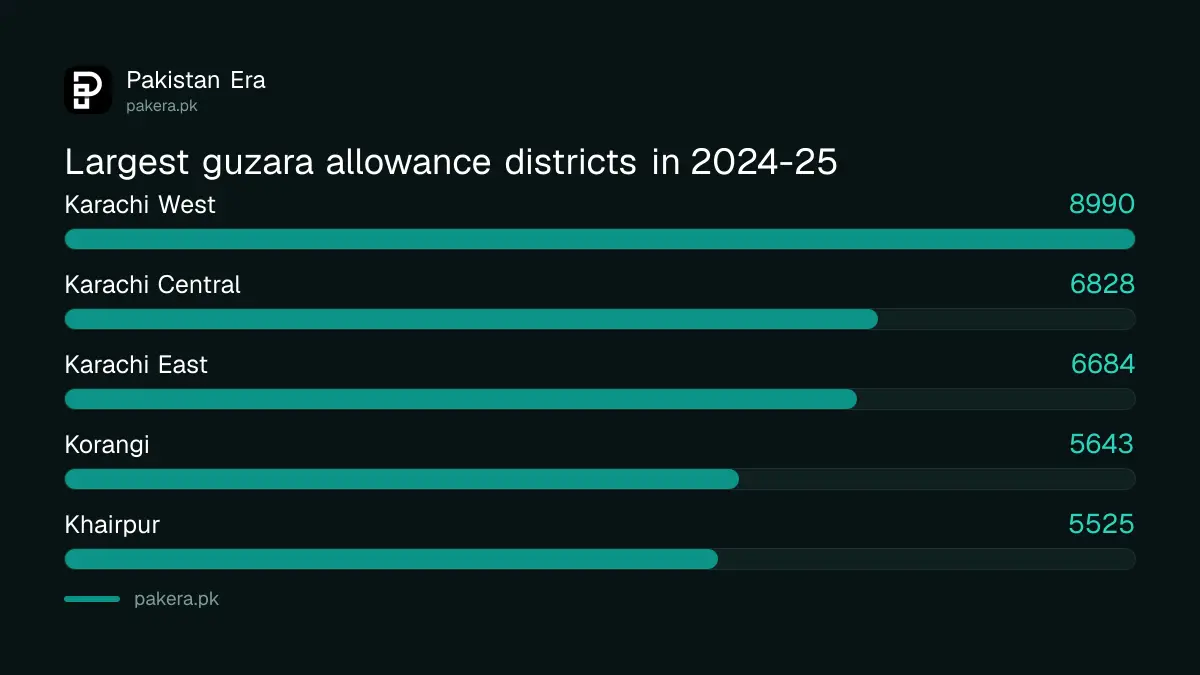
The 2024-25 allocation splits the 110,000 places by the population ratio in the 2017 census. Karachi West gets 8,990 beneficiaries, Karachi Central 6,828, Karachi East 6,684, Korangi 5,643, Khairpur 5,525, Hyderabad 5,056 and Sanghar 4,725. At the other end, Tando Muhammad Khan gets 1,555, Matiari 1,767 and Sujawal 1,796.
So a city committee has more places than a rural one, but it also has far more applicants. The procedure's rotation and priority rules decide who waits. Punjab runs its own scheme on different terms, and the guide to zakat help in Punjab shows the Rs 2,000 a month rashan card there.
Common questions
How much is the zakat guzara allowance in Sindh?
Rs 1,000 a month, paid as Rs 6,000 for each six month istehqaq period, plus a Rs 2,000 Eid package in 2024-25.
Who decides if I am eligible?
The Local Zakat and Ushr Committee of your permanent residence. It certifies your istehqaq after you sign the no-income declaration.
Can I get it if I already receive BISP money?
No. The declaration states you receive no assistance from any other government poverty programme.
Can two people in one house get it?
No. The procedure allows only one mustahiq per household.
How is the money paid?
On a Sindh Bank ATM card after biometric verification, according to the department's 2024-25 allocation page.
When are new names added?
The list is reviewed every year between 1 July and 15 August. Applications must be entered in the committee register to be considered.
How we verified this
What we checked, where we read it, and what we could not confirm.
Last checked 19 October 2026. The rate, the six month payment, the eligibility tests, the declaration, the one per household rule, the review window and the bank liaison rules come from the Sindh Zakat Disbursement Procedure PDF, approved on 16 July 2011 and amended on 17 April 2018, on the Auqaf, Religious Affairs, Zakat and Ushr Department's site. The 110,000 beneficiaries, 29 districts, Rs 1.32 billion, Eid package and Sindh Bank ATM card method come from the department's Guzara Allowance Through ATM Card page for 2024-25, read the same day. The per-head figures are our division. We could not find a 2025-26 or 2026-27 allocation on the site, and the department's FAQ page said no information was available, so whether the rate or the beneficiary count has changed since 2024-25 is unverified.
About the author

Global Affairs & Political Economy Writer
Muhammad Hatim is a book lover who started writing because he enjoys it. At Pakistan Era he writes about international relations, geopolitics and the global economy, with a particular interest in South Asia and the forces behind current events.