How to Get the Sindh Zakat Marriage Grant of Rs 20,000 for an Unmarried Woman
Sindh pays a Rs 20,000 zakat marriage grant once, by crossed cheque in the bride's name, after the Local Zakat Committee certifies need. See how to apply.
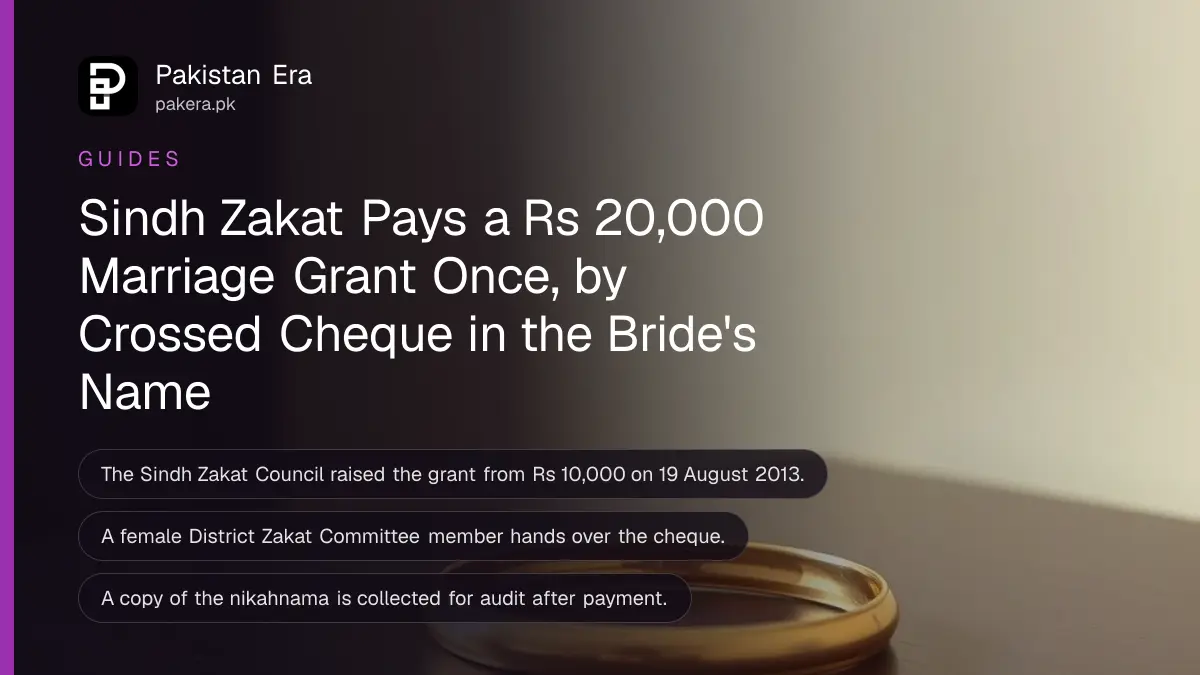
Sindh's zakat marriage grant is Rs 20,000, paid once by crossed cheque in the bride's own name after the Local Zakat and Ushr Committee certifies that she is an adult Muslim whose parents or guardian cannot afford her wedding. The cheque is handed to her by a female member of the District Zakat Committee, and a copy of the nikahnama is collected for audit.
Sindh's own rulebook still prints the older figure of Rs 10,000 in one line and the revised Rs 20,000 in the next, so people are quoted both. We read the Sindh Zakat Disbursement Procedure on the Auqaf, Religious Affairs, Zakat and Ushr Department's site on 19 October 2026, and the marriage assistance section is what this guide follows.
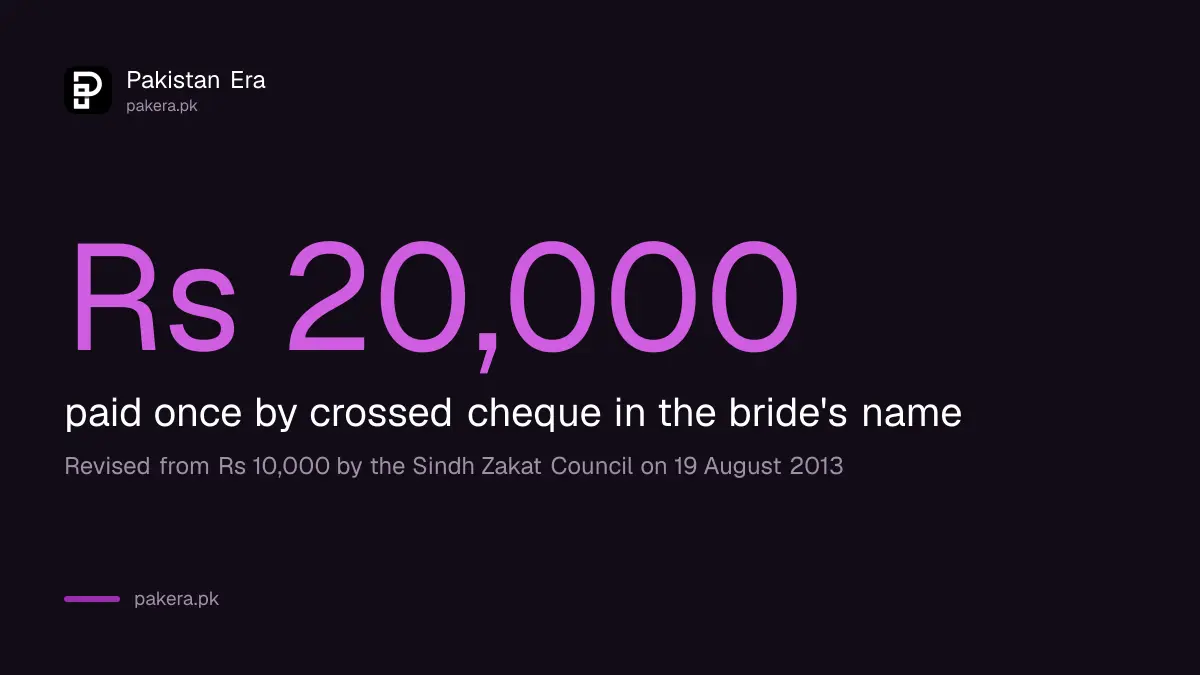
The grant is Rs 20,000, revised up from Rs 10,000 in August 2013
Clause 2 of the marriage assistance section says total assistance for the marriage of a mustahiq woman shall be Rs 10,000. The clause right after it records that the Sindh Zakat Council, at its meeting of 19 August 2013, revised the rate of marriage assistance to Rs 20,000. The later council decision is the operative one.
Payment is made at one and the same time, not in instalments. The grant goes to the woman only. The procedure says parents, a guardian or a member of a social welfare institution are not entitled to receive it on her behalf.
| Rule | What the Sindh procedure says |
|---|---|
| Amount | Rs 20,000, revised from Rs 10,000 on 19 August 2013 |
| How paid | Crossed cheque drawn in the beneficiary's name only, in one payment |
| Who hands it over | A female member of the District Zakat Committee, or a male member before witnesses if none is present |
| Proof required | A copy of the nikahnama, obtained at payment or later for audit |
| After payment | Her name is struck off the list of mustahiqeen |
Punjab pays Rs 50,000 for the same purpose, which is why Sindh's figure looks small next to it. The process to apply for zakat help in Punjab goes through the district committee there as well.
She qualifies if she is an adult Muslim dependent on parents who cannot pay for the wedding
Clause 1.3 sets two tests for istehqaq, the word for entitlement. The beneficiary is an adult Muslim who depends on her parent, guardian or a social welfare institution for her living. And if she lives with parents or a guardian, their financial position is such that they cannot afford the expenses of her marriage.
The committee that decides is the one for her area of residence: the chairman of the District Zakat Committee, the Taluka or Town committee, or the Local Zakat and Ushr Committee. Her permanent address normally fixes the area. If she has moved, the committee of the new address can decide, provided she has lived there for more than a year.
A woman living in a Darul Aman or another registered social welfare institution is assessed by the committee of the area where that institution stands. The guide to Dar-ul-Aman admission in Pakistan explains who those homes take in.
Apply through the Local Zakat and Ushr Committee before the nikah
The procedure does not print a separate form for marriage assistance, so the route is the same written application to the local committee used for every zakat head. Apply before the wedding, because the grant is for a mustahiq unmarried woman and the nikahnama is collected afterwards as proof.
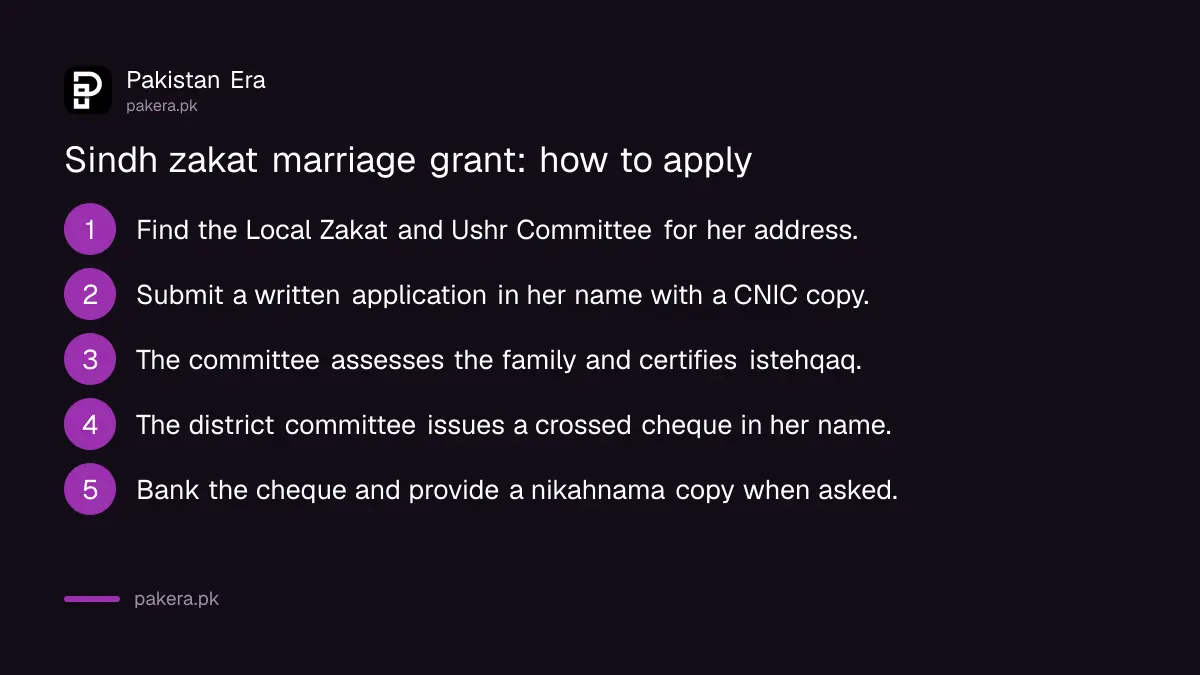
- Find the chairman of the Local Zakat and Ushr Committee for the bride's permanent address.
- Submit a written application in her name with her CNIC copy and the parents' or guardian's details.
- The committee assesses the family's means and certifies istehqaq.
- The district committee issues a crossed cheque in her name for Rs 20,000.
- Collect the cheque in person. A female committee member delivers it, or a male member does so before witnesses such as the imam and the local school head.
- Deposit it in an account in her name, and provide a nikahnama copy when asked.
A crossed cheque can only be paid into a bank account, not cashed over the counter. If she has no account, an Asaan digital account opens with a CNIC and no minimum balance. Clause 2.4 tells the committee to keep in touch with banks so beneficiaries have no difficulty encashing the cheques.
Middlemen are barred, and the payment goes only to her
Clause 2.5 says zakat paid clerks and group secretaries will not be involved at any stage of payment. The cheque is drawn in the bride's name, so nobody else can bank it. A relative or a tout who promises to "get" the grant for a cut has no role under the procedure.
The department has a complaint form on its site, and its Karachi office is at the 8th floor of State Life Building No 11 opposite Zainab Market, phone 021 99203611, open 9 am to 5 pm. Take the committee name and the date of your application when you call.
The grant is one head among several a poor family can use
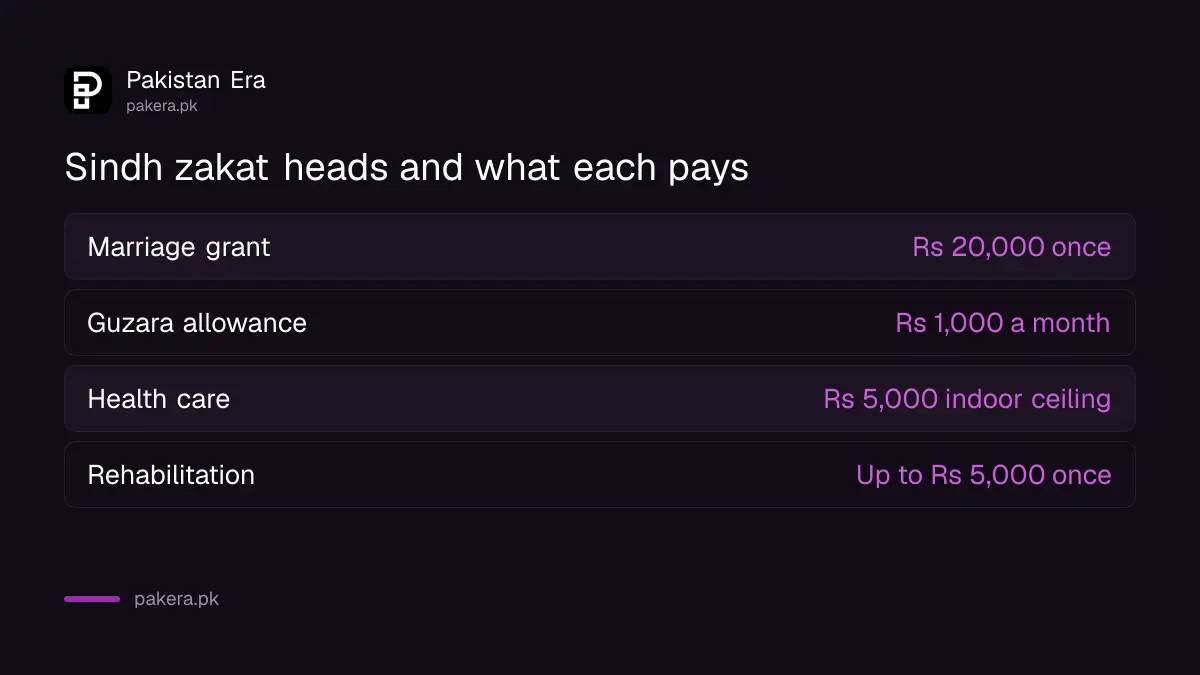
Marriage assistance sits in a list that also includes the monthly guzara allowance, educational stipends, health care through hospitals and a rehabilitation grant. A bride's mother who is a widow with no income may qualify for the Sindh zakat guzara allowance of Rs 1,000 a month on her own istehqaq.
The heads do not stack for one person. The rehabilitation rules say a beneficiary should not be receiving assistance from another zakat programme, and after the marriage grant the bride's name is removed from the mustahiqeen list. Plan for one grant per person, not several.
Common questions
How much is the zakat marriage grant in Sindh?
Rs 20,000, paid once. The procedure's text still shows Rs 10,000, but the council revised it to Rs 20,000 on 19 August 2013.
Who receives the cheque?
The bride only. It is a crossed cheque in her name, and parents or guardians cannot collect it for her.
Can a married woman apply?
No. The head is marriage assistance to unmarried mustahiq women, and a nikahnama copy is taken after payment as proof.
Where do I apply?
To the Local Zakat and Ushr Committee of the bride's permanent address, or the committee of a new address where she has lived for more than a year.
Is there a form?
The procedure prints no separate marriage form. A written application with CNIC copy to the local committee chairman starts the case.
Can she get the guzara allowance as well?
Not in practice. After the marriage grant her name is struck off the list of mustahiqeen.
How we verified this
What we checked, where we read it, and what we could not confirm.
Last checked 19 October 2026. Every rule, the Rs 10,000 figure, the 19 August 2013 revision to Rs 20,000, the crossed cheque, the female committee member, the nikahnama copy, the residence tests and the bar on clerks come from the marriage assistance section of the Sindh Zakat Disbursement Procedure PDF, approved on 16 July 2011 and amended on 17 April 2018, on the Auqaf, Religious Affairs, Zakat and Ushr Department's site, read on 19 October 2026. The office address and phone are from the department's site the same day. We could not find a published budget for the marriage head for 2026-27, a prescribed form or a count of grants made, so those are unverified.
About the author

Global Affairs & Political Economy Writer
Muhammad Hatim is a book lover who started writing because he enjoys it. At Pakistan Era he writes about international relations, geopolitics and the global economy, with a particular interest in South Asia and the forces behind current events.