How to Get the Sindh Zakat Rehabilitation Grant: Rs 5,000 for a Small Business or Push Cart
Sindh zakat pays a one-time Rs 5,000 rehabilitation grant for a small business, push cart or tricycle, or someone left penniless. See the four tests and apply.
Sindh's zakat rehabilitation grant is a one-time payment of up to Rs 5,000 by crossed cheque to an adult Muslim who has been left penniless or without shelter, wants to start a small business, needs a tricycle or push cart, or is a new Muslim struggling to settle. Apply to your Local Zakat and Ushr Committee, which certifies your istehqaq, and expect to wait, because the rules ration the grant to about one person per committee a year. After payment your name comes off the zakat list.
This is the smallest and least known zakat head in Sindh, and it is the only one aimed at getting someone back to work rather than keeping them fed. We read the Social Welfare and Rehabilitation section of the Sindh Zakat Disbursement Procedure on the Auqaf, Religious Affairs, Zakat and Ushr Department's site on 19 October 2026.
The grant is up to Rs 5,000, paid once, by crossed cheque
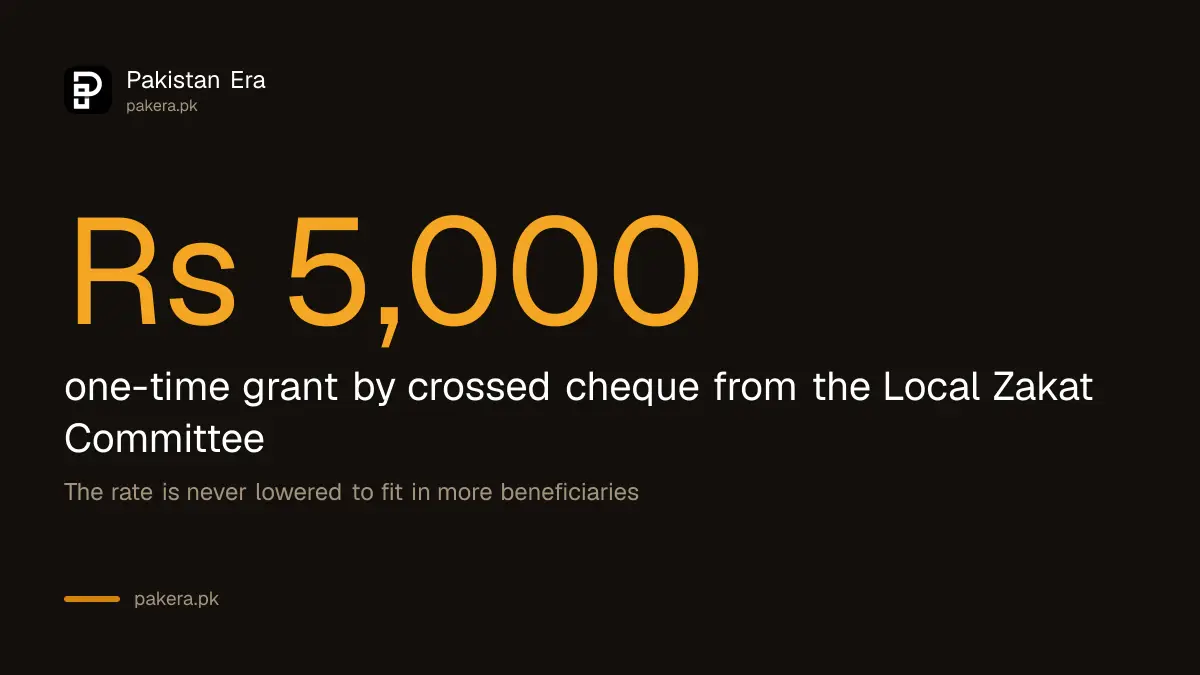
Clause 2 says a one-time grant of up to Rs 5,000 may be provided for the rehabilitation of a mustahiq, whose name is then struck off the list of mustahiqeen. Clause 4 says zakat funds reach a mustahiq through a crossed cheque from the Local Zakat Committee of their area of residence.
Clause 2.4 is blunt about the amount. Neither the budget may be crossed nor the rehabilitation rate lowered to fit in more beneficiaries. So the grant is not split into smaller sums to reach more people. It is Rs 5,000 or nothing, and fewer people if the money is short.
| Rule | What the Sindh procedure says |
|---|---|
| Amount | Up to Rs 5,000, once |
| How paid | Crossed cheque from the Local Zakat Committee |
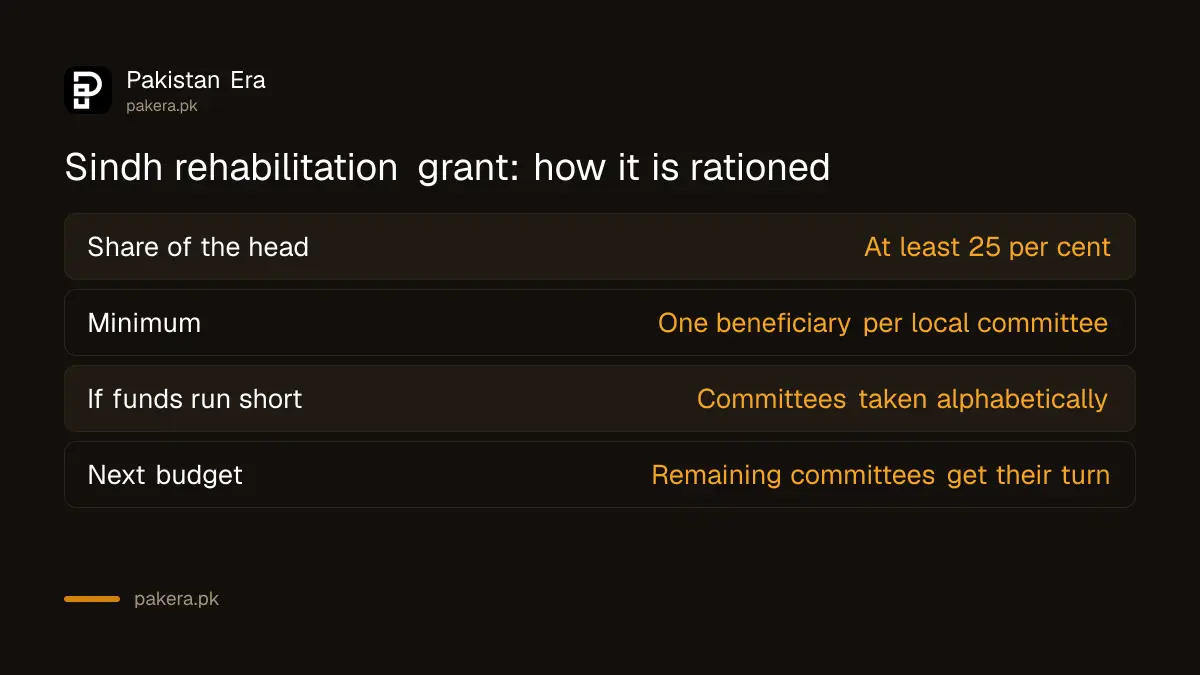
| Share of the head | At least 25 per cent of the social welfare and rehabilitation budget |
| Rationing | At least one beneficiary per Local Zakat Committee, then by rotation if funds run short |
| After payment | Name struck off the mustahiqeen list |
A crossed cheque has to be paid into a bank account. If you have none, an Asaan Mobile Account opens from a basic phone with a CNIC, and a branchless account at any bank agent does the same.
Six situations qualify, from a push cart to a new Muslim settling in
Part A of clause 1 lists the istehqaq criteria for rehabilitation. The beneficiary is an adult Muslim not receiving assistance from any other zakat programme, with a need that is genuine and pressing, such that if it is not met the person would be forced to beg. Then one of the following must apply.
- The beneficiary has been a victim of circumstances that left them penniless or shelterless.
- The beneficiary wishes to start a small business of their choice for immediate subsistence.
- The beneficiary is a newly converted Muslim facing social problems adjusting to the new environment.
- The beneficiary needs a tricycle or push cart.
The tricycle line is the one disabled applicants should note. A hand-pedalled tricycle for a person who cannot walk falls under rehabilitation, not under the health care head. For a wheelchair or hearing aid at no cost, the Bait-ul-Mal disabled assistance route gives the equipment itself rather than Rs 5,000.
"Not in receipt of assistance from any other zakat programme" means a person on the guzara allowance cannot take this grant on top. One head per person is the pattern across all of Sindh's zakat rules.
The money is rationed so every local committee gets at least one grant
Clause 2.1 reserves at least 25 per cent of the social welfare and rehabilitation head for rehabilitation, with the other 75 per cent going to registered institutions such as orphanages and Darul Amans. Clause 2.2 then tells the District Zakat Committee to spread rehabilitation funds so that at least one beneficiary from every Local Zakat Committee is accommodated.
If even that is not affordable, the local committees are taken in alphabetical order as far as the money goes, and the rest get their share in the next budget. Clause 2.3 lifts the cap when funds allow more than one per committee. Clause 2.5 gives priority to releasing money for a deserving person's rehabilitation.
In practice this means a committee in a district with a small allocation may have one grant a year to give, and the chairman decides who gets it. Ask where your committee stands in the rotation before you plan around the cheque.
How to apply through the Local Zakat and Ushr Committee
Clause 1 says the istehqaq of a mustahiq is determined by the respective Local Zakat Committee. There is no separate form printed for rehabilitation, so the written application used for every zakat head starts the case.
- Find the chairman of the Local Zakat and Ushr Committee for your permanent residence.
- Write an application with your CNIC copy saying which of the four situations applies, for example a push cart for selling vegetables, and what the Rs 5,000 will buy.
- State that you receive no other zakat assistance. The committee will check its register.
- The committee certifies istehqaq and the district committee releases the cheque when its turn in the rotation comes.
- Collect the crossed cheque in your name and bank it.
If you are refused, ask whether the reason is eligibility or the rotation. A refusal on funds means you stay on the list for the next budget. A refusal on eligibility can be taken to the district committee or through the department's complaint form on its site, phone 021 99203611.
Institutions that house the poor get zakat on a per head rate
The other 75 per cent of this head goes to registered social welfare institutions: orphanages, Darul Amans, homes for destitute women, mothers and children, the old and infirm, needy girls, abandoned babies, and special education and rehabilitation centres for disabled persons. Each resident's istehqaq is certified by a local committee before the institution applies.
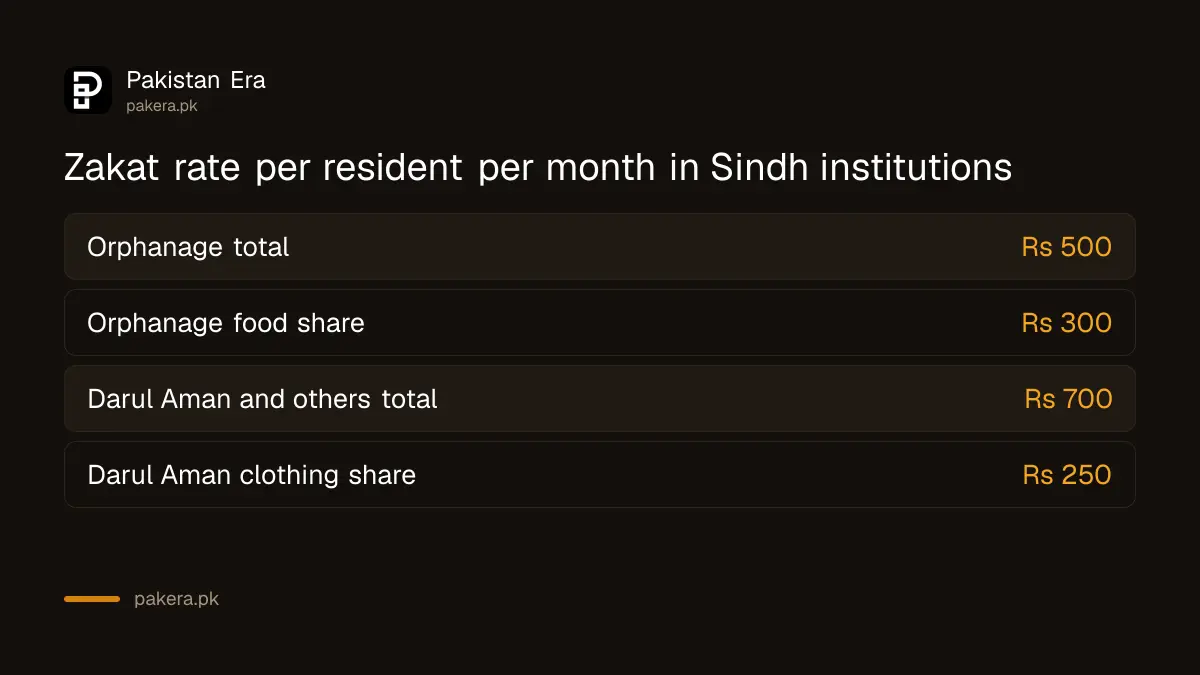
The procedure sets the monthly rate per resident that the grant is calculated on. For orphanages it is Rs 500: Rs 50 for education and books, Rs 100 for clothing, Rs 300 for food and Rs 50 for accommodation. For other institutions such as a Darul Aman it is Rs 700, with Rs 100 for skills education and Rs 250 for clothing. Funds are released half-yearly by crossed cheque to the institution head, and NGOs that already receive government or donor money are excluded.
Those rates are decades old and tell you how thin the money is. A family deciding whether a relative should enter a Darul Aman should read the guide to Dar-ul-Aman admission for what the homes actually provide, rather than counting on the zakat rate.
Common questions
How much is the Sindh zakat rehabilitation grant?
Up to Rs 5,000, paid once by crossed cheque. The rate is not lowered to fit more people in.
Who can get it?
An adult Muslim with a pressing need who has been left penniless or shelterless, wants to start a small business, is a new Muslim facing social problems, or needs a tricycle or push cart, and who gets no other zakat help.
Can I get it along with the guzara allowance?
No. The criteria require that you are not receiving assistance from any other zakat programme.
Why has my committee said there is no money?
The rules give at least one grant per Local Zakat Committee, then rotate alphabetically when funds run short. Your committee may be waiting for its turn in the next budget.
Where do I apply?
To the Local Zakat and Ushr Committee of your permanent residence, in writing, with a CNIC copy.
Does an orphanage get zakat for each child?
Yes, a registered orphanage gets a grant calculated at Rs 500 per resident per month, paid half-yearly, after each child's istehqaq is certified.
How we verified this
What we checked, where we read it, and what we could not confirm.
Last checked 19 October 2026. The Rs 5,000 one-time grant, the four qualifying situations, the no other zakat rule, the 25 and 75 per cent split, the one per committee rotation, the crossed cheque, the striking off, the list of institution types and the Rs 500 and Rs 700 per resident rates all come from the Social Welfare and Rehabilitation section of the Sindh Zakat Disbursement Procedure PDF, approved on 16 July 2011 and amended on 17 April 2018, on the Auqaf, Religious Affairs, Zakat and Ushr Department's site, read on 19 October 2026. The department's phone number is from its site the same day. We could not find the current year's allocation for this head or any count of grants paid, and we did not apply ourselves, so how many grants a committee has this year is unverified.
About the author

Global Affairs & Political Economy Writer
Muhammad Hatim is a book lover who started writing because he enjoys it. At Pakistan Era he writes about international relations, geopolitics and the global economy, with a particular interest in South Asia and the forces behind current events.