How International Toll Manufacturing Works in Pakistan: EFS Import Without Remittance and the Bank Steps
Make goods for a foreign principal without sending money abroad. See the EFS toll manufacturing rule, the six bank and customs steps and the SBP Form-R code.
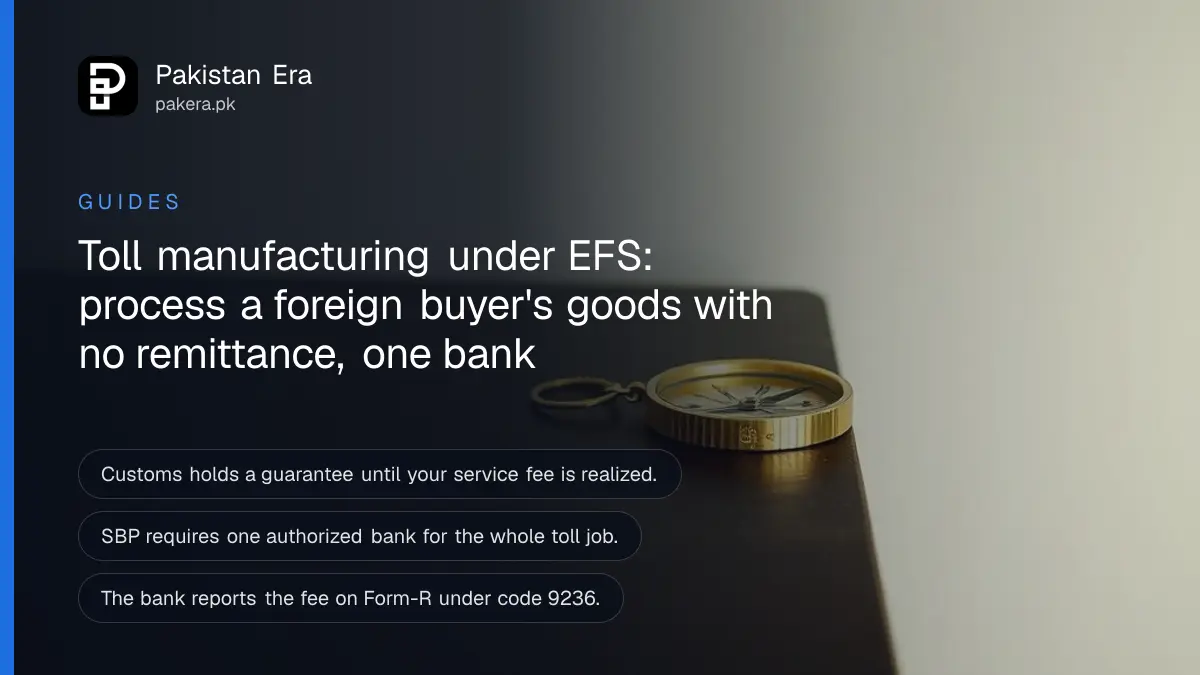
Under international toll manufacturing, a foreign buyer sends you raw material, you make the goods in Pakistan, and you export them back. Pakistan allows this under the Export Facilitation Scheme (EFS) without any foreign exchange leaving the country. You need an EFS authorization, one authorized bank for the whole job, and a bank guarantee or bond that is released after your fee arrives.
Two official texts set the rules. Rule 885 of the Customs Rules, 2001 (Chapter XL) gives the customs side, and State Bank of Pakistan (SBP) EPD Circular Letter No. 18 of 2023, dated 27 December 2023, gives the banking side. We read both. We did not find a later SBP circular that replaces the second one, but check before you start.
Toll manufacturing means you earn a service fee, not a sale price
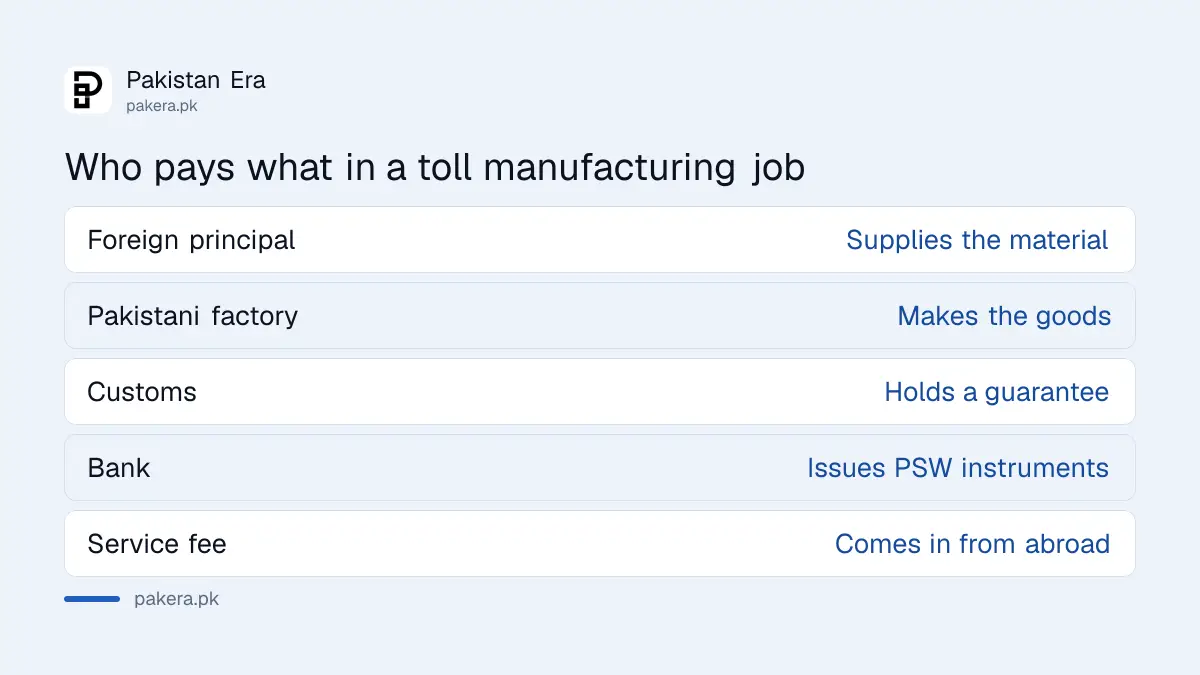
The EFS rules define international toll manufacturing as an arrangement where a foreign principal provides input goods to an exporter to produce finished goods for later export. Your income is the service charge or value added, and that fee must come in from abroad as foreign exchange.
That is why no remittance goes out. The principal owns the material, so you do not pay for it. You import it under a special declaration, process it, and export the finished goods. A stitching unit that gets cloth from a foreign brand is a typical case.
The scheme lists toll manufacturers as eligible users, and they fall in Category C. Users must be registered in WeBOC or PSW. For the authorization itself, the EFS application, papers and time limits are the first step.
Customs takes a guarantee until your fee arrives
At import, the system debits your bank guarantee balance, or accepts an indemnity bond and post-dated cheque, for the duties and taxes due on the goods. Those duties are not charged. The security is released after your service charges are realized and your bank reports them to SBP.
The rule also asks for a nil-remittance I-Form approved by your bank before import. At export you submit an E-Form for the service charges. When the money arrives, the bank certifies it to SBP on an R-Form. Only then does customs credit the guarantee or return the bond and cheque.
SBP wants one bank and two financial instruments
The circular says import and export under toll manufacturing go through a single authorized dealer, meaning one bank, for reconciliation and reporting. The bank issues a financial instrument in the Pakistan Single Window (PSW) before the import declaration and another before each export declaration.
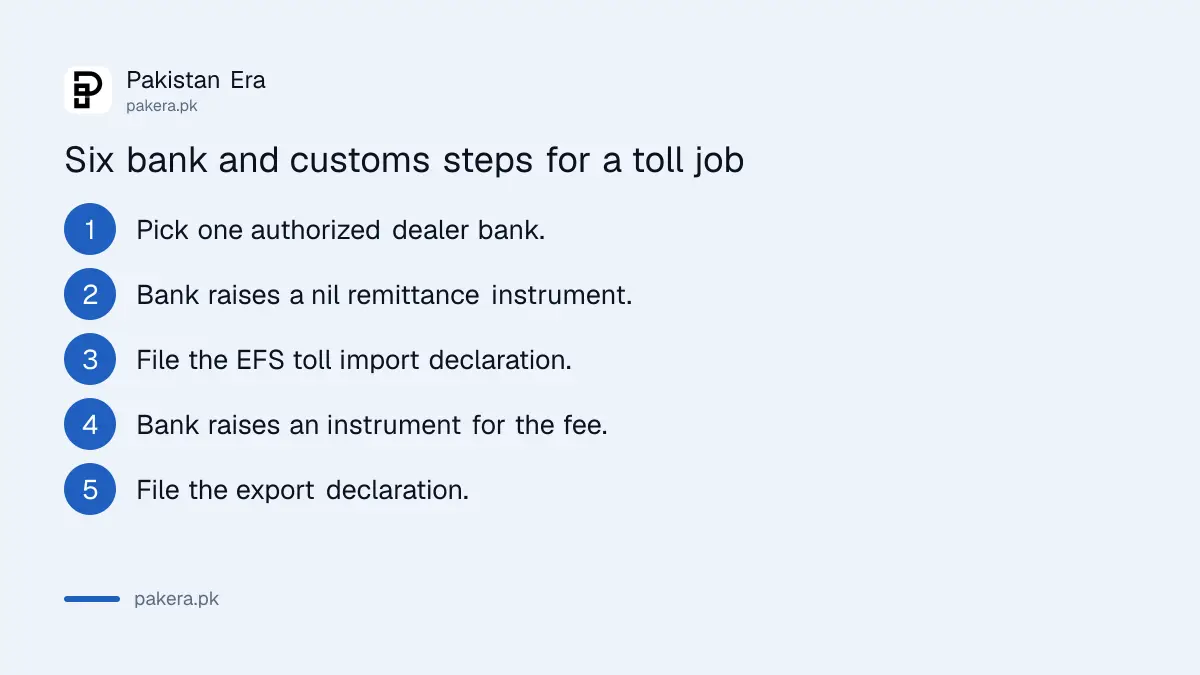
- Pick one authorized dealer bank and share your EFS authorization and contract with it.
- Your bank issues a financial instrument in PSW on a "remittance not involved from Pakistan" basis.
- You file the EFS import declaration, ticking the "EFS toll manufacturer" box.
- After production, your bank issues a second instrument equal to the service charges.
- You file the export declaration, and the foreign principal pays the fee into Pakistan.
- Your bank posts a credit advice in PSW, which lets customs release your security.
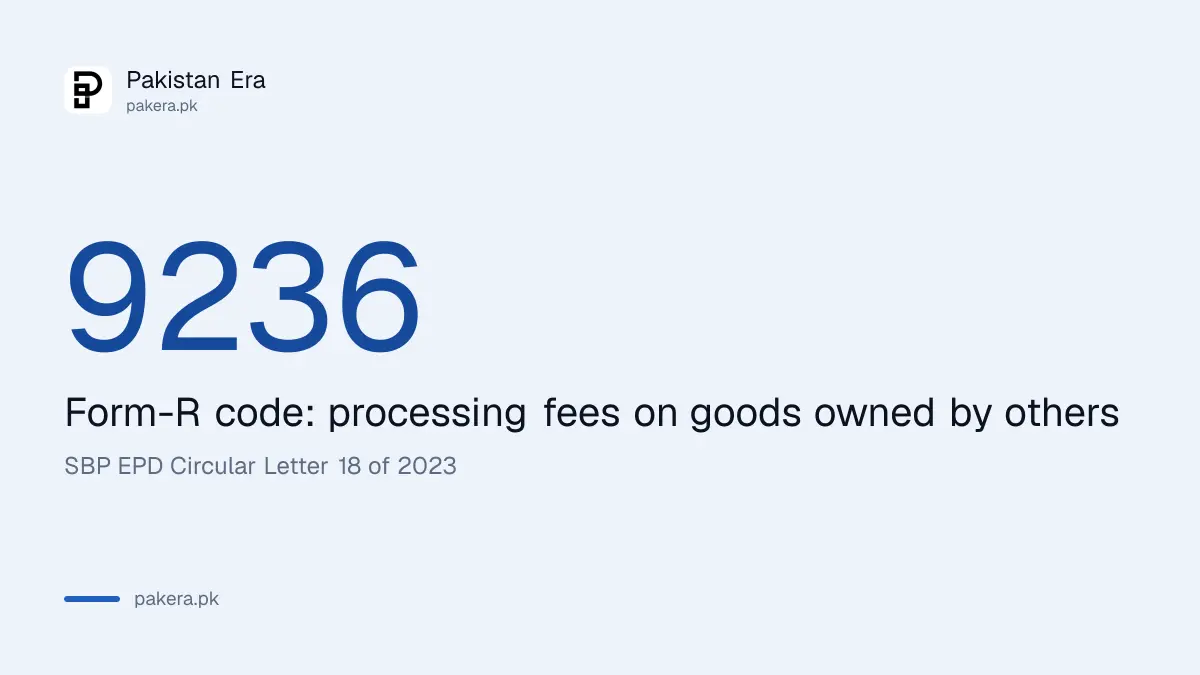
The bank also reports the fee to SBP on Form-R under code 9236, "Processing fees on goods owned by others". If your bank profile is already linked in PSW, the instruments are easier to raise.
Your bank will ask for five documents
As part of its checks, the bank must obtain five papers from you. They are your EFS license from customs, a certified copy of your EFS application, the service contract with the foreign principal, the export invoice for the service charges, and your periodic reconciliation statements.
| Paper | Why the bank wants it |
|---|---|
| EFS authorization from customs | Shows you may use the scheme |
| Copy of your EFS application | Matches the authorization to what you filed |
| Contract or supply order with the principal | Fixes the service fee and the goods |
| Export invoice for the service charges | Matches the fee the bank expects to receive |
| Reconciliation statements | Show inputs received and goods exported (rule 892) |
Banks also run KYC and customer due diligence, and they must follow SBP's framework on trade-based money laundering.
A late fee is treated as an overdue export bill
If the service fee does not arrive on time, the bank reports the case as overdue under Paras 33 and 33A of Chapter 12 of the Foreign Exchange Manual. That is the same rule as for any export. Delayed money can then be converted at a lower exchange rate for the exporter.
We explain that rate rule in what happens when export proceeds arrive late.
Common questions about toll manufacturing
What is international toll manufacturing?
It is an arrangement where a foreign principal supplies input goods to a Pakistani exporter, who makes finished goods for export. The exporter earns a service fee instead of selling the material.
Do I pay duty on toll manufacturing inputs?
Not if you complete the job. Customs holds a guarantee, or a bond and post-dated cheque, for the duty and taxes, and releases it after your service charges are realized and reported to SBP.
Can I use more than one bank for a toll job?
No. SBP says import and export under toll manufacturing must go through a single authorized dealer for reconciliation and reporting.
Which SBP form reports the service fee?
The bank reports it on Form-R under code 9236, "Processing fees on goods owned by others", in Schedule J/O-3 of the International Transactions Reporting System.
What if the foreign principal pays late?
Your bank reports the case as overdue under Paras 33 and 33A of Chapter 12 of the Foreign Exchange Manual, as for any other late export proceeds.
How we verified this
What we checked, where we read it, and what we could not confirm.
Last checked 14 October 2026. Customs rules come from Rule 885 of the Export Facilitation Scheme in the consolidated text posted on the FBR website as of 17 June 2026. Bank steps come from SBP EPD Circular Letter No. 18 of 2023, which we read in the SBP circulars archive. We have not run a toll job ourselves, and we found no fee or guarantee charge in either text.
About the author

Senior Writer, Public Services and Technology
Shahid joined us in 2024 as an author. He is a senior contributor to Pakistan's leading technology websites. He writes detailed articles, mostly covering his expertise in the latest tech, mobiles, apps, gadgets, and step-by-step guides. His ideology is to help people understand the latest trends and explain complex methods through very easy-to-understand guides.