Interpol Notice in Pakistan: How Police Request Red and Yellow Notices Through the FIA
Pakistan's FIA lists eight Interpol notice types and a police-only request route to the Interior Ministry. See the papers needed for Red and Yellow notices.
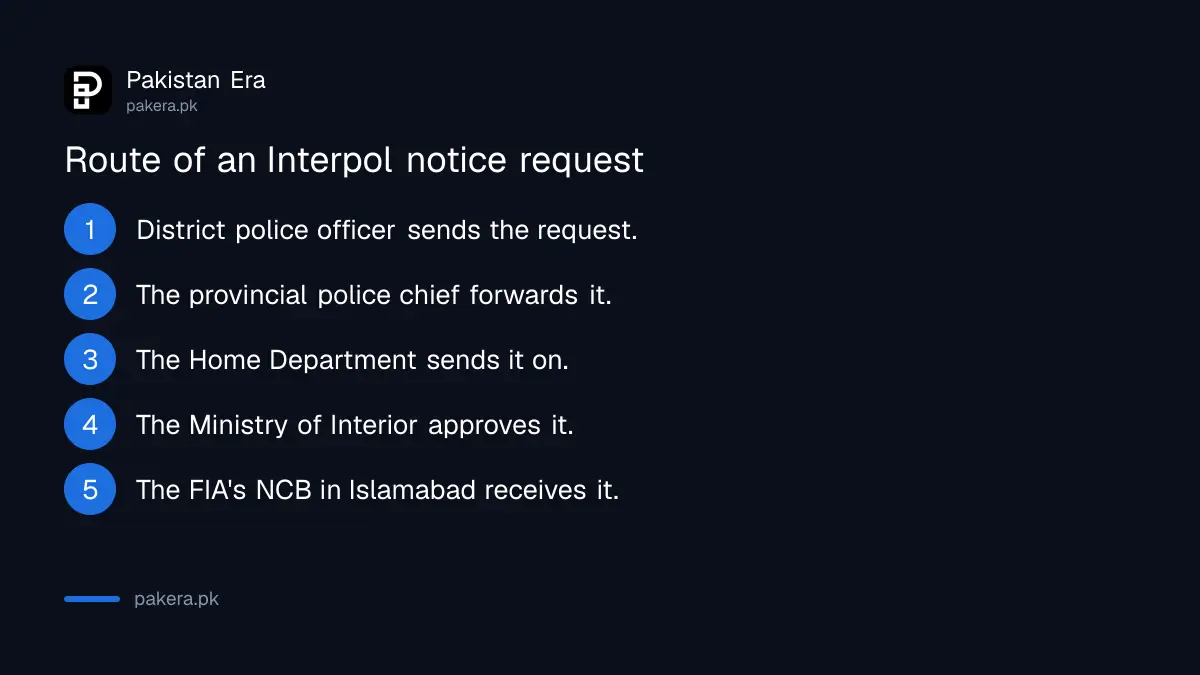
In Pakistan an Interpol notice is requested by the police, not by a private person: the district police officer sends the case through the provincial police chief and Home Department to the Ministry of Interior, which approves it and passes it to the FIA's National Central Bureau (NCB) in Islamabad. A family hunting for a missing relative abroad starts with an FIR and a police request for a Yellow Notice.
We read the Interpol page of the Federal Investigation Agency (FIA) on 22 October 2026. It lists eight kinds of notice, the papers each one needs, and the route a request takes. This page explains that route in plain words and keeps to what the FIA says.
The FIA runs Pakistan's Interpol bureau in Islamabad
The FIA page says the National Central Bureau of Interpol in Pakistan was set up in 1957 and is now a bureau of the FIA in Islamabad. The Director General of the FIA heads it, under the Ministry of Interior. Interpol itself has 194 member countries, according to the same page.
Interpol is the International Criminal Police Organization. It does not arrest anyone. It lets police forces share requests, and each country's own law decides what happens next. The FIA page lists 142 Red Notices issued in 2019 and 96 extraditions that year. It does not explain how the two numbers connect.
The FIA lists eight kinds of notice, each with its own purpose
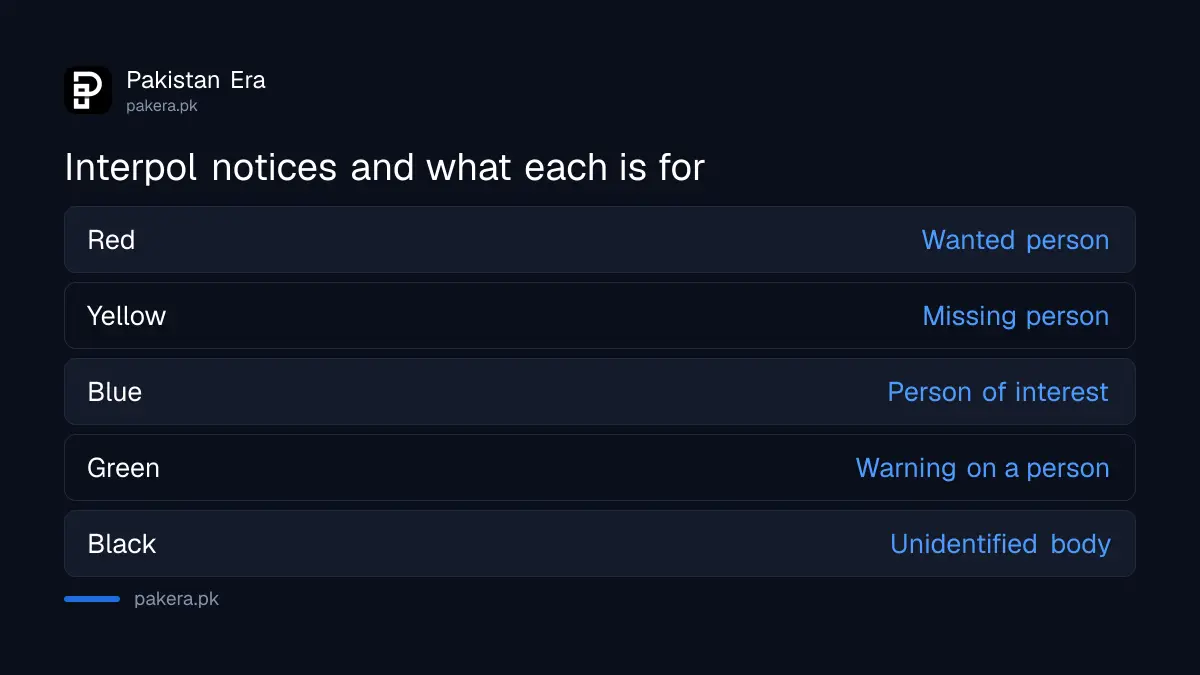
The page describes Red, Yellow, Blue, Green, Black, Orange and Purple notices, plus a UN Special Notice. The table shows the purpose of each as the FIA states it. The colour tells police what is being asked of them.
| Notice | Purpose, as the FIA states it |
|---|---|
| Red | Find a wanted person and detain, arrest or restrict movement for extradition or similar action |
| Yellow | Locate a missing person, or identify a person who cannot identify himself or herself |
| Blue | Obtain information about, locate or identify a person of interest in a criminal case |
| Green | Warn about a person's criminal activities |
| Black | Identify dead bodies |
| Orange | Warn of an imminent threat to public safety |
| Purple | Warn about methods used by offenders, or ask for information on offences |
| UN Special | Say that a person or entity is under UN Security Council sanctions |
A request travels through five offices before it reaches the FIA
The page gives the same route for every notice. The district police officer or the head of the requesting agency forwards the request to the Inspector General of Police. The IGP sends it to the provincial Home Department, which sends it to the Ministry of Interior. After approval, the Ministry refers it to the Director General FIA.
That is why a family cannot apply to the FIA directly. The page describes no route for individuals. If you need police action for a missing person, start at your local police station. Our guide to filing a police lost report in Islamabad shows how a first police report works.
A Red Notice request needs eleven kinds of paper
For a Red Notice the FIA lists the Interpol application form, a copy of the FIR with English translation, witness statements under section 161 of the Code of Criminal Procedure, a case summary in English, a court warrant of arrest, a proclamation order, and a perpetual warrant. It also asks for travel history, a photograph and travel documents, CNIC details and the regions likely to be visited.
A Yellow Notice for a missing person needs far less: the form, the FIR with translation, a case summary, a photograph and travel documents, distinguishing marks and teeth, the likely regions, and CNIC details. Dates must be in day, month, year format.
- File an FIR at the local police station.
- Ask the police to put the case to the district police officer for an Interpol notice.
- Gather the photograph, travel documents and CNIC details of the person concerned.
- Ask for the FIR to be translated into English.
- Follow the case through the police chief and the Ministry of Interior.
The page does not say how long a request takes
The FIA page gives no fee, no time limit and no appeal route. It does not say who decides whether a notice is published. Treat those as unknown. Interpol's own secretariat decides on its side, and the page does not describe that step.
If you are stopped at an airport and think a record is wrong, see how to avoid offloading at the airport and how to check the ECL at a passport office. An Interpol notice and the Exit Control List are different lists.
Common questions
Can I apply for an Interpol notice myself in Pakistan?
The FIA page describes only a police route, from the district police officer upward. It has no route for private applicants.
Which notice is for a missing person?
The Yellow Notice, which the FIA says is meant to locate a missing person or identify one who cannot identify himself or herself.
Who approves a notice request in Pakistan?
The Ministry of Interior is the approving authority. After approval it refers the request to the Director General FIA, who heads the NCB.
Is a Red Notice an arrest warrant?
The FIA says its purpose is to seek the location of a wanted person and his or her detention, arrest or restriction of movement for extradition. Each country applies its own law.
When was the Pakistan Interpol bureau set up?
The FIA says the NCB was originally set up in 1957.
Where can I read the FIA's list of papers?
On the Interpol page of the FIA website, under each notice type. We read it on 22 October 2026.
How we verified this
What we checked, where we read it, and what we could not confirm.
Last checked 22 October 2026. The notice types, purposes, papers, route and figures come from the Interpol page of the FIA, read on that date. The page gives no fee, time limit or appeal route, and its figures are labelled only by year. We did not ask the FIA or the Ministry of Interior, and we do not give legal advice. A lawyer should handle any case in which you are the subject of a notice.
About the author

Public Services and Education Journalist
Fajr Riaz is a journalist and content writer at Pakistan Era, based in Lahore. She covers the questions people meet in everyday life in Pakistan: how a public service works, what a change in the rules means, and where to find a reliable answer.