How to Challenge a Federal Constitutional Court Registrar's Office Objection: 30 Days and a Miscellaneous Appeal
Fix an FCC office objection in 14 days or appeal to the Judge-in-Chambers within 30 days. See the 2026 rules and what three September 2026 orders held.
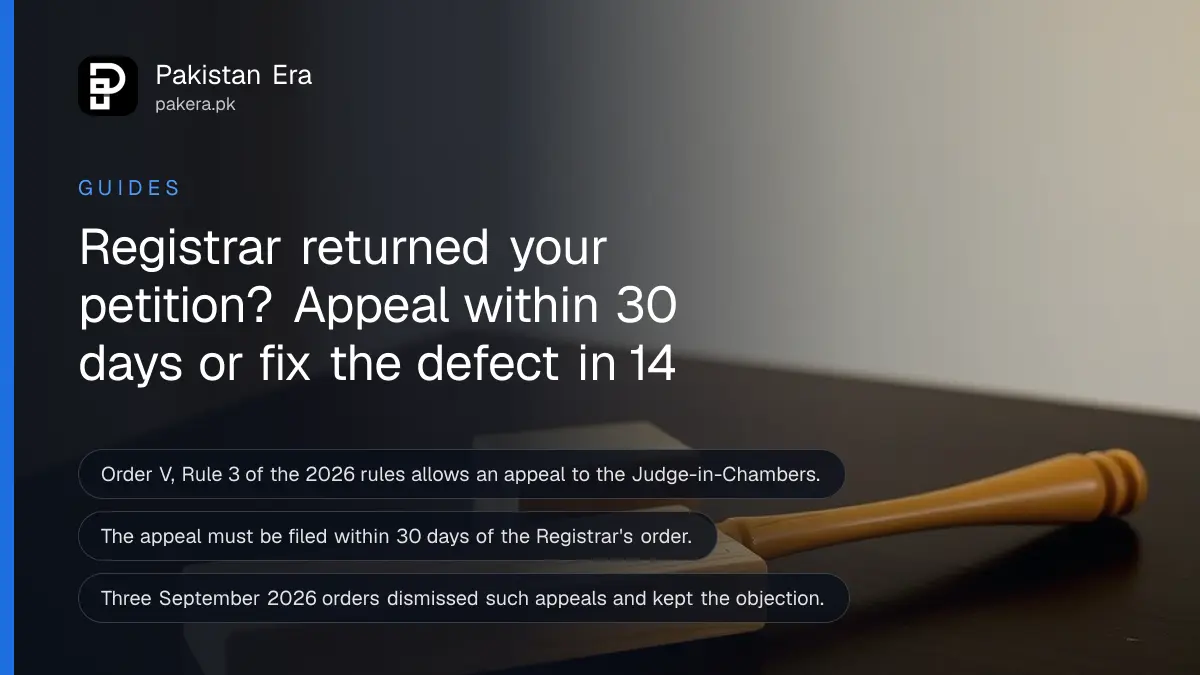
Short answer: If the Registrar of the Federal Constitutional Court (FCC) returns your petition with an office objection, you can appeal to the Judge-in-Chambers. The 2026 rules allow it in all cases and set a 30 day limit from the date of the order. A simple paperwork defect is usually removed within 14 days instead.
A petition comes back stamped "returned". The lawyer says the registry objected. The client asks the obvious thing: can anyone overrule the registry? Under the court's new rules, yes, but only through a set route and only if you move in time.
We read the Federal Constitutional Court (Practice and Procedure) Rules, 2026, notified in the Gazette of 16 September 2026, and three orders from late September 2026 where the court decided such appeals. All three appeals failed. That does not mean every appeal fails, but it shows what the court looks at.
The Registrar can refuse a petition, and a Judge hears the appeal
Order V of the rules lets the Registrar register petitions and refuse to receive one that is not filed in line with the rules or contains scandalous matter. Rule 3 of the same Order says an appeal lies from an order of the Registrar to the Judge-in-Chambers, in all cases.
That last phrase matters. The rules do not limit which Registrar orders can be appealed. In the three orders we read, the appeals were filed as civil miscellaneous appeals under Order V, Rule 3, and a single Judge sitting in Chambers decided them.
| Step | Rule | Time |
|---|---|---|
| Registry lists defects in your petition | Order XIX, Rule 14(1) | Notice sent by the Registry |
| You remove the defects and re-submit | Order XIX, Rule 14(2) | Time set by the Registrar, or 14 days |
| You ask the court for more time to remove them | Order XIX, Rule 14(4) | For sufficient cause shown |
| You appeal the Registrar's order to the Judge-in-Chambers | Order V, Rules 3 and 4 | 30 days from the date of the order |
A defect is fixed, and an objection about the court's power is appealed
Two different things get called an office objection. One is a defect in paperwork. The other is a view by the registry that the court cannot hear the petition. The first is fixed. The second is what the appeal is for.
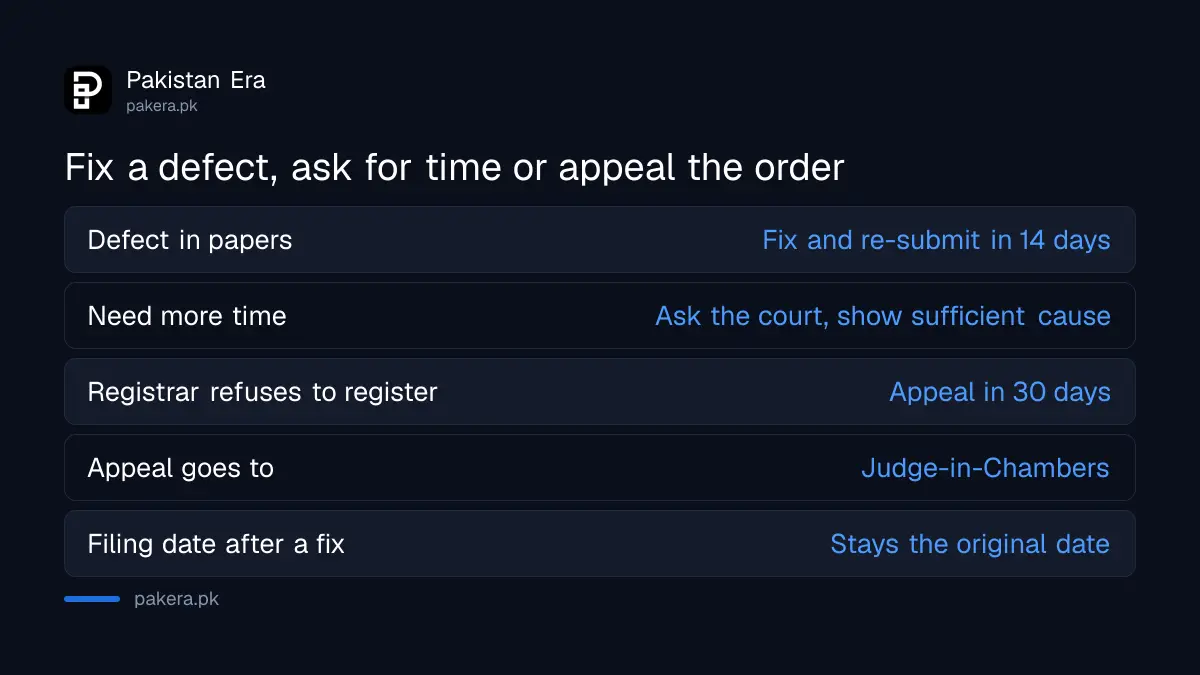
Rule 14 of Order XIX covers the first. The Registrar tells the petitioner or the Advocate-on-Record of the defects. You remove them and re-submit within the time given, or within 14 days if no time is given. Unless the court orders otherwise, removing the objections does not change your original filing date.
If the objection is not removed in time, the Registrar may decline to register the petition or place it before the Court or a Judge-in-Chambers. The Court may extend the time for sufficient cause. Scans and file format are common causes of returned papers, as set out in the guide to preparing scanned copies for the FCC.
What the Judge looked at in three September 2026 orders
In the three orders, the Judge-in-Chambers dismissed the appeal and kept the objection. The reasons were different each time, and each one is a warning about a weak ground.
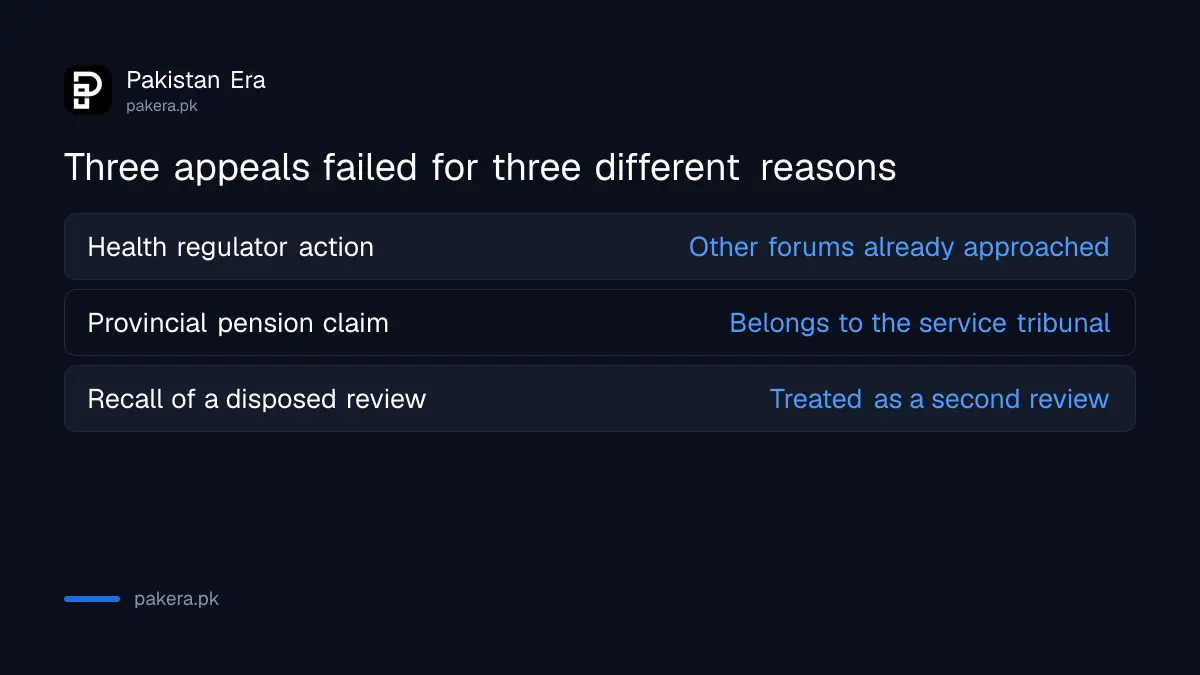
- A petition against a health regulator's action: the appellant had already gone to the Lahore High Court and had a statutory appeal pending before a District and Sessions Judge. The court said urgency does not justify parallel proceedings.
- A pension claim by employees of a provincial government: the court said service claims belong to the service tribunal under Article 212. A large number of affected people did not change that.
- A request to recall an earlier order that had disposed of a review petition: the court treated it as a second review, which the rules bar, however it was described.
For a worker with a service dispute, the route the court pointed to is the one in the steps to file a Federal Service Tribunal appeal, which has its own 30 day limit.
The Razia Aslam order does not give a shortcut
Appellants in all three orders relied on an earlier order, Razia Aslam v. Registrar, Civil Miscellaneous Appeal No. 4 of 2026. The Judge said that order limits what the Registrar can decide on his own. In two of the orders the Judge added that it did not hold the petition to be maintainable and does not let a litigant skip another remedy. In the third, the Judge said it does not require the registry to accept an application that the rules expressly bar.
In plain terms, the Registrar cannot finally decide disputed questions about enforcing Fundamental Rights or whether a case raises a public importance question. A Bench decides those. But the Bench can still find that another remedy exists, and that was the outcome in the orders we read.
Anyone planning a petition on rights should read the steps to file a habeas corpus or Fundamental Rights petition in the FCC first.
How to plan the appeal, step by step
This is a plain summary of the rules and the three orders. It is not legal advice, and an Advocate-on-Record should settle the filing. The court's own timetable is explained in the page on FCC appeal and review time limits.
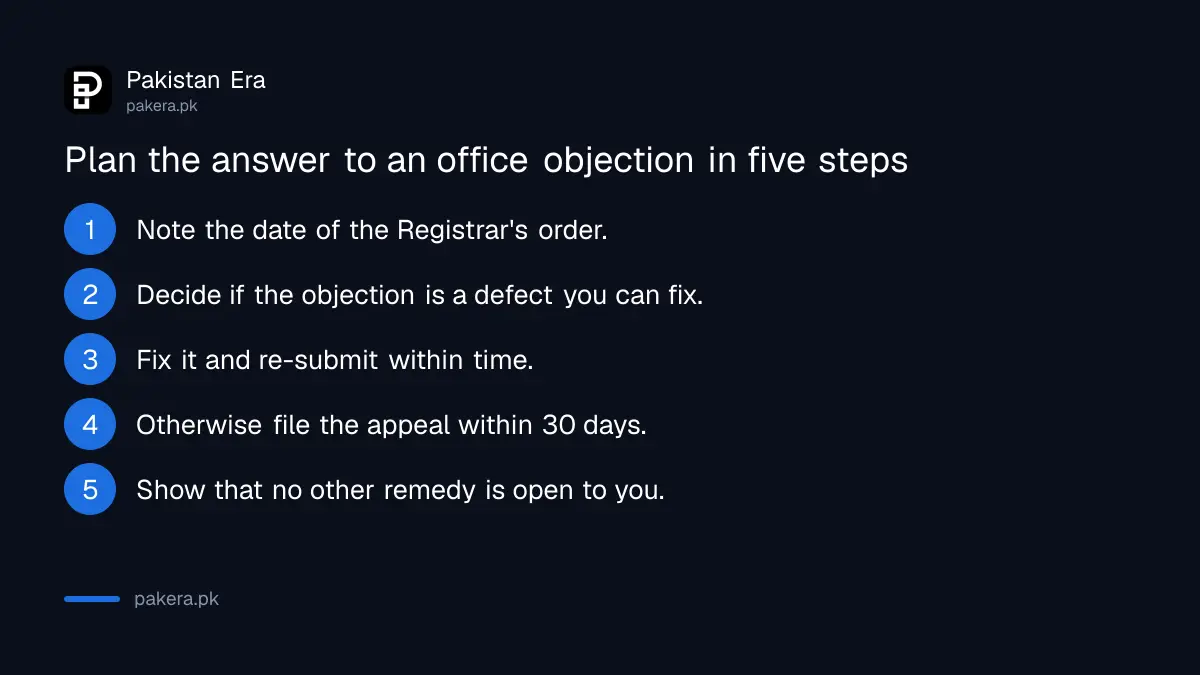
- Note the date of the Registrar's order. The 30 days run from that date.
- Read the objection and decide whether it is a defect you can fix.
- If so, fix it and re-submit inside the time given, or 14 days.
- If not, file the appeal under Order V, Rule 3 within 30 days, and state why the court can hear the petition.
- Show that no other forum or remedy is available, or explain why it cannot work.
Common questions
Who hears an appeal against the Registrar's order?
A Judge-in-Chambers. Order V, Rule 3 of the 2026 rules says an appeal lies from the Registrar's order to the Judge-in-Chambers in all cases.
How long do I have to appeal?
30 days from the date of the order you are challenging. Order V, Rule 4 sets this for appeals and for applications for reconsideration.
How long do I have to remove a defect?
The time the Registrar sets, or 14 days if none is set. The court may extend it for sufficient cause.
Can I reopen a review petition that was already decided?
Not by renaming the application. In one of the three orders the court treated a recall request as a second review and kept the objection.
Does an appeal against an office objection stop the clock on my limitation period?
We have not seen the court say so, and we cannot confirm it. Ask your Advocate-on-Record, and protect the filing date by removing defects within time wherever possible.
How we verified this
What we checked, where we read it, and what we could not confirm.
Last checked on 13 October 2026, Pakistan time. We read the Federal Constitutional Court (Practice and Procedure) Rules, 2026 (S.R.O. 1580(I)/2026, Gazette Extraordinary of 16 September 2026) from the court's website, and three orders listed on its judgments page, dated 29 and 30 September 2026. We did not read the Razia Aslam order itself, only how these orders describe it. Three orders are a small sample, and later orders may differ.
About the author

Tax, Bills and Technology Writer
Ali Akhtar is a young and curious voice here at Pakistan Era. He is currently pursuing his A-Levels and has a growing interest in Pakistan’s changing industrial landscape and educational trends. Ali likes to write in a way that helps him explain and explore the world around him. His writing reflects the perspective of the new generation navigating the evolving trends of Pakistan where technology, youth innovation, and shifting opportunities are reshaping the country’s future.