Islamabad Plastic Bag Ban: What Is Banned, Fines Up to Rs 10,000 and How to Report a Shop
Plastic bags, cups, plates, cutlery and straws are banned in Islamabad. Shops face fines up to Rs 10,000. See the full list and how to report a shop to Pak-EPA.
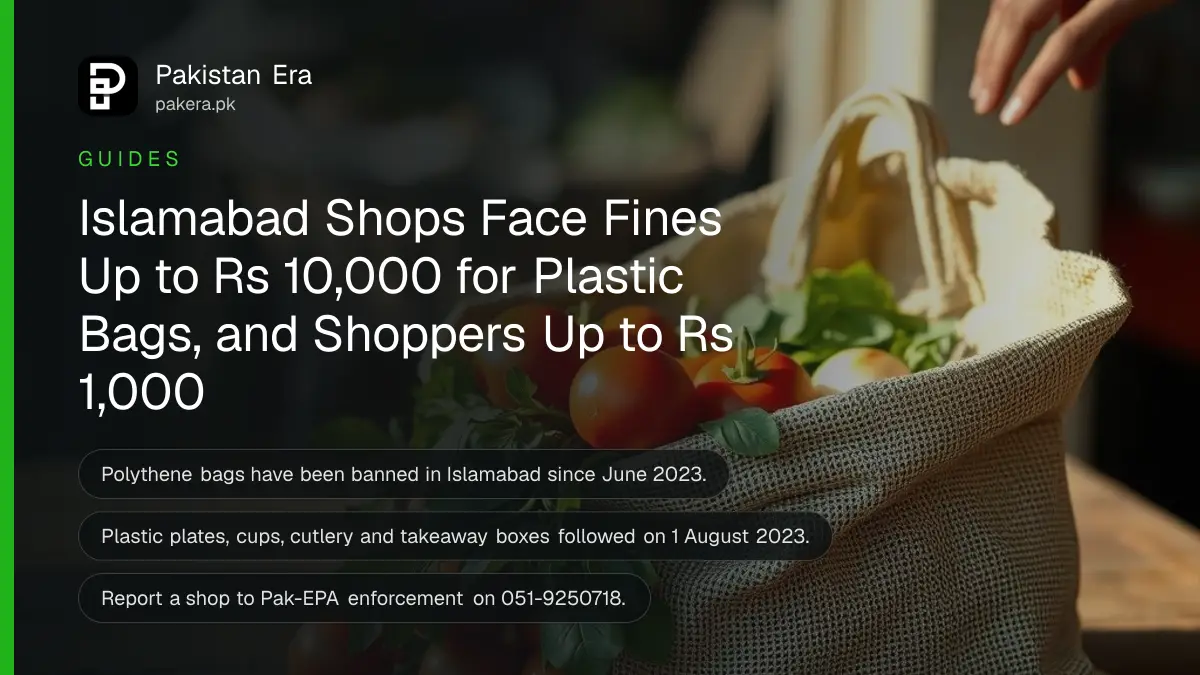
Single-use polythene bags are banned in Islamabad. So are plastic plates, cups, cutlery, takeaway boxes, stirrers and straws. A shopkeeper can be fined up to Rs 10,000, and a shopper up to Rs 1,000, under the Single-use Plastics (Prohibition) Regulations, 2023. Report a shop to the Pakistan Environmental Protection Agency (Pak-EPA) on 051-9250718.
Update, 17 October 2026: Pak-EPA has said PET bottles are not banned in Islamabad, as reported.
Islamabad's plastic bag ban is not new. Pak-EPA notified it in June 2023, and it was printed in the Gazette of Pakistan on 22 July 2023. What is new is the pressure. The city administration started a "Plastic-free Islamabad" drive on 5 October 2026, according to reports, with checks on markets, food outlets, schools and parks.
We read the regulations in full on Pak-EPA's website. Below is what is banned, what is still allowed, the fines in the law, and how to report a shop that keeps handing out polythene.
Islamabad bans six kinds of single-use plastic
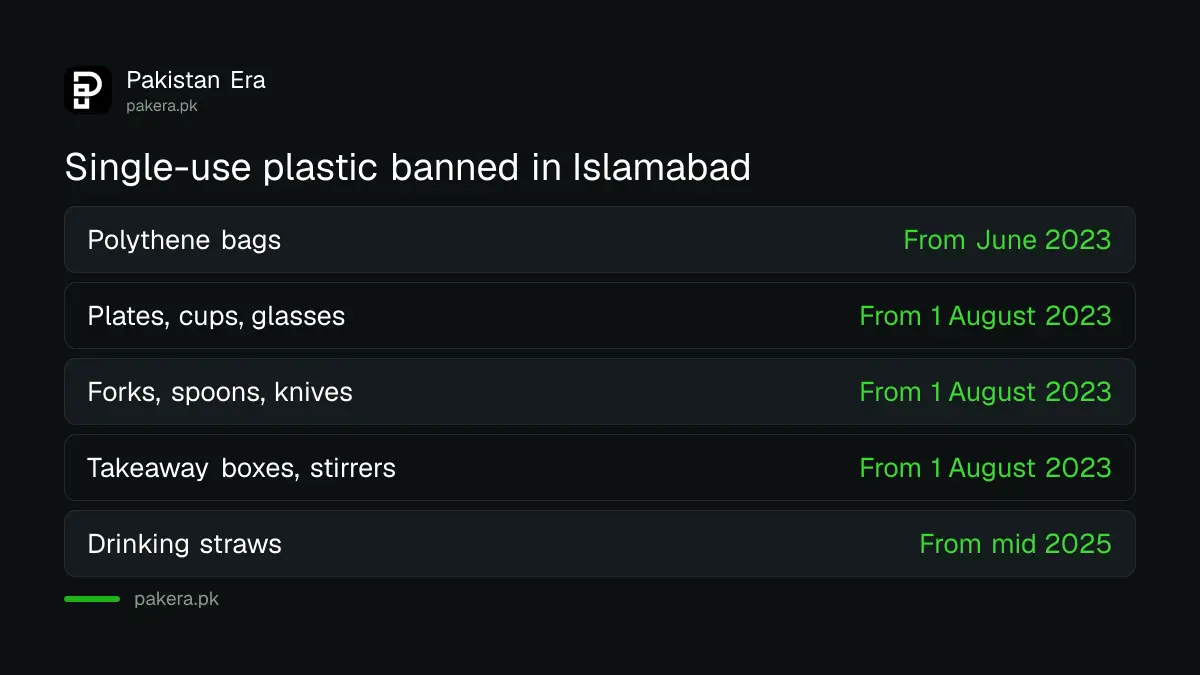
Schedule I of the 2023 regulations bans six groups of single-use plastic in the Islamabad Capital Territory (ICT). Bags were banned at once. Crockery, cutlery, takeaway ware and stirrers followed on 1 August 2023. Straws had a two-year grace period.
| Item | Examples in the law | Banned from |
|---|---|---|
| Polythene bags | Carrier bags and flat bags | Commencement, June 2023 |
| Plastic crockery | Plates, bowls, cups, glasses | 1 August 2023 |
| Plastic cutlery | Forks, knives, spoons, chopsticks | 1 August 2023 |
| Foodservice ware | Lidded containers, boxes, cups, plates, bowls for ready food | 1 August 2023 |
| Stirrers | Any plastic item to stir drinks or stop spills from a lid | 1 August 2023 |
| Drinking straws | Single-use plastic straws | Two years after commencement, so by mid 2025 |
The ban covers the whole chain. Regulation 3 stops anyone from making, importing, distributing, selling, supplying, stocking, buying, trading or using these items in ICT. Old permits stopped counting once the deadlines passed.
Plastic drinks bottles are not banned. Instead, from 1 July 2028 they must contain at least 50 per cent recycled plastic.
Shops face fines up to Rs 10,000 and shoppers up to Rs 1,000
Schedule IX of the regulations sets three penalty bands. The amounts are maximums, written as "up to". The officer decides the actual amount under Pak-EPA's 2015 rules on compounding offences and administrative penalties.
| Who breaks the rule | Maximum penalty |
|---|---|
| Producer or importer | Up to Rs 1,000,000 |
| Shopkeeper, hawker, stall holder or supplier | Up to Rs 10,000 |
| Individual consumer | Up to Rs 1,000 |
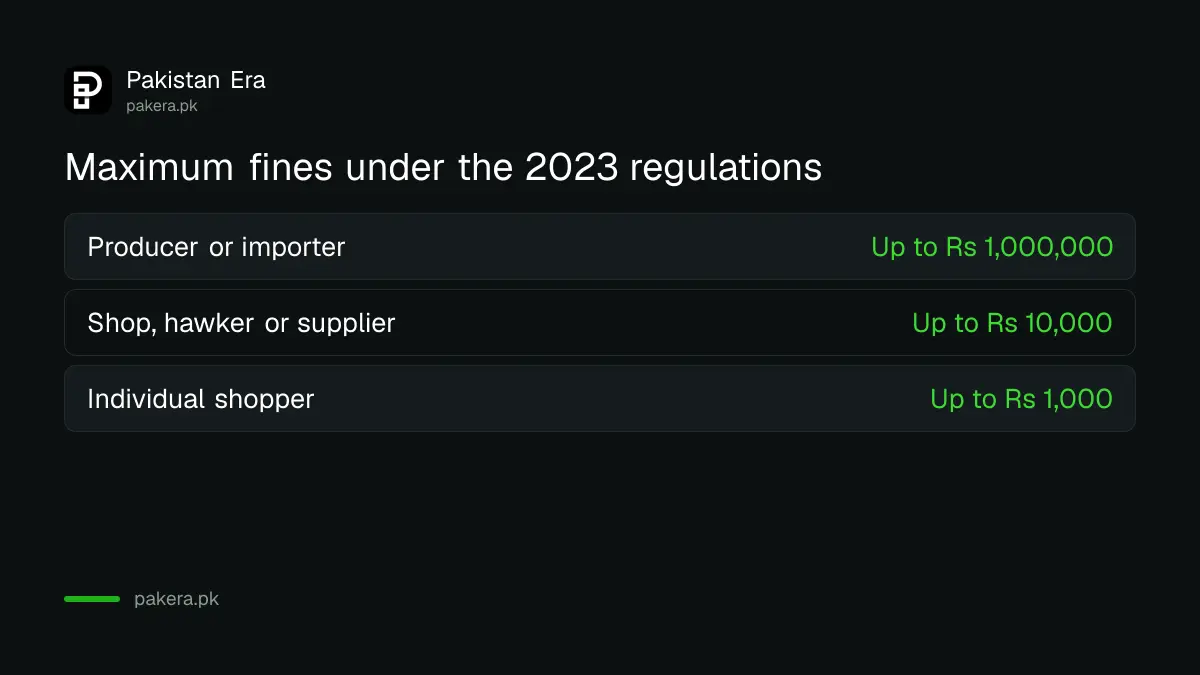
That last line surprises most people. The law lets an officer fine the person carrying the bag, not only the shop that gave it out. In practice the raids we have seen on record target sellers and stock.
Authorised officers can also enter premises, inspect, take samples and confiscate banned items under regulation 10. Pak-EPA can order a business to stop work if a violation continues.
Some plastic is still allowed, with an exemption
Regulation 4 lets Pak-EPA exempt plastic used for industrial packaging, medical work and science. Bags for hospital waste, municipal waste and hazardous waste are also exempt. Each exemption needs an application, a fee and, for makers and importers, a recycling plan.
An exemption lasts three years. Pak-EPA must decide an application within 60 days and can revoke it after a hearing.
So the bin liner from a licensed supplier and the packet your medicine comes in are not the target. The thin shopping bag at the sabzi stall is.
A paper or cloth bag is the safe swap. If a shop then charges you for a branded bag, the rules on being charged for a shopping bag are a separate question from this ban.
Enforcement is picking up across Islamabad
Pak-EPA posts its raids on its own website. On 11 February 2026 its team seized about 55 kg of banned plastic bags at Sohan and issued warning notices. Earlier raids at Tarlai Kalan and other markets were posted in January 2026.
The new drive is larger. Over two days the district administration arrested 122 people, seized 293 kg of plastic bags and sealed 7 shops, according to reports on 5 October 2026. Assistant commissioners are to watch their own areas, the same reports say. We did not find these figures on an official website, so treat them as reported.
The campaign was ordered by the Interior Minister, who also chairs the Capital Development Authority (CDA), according to reports. It focuses on markets, commercial areas, food outlets, schools, parks and picnic spots.
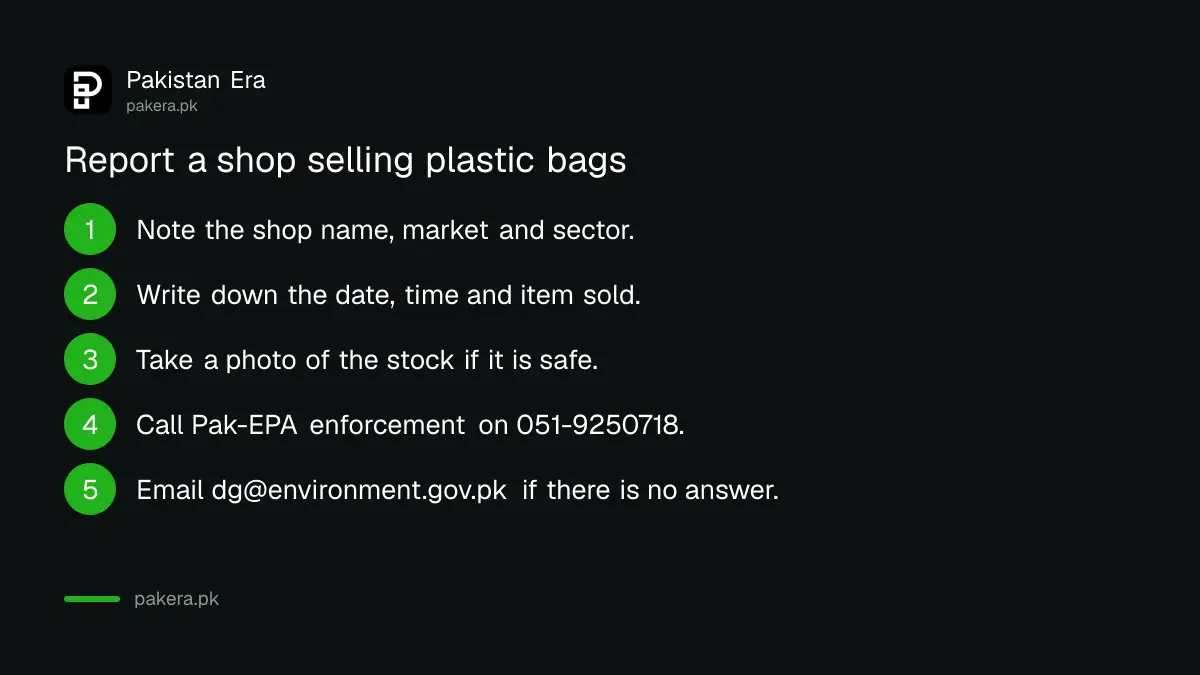
Report a shop to Pak-EPA in five steps
Call or email Pak-EPA's enforcement wing with the shop's name, exact address and what you saw. Pak-EPA's office is open Monday to Friday, 8am to 4pm, and closed on weekends, according to its contact page.
- Note the shop name, market and sector, for example a shop in a named market in G-9 or F-10.
- Write down the date, the time and the item, such as thin carrier bags or plastic takeaway boxes.
- Take a photo of the stock if you can do so safely. Do not argue with the shopkeeper.
- Call Pak-EPA's Director (Admin, Legal and Enforcement) on 051-9250718, or the Deputy Director (Legal and Enforcement) on 051-9250731.
- If you get no answer, email the Director General at dg@environment.gov.pk with your details and photos.
Keep a note of who you spoke to. If the shop is still selling after a week, report again and mention the first complaint. The same habit helps with a noise pollution complaint, where a dated record also matters.
Common questions
Are plastic bags banned in Islamabad?
Yes. Single-use polythene carrier and flat bags are banned in Islamabad Capital Territory under the Single-use Plastics (Prohibition) Regulations, 2023.
What is the fine for using a plastic bag in Islamabad?
Up to Rs 1,000 for an individual shopper, up to Rs 10,000 for a shopkeeper or hawker, and up to Rs 1,000,000 for a producer or importer.
Are plastic straws banned in Islamabad?
Yes. The regulations banned single-use plastic straws two years after they came into force, which was mid 2025.
Can I still use bin bags in Islamabad?
Bags for municipal, hospital and hazardous waste are exempt, but the supplier needs a Pak-EPA exemption.
Who enforces the plastic ban in Islamabad?
Pak-EPA's authorised officers enforce it. The ICT administration's assistant commissioners have also run raids, according to reports.
Does the Islamabad ban apply in Rawalpindi?
No. These regulations cover Islamabad Capital Territory only. Rawalpindi follows Punjab's own plastic rules.
How we verified this
What we checked, where we read it, and what we could not confirm.
Last checked on 6 October 2026. We read the Single-use Plastics (Prohibition) Regulations, 2023 (S.R.O. 935(I)/2023, Gazette of Pakistan, 22 July 2023) on the Pak-EPA website, including Schedules I, II and IX. Pak-EPA's contact page gave the phone numbers, email and office hours, and its news page gave the February 2026 Sohan raid. The 5 October launch, the 122 arrests, 293 kg and 7 sealed shops come from news reports. This is general information, not legal advice.
About the author

Tax, Bills and Technology Writer
Ali Akhtar is a young and curious voice here at Pakistan Era. He is currently pursuing his A-Levels and has a growing interest in Pakistan’s changing industrial landscape and educational trends. Ali likes to write in a way that helps him explain and explore the world around him. His writing reflects the perspective of the new generation navigating the evolving trends of Pakistan where technology, youth innovation, and shifting opportunities are reshaping the country’s future.